Showing posts with label Family Letters. Show all posts

Wednesday, July 29, 2026

About Anna's Husband


There are some extra details to know about Anna Flanagan, our eighth of this year's Twelve Most Wanted, to help us find her roots in County Limerick in the mid-1800s. As difficult as it may be to find someone with a surname like Flanagan, at least coupled with Anna's husband's name, it might make the challenge a little less daunting.

At least, that's what I thought. Looking for the marriage records for the Catholic parish of Ballyagran, where Anna's brother William had claimed his roots, I realize that not many church records have been preserved. The listing, according to the National Library of Ireland, leaves a big gap right where I'd guess Anna and Stephen Malloy might have gotten married.

The marriage date is only a guess, based on the date of birth for the couple's only child. Catherine, presumably born in the same place where her uncle William claimed his roots, and where Stephen's farewell letter to her mother was addressed, arrived in either 1847 or 1848, depending on the dates provided by later records in the United States, where she and her mother eventually moved after her father's disappearance.

I have yet to find any marriage record, but knowing how my eyes just love the blurry digitized microfilm records, I'll probably cry over that mystery once again, just to be sure. At least we still have something to search through.

Complicating matters is another detail: just how to spell Anna's husband's surname. Whether in Ireland or in Chicago, where Anna eventually migrated, her married name was treated to multiple variations in the spelling department. Sometimes Mulloy, sometimes Malloy or even Melloy—or take away an "l" to make it even more challenging—this is clearly a case of employing wildcards for the search.

All I know for sure is that one day in February of 1849, Stephen sat down—most likely with someone who could write the letter he dictated—to send fond farewells to his wife and let know that, due to a warning he had received, he was leaving from Liverpool, bound for Boston. That was the last that Anna heard from her husband.

On the other side of this story, nearly one hundred seventy years into her future, the envelope that she saved along with that letter guided us in our travels to County Limerick, and brought us, perhaps, to the very parcel of land where she lived while awaiting word from her husband. Even if institutions were not able to preserve records about a specific ancestor, I'm grateful for our own family members who realized the importance of preserving the few details they could find among their relatives' mementos.

Wednesday, July 30, 2025

Fading Into the Future


There's been a volley of messages exchanged this week between myself and one DNA cousin connected to my father-in-law's Irish Flanagan roots. I'm certainly thankful for the willingness of total strangers to provide so much family information from personal experience and from the memories of their immediate family members. But I'm also awakening to the painful realization that these ephemeral memories are precariously perched on a point in a calendar which stands still for no one. Those memories are fading into the future with each approaching new day.

One Flanagan cousin has been sharing notes about the extended family on the Irish side of the equation, and telling me about the sources for these remembrances. One detail was passed along to me from the preserved memories of an eighty five year old woman; another source was a cousin moving into his nineties. These remembrances represent micro-histories of average, everyday people which, if not preserved, will someday be entirely lost. At some point, there will be no one left to ply with our endless questions about our ancestors' history.

On my side of the equation, I wasn't only asking the questions. I sent back photos and stories of what we had found on that Flanagan family from our trip to Ireland, now over ten years ago. Just to review the details for myself, thankfully I could refer back to posts made here at A Family Tapestry, as this blog has become somewhat of a research journal.

I sent this cousin the story—how grateful I am that someone in our family saw the need to preserve it over the years—of the 1849 letter sent to Anna Flanagan from her husband, Stephen Malloy, on the eve of his departure from Liverpool for Boston. I also shared our experience tracing the very address on that letter's envelope which led us to the place where, most likely, Anna stayed while awaiting news of her husband's arrival in America, and what we found when we got there to see the place for ourselves. 

Perhaps those photos will jog some memories, back in Ireland, for those who still live in that same area. I hope so, for in some cases, all we have left for some family research there is the memories of the oldest generation. And they are beginning to fade.

At the close of a month, I hate to lay aside the research project selected for the past thirty days. The "Twelve Most Wanted" project is helpful in keeping me on task in my research, as well as keeping the research moving through the entire spectrum of the family's ancestry. But thirty days—or even the bonus thirty one days for a month like July—can never truly be enough, especially as we move back through the generations, where the records become sparse and the brick walls impenetrable. I confess I may linger on this Flanagan research problem, even as we launch into a new inquiry in August.

Tuesday, December 21, 2021

The Rest of the (Very Short) Story


Two weeks shy of an exact twenty one years after Effie Woodworth sent her grandson a letter lecturing him on his lack of respect for a family name, she followed with another letter to the same family. Only this time, Earle Bean had been dead for over a year; this letter was to Earle's widow, Marilyn Sowle Bean. Marilyn was dealing with the dire possibility that her husband's fate, owing to Marfan Syndrome, might one day become the same story for her son.

Ironically, the letter began with Effie—the same one scolding Earle for dropping the "e" in his given name—apologizing for not remembering how to spell Marilyn's name. I'm not sure how to read between the lines on this one, but when I found it, Effie's May 1957 letter had tucked within its envelope that original letter to Marilyn's then-ten-year-old husband about his name—likely left just the way Marilyn had stored them.

Along with the earlier letter from Effie was a newspaper clipping, two columns' length cut from an unnamed and undated newspaper, held together with a straight pin. On her 1957 letter, Effie added a note, "You see I have had that clipping about 30 yrs." She was right; it was almost exactly thirty years.

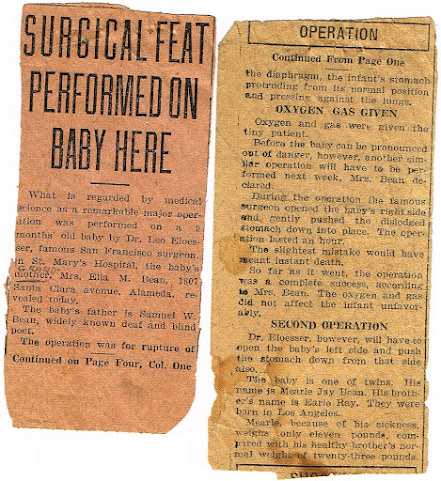
Headlines to the story read "Surgical Feat Performed on Baby Here"—the "here" apparently meaning the city of San Francisco. The baby was Effie's grandson, Earle's twin brother Merle, who unlike his womb-mate, had failed to thrive in the first year of his life. At nine months, while Earle weighed twenty three pounds, his twin weighed only eleven.

I had long known Earle had a twin brother, and though I knew he had died just short of what would have been his first birthday, I never knew what happened to him. According to the news article—replicated, though without his name, in an article in the San Francisco Examiner—the surgery was to repair a ruptured diaphragm, which had caused the infant's stomach to protrude and press against his lungs.

The procedure involved a two-step process, with one surgery approaching the site from the baby's right side, pushing the stomach back into place, and a follow-up surgery would correct issues on the left side. The medical feat was brought to the attention of the press by Merle's other grandmother, Ella Bean—incorrectly reported to be Merle's own mother. Effie's letter continued with the explanation that the child's aunt—Leona, herself a public health nurse—said that physical malady was not what killed Merle, but that he had erysipelas. However, the child's mother didn't agree, and neither did Effie, who launched into a long explanation in her letter of all the people in the Woodworth family who were troubled with hernias.

Whatever it was—and Effie, with her extensive knowledge of Woodworth family history, may have trumped the professional opinion of the child's aunt—nine month old Merle may have survived the ordeal of the two surgeries in May of 1927, but by July, one week before his first birthday, he breathed his last. Whether the surgery helped, hindered, or didn't make any difference at all, Maude Woodworth and her blind and deaf husband Samuel Bean had to say goodbye to their baby boy.

In searching out the data regarding our family's story, we strive to obtain the names, dates, and places  to record each person in the family constellation. We see some living long, perhaps even living past the century mark, while others' life stories are far more brief in the telling. Yet sometimes, the only way to fully know the story is not solely by governmental documentation, but through the gift of personal recollections. Finding the treasure trove of Marilyn Sowle Bean's memorabilia at the antique store the other day affords me that peek into the minutiae of just what happened in Merle Bean's very short life.


Above: Undated newspaper clipping, likely from the San Francisco, California, area, describing the first of two 1927 surgeries by "famous San Francisco surgeon" Dr. Leo Eloesser on nine-month-old infant Merle Bean to repair his ruptured diaphragm and displaced stomach.


Sunday, December 19, 2021

A Letter Circles Back Home


Have you ever written a letter to family, only to find it returning to you, years afterwards? That's what just happened to me.

Yesterday was the day set aside to head to the antique shop in town where a newfound genea-friend had, earlier this year, alerted me about some family photographs for sale. Since the store is soon closing for the last time, it was important for me to get down there before I missed my chance to regain some of the photographs once owned by Marilyn Sowle Bean.

On the appointed day, I met with the store's owner, who had graciously set aside all she had assembled of the remains of Marilyn's collection.

To cut to the chase on the day's outcome, I suppose I should start out with the hackneyed offering: "first, the bad news." There were no remaining photographs. While I don't quite understand the explanation, apparently an "estate liquidator"—sounds so ominous!—had come in and removed all the photographs. Just the photographs.

Just my luck.

The good news is that, despite the loose-leaf condition of the remainder of Marilyn's mementos, the store owner kept noticing the same names, figured the items all belonged to one family and had, over the years, assembled them into one collection. There were newspaper clippings, club newsletter announcements, and letters—including one letter written to Marilyn from me.

"Hey, that's my handwriting," I blurted out upon seeing the envelope. I hardly expected to find my own writing becoming part of the ephemera for sale in an antique store—at least not yet!

The letter, while brief enough to fit on two sheets of stationary, was written on the occasion of having returned from a visit to Belle Woodworth, wife of Marilyn's husband's uncle—the one whose several sons manifested some form of Marfan Syndrome which lately has prompted me to search the tree for signs of which line might have carried any genetic propensity for the disease. Apparently, that same thought had been on my mind when I first began researching Marilyn's family tree so long ago.

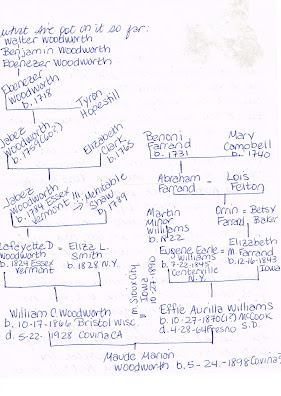
The Bean family was my first foray into genealogy, so I was surprised to see how much information I had already laid out for Marilyn. The letter contained only a thumbnail sketch—and most of that, thanks to the documents assembled by a Woodworth cousin in that pre-Internet era of research. But much of it has been since borne out by my exploration last month.

Besides that letter to Marilyn, there were several others, including notes from her husband's maternal grandmother, Effie Williams Woodworth, on another side of the family's history. While much of the information I've already gleaned from the online resources we now find so beneficial for research, it is the little details newly found which bring these stories to life—stories which I hope to share early next year.

We'll keep in touch, this storekeeper and I, in the hopes that something else might materialize from what used to be Marilyn Sowle Bean's collection of memorabilia. In all likelihood, whatever photos remained from her original collection are now parted out and scattered in multiple directions. But we can always hope that something else will show up from the storeroom, or when the new owner sells those photos, or...or...


Above: Excerpt from letter to Marilyn Sowle Bean, outlining portions of the family tree of her mother-in-law, Maude Woodworth Bean.

Wednesday, September 29, 2021

Reaching Back to Old File Folders


How does one manage to conflate the genealogical records obtained over a lifetime of research with those instantaneously obtained with the click of a mouse? How do we shift those piles of analog paperwork to the streamlined world of the digital?

Having to pull up details I obtained through hands-on research twenty, thirty, or more years ago—which were never added to the online world—can be a challenge, if a system to combine the two sets of records was not set up. In the case of our Johanna Flanagan Lee and her unnamed father, she unfortunately falls within that camp. Going through my old Flanagan and Lee file folders—and I do mean literal file folders, not those cute little icons online—they contained several now-familiar details, but alas, not the two notes I had written concerning one person: a man named Edward Flanagan.

Among my many research routines, decades ago, was to call the cemetery in which any ancestor had been buried. The purpose was straightforward. I wanted to verify—especially before the advent of Find A Grave—that my ancestor was indeed buried in that cemetery. Further, I'd use the same phone call to obtain the location of the specific burial plot.

More than that, though, was my hope to sweet-talk the person on the other end of the line to provide me with a list of everyone else who was buried in that family plot. Especially for burials in the 1800s, often the ancestor I'd be researching would actually be buried with others in what was called a family plot. While the assumption that everyone else buried in that plot would strictly be family members was not guaranteed to always be so, oftentimes it would be the case.

Regarding our William Flanagan, that kind of question did indeed provide helpful information. For one thing, that was also, apparently, where our Joanna Flanagan Lee was buried. But in addition to the listing of her name in that family plot, there was another Flanagan included. This man's name was Edward Flanagan.

Finding information on Edward was not easy. Back then, pre-Internet, I failed to locate much information at all, other than his name and significant dates of birth and death. The assumption, of course, was that Edward had found himself at that location specifically because he belonged to that family—same as William and Johanna. But how was he connected?

The thought was that Edward could easily fulfill the role of father to Johanna—but how often do we find that the easy "answers" do not end up being the real answers? Edward could have been a cousin, perhaps. Or a distant relative. 

Further, just as was the case with Johanna, Edward had no headstone to mark his burial. All I had to go on was an old cemetery record, passed to me via a long distance phone call decades ago—and now, only a dim memory of the exchange, at that.

However, in this Internet age in which we've all become accustomed to the ease of finding facts once hard to locate, concurrent with this struggle, I was able to reach across an ocean to discover another tantalizing connection: the Griffith's Valuation record for the townland to which Stephen Malloy had sent his letter to his wife Anna Flanagan contained another familiar surname.

Looking through that record for familiar names—looking in vain, it turns out, for other Flanagan households—what should I stumble upon but the surname which, decades later and nearly half a world away, was to become the married surname of our Johanna Flanagan.

The household in question was that of William Lee in the townland of Cappanihane. While I have no way to discover—at this point, if ever—who was attached to that home and family, reaching forward from that County Limerick property in 1848 to an American census record in 1880, I found it an encouraging sign that Johanna and John Lee named their eldest son by that same given name: William.

Come tomorrow, we'll have arrived at the end of another month and thus the time set aside for another family history research goal. While I'm far from achieving what I had hoped—finding the roots for that mysterious letter writer Stephen Malloy—I've located some encouraging hints and at least pinpointed the family's location in County Limerick. Tomorrow will be time to assess what we've found—and what we still lack—and develop some goals for the next time we tackle this research dilemma. 


Monday, September 27, 2021

The "What If" Strategy Revisited


Sometimes, we stumble upon research possibilities which look good—except for one detail. That detail might be a missing document, or a date which looks like too much of a stretch to be believable. No matter what the research glitch, it leaves a hole in our proof argument demanding to be secured.

While I play around with the possibilities, juggling the facts I can support with the conjectures I cannot, I engage in what I call "what if" strategies. As we enter the final week of grappling with my research project for September, let's rearrange what we've gleaned on my father-in-law's Flanagan family, both in Ireland and in the United States.

We've seen that Anna Flanagan Malloy somehow made her way from her home in or near Ballyagran, County Limerick, to a new residence in Chicago. We know that she was in the neighborhood of Ballyagran in 1849, based on the letter sent to her there from her husband, Stephen Malloy, before his disappearance. We can find Anna with her daughter Catherine and her brother William in the 1860 U.S. census in Chicago. When they left Ireland, or how they arrived in North America, I can't yet tell, but I know each of them remained in Chicago for the rest of their lives.

Record of tenants in the region where Anna was staying when she received that letter from her husband showed only one property attributed to the surname Flanagan: a small house and lot leased to one William Flanagan. Later, that lot's tenant was listed as Catherine—then even later as James Flanagan.

Church records show that there was one James Flanagan in the area whose son by the same name was baptised in 1864. Could that elder James Flanagan be the same as the James Flanagan listed in the Valuation records for 1868? My "what if" conjecture would be: could James Flanagan be son of William and Catherine Flanagan? And could our Anna be James' sister? After all, it would have made sense for Anna, once her husband left, to return to her parents' home, especially if she were a young mother with a one-year-old child to care for.

While we lack a paper trail which could demonstrate—or negate—such a possibility, we do have another type of record at our disposal: autosomal DNA. It turns out that my husband, who is Anna Flanagan Malloy's great-great grandson, has a DNA match with a descendant of a James Flanagan. If the elder James, father in that baptismal record, were brother to our Anna, with this DNA match, we'd be comparing third cousins once removed.

According to Ancestry.com, where the match was located, the two Flanagan descendants share a mere seventeen centiMorgans. What are the possibilities for a match at that level of shared genetic material? Consulting the charts at DNA Painter, it is quite possible. Third cousin once removed, for seventeen centiMorgans, occurs in the top tier, according to statistics provided by Leah Larkin at The DNA Geek. In other words, the likelihood of this being a possible connection for a third cousin once removed is twenty three percent.

But what if that isn't the case? After all, there are other possibilities, as well. Even if they were less likely, the connection could have been farther away—say, fourth cousin—or even closer, as in third cousin. The measure of the genetic connection doesn't quite pinpoint the relationship; it just provides us assurance that we're in the right general area.

That, of course, is a start. It confirms that, whoever was the original tenant in that one Flanagan home in the Catholic Ballyagran parish, he was related to our Anna. And whoever his property eventually got passed to was likely one and the same as the James Flanagan whose son's name was preserved in that 1864 baptismal record. Though that isn't a "for sure" thing, it at least gives us license to play that "what if" strategy with a bit more confidence.


Friday, September 24, 2021

The Trail to the Ones Left Behind


When we are able to paint only a partial picture of those relatives left behind by our immigrating ancestors, is there a way to use what we know to find our ancestor's way back home? In the case of Anna Flanagan, wife of the disappearing Stephen Malloy, we at least have the assistance of facts gathered about her brother William.

It was William's impressive stone memorial which informed the world—and, thankfully, my little researching self—that the journey which landed him in a Chicago cemetery began in the Catholic parish of Ballyagran in County Limerick. That minute detail, combined with the address on the letter sent by Stephen Malloy to his wife Anna, pointed us to his humble beginnings in the townland of Cappananty, site of only one property in the 1850s Griffith's Valuation bearing that man's surname.

Whether the William Flanagan of the Valuation was one and the same as the old bachelor of Chicago, I can't yet tell. After all, the man leasing the Irish property could well have been his father. At any rate, the beauty of the Irish property records is that they didn't remain static with the one assessment done by Sir Richard John Griffith. A visit to the Valuation Office in Dublin can reveal the history of the property as it changed hands over the decades—and that was indeed what I was able to do, nearly seven years ago.

Reviewing the notes from that research journey now—review being one way to rediscover the details missed the first time we struggled with this puzzle—I can see the Cappananty property passed from the original entry for a William Flanagan to a woman by the name of Catherine Flanagan by 1855. While that property record, itself, does not tell me which William or Catherine that might have been, it at least identifies some names belonging to that one Flanagan family circle in Cappananty.

Taking that property record forward in time, we again see a change in name for the lessee in the year 1866. In red ink, Catherine Flanagan's name was lined out, and eventually replaced by another name with a note, "68." That name—presumably added by 1868—was another Flanagan. This time, the name was James.

It was interesting to stumble upon that name James in this review. During the past week, frustrated by the gaps in church records for the Ballyagran parish—leaving those gaps precisely placed where baptisms might have occurred for Catherine Malloy and Johanna Flanagan—I decided to search all baptismal and marriage records for the Ballyagran parish, regardless of dates, using John Grenham's website gateway to Find My Past. Not much came up in that search.

Not much, that is, except for one: the baptism of one Jacobus Flanagan in 1864, son of Jacobo and Elizabetha.

Looking at names like those surely prompts the reader to assume that is not English we are reading in that transcription. Sure enough, that is the original Latin of the Catholic baptismal entry. Checking one list providing corresponding English or Irish names for their Latin versions, we see that the son, Jacobus, was more likely named James—same as his father.

Finding a father and son named James Flanagan in 1864 in the Ballyagran parish opens my eyes to a possibility. This James, the elder, could have been the Flanagan named as lessee of the one Flanagan property in the townland of Cappananty which once was attributed to Catherine Flanagan, and before her, a man by the name of William.

Though I can't yet be certain of this, what if Catherine was widow of William, and mother of the elder James? What if that Catherine was also mother of Anna—who named her own firstborn daughter Catherine, in good Irish tradition being the namesake for the child's maternal grandmother? And could the William Flanagan who died in Chicago himself be son of another man named William?

The time frames may be stretched too far for these flights of fancy to be solid possibilities. After all, our William was said to have been born in 1813. If he were indeed son of a man named William, by Irish naming tradition, he would have been the man's third son.

Assuming by that point that the elder William had only three children—in other words, no daughters interspersed in that time frame—and given a spacing between births of two years apiece, it would calculate to a marriage about 1808. If, as was reported to be customary, the elder William, as groom, was twenty two years of age at that date, he would have been born in 1786. Thus, the stretch: if this were the correct person to be our William's father, an 1855 death would have yielded the ripe old age of sixty nine years.

Not that that couldn't have happened—but it provides a detail which suggests we examine alternate connections. But, why connections at all? After all, Flanagan is a fairly common name. Yet, there was one more detail which I needed to consider. There was something else connecting our American Flanagans with the Flanagans of this postage stamp sized property in Cappananty.  

Wednesday, September 22, 2021

Major Roadblocks, Minor Revisions


Let's admit it: at this point, we are stuck with the puzzle of what became of Stephen Malloy, my father-in-law's great-grandfather. Perhaps, as his 1849 letter to his wife Anna indicated, he did indeed sail from the English port of Liverpool, heading to a new life in Boston. As far as the family knew after that point, the man simply disappeared.

Anna, Stephen's wife, did not let that deter her. She, too, took passage to America, though I don't know how—let alone exactly when and where—she arrived. All I know is that she ended up not in Boston, but in Chicago.

Stephen Malloy's disappearance thus becomes a major roadblock to my research goals. Seeking out further details on how Anna and her daughter arrived in Chicago, however, amounts to minor revisions. And these discoveries are indeed possible, considering the fragments of information we can glean from other records.

For instance, perhaps Anna traveled alone; perhaps she didn't. We can't yet tell. We do know, however, that Anna's young daughter Catherine—her only child—lived with her at the point when we found documentation of them in the 1860 census. Then Anna, along with Catherine, lived in Chicago with Anna's brother, a single man by the name of William Flanagan.

It is there in Chicago that we've pieced together as much of the story of Stephen and Anna as we could find—everything from the scant information on death certificates of that era to family lore explaining what they had heard about the disappearing Stephen Malloy. And while Stephen's story still presents what seems like an impenetrable enigma, it is the smattering of details we can gather on the rest of the family which, in yet another review, may lead us to answers—or at least revisions of our understanding of the story.

Take Anna's brother William. The family's story was that William had been arrested for a minor crime and sentenced by the British authorities to "transportation" to Australia to serve time. It turns out there was a record for one such William Flanagan in 1851. The case was decided in County Cork, not in the location of our Flanagan residence in County Limerick—but keep in mind that Anna's and William's home church parish reached across the county line, close to the main road leading south to the city of Cork.

While William was eventually "discharged"—as I learned during our visit to Ireland several years ago—in reviewing this detail now, I see the date of that decision was May 9, 1855. This date may become helpful to us in pinpointing the family's move to America.

Of course, we must not rely on only one document to build our case here. Keep in mind, I'm not entirely sure this entry in the Irish National Archives database is our William Flanagan. Taking a look at other indicators of the family's date of immigration, though, we find approximate corroboration.

For one thing, Anna's own death certificate bore the report that she had been in the state of Illinois for thirty years from her 1885 death. Granted, that detail was gleaned from someone else's report—an unnamed person, at that—but seeing the added comment on the certificate, "Mother of Mrs. John Tully," one could presume that the reporting party was indeed her daughter, the former Catherine Malloy.

That one document pointed to an arrival date—at least in Illinois—in 1855, aligning with William Flanagan's release from his sentence. Let's look for one more indicator: daughter Catherine's own report of her arrival in the United States. Although the one place where I found it was a document which was horribly overwritten, that 1900 census record also asked the question in a second manner: how many years was she in America? Catherine answered forty-five years, once again pointing to an arrival in 1855.

Having reviewed the documents I already had noted in my records, I can now at least estimate a year for their arrival. Furthermore, rather than the assumption which was held previously by the family—that Anna and Catherine arrived first from Ireland and then, somehow, William joined them from Australia—we can assume the trip may have been made by all three on the same passage.

Additionally, there is a strong possibility that those three Flanagan descendants—William, Anna, and her daughter Catherine—were not the only Flanagans to travel to Chicago. Years ago, I explored another woman who, in some references, was mentioned as a Flanagan related to these others. I had followed her family tree as much as possible in the past, but the work was incomplete due to lack of some records. Revisiting this other Flanagan relative one more time, perhaps we can find some additional connections to explain more of the extended family's saga.


Above: One possible entry from the Ireland-Australia Transportation Database at the National Archives of Ireland's website indicates a William Flanagan who had been sentenced in County Cork in 1851, but ordered to be discharged in 1855.

Tuesday, September 21, 2021

The "What If?" Strategy


In the process of searching for our specific ancestor, it is tempting, once finding a reasonable document, to assume that is the proof we are seeking. That's never a foolproof approach, though. There are several reasons why we seek more than one document to confirm the details of an ancestor's life story.

For one thing, we need to consider what I call "name twins." There is a strong possibility—especially given common names of folks living in population centers—that someone else could be given the same name as the ancestor we are researching. A wise alternative is to seek several documents along that person's life trajectory to confirm we are following the same person's history. 

Likewise, keeping track of not only the timeline but the locations where significant life events occurred is important for ensuring we are still researching the same person. Impossible feats of travel, given restrictions of the time period, would be a clue that we have jumped track from our ancestor to someone of the same name but different family.

In the case of my father-in-law's mystery great-grandfather, Stephen Malloy, we have a situation where the family received one report of his demise which might be quite believable—until we begin asking questions about the circumstances.

Questions, as it turns out, are a good device to employ in genealogical research. We always need to consider possible alternative explanations. And in Stephen Malloy's case, there are questions.

One question we had mentioned yesterday: the fact that Stephen's wife Anna chose to remain unmarried for the rest of her life, despite being free as a widow to remarry—indeed, in that day and age, especially with a child to support, that would have been the norm. Was there any doubt about that story that her husband had been killed in Boston?

Another question flows from the very details found in the passenger record of the ship upon which our Stephen was supposed to have been aboard. The age for that man was cited as twenty six, and yet his supposed bride would have been thirty seven that same year—hardly a believable age spread for a couple during that time period.

The least verifiable of my doubts comes from the overarching history of the region which Stephen Malloy left in 1849. Ireland had experienced some civil unrest, both politically and from a sectarian point of view, and Stephen's abrupt and seemingly mysterious defection plays with my own doubts in ways not likely to be substantiated without further evidence. I begin to wonder: why did Stephen Malloy leave home so abruptly? Could it be that he never made it on board the ship in Liverpool? If he were fleeing trouble back home, could he have assumed an alias?

Perhaps my questions might never have found a satisfying answer—except that now, we have search capabilities unparalleled in previous generations. While I can take the tedious route of searching Boston newspapers for crime reports of the murder of one Stephen Malloy, I can also search for alternate explanations by other means as well.

One possible alternate explanation could be that Stephen did make it to Boston and decide to settle there, making a new life for himself. Searching online records did reveal one document which gave me pause to consider these alternate possibilities: a petition for citizenship filed by one Stephen Mulloy in the state of Massachusetts in 1855.

According to the document, this Stephen arrived in Boston on or about the first day of April in 1849, only a few days after the date given on the passenger list for the Anglo American. The document also provided his date of birth and current age: born December 24, 1827, he claimed to be twenty eight when he completed that 1855 document. Thus, he was nearly—but not quite the same—as the age of the Stephen Molloy on the passenger list.

Though the tantalizing detail of the record was that this man, too, was born in County Limerick—location of the home where our Stephen sent his letter to his wife in 1849—his age, being so much younger than his supposed wife Anna, gives me pause to wonder whether this traveler was the same man as our Stephen. Indeed, records of this man in the Massachusetts 1855 state census, where he was boarding with a Reardon family, could lead one to presume he was waiting for his wife's arrival from Ireland—but the subsequent state census in 1865 showed him a married man with two children. Hardly our Stephen Malloy. Or was he?

There are, of course, other possible explanations for our Stephen Malloy's disappearance. Coming here in 1849, of all times, he could possibly have caught gold fever and headed for California. He could, once in this country, have assumed an alias. Either of those scenarios could have reached a climax of finding him shot to death—but even with today's search tools, we might never find the full story.

With that, we have some other search options to explore before the month is out and we turn our attention to other research goals. At this point, the best way to determine next steps is to talk it all out. We'll grapple with the possibilities tomorrow.

Monday, September 20, 2021

Back to Boston


One plus to revisiting our family history research trail over the years is the possibility that additional documents may have been uploaded to digitized collections. This was indeed what I had discovered while grappling with my father-in-law's puzzle concerning his great-grandfather, Stephen Malloy.

Having left his home in Ireland via Liverpool in a hurry, Stephen had written to his wife Anna, telling her that he was bound for Boston. While the name of the sailing vessel matched up with passenger records I've been able to find almost two hundred years later, that was the last confirmation of what had become of him.

Family stories didn't help the research effort. According to the oral tradition passed down by the family, Stephen Malloy had made it to Boston, alright—but some time after his arrival, he was shot and killed.

That's what his descendants had said, repeating the story generation after generation with no proof to substantiate the claim. I decided to look for myself—but that was years ago. Sure enough, I found his name on the right passenger list, arriving in Boston about March 27, 1849. But what about his death? Surely someone would have made an official note of such a crime.

Back at that time, I did stumble upon a possible record. It was, however, only a transcript, as many of the records available for genealogical purposes were at the time. 


The record basically reported the death of one Stephen "Maloy" in Boston during 1850. The date looked reasonable, and since I'd already discovered the numerous spelling varieties used for Stephen's surname, an entry for "Maloy" didn't disturb me too much.

Clicking through on a second tab for the reference, labeled "source," gave me more information on this entry. It provided me with the name of the original document from which this indexed collection had been drawn—helpful information, indeed, if I wished to track down the source for myself to view anything more than a mere, possibly error-laden, transcription.


At the time I first found this entry—this was years ago—all I could do was presume this was the indicator of Stephen Malloy's demise, just as the family had insisted was his fate. Later, fortunately, the document itself was digitized, enabling me to see for myself the full story. In fact, there were several versions of the record made available, from typed transcript back to what appears to be a time-worn original version of the record itself.

Once I was able to view the actual document, I learned that, once again, our Stephen Malloy had thrown me off his track. The entry for the 1850 death was indeed for someone in Boston named Stephen "Maloy," but it was for a babe in arms aged one year and five months—hardly of an age to be husband of Anna Flanagan or father of Catherine Malloy.

The child, son of John and Elizabeth Maloy, was certainly not our Stephen. But what if the family could have been related to Stephen? After all, why did Stephen choose to migrate to Boston? He could, as did many Irish immigrants, have rather chosen the route to New York City—or chosen the more prudent expense of transportation to the British portion of North America, and head for Canada.

That Stephen's wife Anna may not have been entirely convinced of his tragic death was evident in that she, a devout Catholic, remained unmarried for the rest of her seventy three years—or, perhaps, she just never gave up hope that she'd see him again.

I, on the other hand, in revisiting this research puzzle couldn't help but take a look at all the other documents which have more recently been digitized and placed online for our benefit. While this may be a wild and crazy conjecture on my part, I couldn't help but notice that there were other records from the Boston area concerning men of the same name during that time period.

While a game of "what if" should never have any part in the final proof argument drawn up at the conclusion of a difficult ancestral search, it certainly doesn't hurt to at least consider other possibilities while we are still in search mode. And there was one possibility in particular which made me think twice.


Note: both search results, shown above in insets, are from Ancestry.com, as indicated by the hyperlinked text next to each example shown.     

Friday, September 17, 2021

Falling Through the Gaps


How big a mug do we need to contain the genealogy crocodile tears we'll cry into our beer today?

It's February 17, 1848, and Anna Flanagan Malloy has just given birth to the daughter who will become her only child. She and her husband Stephen name the child Catherine—presumably, in the old Irish naming tradition, after Anna's own mother.

We already know what happened after that. At some point in the next year, Stephen finds it necessary to run to Liverpool where, on the eve of a subsequent departure, he dictates a hasty letter to his wife, alerting her that his next stop would be across the Atlantic Ocean in a place called Boston. From there, he disappears.

Meanwhile, from our hundred-seventy-plus year vantage point, we discover that, in an oh-no-you-don't-either moment, Anna grabs her daughter and heads to America...only she and Catherine inexplicably end up not in Boston, but another thousand miles further in Chicago.

Surely, we think, there must be a way to muddle through this research puzzle and determine the prior history of both Stephen and Anna. More certainly, we assume we can find some documented trace of baby Catherine, who at least could claim native birth on the Emerald Isle.

Apparently, this is not so. There is one barrier to our research plans. As John Grenham wryly put it in a recent blog post, "Nothing like some birth records to get a good fire going."

Ah, the Irish. Can you blame a starving man for seeing things from a more practical perspective?

In case you haven't yet stumbled upon the work of John Grenham, let's take a moment to consider the man and his efforts on behalf of Irish genealogy. There is a lot to be said of him.

In typical British understatement, for instance, blogger Alistair McGowan reports, "John Grenham is probably Ireland's leading genealogist."

Probably.

John Grenham is certainly known for his useful guide on Irish genealogy, Tracing Your Irish Ancestors, updated in 2019. Far more than that one publication, he has contributed decades of work on projects as an accredited genealogist in Ireland. Much of his work is now housed on his own website.

Let's take our issue with Anna Flanagan and her daughter Catherine Malloy to the Grenham website to see what we can find. Just looking at some basic charts and graphics will help illuminate our research difficulties.

First, let's see what we can discover about the surname Flanagan. After all, we've already noted that Anna, after her husband's departure, likely resided with some Flanagan family members in County Limerick. At about the same time as Stephen's departure in 1849, though, the surname Flanagan was widespread throughout Ireland, making it difficult to determine whether her roots were indeed in that specific civil parish where she received her husband's letter.

Malloy, on the other hand, was a surname centered in very few population centers. Of course, that is considering only one of many spelling variations; searching for Molloy, for instance, would produce a vastly different picture, covering almost the entire island, with the exception of the southwest region. Again, we find little to help us pinpoint where our elusive Stephen Malloy might have originated.

If we instead focus on finding the baptismal record for their daughter Catherine, as we discussed yesterday, once again we encounter a problem—but not of the same type as the widespread surname distribution we've mentioned above. This time, it is perhaps more akin to the conjecture offered only partially in jest by John Grenham: the availability of baptismal records in the specific Catholic parish where Anna and her daughter resided.

The Grenham site, along with many other resources, offers a date range of record availability by geographic location. Since we already know the Catholic parish where Anna and her baby were living at the time of Stephen's letter, let's take a look at what John Grenham provides for the parish of Ballyagran.

Bottom line: quite a bit...if you aren't looking for a baptismal record any time between August 30 of 1847 and September 22 of 1850.

As it so happens, an Irish child born on February 17, 1848, would likely have been baptised almost immediately, if not within a few days after birth—but, if born in the Catholic parish of Ballyagran, falling exactly within a three-year gap between a significant run of document availability ranging from 1841 through 1880. In other words, confirmation of Catherine's baptism is unfortunately no longer included in the church's records.

And so, we cry in our beer.

Something inside of me struggles to keep up the search. But...but...I sputter...there must be another way around this research dilemma. What about picking up that first trail, the one tracking Stephen Malloy across the Atlantic to Boston? 

Indeed, what revisiting this research brick wall teaches me is that it is useful to retrace our steps over the years. Going back to revisit the Stephen Malloy dilemma this month, after having laid aside the problem for years, did yield some new information—just not what we would have hoped. We'll check that out next week.


Above: Sign on road approaching the village of Ballyagran in County Limerick, Ireland, seen during our visit there in 2014.
 

Thursday, September 16, 2021

Pivoting Around a Brick Wall


When we are faced with an insurmountable research brick wall, one approach might be to pivot and sidestep the issue, instead of being fixated on one sole route to our answer. Thus, making no progress in finding the origin of my father-in-law's great-grandfather, Stephen Malloy, we'll turn our attention today to his only daughter, Catherine.

Because Catherine was in my father-in-law's direct family line, we know the rest of her story. Born somewhere in Ireland, we know only that by the time she was barely one year of age, her mother was living in County Limerick. That detail we glean only from the fortunate discovery of the envelope of a letter mailed to her mother upon her father's abrupt departure for America.

Catherine and her mother, Anna Flanagan Malloy, eventually immigrated to the United States, as well, but not to the destination her father had indicated when he outlined his own plans. Anna brought her young daughter to Chicago. Whether the choice was made because Anna's brother, William Flanagan, had also moved to that midwest city, I can't tell; all I know is that the mother and daughter both spent the rest of their lives calling that city their home.

From that era of their lives in Chicago, I learned that Catherine married another Irish immigrant named John Tully. The year of their marriage—1870, as suggested by a subsequent census report—may explain why I've been unsuccessful in locating any documentation for that event. Following that event—whenever it occurred—Catherine and John became proud parents of six children: five daughters and one lone son.

Catherine's death in 1922 provided confirmation of both her parents' names and the specifics of her date of birth—17 February 1848—giving us a clearer idea of her age when her mother received the farewell letter from the emigrating Stephen Malloy.

Given that Catherine was actually born in Ireland, and considering that her parents—well, at least her mother—had been Catholic, it would stand to reason that Catherine would show up in baptismal records sometime before her mother's departure in pursuit of her husband. Yet, taking a look at online resources for Irish Catholic baptismal records in the county where Anna lived when she received Stephen's letter, there is no sign of a baptism for daughter Catherine, no matter how I manipulate the spelling of that surname.

The next thought was, if nothing was showing in County Limerick that could match the family we're seeking, could it be possible that Catherine was born elsewhere? After all, there might be a chance that Anna, knowing Stephen was seeking a way to head to America, might have left the home where they, as a married couple, had settled to move back in with family in his absence.

But where would that "elsewhere" have been? Keeping in mind our search task would include seeking several spelling variations for that surname, I looked for baptismal records under "Malloy," then "Molloy," and even "Mulloy." Despite the search engine engaging in some liberal handling of spelling variations as well, not one match came up with the correct set of parent names, no matter where in Ireland the results pointed us.

So where was she? Obviously, Catherine Malloy was born somewhere in Ireland. That I haven't been able to find her—or her mother—in passenger records might have been one issue, but surely there should have been some sort of baptismal record before the mother-daughter duo left their homeland. 

There was, however, yet another problem with which we—as all other researchers of Irish family history—need to contend. We'll cry into our ready beer mugs tomorrow as we examine our research dilemma.

Wednesday, September 15, 2021

Reframing the Question


If we cannot find the answer to the research question we've posed, why let that stop our progress? Let's try reframing the question.

In the case of Anna Flanagan and her disappearing husband, Stephen Malloy, we've been unable to find him in the townland—or even the civil parish—where he mailed his last message to her. Granted, searching for the surname Malloy can be challenging; in the few documents where I've been able to locate his surname, it has been spelled in just as many different ways.

Indeed, searching for Stephen—or anyone with his surname—could be a challenge. As we've noticed from researching others from this location and time period, spelling could be a flexible skill. That surname could be rendered Malloy, as we've seen in some records once Anna settled in Chicago, or it could have been recorded as Moley, as the letter had been addressed to Stephen's wife. In fact, besides the most common spelling of Molloy—derived from the Irish phrase meaning "proud chieftain"—and Malloy, the name had been anglicized to several other formats, as far ranging as Mulloy is from Miley.

With the number of possible spelling permutations, in order to conduct a reasonable—to say nothing of exhaustive—search would test the patience of even a saint as Irish as Saint Patrick. While I continue to pursue such a quest in the background—genealogy and sausage-making and all—we can attempt to answer our research question by reframing it.

We need to remember that there was a third party in the matter of this letter from a disappearing husband to his wife: Catherine, daughter of Stephen and Anna. Born in Ireland sometime before the date of Stephen's 1849 letter, surely Catherine would have left a paper trail of her own. As the child of Catholic parents, if nothing else, she would have been baptised—possibly even in the parish of Ballyagran of which her uncle William Flanagan was so proud. She, too, would have made the journey across the Atlantic at some point; after all, she ended up in Chicago before the 1860 census.

Thus, if we are stuck with the question of Stephen Malloy's origin in Ireland, perhaps we can momentarily sidestep him to pinpoint where the family lived before 1849 by searching not for Stephen or his wife Anna, but for records concerning their young daughter Catherine. 

Friday, September 10, 2021

The Inevitable: Taxes


As the saying goes, nothing in this world can be as certain as death and taxes. For governments, that means two certain sources of records. And for genealogists, it translates into two sure resources in which to locate our ancestors.

For those of us who can claim Irish ancestry, one such source of records came in the form known as Griffith's Valuation. Sir Richard John Griffith, appointed first by the British government to conduct a boundary survey of all the political borders in Ireland, subsequently conducted Ireland's first "tenement" survey. This survey—the instrument which eventually became known as Griffith's Valuation—was meant to assess the value of all properties, not just those of the landed gentry, for the purpose of determining liability to pay the Poor rate for support of the destitute within each Poor Law Union

While paying taxes is seldom an act we welcome, the fact that our ancestors were implicated in such obligations is something we can celebrate as family historians: in that very act, they left a paper trail behind them for our benefit. Especially in Ireland, we can be grateful for such records, as very little else in the way of census or other governmental records of the nineteenth century is left us.

That said, zeroing in on the location of my father-in-law's great-grandmother, Anna Flanagan Malloy, thanks to the letter sent to her on her husband's departure for America, was something I could hardly wait to do. If nothing else, I was curious to see whether any records could confirm the whereabouts of these brick wall ancestors.

Consulting the free online resource for Griffith's Valuation at the website Ask About Ireland, I checked first for any sign of a Flanagan family in the civil parish of the townland to which the letter was sent. Clicking on "Griffith's Places," rather than entering a surname, I wanted to see all the surnames in the region surrounding the destination of Anna's letter.

There were twenty four entries for the civil parish of Corcomohide listed in the transcription. Only one came up with the surname Flanagan. Keep in mind that Griffith's valuation did not list the name of every resident of the parish, only those, as head of household, who were attached to the assessed properties.

From that transcribed listing of the "occupiers" of the parish, it is possible to pull up a copy of the actual handwritten ledger by clicking on the icon for that choice. Doing so for the only Flanagan listed—his name was William—I noticed his entry was in a different townland than that of the letter sent to Anna. While the entries for the townland of Cappanihane—complete with listings regarding landlord John Mason—did not include any Flanagans, William Flanagan's name was included within the nearby townland of Cappananty.

According to the handwritten record, William Flanagan's entry included a house, office, and garden. His property, judging by those surrounding it, was rather on the modest size. Whether William was one of those in the district bordering on "destitute" or whether this was a layout suitable for a single dweller rather than head of a large household, I couldn't tell. In fact, I couldn't even tell whether this Flanagan was related in any way to our Anna Flanagan Malloy. But the fact that there was even one Flanagan located in the area was encouraging.

That the one Flanagan in the area was named William was also a welcome sign—but in order to explain that, we'll have to take a giant step forward, both in time and distance, to see the connection between Anna and someone named William Flanagan, on the other side of their lifetime, thousands of miles away in a place called Chicago.   

Thursday, September 9, 2021

Lists of Links and Ways to Find Them


From the maze of geopolitical divisions in 1840s Ireland—now that we've sorted out the precise location where we hope to locate Anna Flanagan Malloy—we can determine where, if anywhere, we can find records containing her family's names.

We are fortunate that my father-in-law's great-grandmother Anna had one keepsake which she, and then her daughter and descendants after her, kept as the only reminder she had remaining of the husband who, after writing her, was never seen by her again. From that letter, we can surmise that its address reveals either the place where she lived in 1849 or, at the very least, the location of her family's landlord.

From that address—the townland of Cappanihane in County Limerick—our next step is to explore what records might still be available to examine for any signs of the family's whereabouts. Whenever I explore a new research location, my first step is to orient myself with maps and brief descriptions of the region or town (if applicable), and then delve into lists showing possible resources for further genealogical research.

A first step in that tour of lists, of course, is to explore the FamilySearch.org wiki, but in the case of this townland or even its next-step geographical division—the civil parish of Corcomohide—there is not much information to be obtained at this resource. Wikis, in general, provide a quick way for researchers to collaborate on compiling resources, but lacking any input from these volunteers, we can see—at least in the case of this wiki at FamilySearch for Corcomohide—the bare bones generic template provided by organizers to guide volunteers in adding any specifics.

In other words, there is not much available, at least at FamilySearch.org in their wiki, to guide us in researching family roots from that particular civil parish—yet.

Another resource for guidance I've often consulted when approaching research in new-to-me regions is Cyndi's List. However, while there is a category specific to County Limerick in Ireland, of the sub-categories (which currently include nearly one hundred links), I found little of substance that can't be obtained through other means.

A resource touted by some researchers, Linkpendium, likewise contained several links for County Limerick, most of which were either outdated or could have been obtained by other means.

When all else fails—and why wait until that point?!—I turn to general search engines like Google, even when researching genealogy. Sometimes, my approach is to employ the specific suffix of the country I am researching when accessing the search engine—in this case, it would yield the address google.ie to allow me to search the same way people in Ireland use the website for their searches—but this time, I didn't even need to go that route. I found some useful resources even by employing the Google site specific to my own country.

Granted, there were some pockets of information I could glean from the usual resources. FamilySearch, I've long since discovered, may have more than one way to describe the information I'm seeking. Searching for specific topics on FamilySearch by employing Google to do so—use Google to search the term FamilySearch.org plus the topic or specific term I'm seeking (the townland of Cappanihane, for instance)—sometimes brings up three or more options, such as this clickable list of all civil parishes located in County Limerick, or this chart of those same civil parishes, linking them to their corresponding barony, poor law union, Catholic parish, and Catholic diocese. Helpful resources, indeed.

From this foray into the genealogical side of Google, I was reintroduced to the updated resource posted online by the diocese of County Limerick, called the Diocesan Heritage Project. From the cross-referenced chart at FamilySearch.org, I could see that the Catholic parish for Corcomohide was known as Ballyagran and Colmanswell. The Diocesan Heritage Project entry for "Ballyagran-Colmanswell" provided some history for the changing parameters of the church parish.

Besides the dates and names of locations within the parish, the Heritage Project provided one detail which urged me to research further. According to the website, the first parish priest for Ballyagran was a man listed only as "Fr. Flanagan."

Flanagan!

Scrolling down the website entry for the parish, I also noticed a chart listing the names of all the parish priests by year. Though certainly not the earliest listing, there was a James O'Flanagan listed as priest from 1842 through 1850, the same years in which our Anna Flanagan and her family might have lived in the area. Whether Flanagan and O'Flanagan was the same family at that time—or whether James O'Flanagan was the same man as the priest mentioned in the Diocesan Heritage Project as "the first parish priest"—I can't yet say.

One thing I can tell, at this point: there were at least two people named Flanagan living in the region of that church parish when Anna received her letter from her husband, Stephen Malloy.

Now to see if we can find any further records for Flanagans in the civil parish of Corcomohide—wherever the records might be kept. 

Wednesday, September 8, 2021

Getting Political About Divisions


Anyone researching their Irish forebears eventually becomes accustomed to seeing such terms as townlands and civil parishes. When we delve into the mystery of just where Stephen Malloy's wife and daughter were staying during his abrupt departure for Boston, those division labels become an important part of the Irish research lexicon.

Basically, a townland was considered among the smallest of geographical divisions in Ireland. As an indication of their relative size, keep in mind that there were literally tens of thousands of townlands in Ireland when Stephen Malloy sent his letter to his wife Anna in 1849.

Finding the townland of an Irish ancestor becomes, for some, the equivalent of pursuing the genealogical holy grail. Yet, here we are handed that information passed down to us in the form of a letter clutched closely for the rest of her life by the wife of the man who supposedly sent it. If the letter to Anna Flanagan Malloy was indeed sent care of the Flanagans' landlord John Mason, his property holdings, as the envelope led us to believe, were noted to be contained mostly in the townland of Cappanihane.

From that tiny vantage point of the townland, we can examine the various geopolitical divisions in which the Flanagans' home was located. Cappanihane was contained within the electoral division known as Ballyagran—an important name for us to keep handy as we explore this possibility later this month.

Beyond that, the local civil parish would have been Corcomohide, contained within the barony of Connello Upper. All this was under the jurisdiction of County Limerick, despite the original townland—to say nothing of the Catholic parish to which they were personally affiliated—actually including land either at the county line, or (in the case of the Catholic parish) reaching across to the other side of the border with County Cork.

Confusing? I still find the designations hard to remember, which may be reason for so many researchers urging us to persist in seeking those townlands. And yet, with those terms, we can now begin to explore what records for the Flanagans and the Malloys are available to us from that time period, both at the governmental level and from their own church parish.  

Tuesday, September 7, 2021

Learning About the Location


Having a copy of the letter which Stephen Malloy sent to his wife Anna in Ireland before his abrupt departure for Boston helps us just a little. After all, the address on the envelopestill kept with the letter itselfpinpoints where, at least, Anna was living in February of 1849.

I find it helpful, when beginning a new research challengeor even when revisiting a brick wall with the hopes of this time tearing it downto examine details on the place where these specific ancestors were located. Delving into the description and history of the ancestor's location can sometimes shed clues useful for further study: additional tips and resources, or explanations of situations which may have impacted our ancestors' life decisions. In the case of Stephen Malloy and his abandoned wife and daughter, I was searching for anything which might open up a little crack in that brick wall.

That said, I can't be certain that the address on the letter to Anna Flanagan Malloy was meant to send Stephen's message to his own home back in Ireland. Anna may have been well aware of Stephen's circumstances; his absence, though likely temporary, may have been an extended one, and she could have moved back home to be with Flanagan kin during her husband's absence. It is hard, given only one letter at this point, to tell what the entire back story might have been.

Though we are all quite familiar with how people address letters in our own times and location, we need to remember that that was not a universal, timeless custom. I had to learn from Irish researchers how residents of Ireland were accustomed to addressing letters, back in the 1800s. I also needed to keep in mind that Stephen, as a Catholic living in Ireland during that era, likely did not know how to read or write, himself, but may have required the services of someone else (hopefully a friend) to compose his message.

The envelope (shown below) bore this address:

Anne Moley
Cappanahane
County [Cork?] Charleville
[to?] care of J— M— Ireland

Let's examine that information, line by line. On the very first line, we obtain the reminder that spelling was not an important factor during that time period, at least to the person writing the letterand doubtlessly to Stephen Malloy, who probably knew very little about such details. It does, however, remind us to be just as flexible as we reverse the situation and attempt to find records for someone with that surname.

The second detail we need to realize is that this letter was being sent to someone located in a rural area far from any urban centers on an island which traditionally presented a uniformly rural setting. Thus, there was no need to designate a street name, let alone a house number. The address basically serves to direct the letter carrier from the point of the urban area through the next-sized town, and then on to the actual townland, where someone was sure to know who the addressee might have been.

Thus, we find Stephen's letter, sent from Liverpool in England, directed first to the seaport in County Corkthe city by the same name, most likelythen northward on the main road leading from the city of Cork on the way to Limerick. That midpoint was the town of Charleville, still within County Cork.

Just looking at the entry for Charleville at Wikipedia allows us to glean a brief sense of what the region had been experiencing, leading up to that time period. Keeping in mind that Anna was Catholic, the Wikipedia Charleville history observes that ever since the enactment of the Penal Laws, Catholics wishing to attend Mass had to do so secretly. Though that edict occurred well before the time of Anna's generation, over decades, it meant the abandoning of church facilities and the combining of Catholic parishes. Thus, the parish at Charleville became joined with parishes at nearby Bruree and Colmanswell.

These, as it turns out, were across the county line in County Limerick. This draws us even closer to the location to which Anna's letter was heading, the townland of Cappanihane in County Limerick.

Added in even smaller script underneath the address, as if an afterthought, was the direction, "care of," followed by an illegible name. Even scanning and enlarging the photocopy in hopes of making the script easier to decipher didn't help much. Perhaps the name was John Masonjudging from other examples of the handwriting, the initial letter seemed to be a "J" followed by an "o"but the surname could just as easily have been something like "Melon."

However, knowing a bit more about the location now, it was easier to discover that the property in that townland was largely the responsibility of the Mason family, of which one John Mason was immediate lessor during the time of Griffith's Valuation. While it is not possible to know for sureconsidering the condition of the envelope's copy and the unclear handwriting on that lineit is quite possible that Stephen Malloy addressed his last letter to his wife by sending it in care of the Flanagan family's landlord.

Now that we have a better idea of the vicinity in which Anna Flanagan Malloy had been livingat least temporarilywe can delve further into the geopolitical details tomorrow. After that, we will begin to explore the online resources available to us for our research on this family.  


Above: Enlarged detail from the envelope containing the 1849 letter, handwritten on the behalf of Stephen Malloy and addressed to his wife back in County Limerick, Ireland.

Friday, September 3, 2021

Warning? What Warning?


Whenever we attempt to examine the motivations behind why our ancestors made the choices they made, we need to expand our study to include the bigger picture drawn from the macro history of their time period and location. In the winter of 1849 in Ireland, we cannot help but notice the one great motivator behind the vast exodus of the island's desperate residents, but there were more types of desperation than mere hunger housed in those peasant hovels.

Reading the 1849 letter sent from Stephen Malloy in Liverpool to his wife Anna back home in County Limerick, one line among those scrawled in the barely legible hand stood out. I couldn't help it; the phrase led my imagination to run amok.


I took my scanned copy of the original letter, enlarged and darkened it to see if I could decipher it any better.

Stephen had, in this brief message, made it clear to his wife that he was leaving directly from Liverpool, the origin of the letter, to sail to Boston. He even provided the name of the vessel: the Anglo Americano. As to why he was making this sudden move, I wasn't yet sure—until I spotted this line: "...gave me warning on th- ... month to go to America...."

So, the trip to Boston wasn't entirely Stephen Malloy's idea? If not his, then whose idea was it? And why was it a "warning" and not a suggestion?

It didn't help my imagination that just preceding that line were two words, each one capitalized, as if the mention of a name. Smith? B----?

Nor was the date lost on me: February in 1849, not long after a particularly hot summer of 1848, back in Stephen Malloy's homeland. Granted, back in that era, it would have taken him longer to travel from his wife Anna's home, halfway up the main road from Cork to Limerick, all the way to Dublin, then across the Irish sea to Liverpool. Even today, that would require nearly three hours' drive to Dublin, let alone a ferry ride to Holyhead in England before driving the rest of the way to Liverpool—another seven to eight hours travel. Undoubtedly, the trip would have involved much more time than that, back in Stephen's day.

The question I've been considering: was Stephen Malloy involved in the political uprisings of his day? Could that have been what made him leave home, wife, and infant daughter so quickly?

This letter obviously had sentimental value for its recipient—after all, the only reason I have a copy is that Anna kept the letter close to her for the rest of her life, then passed it to her daughter as the only token she had of her father. But it might also have held a secondary message for us, if we can somehow read between the lines which have been spared from the wear and tear of five generations of family history.


Thursday, September 2, 2021

Beginning With a Letter


Most family history inquiries begin by following a line through the generations, beginning with one's self, then moving to parents, then grandparents, and so on, back through time. However, following that route for my father-in-law would do nothing more, in the case of one particular great-grandfather, than yield us a name: Stephen Malloy.

Fortunately, there was a second way to approach my research dilemma. Thankfully, my father-in-law's family has included generation after generation of people who felt the compulsion to securely store all their "important papers." Thus, one generation would, instead of disposing of the previous generation's records, add them to the next generation's compilation.

Thanks to this generational hoarding, I became the keeper of a photocopy of a photocopy. The original this copy was drawn from was a letter, written from Liverpool, England. The letter was dated February 20 of 1849, just hours before its sender, Stephen Malloy, stepped aboard the Anglo-Americano and sailed for Boston.

That the announcement the letter contained might have been a surprise to Stephen's wife, I have no doubt. That there were serious gaps in the message, I seriously regret. I've been trying to decipher the missing words and handwritten enigmas in an attempt to read between the lines. Something keeps telling me there must be more to this story than what I can determine from its face value.

Even so, in revisiting this research problem now—the last time I considered the letter was over seven years ago—I spotted some details I previously missed.

With that, let's review the letter and its transcription, provided as closely as I could decipher it—spelling variations and all—as I noted it back in 2014. Tomorrow, we'll explore what else might have been implied in the text.

                                        Liverpool 20th febuary 1849
Dearest wife, I now address you with a few lines of respect—and love. I am now going off to a [dis…] [tomorrow?] … … by the Anglo Americanio for Boston. I fell verry lonesome at parting you and beside not going to see you wich I hope you will excuse and pardon me for that. If God spares me the health I promise to you the next … that I will [erase?] you shall have [it?] [any?] … [Anuit?] [Bom--?] gave no warning on th- … month to go to America as God [section of letter torn off here] to me and me dear wife I did not like [letter torn off here] you about it as I [taught?] you would … …of [going?] and me dear wife I hope you will content your mind as please the Alamightly God you will be with me before it is long——
I have no time say any more as we are going to sail in half-[am---?]
              I remain your ever dear and affectionate until death
              Stephen Mulloy