Showing posts with label Medical Issues. Show all posts

Tuesday, December 21, 2021

The Rest of the (Very Short) Story


Two weeks shy of an exact twenty one years after Effie Woodworth sent her grandson a letter lecturing him on his lack of respect for a family name, she followed with another letter to the same family. Only this time, Earle Bean had been dead for over a year; this letter was to Earle's widow, Marilyn Sowle Bean. Marilyn was dealing with the dire possibility that her husband's fate, owing to Marfan Syndrome, might one day become the same story for her son.

Ironically, the letter began with Effie—the same one scolding Earle for dropping the "e" in his given name—apologizing for not remembering how to spell Marilyn's name. I'm not sure how to read between the lines on this one, but when I found it, Effie's May 1957 letter had tucked within its envelope that original letter to Marilyn's then-ten-year-old husband about his name—likely left just the way Marilyn had stored them.

Along with the earlier letter from Effie was a newspaper clipping, two columns' length cut from an unnamed and undated newspaper, held together with a straight pin. On her 1957 letter, Effie added a note, "You see I have had that clipping about 30 yrs." She was right; it was almost exactly thirty years.

Headlines to the story read "Surgical Feat Performed on Baby Here"—the "here" apparently meaning the city of San Francisco. The baby was Effie's grandson, Earle's twin brother Merle, who unlike his womb-mate, had failed to thrive in the first year of his life. At nine months, while Earle weighed twenty three pounds, his twin weighed only eleven.

I had long known Earle had a twin brother, and though I knew he had died just short of what would have been his first birthday, I never knew what happened to him. According to the news article—replicated, though without his name, in an article in the San Francisco Examiner—the surgery was to repair a ruptured diaphragm, which had caused the infant's stomach to protrude and press against his lungs.

The procedure involved a two-step process, with one surgery approaching the site from the baby's right side, pushing the stomach back into place, and a follow-up surgery would correct issues on the left side. The medical feat was brought to the attention of the press by Merle's other grandmother, Ella Bean—incorrectly reported to be Merle's own mother. Effie's letter continued with the explanation that the child's aunt—Leona, herself a public health nurse—said that physical malady was not what killed Merle, but that he had erysipelas. However, the child's mother didn't agree, and neither did Effie, who launched into a long explanation in her letter of all the people in the Woodworth family who were troubled with hernias.

Whatever it was—and Effie, with her extensive knowledge of Woodworth family history, may have trumped the professional opinion of the child's aunt—nine month old Merle may have survived the ordeal of the two surgeries in May of 1927, but by July, one week before his first birthday, he breathed his last. Whether the surgery helped, hindered, or didn't make any difference at all, Maude Woodworth and her blind and deaf husband Samuel Bean had to say goodbye to their baby boy.

In searching out the data regarding our family's story, we strive to obtain the names, dates, and places  to record each person in the family constellation. We see some living long, perhaps even living past the century mark, while others' life stories are far more brief in the telling. Yet sometimes, the only way to fully know the story is not solely by governmental documentation, but through the gift of personal recollections. Finding the treasure trove of Marilyn Sowle Bean's memorabilia at the antique store the other day affords me that peek into the minutiae of just what happened in Merle Bean's very short life.
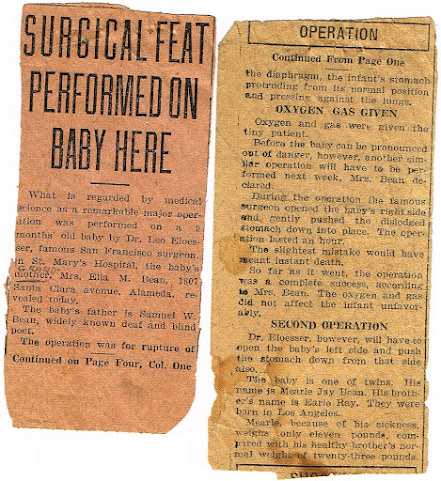

Above: Undated newspaper clipping, likely from the San Francisco, California, area, describing the first of two 1927 surgeries by "famous San Francisco surgeon" Dr. Leo Eloesser on nine-month-old infant Merle Bean to repair his ruptured diaphragm and displaced stomach.


Wednesday, November 17, 2021

The Gift of Governmental Documentation


Every so often, tracing the trajectory of an ancestor's life story leads us straight into the midst of conflict—the kind of conflict which, though unfortunate, becomes a rich source of documentation. For our American ancestors, such was the War Between the States—or, as Eugene Williams' side of the story would characterize it, the War of the Rebellion.

Eugene Williams was Maude Woodworth Bean's maternal grandfather. Though he was born in New York, his as yet uncovered story was the reason why Maude's mother, Effie Aurilla Williams, was born and raised in what was once called Dakota Territory, but spent her later years in Sioux City, Iowa, where she met her future husband, William Woodworth.

For the young couple Effie and William, from the point of their wedding in 1890, it was off to California and the adventure of a new life together. It wasn't long, however, before Eugene and his wife Elizabeth followed their daughter's path. And with that move came the gift of governmental documentation which allows us a clearer glimpse into the wanderings of Effie's father.

Eugene and Elizabeth Williams were still residing in Sioux City by the time of the 1900 census, but by December 14, 1904, Eugene was admitted to a National Home for Disabled Volunteer Soldiers—but not in Iowa. His admission to the facility was due to heart disease, and the records indicating this also revealed that, prior to entry at the Home, the couple had been living in Irwindale, a town not far from the southern California home of their daughter and son-in-law, the Woodworths. The 1910 census revealed the identity of that National Home as the "Pacific Branch" located in Malibu township in Los Angeles county.

From the scant entries on the page of Eugene's record at the Home, we gain everything from a physical description—blue eyes, fair complexion, height of five feet and eight inches—to the cause of his death on May 11, 1914. Though a veteran's marker was supposedly placed on his grave at the Los Angeles National Cemetery—at least, according to transcribed records included at Ancestry.com—there is no photograph of such featured on his memorial at Find A Grave.

That, however, is not the information I'm keen to glean at this point, though it does need to be checked. What I'm grateful to find in that same record of his admission to the National Home was the specific details of his service in the Civil War. Learning that on August 15, 1862, Eugene Williams enlisted to serve as a private at Portage, Wisconsin, along with the details on the company he was assigned to, becomes my springboard to follow his fate from that point until the time of his discharge at the close of the war.

Details such as those afforded by this government record provide us entrance into a well-stocked inventory of historical details—the macro-history through which this micro-history traveled.

And that recounting of Maude's grandfather brings us to our stepping off point tomorrow in exploring my latest discovery in that research weakness called Bright Shiny Object Syndrome.     

Tuesday, November 16, 2021

What About the Williams Line?


Sometimes, family history research takes the form of speed searching. That certainly was the case when I took a whirlwind tour through the Williams line of Maude Woodworth Bean's maternal grandfather. My goal—the overarching goal of this month's research—is to see which line related to the Woodworths might have passed along the Marfan Syndrome which manifested itself in Maude's sons, nephews, and even grandson.

Speed searching through the paternal line of Maude's mother Effie Aurilla Williams didn't point to any lives tragically cut short in their prime—although, oddly enough, there were a couple spouses who did die at a relatively young age. However, one unexpected discovery emerged as I read through the marriage announcements and obituaries for the various Williams relatives.

Effie's brother Arthur Williams had three sons, one of whom—Ray—held a bachelor's degree in music and was noted to have served as soloist at his younger brother's wedding. (Considering this musical bent in the family, I couldn't help but wonder whether that youngest brother's name—he often went by "A. Minor Williams"—wasn't an inside joke in the family.)

The mention of musical talent in the family caught my attention for two reasons. First, the former owner of the photographs I had rescued from a local antique shop, Marilyn Sowle Bean, had a musically talented son, herself. That was the son who lost his life to Marfan Syndrome.

Then, too, in Marilyn's photographs was a picture of her brother-in-law—Sam, the poodle trainer for the Ice Follies, who also died of Marfan Syndrome—playing his guitar and singing with friends at an informal evening gathering. The family had always left me the impression that somehow such well-developed talents as this were a hallmark of the syndrome, but here was an example of musicality minus malady.

While the propensity to perform artistically may have been passed down to Marilyn's son and brother-in-law from the Williams' line, in my rapid-fire race through the Williams pedigree, it didn't appear there was any sign of Marfan Syndrome in that side of the family.

However, as often happens in such searches, there were a few other details of interest that I'd like to pause and examine. Call it the Bright Shiny Object Syndrome if you will, but before we judge such a dalliance, let's just call it productive exploration and grant a day's lenience to explore a bit more about the Williams line.


Above: Photograph of Maude Woodworth Bean's son Sam playing the guitar at an informal outdoor gathering; undated picture from the collection of Marilyn Sowle Bean.

Tuesday, November 9, 2021

Digging Deeper for Details


Sometimes, the answer we're seeking to our family history research question is buried in the details. Right now, I'm wondering just where the hereditary disease known as Marfan Syndrome might have first manifested itself in the family of Marilyn Bean, the woman whose photographs surfaced at a local antique shop after her death seventeen years ago. Most of those details point to Marilyn's mother-in-law Maude Woodworth Bean as the carrier. But was that legacy bestowed upon her and her brother from the Woodworth side of the family, or from their mother's Williams family line?

In trying to answer this question, there are complications in the research process. Who's to say what the cause of death was, barring access to the details in an actual death record? 

In searching for any sign that others in Maude Woodworth's extended family showed signs of the deadly Marfan Syndrome—either in Kenosha County, Wisconsin, where many in that family were born, or Sioux City, Iowa, where they stayed before emigrating to Los Angeles County in California—there were very few family members who died of any cause at a young age.

True, for deaths of that time period and location, it would take that old-fashioned research route of sending for a death certificate if the record wasn't digitized at any of our usual go-to genealogy websites, so we'd still have to wait for an answer. In the meantime, though, it seemed quite a few of Maude's relatives made it at least to retirement age, or well beyond it.

For those who did die far too soon, it is hard to determine whether the underlying cause might have been an as-yet not widely understood disease like Marfan Syndrome. Besides, in the time periods we're examining—Maude's father William was born in 1867—there were any number of diseases which could have claimed a child's life, or that of twenty-somethings, for that matter. Not to mention, just as we're experiencing right now, there were epidemics which felled large numbers of people, children and adults.

With that in mind, family history might have as its corollary research requirement the knowledge of the history of contagion. Perhaps not in all cases, but especially in ours, being aware of the ebb and flow of contagious diseases could help clarify signs of the goal we're focusing on. 

For instance, in pursuing this question of the cousins who met an early death, there were a few whom I wondered about. Take, for example, the instance of Helen Vanderburg Standard. Cousin to Maude, Helen was only twenty eight years of age when her husband put out an emergency call after midnight for assistance at their home. She died that March 3, 1942, still at home. What was the cause of death? Was it sudden? Was it lingering? Was it unexplained?

Another sad loss in the extended Woodworth family was that of Charles Sumner Woodworth. He would have been Maude's uncle—if he had lived beyond childhood. A clue to his brief life is carved right into his headstone, listing his name as "Charlie" Woodworth. The now-old memorial is difficult to read, and it is likely that the age marked on the headstone may have been transcribed in error as a younger age than Charles was at his passing. No matter: here was another Woodworth relative who may have been lost simply because of Marfan Syndrome.

Or was he? It is hard to tell without more information. But not even a death record from 1861 could have completely informed us—even if we could locate such a record at all.

One detail I did unearth as I was building out the Woodworth tree: Maude's grandparents had plenty of company when they made the decision to uproot their family in Iowa—including Maude's dad William—and move to California. Before we examine the roots of Maude's mother's family, let's take a look at just how many from the Woodworth side of the family made the move to California—and see what drew them to that vastly different region of the country.

Monday, November 8, 2021

Maude's Siblings — Surviving or Not


When a death-dealing malady strikes many members of a family, the question may evolve: where did it come from?

In the case of Marilyn Sowle Bean's family—the family whose photographs were rescued from a local antique shop—the effects of Marfan Syndrome may have been a mainstay for many generations. Marilyn's son certainly succumbed at a young age—in his thirties, thanks to medical advances during his early twenties which granted him another decade more than his dad had. Then, too, besides Marilyn's husband, her brother-in-law Sam, the poodle trainer for the Shipstads and Johnson Ice Follies touring shows, also was felled by the same syndrome.

But what about previous generations? We've already observed that Marfan Syndrome likely entered the family through the line of Maude Woodworth Bean, Marilyn's mother-in-law. Maude's brother Lucius certainly had several sons afflicted by the same malady. But was it owing to Maude's and Lucius' father William Woodworth? Or his wife, Effie Aurilla Williams?

Before answering that question, I was curious to see whether anyone else in Maude's generation might have showed signs of the illness. According to Maude's father's obituary, William and Effie were parents of six children, of whom only three survived beyond the year of William's death in 1928. Of those six, I can only trace five, making me wonder whether the sixth child might have died in infancy.

The five of William's children faced varying fates, though none of them seemed to manifest Marfan Syndrome personally. Eldest daughter Nieva, born in 1892, lived to be a respectable ninety one years of age, hardly the symptom of a malady like Marfan Syndrome. Married twice, Nieva had four children, two of whom lived until at least retirement age, though one three-year-old son died and one daughter I could not trace beyond her twenties. Perhaps there is a story hidden there.

The second daughter of William and Effie, however, died at ten years of age. Though I can't yet find any record stating cause of death for Irma Woodworth, the early age of death might be a clue—or perhaps just an expected outcome for a childhood which ended in 1907.

The youngest child of William and Effie also died at a relatively young age. However, rather than signalling another death due to Marfan Syndrome, Helen Woodworth's death in 1921 at the age of twenty one was due to quite different and tragic circumstances.

So did Maude and Lucius merely serve as carriers of the Syndrome? Though each of them died at relatively young ages—Maude at thirty five and Lucius at forty five—it is likely their deaths were results of other maladies. The next step is to take a close look at each of Maude's parents and their related lines. We'll remain with the Woodworth family for yet another generation tomorrow to see whether we can find any telltale signs of Marfan Syndrome in their history.  

Tuesday, November 2, 2021

What got me Started


Anybody who has arrived early in a doctor's office to complete requisite paperwork before that first consultation will be able to relate to what I'm going to discuss today. Remember all those questions about which diseases you've suffered through—or hardly remember having? The questions which push farther back to the ailments of ancestors might be enough to make one wish there was a way to merge medical history with a pedigree chart. And that's what got me started in genealogy—with the Bean family tree, that is.

While some people might worry about high cholesterol leading to a massive heart attack or stroke—just like dear old dad—someone in the Bean family had passed along a medical inheritance just as deadly, but not as well known. I didn't even need to draw up a pedigree chart to see how far that genetic tendency had spread in this family. Though Marilyn Sowle Bean—last keeper of the family photos rescued from a local antique store—didn't suffer from the ailment herself, her husband, his brother, and several others on the maternal side of that Bean family were struck dead in their early adulthood. Or, surviving beyond that age, they suffered so much, they wish they had been.

That tragic legacy became part of the family's story. To learn the Bean family history was to learn about Marfan Syndrome and its hallmark sign—in this family, at least—of elongated limbs and exceptional height. On the human side of the story, that meant a great deal of loss for all those who married into that family line, Marilyn included. On a more technical side—at least for a genealogy researcher like me—I wondered whether I could pinpoint the family line to which the syndrome could be attributed, or even if, going back through history, it would be possible to trace such a tendency.

There are, of course, special symbols which can be included in a medically-oriented pedigree chart, such as this example from a 2008 publication by Genetic Alliance shared on the website of the National Center for Biotechnology Information. While I could use such an approach in tracing the family members afflicted with Marfan Syndrome, my question slanted more toward the genealogy than the genetic. I want to see if I could follow the correct family line through several more generations.

To do that means first to focus on the relatives in this family whom I once knew personally: Marilyn's nephews on her mother-in-law's side of the family, the Woodworths.

Tuesday, May 18, 2021

Our Implicit Confidence,
Our Affectionate Regard


On the morning of December 24—Christmas Eve—Joseph Ijams must have taken abrupt leave of his family. That, at least, is how the Knoxville Daily Chronicle portrayed that most permanent of departures in a full column's length report of his 1882 funeral service a few days later.

The Knox County death register noted, in its hurried scrawl, that Joseph Ijams had succumbed to "cong. brain"—possibly referring to the malady of "congestion," the accumulation of fluid surrounding a specific body part. During that time period, "cerebral congestion" was considered a cause of apoplexy, indicating that, while the onset of a stroke may have felled the man quickly, the likely hypertension bringing on the finality of that diagnosis may have been a longstanding symptom.


How difficult it must have been for his wife Mary to receive such news. The sudden widow of the family's five remaining children was mother to a six month old infant, with the oldest barely a teenager. The kind words spoken in the funeral may have been encouraging—the eulogy was delivered by Knoxville judge John L. Moses to a large assembly of community members and students of the school which Joseph Ijams had come to Knoxville to oversee—but no matter how beautifully the choir sang, or the school's chapel was decorated, grief seldom lifts so simply.

The eulogy offered by the judge provides us ample opportunity to piece together Joseph's life—it is from this column that I borrowed the details for yesterday's post—and to learn how capably he discharged his current duties at the institution where he served. A remark Joseph was quoted as saying does have staying power: "Remember...every single thought you impress upon the mind of one of these children will form part of a bridge over a great gulf." Joseph saw his duty not merely as an occupation, but as a mission.

Indeed, news of his death reached as far as Boston, where it was mentioned on December 26 (page 3, column 3) in the Boston Evening Transcript

Likely, his passing was noted back at Iowa City as well as Washington, D. C., where he had had professional affiliations. Despite the respect Joseph Ijams commanded, or the accolades heaped upon his memory, though, there was one thing that puzzled me as I searched for more information on his life: a document drawn up almost a year after his death, filed with the Clerk of the Court in Knox County.

I, as Administrator of the Estate of J. H. Ijams, deceased, do hereby suggest the Insolvency of the Estate of said J. H. Ijams, deceased.


Wednesday, April 15, 2020

Remnants of an Ancestral Story


Luther C. Fischer arrived in 1871 as the firstborn child of widow Sarah Rainey Smith and her second husband, Hartford C. Fischer. Growing up on his father's farm in Coweta County, Georgia, along with his younger sister and two brothers plus his three older half-sisters, one might not imagine Luther's family situation to be one to bestow upon him a fortunate future—especially considering his father's subsequent divorce. And yet, somehow, he found a way toward a better life.

In Georgia about that time arose a new business concern which developed a syrup, or concentrate, which could be sold to drugstore soda fountains to produce a "temperance drink." Somehow, Luther got wind of that business opportunity and began selling the concentrate across the state. He had a motivation for his industriousness: a need to finance his own education.

Even for the times, his education must have cost a sizeable amount. Luther Fischer had enrolled in the Atlanta College of Physicians and Surgeonseventually known as Emory University School of Medicine—and graduated in 1899. Leaving there—and the part time occupation of selling Coca Cola syrup which financed his education—Luther traveled to Europe to continue with post-graduate studies.

Upon his return to Atlanta, the new Dr. Fischer teamed up with a former professor, Dr. Edward Campbell Davis, to open the Davis-Fischer Sanatorium by 1908, which quickly outgrew its capacity. Inspired by the tragic news of the preventable loss of lives in fires destroying hospitals in Michigan and Montreal, Luther made the decision to change architectural plans for a new sanatorium from the typical wood construction to a building completely constructed of fireproof material. That eighty-five bed facility, though costly, opened its doors in 1911.

By 1931, Luther's business partner Dr. Davis had died, and according to the two men's plans, Dr. Fischer rechartered the sanatorium as a nonprofit institution and renamed it in honor of the (somewhat disputed) originator of the anesthetic use of sulfuric ether, Dr. Crawford W. Long. That institution, in subsequent years, saw its name evolve from the Crawford W. Long Memorial Hospital to the Emory Crawford Long Hospital to, simply, Emory University Hospital Midtown.

What's in a name? Sometimes, we can't really tell, until we learn its history. We learn from history, too, what went into our own genetic makeup, as we discover the personal stories of those whose lives shared the specks of DNA we also find in our own chromosomes. If not for piecing together stories like Luther Fischer's from the scraps of resources cobbled together through a Google search, perhaps not even this might have been discovered.

This, however, was not the story which led me to look closer at Luther Fischer's life. After all, the only time I've been to the state of Georgia has been to fly through its largest airport; I certainly have not had any opportunity to delve into family research there in person. It was only thanks to the kind remembrance shared on a memorial that I learned of another aspect of Luther Fischer's life.

You see, during the rise of his career, Luther also was party to another partnership: that of his marriage to Lucy Jane Hurt in 1900, daughter of Dr. C. D. and Mamie Grant Hurt. Lucy must have meant an awful lot to Luther, though it is only in traces of what was left behind—yet only briefly—that we can see any signs of their care for each other. Thankfully, in preserving that story, others have enabled it to be passed along so we, too, can know it.

I'll share what I've found about Luther and Lucy tomorrow.


Above: Undated picture of the Davis-Fischer Sanatorium, Atlanta, Georgia, possibly from mid-1920s.

Sunday, February 18, 2018

When Your Family History is
Being Written Right Now


Most of the time, genealogists believe they are preoccupied with the details of lives lived centuries agoor at least decades ago. The things that shaped our ancestors, redirected them to the places where they lived or the occupations they filled or even the people they married, those are the details we search to uncover. In the process, we sometimes uncover those hard truths that dashed their dreams or broke their hearts.

Sometimes, that process of discovery is so removed from our present that we are immune to the experience that enveloped the ones who endured the event. The crisis becomes, for us, an unusual story, not a painful memory. We forget that, in the moment it unfolded, it evoked strong feelings and perhaps even redirected outcomes for families. We can only relate by remembering similar events that may have happened in our own lives.

When those events do happen to us, we sometimes get knocked from our role as the family historian, the keeper of the family narrative. Enveloped in the pain of the tragedy, we drop our pen to participate, abandoning our narration of what is currently unfolding, forgetting that, in the future, this very experience will become our history.

That, I can attest, is a natural outcome, given the circumstances. Here I am, having done the very same thing these past few months. While the whole world, it seems, joined in to celebrate holidays from November through January, our own extended family was rocked with devastating news: the four year old granddaughter of my husband's cousin was diagnosed with cancer. A brain tumor manifested itself around Thanksgiving time, needing immediate surgery. The procedure revealed that not all of the tumor could be safely removed, requiring a sequence of chemotherapy treatments for the next half year.

For three weeks out of every month, this little one needs to remain in the hospital, not just for the chemo, but on account of how it also impairs her immune system. For one week out of every month, little Bea gets to return home to her familya family which recently moved to a different house, and into which a brand new baby was just welcomed. Life goes on for the family, but how different is the direction now taken.

Events like this, remembered years later by siblings, demonstrate how life-changing are the marks we leave on each other. Sacrificial choices, made to help out, shape us in ways we may not realize as we are going through the process. Invisibly but indelibly they constitute the person we become. Afterwards.

In one way, such changes are so stressful as to suck all the verve out of the activities we usually take joy in. For those of us who consider journaling, or recording reflections on, our daily activities to be essential, we may suddenly lose all desire to write down the minutiae of a process which could, in the end, turn tragic. Yet, in many ways, keeping up that writing habit could turn out to be therapeutic—while, if preserved, could provide a history for the family in generations to come.

Right now, there is no doubt that the experience is full of strong feelings—and yet, it is coupled with that stoic determination to just get through life, doing what can be done, and leaving the miraculous to those for whom such touches are meant. And yet, in such trauma, it sets the stage for those who can rise to the occasion to do selfless, sometimes heroic, acts. Sometimes, those selfless acts of kindness are small—like the friend of the family who set up a GoFundMe account for Bea's medical expenses—and sometimes they are the kinds of sacrifices that no family member would think twice about doing, like the grandparents who take turns flying across the country to watch the rest of the grandkids while dad is at work and mom is at the hospital.

Stuff like this may not be considered family history. It isn't—yet. But what we do every day will eventually become part of the history our descendants will someday wish they could find about us. 

Thursday, July 9, 2015

Vectors and Migrations


If one had just arrived in paradise, what could possibly induce a soul to want to leave again?

The move to the Broad River area of Georgia seemed just the thing for the party of Virginians joined by my Taliaferro ancestors, just after the Revolutionary War. The land held out promise of productivity. The river provided convenient access to markets via Augusta to Savannah. What more could anyone desire?

Within one short generation, however, the promise of this new land had begun to fade. And with that fading went the prosperity of the people called there by that very hope.

For one thing, living near a river in a temperate climate can have its down side. A first clue to such difficulties was one I found in a biographical sketch of Nicholas Louis Meriwether—doubtless a distant relation—who had become one of the many who sadly bid goodbye to his Broad River home. The entry noted, "He spent most of his time attending the sick of the Broad River settlement."

The possible cause of such illness might be inferred from a history of nearby Augusta, Georgia—similarly situated upon a river. What was once dubbed "Stranger's Fever" periodically made its appearance in Augusta over the years following the nearby establishment of the Broad River settlement. According to Charles C. Jones' Memorial History of Augusta, Georgia, what later became known as Yellow Fever was documented in an outbreak there in 1839 in which one third of the entire Augusta population suffered an attack. Another such episode followed in 1854.

Members of the local Medical Society set themselves to the task of evaluating possible causes of this devastating illness. Opinions vacillated between conjectures that the disease was not contagious and that it was—and if so, how it was spread.

Eventually in the Society's investigations, it was noticed that "an unusual quantity of animal and vegetable putrefaction" had been found in "a number of small ponds and marshes." (Jones, page 258-259.)

In a stellar example of public policy that might have seemed like a good idea at the time, it turned out that the city fathers, some time before this, had decided that
there be constructed a slide or platform on the river bank for the purpose of throwing the dirt and rubbish collected by the street officer clear of the bank into the river.

As it turned out, their plan worked quite well, as many in the city availed themselves of this dumping-off point—so much so that the heap had swelled into a mountain of its own. Once the local officials realized what they had done to themselves, the next task—a similarly huge assignment—was to dismantle the hazard.

While that entire debacle occurred not in the Broad River settlement, but down river in Augusta, it serves to demonstrate the then-current view of rivers and their usefulness. It also revealed lack of understanding, at the time, of vectors of diseases—including the oft-found mosquitos of such low-lying "small ponds and marshes" as had been noticed in the physicians' inquiry into the Yellow Fever causes. Apparently, the good people of places like the Broad River settlement were all but hanging out welcome signs for the very visitors who bred the disease that was killing them.

I doubt very many of those choosing to leave the Broad River settlement realized, at the time, what it was that convinced them to pack up and move. Perhaps they once again convinced themselves that that periodic wearing out of the land was upon them.

Then again, the rise and fall of fortunes seemed pegged to more local causes, such as the fate of the nearby town of Petersburg—the down river inspection stop for shipments of tobacco headed to Augusta, then Savannah, then across the ocean for international trade. A shift in cash crops from tobacco to cotton and a change in transportation modes from "Petersburg boats" to roads and railroads routed elsewhere had a devastating impact on the economic well-being of the region.

Or maybe the Broad River families succumbed to a new kind of fever—western fever, for which the only known relief was to forsake all and move out West.

Monday, March 2, 2015

A “Who’s Who” of
Your Own Family History


Have you run into any famous names as you push your way into the unknown of your family’s past history?

I thought it rather notable when I bumped into a name of significance as I rolled through the genealogy of my extended Taliaferro line: Frank Lebby Stanton, writer and creator of the poem from which the Association of Graveyard Rabbits has drawn its name.

Finding mention of that name reminded me of the Unit Studies approach of my homeschooling years: a technique for studying a central figure or topic in history, then exploring all the related trails branching from that one point of examination. Sort of like mind-mapping for curriculum design, developing Unit Studies could escort you through varied educational terrain—math, science, composition, geography, language, sometimes even performing arts or athletics—all while studying history. Unit Studies took learning out of the education box and turned it into an observatory of how life really is, where everything is (or can be) related.

That experience—finding Frank—got me to thinking: could there be others who were once recognized as significant by their peers, during their lifetime?

Of course, that thought led to another: would there be enough of those interesting people in my extended family universe to warrant creation of my own family’s Who’s Who of relatives?

While I thought this an interesting possibility, my inner critic decided finding Frank was definitely a fluke—besides, he was an in-law—and dismissed the idea.

Then I ran into yesterday’s story.

There I was, mindlessly grinding my way through the Taliaferro genealogy I’ve been studying for the past month—Willie Catherine Ivey’s Ancestry and Posterity of Dr. John Taliaferro and Mary (Hardin) Taliaferro—and I saw the possibility for entry number two in my own family's Who’s Who.

By this point in my progress, I was up to page fifty six in the Ivey text, and working on the descendants of Dr. John’s son Charles. I had moved on to Charles’ son—named John, after his grandfather—who married Martha Wright and moved from the family’s hometown in Surry County, North Carolina, to Tennessee.

This younger John Taliaferro had a son whom he named William, who had been married twice, owing to the death of his first wife sometime before 1869. William and his second wife—a cousin named Martha Franklin whom everyone called (for some inexplicable reason) Pattie—had one child, born in 1870. They named this son Charles Franklin Taliaferro.

While this younger Charles Taliaferro was listed as “a prominent physician,” that is not why I bring up his story today. Since Charles and his wife had no children, I’m certainly not mentioning his story for that reason—he, too, joined the ranks of those who became the last leaf on their family tree’s branch.

It is solely for one sentence in the Ivey book that I bring up Charles’ record today. He married a woman whose own genealogy was notable enough to be included in the Ivey narrative.
He married Ida Virginia Bolejack, daughter of Nathaniel Bolejack and Victoria (Bunker) Bolejack of Mount Airy, N.C…

Up to this point, nothing in the narrative would be unusual for a genealogy book. It is the continuation of that last sentence that made all the difference.
…and granddaughter of Chang Bunker, one of the Siamese twins.

Siamese twins? I thought the name, Chang, to be quite unusual for the spouse of anyone associated with a family whose roots reached back to colonial days in America. More than that, though, while I understood the concept of Siamese twins, I had never given any thought to the reason why such twins might be dubbed “Siamese.”

Straight to Wikipedia I flew, looking for any possible entry on Chang Bunker.

I found one.

Yes, the original Siamese twins were indeed named Chang and Eng, and they were, literally, Siamese. Born in 1811 near Bangkok, they were observed as teenagers by a Scottish merchant living in the area. The merchant realized the financial possibilities in exploiting the curiosity of the twins’ predicament, and entered into a contract with the twins’ family to take the boys on a world tour.

At the end of their agreed contractual terms, the now-world-traveler twins decided that the place where they would most like to settle was an area near Wilkesboro, North Carolina. They adopted Western styles and ways, choosing even to assume an anglicized surname: Bunker. Becoming naturalized American citizens, they went into business for themselves and became an established part of their new community.

Incredibly—and awkwardly, I am assuming—the brothers married. Two sisters became their wives, Chang marrying Adelaide Yates, his brother marrying her sister Sarah Anne.

Chang and Adelaide became parents of eleven children. One of those children was Victoria Bunker, who eventually married Nathaniel Bolejack. They, in turn, became parents of Ida Virginia Bolejack. And she, as we read above, became the wife of Dr. Charles Franklin Taliaferro.

While Chang and his constant-companion brother Eng became worldwide curiosities, Chang’s granddaughter became someone in my own extended family whom I can consider intriguing. If it hadn’t been for stumbling upon her name—and the inclusion of her family’s story in my family’s genealogy—I wouldn’t have revisited the history of the concept of “Siamese twins” and would have missed the personal connection totally. Though yet another in-law to my Taliaferro line, Ida Virginia Bolejack Taliaferro makes a great candidate for my own private Who’s Who of interesting relatives.


Above: "Chang and Eng, the Siamese twins, One Holding a Book," undated lithograph by unidentified publisher; public domain image in the Iconographic Collections at Wellcome Library, from Wellcome Images, a website operated by Wellcome Trust, a global charitable foundation based in the United Kingdom; this image shared under Creative Commons Attribution only license CC BY 4.0; via Wikipedia.

Wednesday, December 17, 2014

Money Woes


…I was disabled and had neither horse nor money to regain my command.

When examining the timeline and narrative of Charles Edward Broyles in his service to the Confederate Army during the Civil War, there are a few places where we need to stop and take a long, hard look between the lines of his narrative. I believe examining those unexplained blank spots will ultimately help us discern the reasons behind his abrupt move from his home in Dalton, Georgia, to the apparent second life he lived, once he arrived in Colorado territory.

Going back to the entries in Charles’ journal that I had mentioned yesterday, there were a couple sentences we need to look at another time.

The first one, above, mentions how the loss of his horse and money hampered him from returning to service in the Confederate army. While I can’t find any confirmation of this online—and if you are well versed in Civil War era military requirements, please add to the conversation in the comments below—there were apparently requirements beyond that of military skill or leadership qualities, in becoming a person of rank. I had seen hints of that when researching my second great grandfather, Charles’ younger brother Thomas, who had obtained a horse so he could serve in the cavalry rather than as a foot soldier in the infantry. The newly-formed Confederate government was apparently unable to provide mounts for these men; they had to obtain their own.

Again, though I haven’t been able to find confirmation of this, Charles’ journal entry seems to indicate that it was incumbent upon the officer himself to provide financial backing in order to “raise a regiment,” as Charles did along with Colonel Jesse A. Glenn of the 36th Georgia Infantry.

While I am not familiar with the aspects of achieving a rank of command in that era of military history, it seems Charles’ journal entries are implying such requirements. Because of his prior injury to his feet during his first tour of duty (as “a foot”), and also possibly because of his history of having had typhoid fever in his youth (“that so crippled my limbs”), his only possibility of continued service may well have been mounted upon a horse.

Then on its way to North Carolina I was paroled at Anderson Court House S. C. and in the fall of 1865 returned with my family to Dalton Ga.

The journal narrative here enters a murky phase in Charles’ description of his final days of service. He was “furloughed…on the 5th day of February 1865, on account of rheumatism” in Augusta, Georgia, yet not paroled until the unit reached “Anderson Court House S. C.” And while the war officially ended on April 9, 1865, with the surrender of General Robert E. Lee in Virginia, conclusions of hostilities were obtained more as a rolling date, as department after department of the fallen Confederacy yielded to the reality of their losses.

It is hard, from the overview of history, to determine exactly where Charles Broyles might have been during this range of surrender dates. He likely was still considered part of the armies of General Joseph E. Johnston and, due to the rolling dates of surrender even within these companies, may have been—since Charles mentions “on its way to North Carolina”—released as the company made its way to Greensboro by May 4, 1865.

Granted, it seems as if there is an unexplained gap between the date of surrender—wherever and whenever it was for Charles’ company—and his return to his home in Dalton, Georgia in “the fall of 1865.”

This, however, is another example of the gaps in narrative for which we’ve got to read between the lines. Notice he says “returned with my family to Dalton.” This brings up another question: while he was away from home, serving in the Confederate army, where was his family? By the start of the war, he and his wife, Lucy, had had five children. This is a difficult position in which to put a family of such size, especially considering the long absence of the family’s traditional breadwinner.

Not to mention, what about their safety while the Union army was ravaging a significant swath of land across the state of Georgia? We need to remember that neither Charles nor Lucy had close relatives in the area; both had been born and raised in South Carolina.

It is interesting to note that Charles was paroled at “Anderson Court House S. C.” A little geography lesson is in order here. If you remember, Charles’ childhood home was in a place in South Carolina that had once been called Pendleton District. The term “district,” if you follow a geo-political timeline, had been used alternately with that of “county” in South Carolina.

Up until 1826, the Pendleton District included a large area of land in upstate South Carolina which claimed as its county seat the town—logically—of Pendleton. However, in 1826, it was determined that the area needed to be subdivided, and two new districts were formed: one named Pickens, the other named Anderson. Because the town of Pendleton was considered to be too close to the border of the new Pickens District, a courthouse was established at the center of the new Anderson District—named, appropriately, Anderson Courthouse.

If you’ve been following the saga of Charles Broyles for the past several days, you are probably realizing that Anderson Courthouse was simply the new digs for the county seat of what once was considered the home district of the Broyles household. In other words, though the boundaries had changed, for Charles to head to Anderson Courthouse was for him to return to the area of his old family home.

Why would Charles return to South Carolina instead of his own home in Dalton, Georgia? It is likely that his wife and children rode out the turmoil of war, living either with Lucy’s own family in Barnwell or with Charles’ family in the old Pendleton District of South Carolina.

Keep in mind that the overarching purpose of exploring this line of my second great grandfather’s brother is to explore the possible network and connections that led my own ancestor to meet his bride, who was also a Georgia resident, at least before and after the war. The question of where these women and children went to avoid becoming casualties of battles—or at least to mitigate their suffering during the hardship of war times—may help lead us to explanations of how future familial connections were made.


Above: Dalton looking east to Cohutta Mountains; pencil, Chinese white and black ink wash on green paper by Alfred Rudolph Waud, labeled "Battle of Dalton" and dated October 13, 1864; courtesy Library of Congress; in the public domain.

Thursday, June 5, 2014

A Long-Winded Obituary


Receiving a copy of the February 15, 1917, obituary for Mrs. Anna Creahan, for me, was a delight. Not only was it effortless to obtain the record via email from the Indiana library serving as hometown repository for the Bloomington Daily Telephone, the report itself was composed in that genteel and flowery manner of Victorian sensibilities. It was sure to produce the kind of information I’d be seeking.

In many respects, the obituary did not disappoint. Though it started out with the blunt headline, “Mrs. Creahan Dead, Age 78,” it eased up considerably after delivering its duty as factual informer in the first sentence.
Mrs. Anna Creahan, age 78, step-mother of Mrs. Ella Fulk of this city, died Tuesday night at Lafayette from the infirmities of old age. Mrs. Creahan was a fine old Irish lady who came to this country from Ireland when she was a girl. Her husband died two years ago. The funeral will be tomorrow at Lafayette and Mrs. Fulk will attend.

Because I already had found the burial information for both Anna Creahan and her husband Michael, the date and location in Lafayette, Indiana, helped confirm that I was reading the right obituary. This was the Ann Creahan I was seeking.

After this introduction, the Daily Telephone noted that the rest of the obituary was gleaned from the Lafayette newspaper, the Courier—fitting, because that was not only where she had lived, it was actually where Anna Creahan had passed away.
Mrs. Anna Creahan, widow of Michael Creahan, an old and highly respected resident of Lafayette, died at 11:30 Tuesday night at St. Elizabeth hospital. Two weeks ago she was stricken with a severe attack of grip, and several days ago she developed pneumonia.

The Courier seemed in the mood to go into greater detail about Mrs. Creahan’s illness—something we’d rarely see in an obituary today—and though the narrative seems somewhat monotonous, it did provide additional family clues.
She was taken to the hospital a week ago today from the home of her niece Miss Louise Lenihan, 511 Kossuth street. Her condition had been critical since Saturday, and when she passed away she was surrounded by her niece and nephews. Mr. Creahan died in May, 1915.

Lenihan? Hmmm…I’ll have to make a note of this. Very helpful. Remember, I’m still tracing this line in hopes of uncovering who, exactly, that mystery niece “A. M. Crahan” in Mathew Kelly’s household was. Perhaps at last, I’ll find out what those initials “A. M.” stood for.

Right after the sentence that confirmed Anna’s husband’s date of passing—which we had already found, thanks to Find A Grave—my reading came to a screeching halt.
Mrs. Creahan was born in County Roscommon, Ireland, and came to Lafayette with her mother

All was well and good up to this point. Not only had I gleaned the name of another possible relative, but I had received the bonus goodie of learning her county of origin in Ireland—something I’ve yet to determine for these impossible Kellys.

All in the same breath, I had grasped a victory and had it torn from my reach with the very next words:
Mrs. Creahan was born in County Roscommon, Ireland, and came to Lafayette with her mother Mrs. Mary Cunningham, when a little girl and had been a resident here for half a century.

With that, I lost all zest for the discovery—for anything following that sentence, actually. Did it really matter any more? This was not our Ann Kelly. It was someone named Anna Cunningham.

On general principles—the hope that someone will be searching for this Anna Creahan, even if she turned out not to be ours—I’ll post the rest of the obituary below, with the complete transcription. Maybe someone will be entering that phrase in quotes, “Anna Creahan” in a Google search box, and will appreciate the find. I know I would have.

As for the Kelly niece, A. M. Crahan, it seemed I was farther than ever from being able to determine what had become of her. There were too many obstacles to overcome in continuing the search.

Somehow, though, I couldn’t let the thing go. With some brick walls—combined with stubbornness—it seems they come in handy for a good head banging.


            Mrs. Anna Creahan, age 78, step-mother of Mrs. Ella Fulk of this city, died Tuesday night at Lafayette from the infirmities of old age. Mrs. Creahan was a fine old Irish lady who came to this country from Ireland when she was a girl. Her husband died two years ago. The funeral will be tomorrow at Lafayette and Mrs. Fulk will attend.
            Of Mrs. Creahan’s death the Lafayette Courier says:
            Mrs. Anna Creahan, widow of Michael Creahan, an old and highly respected resident of Lafayette, died at 11:30 Tuesday night at St. Elizabeth hospital. Two weeks ago she was stricken with a severe attack of grip, and several days ago she developed pneumonia. She was taken to the hospital a week ago today from the home of her niece Miss Louise Lenihan, 511 Kossuth street. Her condition had been critical since Saturday, and when she passed away she was surrounded by her niece and nephews. Mr. Creahan died in May, 1915. Mrs. Creahan was born in County Roscommon, Ireland, and came to Lafayette with her mother Mrs. Mary Cunningham, when a little girl and had been a resident here for half a century. For more than thirty years she resided at 1112 south Fifth street. Deceased was an earnest member of St. Ann’s church and had belonged to that congregation since the parish was established. Prior to that she was a member of St. Mary’s church. She was possessed of deep religious convictions, and her religion was exemplified in her every day life. She had been a member of the Rosary society of the church for more than thirty years and was also a member of the ladies’ auxiliary of the Ancient Order of Hibernians. She took an active interest in the Hibernian society and was a kind and sympathetic neighbor and friend. Mrs. Creahan had a wide acquaintance throughout the city and her memory will long be revered by those who knew her best. During her long life she was the author of many kind deeds and her passing will be regretted by many. She is survived by the following step-children: John E. Creahan and Mrs. John P. Quinlisk of Lafayette; Mrs. Ella Fulk of Bloomington, and Mrs. Julia Sullivan of Denver, Colo.

Friday, March 14, 2014

Into the Shadows


When I recall all my memories of Lydia Melnitchenko, I can’t think of her without seeing the shadows in her life. Likewise, when I’ve searched online genealogical records to try and reconstruct the structure of her life’s story, the few wisps of documented personal history seem to quickly fade into that oblivion as well.

Despite the quick finds of the last few days, all that has been left to find of Lydia has been her Social Security death record—and even that was drawn up during the era in which month and year, but not the clarity of the day of passing, were the only details recorded. Try as I might, I could locate no obituary to catalog her life’s key points or beloved family. Nor could I find, online, any record of where she might have been buried in her final adopted homeland in New York.

The Social Security Death Index, however, did give a complete date for her birth: March 2, 1899. Wherever that event occurred—within the borders of what, at the time of any notation, might have been known as Russia or the U.S.S.R.—the record merely served to disguise the reality that her homeland was likely the Ukraine.

Wherever her hometown, it must have become witness, at the end of Lydia’s teen years, of much violence—or at best, civil unrest. With much of the Ukraine under the control of the Russian Empire during her childhood, it is no wonder she declared herself to be Russian on all subsequent travel documents. At the point of the Russian Revolution in 1917—followed quickly by the Ukrainian-Soviet war—her native land saw the turmoil conclude in Soviet takeover in 1919.

Where Lydia was, at that date, I can’t yet tell. Obviously, at some point, she met her husband-to-be, the seaman Michael Ivanivitch Melnitchenko, and they somehow escaped that war-torn region for a safer haven.

The couple settled in France by 1924—in Marseilles, where Michael could be close to the coast, from which he drew his livelihood—and welcomed their daughter Genia into their small family. Of course, by that date, France was not as peaceful a haven as they could have hoped, having also just recovered from the ravages of the Great War. And it wasn’t long until a Second World War brought them back to the brink again.

Somehow, in the late 1940s, the family was able to reassemble in a new homeland: the United States. While I suspect Michael, the international sailor, had already spent many shore leaves in and around New York City, the place may not have held the same sort of traveler’s fascination for Lydia. As a poor immigrant’s wife, she found herself keeping “house” in high-rise apartment buildings, not much better than tenement fare in some cases.

New York was the city in which sunlight couldn’t always filter to the ground floor. In the shadows of surrounding buildings, in the dark from insufficient indoor lighting, Lydia eventually became a woman whose entire life was in the shadows.

I remember visiting the Melnitchenkos as a child, taking the commuter train in to “The City” for a day spent in their apartment. The excitement of seeing the family of my fascinating godmother soon wore away for a child like me, raised in the suburbs, where grass actually grew in the schoolyard playground and one was free to run and climb trees—not dodge cars in a cement jungle. Hours of being cooped up in that dark apartment while the adults had their visit was hard for a young child.

Yet, one thing kept me on my toes: the mystery of the woman who never came out into the living room to sit and chat with the rest of us. She was back there—somewhere in a bedroom, I knew. My mother had told me she was there.

She also had told me not to expect to see her—and if I did, not to be surprised if she said or did anything unusual.

For whatever reason, Genia’s mother had been trapped in a painful reality all of her mind’s own making. Despite the rumbling of the traffic far below, hers now was a home in a safe haven, a land unlikely to experience the type of warfare she had known as a teen—and then later as a middle aged adult. Yet, for whatever reason, she was stuck in the paranoid behavior patterns more reasonable for someone always on guard for her own life.

She was said to be mentally ill, but for the most part, kept to herself and didn’t present a problem. Her husband, though, was always with her. Just in case. Once, she had emerged from her shadowy back room, and, standing near the kitchen, suddenly lunged to grab a butcher knife. Looking wild, and somewhat puzzled though she now had the knife within her grasp, she somehow deflated, and her husband gently urged her to put the knife back down.

I wasn’t there to witness traumatic moments like that, but remembering what life in the city was like back then, and realizing so much more about the intricacies of psychological anguish as I do now, brings back so many thoughts about what life must have been like for the family as they went through that challenge together.

I think, looking back on it all now, Lydia was suffering from a type of post-traumatic stress. I can only imagine what she must have been through during her younger years. In a way, that stress—or her response to it—sucked the life out of her, and left her lingering in the shadows for many of her seventy eight years.

Perhaps that’s why I can find no obituary. With Genia being an only child—and a very private person at that—with her father already gone, there was really no one else left to mourn Lydia’s passing. Her death became only a moment to slip away, unnoticed, further into the shadows which she had already, for so long, inhabited.

Sunday, January 26, 2014

A Sad Side Note


When Luther Kite signed his name—with a flourish—on the draft registration card in June, 1917, he claimed an exemption from military service owing to his responsibilities to support a wife and child.

That wasn’t entirely correct.

Yet.

It wasn’t until October 20, 1917, that Luther and Chevis Kite welcomed their firstborn daughter into the world—or at least into Erwin, Tennessee.

They named her, according to the Davis family Bible, Hazel Caroline Kite. I’m sure she was an adorable baby girl—at least until the summer leading up to her second birthday.

Then, suddenly—within the passage of only twelve hours—her body was wracked with a fever so severe, it destroyed her tiny life. She had succumbed to cerebrospinal meningitis.

The family—most likely it was Chevis’ mom, Martha Cassandra Davis—had entered her date of passing as June 17, 1919, but now that we have so many digitized documents available to us through online resources, I see the official date of death was given as July 3 of that year.

Even that would be doubtful, however, if you note the details on the death certificate. Notice the doctor asserted he attended the child from July 3 through July 3. Then the second date was struck out and replaced with the corrected July 4. Within that span of time, as the doctor indicated two lines below, “death occurred, on the date stated above,” at 1:00 a.m.


Wouldn’t that be 1:00 a.m. on July 4?

It is what it is, however. The document recorded it that way, and that’s the way it will be for anyone in the future seeking what became of little Hazel Caroline.

She was buried not in Unicoi County, where the young couple lived, but in Carter County, the home of Luther Kite’s family. Perhaps her burial arrangements were taken up by Chevis’ in-laws because, like many recently married couples, the young parents were hard pressed to scrape together the resources to handle such an unforeseen tragedy.

A tiny headstone for a tiny coffin proclaimed,
            Hazel Carolina Kite
            daughter of
            F. L. and Chevis Kite
            1917 – 1919

Little Hazel was buried in the Patton-Simmons Cemetery. Perhaps, remembering what I just wrote about Luther Kite’s mother, you may have, like me, perked up upon hearing the name of that cemetery. I couldn’t resist taking a look to see how many others of the Kite (or Kyte) family might have been buried there. I thought perhaps Hazel would have been buried with her grandparents, but there was no sign of that, at least according to the partially-transcribed records posted at Find A Grave.

There were, however, plenty of Simmons family members represented. Among them was a gentleman, having died October 12, 1890, by the name of Josephas F. Simmons. Just in case Josephas F. Simmons was not the Flavius J. Simmons I suspected he might be, I took a look at his entry at Find A Grave—which showed his wife’s name to be Mary William Simmons, aligning nicely with the information provided on their daughter Maggie’s own death certificate, and whose 1876 death explained why she hadn’t appeared in the Simmons household for the 1880 census.

Also included in the other Simmons family members at that cemetery was Josephas’ own mother, Mary Kessler Simmons, who died in 1887. A walk through that cemetery—admittedly a small one, with less than two hundred burials—was a walk through family history for anyone claiming to be part of Maggie May Simmons Kyte’s family.

Suffering the loss of a young child will always be a disruptive experience in family life. While that was an occurrence more familiar to those in previous centuries when medical advances we take for granted were not available, it has always been a tragedy with repercussions in the immediate family’s relationships.

Whether that was part of the difficulties tearing apart the marriage of Luther and Chevis, I’ll never know. But I do know the family had more than just that to be concerned with, that summer: they had a four month old baby whom they hoped to guard from the ravages of the bacterial assault that had so quickly claimed the life of her older sister. Emma Lee had taken her place in the family constellation on March 2, 1919, and the loss of another child was, no doubt, the last thing her parents would want to experience.

Monday, January 13, 2014

Confusion Despite Official Documents


Sometimes, in researching our family history, the data dump can morph into an avalanche of dull, dry dates, places and names. With the information overload we subject ourselves to by focusing on getting the facts, we can find ourselves losing sight of the people we originally sought to know.

I confess that exact thing happened as I was collecting the details for Lummie Davis Moore, the woman whose two letters I had just transcribed and posted here in the past week.

Even in the midst of attempting to draw up a timeline of her life to help sift through the clues, I missed one very important fact. In the middle of the narrative of these two letters, I lost sight of the woman’s impending death. It wasn’t until just a few days ago, when in the process of pasting the hyperlink to her page on my very outdated yet publicly-accessible Rootsweb tree, I happened to notice the year of her death: 1962.

“That’s funny,” I thought to myself, “That’s the same year as these letters.”

“Huh?!”

Yes, wallowing in the midst of all this family history overload, I got slapped in the face by that very detail. I have no idea how I had missed it.

It was sad to realize that—even disappointing. It was as if I were reliving that episode in my grand-aunt’s life with her, hoping for the best for her recovery.

Yes, Lummie was infused with an upbeat attitude, seemed restless and full of energy despite her serious injury—but, as often happened to those whose aging hips suffered a fracture, while focusing on the bone that needed mending, the patient was caught unawares with a side effect of the long healing process.

In many cases, the risk to those recuperating from hip repair is pneumonia. As it turned out in Lummie’s case, her decline was not at all that type of lingering misery, but an almost instantaneous attack: she fell to a case of coronary thrombosis. According to the death certificate, length of time between onset and death was five minutes.

While the quickness of the attack may have been merciful for Lummie, I can only imagine how brutal the news must have been for her daughter. Sarah Martha, recently returned home in the Baltimore, Maryland, area with a newborn daughter of her own, was too far removed from Lummie’s Phoenix home to know anything more than the type of news her mother had been sharing with her own brother in the letters we’ve just read.

Piecing together the story now—over fifty years later—I’m encountering a lot of gaps. The fact that there are discrepancies in the official documents doesn’t help. While I’m overjoyed to see the State of Arizona provide genealogical researchers with free access to their online death records through—thankfully!—the year 1962, I’m a bit stymied by the fact that some dates and details don’t line up in the certificate issued after Lummie’s passing.

According to Lummie’s death certificate, she was the daughter of Will David, which of course should be Davis. That became the first clue tipping me off that this document may not be one hundred percent reliable. Of course, it’s pretty hard to demand any family member to answer a barrage of questions one hundred percent accurately under duress of a family death. Perhaps that is why Lummie’s son-in-law, C. J. McKinnon, was listed as the informant instead of her own daughter.

However, when it comes to the date of death, that would seem to be factual information—not something swayed by how distraught the family might have been feeling.

Yet, the death certificate indicates Lummie’s date of death to have been July 19, 1962.

That causes problems when we seek out her obituary record. First, though Lummie claimed many friends in her residence of the past twelve years, I’ve been unable to locate any mention of her death in the Phoenix area newspapers so far. However, I did find an obituary for Lummie in her home town, Erwin, Tennessee.

Published in The Erwin Record, it was dated July 13, 1962—six days before Arizona had recorded her passing (for which I can’t help but recall the statement attributed to Mark Twain, “Reports of my death have been greatly exaggerated”).

To resolve such a records dilemma, don’t think it will help to resort to the cemetery’s grave marker. Apparently—at least according to the volunteer transcriber—engraved in stone is the year, 1967. It will either take a trip to Erwin—or the good graces of a Find A Grave volunteer—to stop by Evergreen Cemetery to brush away the camouflaging wisps of Bermuda grass disguising that last digit in the engraving.

Somehow, local researchers in the Erwin area managed to unearth a date which agrees with the one I had always understood to be Lummie's date of death. According to the book, Cemeteries of Unicoi County Tennessee, by the Unicoi County Historical Society, it was on July 9, 1962, that the Moore and Davis families lost a mother, grandmother, and sister.

Perhaps it was in all the scramble to pack and move their belongings from Roanoke, Virginia, back to their old home in Columbus, Ohio—and then, suddenly, to have to return to the old Davis home in Tennessee, that was the cause of these two letters being tucked away by Lummie's brother and sister-in-law, Jack and Ruth Davis. And, for the next fifty one and a half years, to lay undisturbed in their hideout until another passing passed along the whole passel of papers to me.
Mrs. Lummie Davis Moore, formerly of Erwin, died unexpectedly Thursday in Phoenix, Ariz. Death was attributed to a heart attack. Funeral services will be held today (Wednesday) at 10 a.m. from the Boyd-DeArmond Funeral Home. Dr. Melvin Faulkner, pastor of First Baptist Church, will officiate. She was an Erwin native, the daughter of the late William and Cassie Booth Davis. She was the widow of Wallace Moore, who died in 1952. She had lived in Honduras, Central America, for the past 12 years. She was a member of the Women's Club and the Harmony Club in Phoenix. She was also a member of the Baptist Church. Surviving are one daughter, Mrs. C. J. McKinnon of Ellicott City, Md.; one sister, Mrs. Horace Martin, Erwin, and three grandchildren. Boyd-DeArmond Funeral Home in charge.