Showing posts with label Giving Back. Show all posts

Saturday, February 15, 2025

We All Need a Charlie in Our Corner


During this month, while I've been pursuing the challenge of identifying my Townsend fourth great-grandparents, a steady stream of emails has been going back and forth between me and a fellow genea-blogger. Charlie Purvis of Carolina Family Roots has been sending me links of material he's found—on my Townsend ancestors. And I'm sending back links of what I've found, based on what he discovered. It's been an ongoing dialog as I work my way towards a well-substantiated answer to my question, "Who were the parents of Delaney Townsend Charles?"

We all need a Charlie in our corner when we are struggling with research problems. Even though technology has streamlined family history research to an incredibly amazing degree—with more developments and resources to come—our own two eyes cannot be everywhere, all at once. With the billions upon billions of digitized document pages coming online (or still behind paywalls in private collections), we can hone our skills and specialize in one area. But we can't know it all.

That's where crowdsourcing the answers comes in. And I am hoping that we'll see a swing back towards cooperative group effort in finding the specific resources each one of us needs. 

When the online genealogy giants came into being and we all swooned to think how much of our sleuthing could be done at home—pajamas, bunny slippers and cup of hot chocolate in hand—the unintentional corollary was a move away from group effort toward individual pursuit. We could find almost anything (perhaps with the right subscription) at any time of day or night. Who needed help?!

At first, we saw vestiges of the old genealogical queries—think Everton's Genealogical Helper on steroids—translated into digital form on sites like Genealogy.com or RootsWeb. Those, however, eventually atrophied from (presumable) lack of use, or due to prohibitive operating costs for what had been envisioned as a nonprofit volunteer effort. We lost our way to talk with each other about the families we were seeking.

I've been lately encouraged, in our local genealogical society efforts, by the response to the invitation to just come together to "talk genealogy." No agenda, no special speaker—just talk about where our research has taken us lately, and where we are stuck. An easy time to share notes, great resources, unexpected discoveries, that is something we do now, once a month. Special Interest Groups are like that, too: a way for smaller groups to exchange information on a specific research focus.

Connecting one on one, though, has super-charged the effort. Of course, it helps to write a blog, where others can put their surnames in a search engine and discover a link to just the blog post they need. Blogger Patrick Jones of Frequent Traveler Ancestry and I connected on our mutual Carter roots, initiating a volley of emails between us, full of useful resources, when I was researching the puzzles in that line.

Blogging is not the only way to connect with other researchers, thankfully—though posting a comment on a key blog entry you've found can help, even if you don't write your own blog. There are other ways to connect with fellow researchers and become the kind of research partner who supercharges progress for others. This month, our local genealogical society will be featuring a speaker on using family history groups on Facebook and other social media to connect with those distant cousins we all wish we could find. I love this speaker's subtitle: "Even if you hate Facebook." Yes, I'm in that camp, too—but I've encountered some wonderful people (and unbelievable results) by venturing into that social media corner.

Back during those early years of online genealogy—I'm talking 1990s here, when they only had wood-burning computers—I met a wonderful researcher who shared roots with my mother-in-law's Gordon line. She was a semi-retired professor of history at a key university, and liked to use her summer breaks for road trips to research those Gordon roots. We struck up an online conversation that lasted for years, until debilitating health got the best of her and eventually claimed her life. 

Thankfully, I am now seeing signs on the horizon that we are beginning to emerge from our genea-caves to connect with other researchers and share resources as a sort of ongoing conversation. Whether we are doing so in person or via online connections, the important part is: work together on the research problems that have us stuck. Find someone who is languishing on the same family line and offer help, either as a "Giving Back" approach in thanks for all that others did to help us when we got started, or a "paying it forward" gesture, knowing well that we'll hit more rough patches in our future research. Teamwork can supercharge our progress.   

Saturday, May 4, 2024

Seemed Like a Good Idea at the Time


How do you take a 35,000+ name family tree and merge it with another one of the same size, then edit it down to less than five thousand names? That's what I had planned spending the rest of this weekend doing—but believe me, it wasn't what I had in mind when I first got the idea to sign up for WikiTree.

Yes, it seemed like a good idea at the time. I had been exploring the profiles posted on that universal tree, mainly to examine resources that other researchers had discovered on my family's hard-to-find ancestors. I'm not above being nosy when it comes to well-conceived proof arguments or even the serendipitous footnote.

It was while puzzling over my mother-in-law's matriline that I spotted a note on WikiTree regarding lack of any participants sharing their mtDNA results for that particular ancestor. "There's something I can share," I thought, and decided right then to sign up. I believe in collaboration and in giving back to the genealogy community, and this was the perfect open door.

After reading all the important statements and signing up to be a "member" (WikiTree is free, but does have standards), I got down to the business of uploading my tree. Only problem: WikiTree has a limit of how large a tree can be uploaded via GEDCOM. Depending on when my search engine drops me into the history of volumes of internal conversation on this touchy topic, the number of profiles permitted can be up to five thousand, or down to a much more modest amount. And the drawback is totally understandable: it's hard to police a community tree when there are far more new members doing data dumps than WikiTree volunteers checking for unsourced information.

There is, however, one problem not addressed in the conversation about unsourced material: as I understand it, no matter how well-documented my source tree might be (mine is on Ancestry.com), taking it through the GEDCOM process may automatically remove some of the hard-won documented details I might have added into the original tree. Though facts, notes, and sources are usually retained through the conversion process if text-based, media may be lost in the transition.

Of course, I say this after spending an afternoon and evening collapsing two different trees into one stripped-down pedigree in preparation to convert it to the necessary GEDCOM. Now what? Perhaps the participants in that WikiTree conversation were right: far better to just hand-enter each record one ancestor at a time. A better idea, perhaps—until one realizes the reality of my actually getting around to doing that becomes a rapidly-shrinking "maybe." 

Sunday, April 21, 2024

Revisiting a Six Year Old Story


It was almost exactly six years ago when I began sharing the story of a photograph I rescued from an antique shop up in Gold Country. The picture itself was sweet, containing the cherubic faces of two young boys, the younger barely one year of age. The puzzling part was that the portrait was labeled in French, and likely dated from the earliest years of the 1900s, an odd find from a store in a small town in the northern California foothills.

At that time, I had begun what has become a habit of rescuing old abandoned photographs and researching the subjects of the picture in hopes of finding current-day descendants who might be interested in receiving the orphaned picture. In the case of Emile and Lucien Hallée, the two boys in the photograph, with barely enough details to locate a possible descendant, the generous assistance of a Canadian blogger who spread the word plus the power of social media enabled a happy ending: the photograph made its way home to family.

Ever since that point, I've been totally sold on the thrill that comes from what I call "giving back" to the genealogical community, and have returned several other photographs to family over the years. But it has only been lately that I've been able to share such stories in person. This coming Monday, April 22, I'm privileged to have that opportunity to head up to the same gold rush country where it all began in 1848 to present "The Genealogical Legacy of the California Gold Rush" to the Placer County Genealogical Society. If you're curious or want to hear that story once again (as well as others), I invite you to come along, whether in person for those living in the Auburn, California area, or online for those in time zones in which an evening presentation at seven, Pacific Time, would not be prohibitively late. The Society's website has the information to guide you in accessing the online meeting, and they are very welcoming in inviting visitors to their meetings.


Sunday, April 24, 2022

Surprises in the Mail


In this age of online connectivity, it's quite a surprise just to even receive something via "snail" mail anymore. In the past few weeks, and again yesterday, our local genealogical society did receive such a surprise. More than that, it was the unexpected content which made the packages even more of a surprise: photographs, clippings from newspaper articles, and other memorabilia concerning a specific family once resident in our county.

We hadn't asked for such a gift. But I can't say this sort of unexpected arrival was out of place. We are, after all, a society dedicated to preserving the family history of residents of our area. Like any other local genealogical society, though, we are pressed for space—not to mention, funds. What to do to honor such a gift—and the memory of the long-gone people it represents?

As far as I can tell from a cursory study, the principle people mentioned in the contents left no living direct line descendants, just joining those many dubbed the "last leaf on the branch." Yet that, too, begs the question: how did our benefactor stumble upon such personal papers (including, among other things, an original marriage certificate and even a social security card)?

Somewhere out there is—must be—someone who is related to this family. The situation of an only child of an only child can't be a situation repeated over too many generations; somewhere there must be third or fourth cousins who might take an interest in distant relatives like this family. 

I think of the possible ways to share this collection of memorabilia. Like many local societies, we coordinate a "First Families" program in partnership with our county's historical society, where materials donated through the program can be archived. At this point, though, such a method would lock those photos and letters behind pandemic-restricted doors. I'm looking for a way to share which involves people coming to us in a less-restricted way.

The possibility of using the same sort of channels we use for our personal family trees may be the best option. Some of those online portals provide ways to upload items such as photographs, which other members can then retrieve and save for their own records. It's a way to have our "cake" and eat it, too: to share the content someone wanted to pass along while finding a way to keep it safely preserved for future reference.

It is this very project we've begun, starting with this one local family, thanks to the prompting of an unexpected gift received through the mail. While in the past, I've spent time searching for "orphan photographs" to research and return to the subject's descendants, now the photographs have started coming to us. It will be interesting to go through the same process we use to research our own ancestors, yet this time, benefiting the larger community by preserving a piece of local history for all to share.    

Saturday, April 23, 2022

Passing it On


Last February was such a busy time for our family that when it came time to celebrate our anniversary, my husband and I opted to simply enjoy lunch at a favorite local eatery. As we walked in the restaurant door, we spotted some friends we hadn't seen in a while. We stopped at their table and chatted with them before we were escorted to our own seats.

Coming out of pandemic isolation, it was nice to actually see people we knew, face to face, but we moved on and soon focused on our own meal. When it came time to pay the bill, we were greeted with the news that it had already been taken care of. "Anonymously." We had our guesses, but how do you pay back a gesture like that?

Fast forward to this week. Once again, my husband and I were enjoying a late lunch at a local restaurant when we spotted someone we knew coming in the door: a missionary now seldom in town. On this trip home, he wanted to treat his dad to a special dinner. It didn't take us long to realize we had just been given our opportunity. While some gestures come designed with a way to be paid back, others can only be "paid forward" by passing them on. 

This was our chance to pass it on.

I think of the many times we can "pass it on" in the genealogy world. Anyone who has had that spark of a desire to learn how to build a family tree, to ponder which way to chart the travels of their ancestors, to explore tried and true methods for preserving the family stories, has benefited from the generosity of others. We benefited from the people with the know-how who guided us, shared with us the resources, and listened to the excitement of our discoveries. We've benefited from the help of so many others who've scanned records and uploaded them to share on websites, blogs, online trees and other community resources. We grew into the researchers we've become, thanks to the guidance of others who "paid it forward" by investing their experience in our willingness to learn.

At some point, it becomes our chance to pass it on.

To upload an old family photo to our online tree, to post an answer to an online question, to "get involved" by checking census entries, to volunteer at a library's genealogy reference section: each time we take that little step to help someone else with their research, we become the one who is passing it on. We, too, had once benefited from the help of others. From those who helped us to those whom we can help, we become one step in an ongoing chain of sharing by a community which has learned to help itself by paying it forward. 


Saturday, April 2, 2022

1950 Census for All


The official release of the 1950 U. S. Census was scheduled for midnight this April 1. Perhaps you were among the many who were tempted to pull an all-nighter to spy out your family's details from seventy two years ago. Of course, those of us living on the west coast had the benefit of enjoying our first glimpse of family in that 1950 snapshot of American life at a more reasonable 9:00 p.m.—on March 31. For once, time zones were in our favor.

While many family history enthusiasts were chomping at the bit to find their family in the freshly-released digital document, I don't think anyone flew to the finish line quite so fast as southern California researcher Randy Seaver, who proudly announced on his blog that he had found his family by 9:02. There will be many more shouts of genealogical joy broadcast through blogs and social media over the weekend as others find the family they've been searching for.

I, on the other hand, was looking for something different: I want to know how we, as a genealogy community, can collectively deliver a fully-searchable census to our customary online resources faster than the record-breaking speed experienced with the launch of the 1940 census. Since I am accustomed to doing volunteer indexing work on the weekends, I thought Saturday, April 2, would be the perfect time to start doing my part toward indexing the 1950 census.

Silly me. While the digitized images are already available at the official National Archives website, we will still have more of a wait until the process is fully ready for indexing volunteers to tackle at FamilySearch.org. Sure, the FamilySearch website already allows researchers to explore the images, but what I want is to get in on the action previewed during the recent RootsTech main stage event. 

What is apparently still ahead for us is the chance to actually participate in the collaborative community project to index the massive record. The "Get Involved" app promises to streamline the work involved in translating images into searchable words. Thanks to initial work through Artificial Intelligence handwriting recognition technology at Ancestry.com, and the teamwork of volunteer indexers at FamilySearch.org, the new "Get Involved" process will simplify what has always been an enormous task.

There are two ways to get involved in this volunteer effort, and three types of volunteer projects. One way is through use of volunteers' own computer, which opens up all three project types. The first project, called a "Header Review," asks volunteers to double-check the header information for a page of the 1950 census. A second way to help is by participating in the "Family Review," a more detailed effort in which volunteers will select the names of a single household or family, then review all the details entered for that one selected household. The third way to help is by participating in the "Single Name Corrections"—a review process which can not only be completed on your computer, but also by your mobile phone, once you download the "Get Involved" app.

Besides the fact that the heavy lifting has been done by AI handwriting recognition technology, the review process has been designed to encourage volunteers to target their efforts to the families and locations which mean the most to them personally. As the digitized census sections are uploaded to the FamilySearch "Get Involved" tab, volunteers can specify where they would like to help. Got a specific surname you are chasing? You can indicate you want to work on households with that surname. Want to focus on a particular location where your family settled in 1950? You can request to work on that specific area. If we all do our part to bring our own families to light, it not only helps us with our own research goals, but brings the project forward faster for all of us.

Of course, the more people willing to help make the 1950 census searchable, the faster the completed project will be out there, fully functional, for all of us to use. One aspect of assembling this army of volunteers—one which I am most interested in—is the opportunity to involve members of local genealogical societies. Traditionally, most local genealogical societies have had as part of their mission to make such records available to researchers. It's our organizational calling. Signing up your local society is easy to do, and can interject some esprit de corps into your organization by setting group indexing goals, or perhaps even working together (literally) at society headquarters or at a home library.

I'm cheering on all of us who volunteer to review this 1950 census. This time, we've gotten a powerful boost from technology and user-friendly interfaces. Let's turn this project around even faster than we did the 1940 census! 

Sunday, January 16, 2022

Getting a Chance to Give Back


Years ago, genealogical pursuits were mostly fueled by the energy of dedicated volunteers. These were research advocates who made sure to locate disappearing record sets which could benefit from being brought to light so others could access them more easily, as well. Local genealogical societies took the forefront in such endeavors, unearthing, transcribing, indexing, preserving, cleaning and re-housing—whatever it took to save our collective personal history narratives so others could find the family names they were seeking.

Fast-forward to today. The genealogical world has changed. Granted, we still hold to many of the same research standards, but our finding aids have undergone a massive facelift. In many cases—I note the recent news of two local counties to the east of my home as sad examples—our county genealogical societies are dying, or at least withering, leaving researchers across the country and, indeed, around the world, to hope that someone at FamilySearch.org or Ancestry.com or MyHeritage or FindMyPast will take an interest in lil ol' Harper County, Kansas, or Arthur County, Nebraska, or, for that matter, the black hole of digitized newspapers, Stockton, California. If local volunteers are no longer banding together to preserve these local records, who will?

Rather than bemoan the loss of the will-to-volunteer, I've decided to become a one-woman movement to give back. If only a little, I've realized that each of us, even if we don't have a local genealogical society to rally us together, can go that extra mile—or ten feet, or two inches, anything—to help give back for all the help others have given us over our years of research.

There are still, of course, organized opportunities to volunteer our help. The indexing process at FamilySearch is one organized way to help out, especially with the upcoming release of the 1950 census this April. But there are many tasks we can join in on a daily basis, as we go about our research efforts.

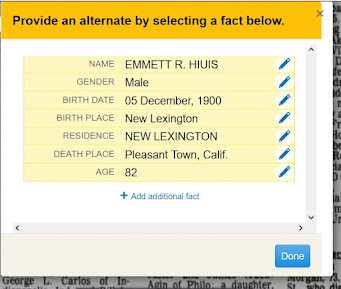
Consider the crowdsourcing efforts of providing feedback, any time you spot a mistaken transcription—especially a machine transcription—from a resource like Newspapers.com. It only takes a minute or two, for instance, to edit the impossible "Emmett R. Hiuis" to restore it to the actual "Emmett R. Hillis" published in a newspaper before adding it to my mother-in-law's family tree. Once done, though, it not only cleans up my family tree readout, but stays in place to help others, as well.


Another way to help is by uploading privately-held documents or photos to your ancestor's profile page at whatever cloud-based genealogy service you use. Over the past month, I have benefited from several fellow subscribers at Ancestry.com who had a copy of a family Bible record, or had scanned an old local history book or other hard-to-access resource. While I'm glad to be on the receiving end on behalf of those brick-wall ancestors, I can't help but recall some of the photos and records I have that could easily be passed along to others in a public gathering place like Ancestry.com or the other genealogical organizations.

Then, too, there are the brave ones who have ventured out to the world of technology and explored ways to post their family tree on their own website through "next generation" programs. Or those who, in a less-scary process, have joined the ranks of hundreds of genea-bloggers to post stories about their own ancestors. It is always exciting to discover someone else is researching the same ancestor.

For that matter, I'm thankful for those readers who have reached out to "give back" with their comments, both on other genealogy blogs and here at A Family Tapestry, as well. Just this week, I've received helpful notes with tips on places to look while researching my fourth great-grandfather Job Tison. The information is out there, but no one person can keep track of it all.

Once again, we crowdsource the answers to more completely research our ancestors from across the country and around the world. I'm grateful for those who have been willing to give back by sharing. That certainly inspires me to continue to reach out and give back, as well.

Saturday, December 18, 2021

A Season for Giving Back


The winter holidays come with a call for giving. Whether Hanukkah or Christmas, there is a sense of gratefulness and a willingness to give. This year, for me, is also a year to remember that this is not just about gifts, but about giving back for all that others have given me through the years.

Most of us, when genealogy newbies, can recall how someone else helped us learn not only how to search, but where to find all the hidden resources. When we turn around, years later, and help someone else, we do it remembering how others were there for us when we got started.

One way I've found to give back to others is to rescue abandoned family photographs and return them to a descendant of the picture's subject. How ironic that it turned out that someone found a photo collection once belonging to someone in my family and sent it to me. Now, I'm finding pictures in that collection which actually belong to another family—whose family, I've yet to discover.

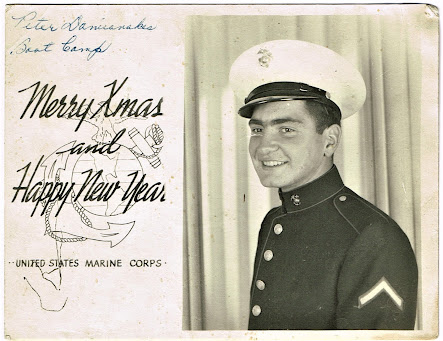
One of the pictures tucked away in Marilyn Sowle Bean's collection was a Christmas postcard from someone in boot camp with the United States Marine Corps. To the young man's photo, someone added a handwritten note: "Peter Danisanakes—Boot Camp."


Who that Peter might have been, I have no clue. Likely a family friend. This is a perfect example of how we find, in family photo collections passed down to us, relics of the F.A.N. Club of our ancestors. I can't help but think that, just as I'd love to receive a picture of one of my ancestors, someone out there—though who, and where, I don't yet know—would love to have this photo for their own collection.

I tried my hand at locating any identifying information on this Peter. Since Marilyn's family had been in southern California since she was a toddler—not to mention her husband's family, which had been in the state for generations—I presumed this Peter might have been a friend of either family, so I took a look at what I could find.

Since Peter's surname was a bit hard to decipher—was it Danisanakes?—I tried searching by various spelling variations. The closest hit I got on Ancestry.com was an entry in a 1907 city directory—much too early a year—for a J. P. Danisankes, a fruit and vegetables vendor in Oakland, California. 

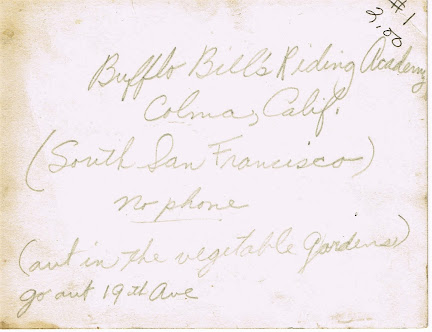
Flipping the card over to read the note on the reverse didn't help. Or maybe it did. In writing definitely not Marilyn's hand, the note read:

Bufflo Bill's Riding Academy
Colma, Calif.
(South San Francisco)
No phone
(out in the vegetable Gardens)
go out 19th Ave.  

Whether this Peter was a relative of the vegetable vendor in Oakland, I can't be sure. The spelling of the surname is different. But the odd insertion of the hint, "out in the vegetable gardens," sure made it sound more likely. The more I thought about it, the more I was inclined to think the note was written by Marilyn's husband's uncle—Bill Bean, the car dealership owner. The handwriting seemed similar, and I've seen other pictures in Bill's own collection with the reverse of the picture seemingly used as scratch paper to note business details. Most important detail: the Bean family was centered in the Oakland and Alameda County area of northern California.

When I think of all the pictures people send out to their friends over the years—high school or college graduation photos of the kids, holiday cards with the family posing, engagement announcements—I begin to realize how many of us could help others reconnect with images of their long-gone family members. They may not have a copy of those photos now, but we might. All it takes is a way to connect: to let others know what we have, and a willingness to take the step to get in touch.

More than ever, with the Internet, this is possible. We'll see whether it will happen for this photo of young Marine Peter Danisanakes.  


Sunday, December 12, 2021

Gifts From S K S


'Tis the season for giving gifts, but no, that "SKS" is not an awkward way to abbreviate Santa Claus. However, over the past few weeks, I have been gifted with some genealogical helps from Some Kind Soul which have helped advance my research goals. 

A while back, I had opened the messaging system used by Ancestry.com subscribers to connect with fellow researchers, and realized someone had actually sent me a message. It was a transcription of an obituary for a resident of the county where my mother-in-law grew up. Being a rural, isolated location, it had been home to early settlers of the place whose extended families, over the generations, have intermarried with the several other family lines in the area.

Now, chances are that almost any obituary for a long-standing family from that area will turn out to represent some sort of distant cousin—and, because I research all collateral lines for DNA match purposes, I want to document all these connections, no matter how intertwined they may become. In my mother-in-law's case, it is not quite what researchers formally label endogamy—however, it is definitely a form of pedigree collapse—so I like to call it "endogamy lite."

Not long after that first thoughtful gift of the unbidden obituary, another arrived in my in-box. And then another. With each subsequent gift, I made sure to add the information gleaned from the article into my mother-in-law's family tree.

In these past two weeks, when I've been wrapping up the photograph-inspired search for the names in Marilyn Sowle Bean's pedigree chart, I haven't been working much on my own research goals. I had expected my biweekly count to drop to near-zero on my own trees, but with this unexpected gift from that genealogical benefactor, I have managed to make some research progress on the trees I'm supposed to be tending. My in-laws' tree gained a modest—but much appreciated—sixty nine confirmed names, to bring that tree's total to 24,453.

As for my own tree, I again received a prompt—though this time, it was thanks to some old communications with a fellow family researcher who has been comparing notes and sharing discoveries with me for more than a decade. Updating my tree from leads in our correspondence—not to mention the continuation of my desperate attempt at working on this month's research goal—I've added sixty five new names to my own tree, as well. That brings my parents' tree tally to 27,040.

We all have some information which, shared, could be of benefit to a fellow researcher. I haven't forgotten a recent conversation with a fellow genealogical society member, a woman who realized that her extensive family photo collection could be shared with no loss to her own possessions if she simply scanned each picture to digitize it. In some ways, we can have our genealogical cake and eat it, too.

The month of December is calling my name to go and do likewise.Though I have very few family photographs which I can share, I certainly have Marilyn's collection—and hope to pass it on. Then, too, there are photographs of headstones, taken the old-school way with film; they, too, can be digitized and posted to Find A Grave where no other memorial has yet been created.

In fact, there are many ways we can all try genealogically giving back during this season of sharing. The only experience better than receiving an unexpected gift from Some Kind Soul is to turn into one and pass a gift on to someone else.

Tuesday, December 7, 2021

Making the Leap Once Again


Family history buffs seem so excited to arrive at that momentous step when they will leap "across the pond" to explore their roots in the ancestral homeland. Landing in that strange new world, however, can be quite disorienting.

The premise, of course, is that one of the genealogical guides we've become accustomed to relying on in the English-speaking world will be there to take us by the hand and introduce us to the challenges of research in a new setting—and often in a new language. In some instances, that will indeed be the case. For my foray into Poland and my paternal roots, unfortunately, the records I need are not there at my favorite go-to sites—yet.

From the kindness of others further down the research path than I am, I've learned about some alternate genealogical resources in Poland. We've already explored what is available when I tackled my research challenges concerning my paternal grandmother. Sophie Laskowska was born in what is now Poland and arrived in New York as a young child—too young, probably, to even have remembered what home was like, or where to find it. But from some serendipitous errors on the part of census enumerators in New York, I was able to learn exactly where in Poland the family originated: a region called Posen by the Prussians, but PoznaĹ„ by the Polish.

As it turned out, the lack of digitized documents for the region in our usual go-to places was made up by a website put together by enterprising genealogists in Poland. You can be sure I made good use of that website, once I found it. But I also discovered something about that website: it worked great for finding way pointers for my ancestors related to Sophie's family in that region, but not for her future husband's family. Why? Because that line—my father's patriline—came from a different region of the country which is now Poland.

Thomas PuchaĹ‚a, my great-grandfather, came from an area of Poland known as Pomerania.While the website covering records from PoznaĹ„ would be of no help to me in this new project, there was—thankfully!—another resourceful group of local genealogists who banded together to create a database of use to researchers like myself.

The website was created by a group known in Poland as Pomorskie Towarzystwo Genealogiczne—or, translated, the Pomeranian Genealogical Association. Let's just say I'd like to follow suit and call them PTG for short, as they suggest. 

The PTG has been in existence since the key organizers met in 2005, but they formalized the organization in 2011. Adopting the slogan, "If you want something to be done for you, you should do something for others first," the PTG set about transcribing local records which are searchable for free on their website. Transcribed information covers baptisms, marriages, and deaths, as well as information regarding cemeteries. Each resource is cross-referenced to the location of the original record.

From that discovery, brought to my attention by a fellow researcher following the same line as I am, I became the recipient of one of those acts of "giving back," that genea-kindness which has helped so many of us progress in our research. Now, my quest—although at this point, it may merely be an attempt—is to see if I can push back to yet another generation on this line, to the parents of my great-grandfather Thomas PuchaĹ‚a.


Friday, December 3, 2021

Postscript on Marilyn's Family Photos


It was a "giving back" project which started me on a path of finding "orphan" photos and putting family history research skills to work to return them to long-lost family. Genealogists have long had a tradition of volunteering to help other researchers—especially those just starting out—because we, too, were once beginners. We call it "giving back" in gratitude for what others once did to help us, or "paying it forward," knowing that one day, we too will need a hand with our brick wall research problems.

Never did I think, however, that one day I'd find myself rescuing my own family's pictures, but that is exactly what happened when I got the message that someone had found Marilyn Sowle Bean's photo collection in a local antique store.

Finding Marilyn's photos prompted me to dive deeper into a project which I had started but long ago set aside: to find any sign in her now-deceased son's family tree of the genetic origin of the disease which eventually cost him his life. I already knew there were several cousins in the family related to Marilyn's mother-in-law, Maude Woodworth Bean, who had inherited some form of Marfan Syndrome, but that there weren't any signs of the malady in the other branches of the family.

In this past month—after a research lull following my inability to find details on the month's goal for my Twelve Most Wanted ancestors—we spent the month exploring the family related to Marilyn's mother-in-law, Maude. We made it through each of Maude's four grandparents' lines—Woodworth, Williams, Farrend, and Smith—but I can't say that I located any conclusive evidence to pinpoint that deadly heritage upon any of those four lines.

Granted, seeking early deaths in a family timeline stretching back into the nineteenth century can be a tricky business. Recorded causes of death are not as accessible in those old files as they might be in a modern death certificate. Besides, given that Marfan Syndrome wasn't observed as a separate entity until it was first described by a pediatrician—by the name of Antoine Marfan, as you may have guessed—in 1896, or even used as a descriptor of that set of symptoms until 1931, there would be no mechanism for pinpointing such a cause of death in Maude's ancestors of the 1800s.

But, of course, we could still guess. Any male descendant in Maude's grandparents' lines who died as a young adult caught my eye. However, many early deaths could be ruled out by the usual explanations of that century: injuries from battle in wars, contagion from widespread diseases among them.

But there were others whose demise still left me puzzled—such as Joel Smith, the twenty year old brother of Maude's paternal grandmother. His death in 1852 was noted only by a cenotaph erected where his parents lived in Kenosha County, Wisconsin. Looking closely at the monument, a now-barely legible line after his name and date of death states "Buried in Greenwood Cemetery NY." As you might have guessed, there is more than one cemetery in New York by that name, and no, none of them produces a record of that name when searched on Find A Grave—let alone any obituary published in a New York newspaper.

Along the way in this pursuit of Marfan Syndrome in Maude Woodworth Bean's family, we did make some worthwhile discoveries. I've built out a family tree for Marilyn—yes, her side was included in this effort—and ventured beyond just the names, places, and dates to discover the stories behind the statistics.

But there is a melancholy down side to all the discoveries: there is no one left in the family with whom to share these stories. They are all gone: Marilyn, her two children, her parents and in-laws, even those cousins whose telltale height trumpeted their inheritance of Marfan Syndrome.

On the bright side, I also learned that what once might have been a very elongated death knell—after all, we all have been handed a terminal diagnosis, it's just that some of us get down to the business of it quicker than others—may now be far from such a somber diagnosis. While still a serious consideration, Marfan Syndrome is apparently now one which has been said to allow for "something approaching a normal lifespan." That is a remarkable victory.

All told, I'll still keep working on Marilyn's family photographs. As for the research goal of pinpointing family in previous generations afflicted with Marfan Syndrome, I will keep building out Maude's family tree and learning her relatives' life stories.

But this is a new month, and with the flip of a calendar page comes yet another research goal to conquer. Though I've made the unfortunate choice of piggy-backing December's goal with that of my failed November goal, we'll still review what, if anything, can be found, before moving on to more discussion on "giving back" projects and, finally, wrapping up the month with a look ahead to the new year's Twelve Most Wanted. 

Sunday, November 21, 2021

Picture This


What if you have the missing piece to someone else's family puzzle?

 A while back, I was having lunch with a friend from our local genealogical society. This friend comes from one of those fortunate families with a rich heritage, complete with photos of generations past. In fact, there are so many pictures that, in her current de-cluttering mission, she is hard pressed to decide what to do with them all.

Her conclusion: share the wealth. Since my friend certainly does not have a monopoly on her ancestors, she plans on putting the pictures "out there" where others can help themselves. After all, her great-grandfather, for instance, is certainly relative to other distant cousins, as well.

The first step toward her goal is the tedious process of scanning all the photographs. Then comes the task of organizing the saved files on her computer for future accessibility. All that is prelude to deciding where to place the photos so others may easily find them and add them to their own family records.

Some plans are elegantly streamlined, and my friend's idea was just that. Her strategy, once the photos are scanned, is to upload the digital file to the appropriate profile page on her Ancestry.com public tree. From that step, it is self-serve for anyone who wishes to save the same file to their own tree. My friend will provide what information she can to identify each photo, but from that point on, it is simply "free to good home."

The beauty of such a plan is that, once digitized, a photo can be in a million places all at once. No need to decide which one person to gift the picture to—let alone find a way to deliver it to the intended recipient. As many people as want that picture can have their own copy—without preventing anyone else from doing the same.

For someone like me—a family historian who, despite inheriting photos for someone else's long-gone family, has next to no pictures of her own familial roots—it would be a blessing to discover a picture of, say, a great-great grandmother. I'm sure there are many others who would feel just the same. On the other hand, when I think of the photos I do have, it makes me realize I may have more than I thought—enough to at least share and, hopefully, make someone else's day, as well.

Saturday, November 20, 2021

After the Ask


Sometimes, all you have to do is ask.

In the case of my latest wanderings through the Bright Shiny Objects of Maude Woodworth Bean's ancestors, I discovered her maternal grandfather, Eugene Williams, had served in the Union Army during the American Civil War. Though he was born in New York state and migrated to Wisconsin—and despite being discharged at the end of the war in Mobile, Alabama—he eventually settled in southern California.

Eugene's details of service were easy to find, thanks to the records digitized at Ancestry.com. One detail that I would have liked to see, though, was a photo of his headstone, but Find A Grave, the go-to source for such items, did not include one. 

Yet.

Thankfully, Find A Grave has a provision in which a researcher can request that a photo be uploaded to a current memorial. If there is a Find A Grave volunteer in the area—and where there are, many are quite dedicated to their mission—someone will claim the request and follow through when able.

In the past, I have made a few such requests. Some, in out-of-the-way places, understandably have gone unanswered. Others, such as a request I made for a photo of a headstone in a mountainous region of western Canada—during the winter, no less—was understandably answered with a note to wait until the spring thaws were over.

In the case of the Eugene Williams memorial, it was last week while I was researching the man when it occurred to me to ask. The Find A Grave website has streamlined the process. Just by clicking on the tab for photos on his memorial brought me to a page where I could click on a button labeled "request photo."


Click. Easy as that. In less than twenty four hours, a Find A Grave volunteer indicated that he had claimed the request, and last night I received an email indicating the photo was uploaded to Eugene Williams' Find A Grave memorial.

Of course, I logged on to the site to thank the volunteer profusely—I really do appreciate the help, especially when I am not able to travel to the area—but going through the process reminded me of another detail. Not only did the photos tab at Find A Grave enable me to easily request a photo for a memorial, but there was another tab there that was just as easily clickable: the tab labeled "Add Photos." 

That's the tab which reminds me about the photos I've long had, but still need to digitize and upload, myself. That's a goal to add to my to-do list for upcoming projects in the very near future. Some, in fact, relate to family members from Maude Woodworth Bean's own family, the family whose photos we've rescued from a local antique shop. There is, after all, no time like the present—and no presents like the ones which save us time.

Tuesday, June 15, 2021

Getting to Know the Territory


Researching our family history is not only about names and dates. In pursuit of our ancestors, we also need to hold firm to a sense of place: where our ancestors lived, and what it was about those places which shaped our ancestors into who they became.

Familiarizing ourselves with the place where Elizabeth and Susannah Ambrose lived before their marriage to the two Flowers brothers in my mother-in-law's family means exploring the location where their father, Mathias Ambrose, filed his last will.

Thanks to an Ambrose researcher who was willing to digitize and share Mathias Ambrose's will on Ancestry, we now know the will was filed in Dublin Township in Bedford County, Pennsylvania. Furthermore, based on the title affixed to that document uploaded at Ancestry.com, we also know that the Ambrose family had something to do with a place there called "Brothers Valley."

That was then, however. Now, we need to learn how that translates into today's terms.

My first step, when my research leads me into unfamiliar territory—literally—is to take a brief tour of what can be discovered online about that location. Reading a quick overview of Bedford County, Pennsylvania, tells me right away that the state of Pennsylvania is unlike any other state I've researched so far—at least, as far as geopolitical boundaries go.

The entry at Wikipedia for Bedford County informs us that Pennsylvania law has created four different types of incorporated municipalities. In addition to the cities, a category with which we are all familiar, Pennsylvania also has what they call boroughs and townships. The fourth category of incorporated municipalities turns out to be an outlier, as there is only one such case in which a municipality is identified simply as a town.

Now knowing that, we have the vocabulary to deal with those labels of boroughs and townships. But looking for Dublin Township in Bedford County yields us a null set—until we remember the history of Bedford County, which was not formed until 1771, and from which several other counties were carved in the subsequent eighty years.

"Old Bedford County" yielded up some of its territory to form Somerset County in 1795. Though I am still at a loss to determine what became of the Dublin Township where Mathias Ambrose drew up his last will, it is from this newer county that we can locate the "Brothers Valley" township from the label affixed to the digitized will posted at Ancestry.com.

Even so, it takes some delving into local history to clarify that "Brothers Valley" label—but in doing so, we may glean some possible explanation for why Mathias Ambrose found himself settling, with his large family, in this frontier region of southwest Pennsylvania in the late 1700s. Thankfully, persistent googling combined with that genealogical "giving back" spirit yield us some helpful information on "Brothers Valley."

From a local history book transcribed and posted within the Pennsylvania GenWeb site, we learn that the earliest settlers in the region included several Germans who were members of the German Baptist church, or "Dunkards." These immigrants called themselves "Brethren" and, in time, dubbed their home, in German, "Brothers Valley," while the English-speaking settlers called the area "Stony Creek Glades."

The territory of this early township stretched far beyond what one might expect, reaching into what now is part of Somerset County, as well as portions reaching into present-day Cambria County.

Among the earliest settlers in this Brothers Valley settlement was one man by the name of Frederick Ambrose. While I can't yet determine whether there was any relationship between Frederick Ambrose and Mathias Ambrose, it is possible to find early signs of Frederick's residence there through digitized tax records showing his name as "Fredrick Amboss" in 1782, and "Frederick Ambrosia" in 1785.

There is much more to do before we can connect these different Ambrose men—including all the spelling permutations offered in handwritten documents of that era—but this initial discovery of local history opens up possibilities regarding where Mathias and his family may have originated, and what religious persuasion they adhered to.

As for "Brothers Valley," that term did not yield much in my search efforts. For yet another reason confirming the necessity of learning more about the territory where ancestors settled, I uncovered a story which explained my research problem. Over the years, and for an as-yet unexplained reason, the term "Brothers Valley" morphed, with the removal of the single space between the two words, to become the name the jurisdiction is known by today: Brothersvalley Township.

When it comes to computerized searches, even an empty space counts for something.

Sunday, May 23, 2021

What's Lost, Now Found,
Turns Strangers to Friends


There is a coffee shop in town which is perfectly situated for meeting friends, both old and new. In fact, if I am about to meet a stranger, there isn't a better location locally than that one, in my experience. With a pleasant and wide open outdoor seating area, the place has a constant flow of customers, coming to meet with each other.

I know from experience that, if I'm to have one of those potentially awkward first-meeting experiences, that is my go-to location. It was, for instance, the very spot I chose when, out of the blue as a new blogger ten years ago, I received an email from a genealogist in town who thought "nobody" lived in our city who'd be as rabid about genealogy as we both were. From a simple email and the meeting it led to, that "stranger" eventually became my genealogy guardian angel and mentor, "The Educated Genealogist."

I'd say that was a meeting of strangers worth encountering. There are some risks which are just worth reaching out to take, and I've found this particular spot in town to be so well suited to such occasions.

That's the place where I've since come to anticipate serendipitous first meetings, and yesterday was no exception. This time, the occasion was once again to meet a total stranger, but the back story was a bit different. Again, it was a contact made by someone reaching out to me—this time through the Ancestry.com messaging system. Again, it was a meeting of two people who speak the same language of family history research. And, heartwarmingly enough, it was someone who had been on the very same mission I've found myself on so many times before: delivering an orphaned photo back to family.

Though I haven't done so myself for a while, I have so often purchased abandoned pictures from antique stores as a challenge to return the treasure to a living descendant of the photo's subject. As inspiration for that mission, I can thank another mentor, the blogger who created Forgotten Old Photos. Every time I've followed in that blogger's footsteps, however, it wasn't with as altruistic an attitude; I've often thought, How I wish someone else would find one of my family's photographs and return it to me.

This week, consider that wish granted. Earlier this spring, I received a tentative message at Ancestry.com asking if a photo found might be related to someone in my family. It was. In fact, it was another picture snapped at the same birthday party as the photo I used to begin this series of posts eight years ago.

What's more—and this is the most encouraging part—the person who rescued the photo is an accomplished young student who has delved into family history as a self-directed project, pouring hours into research, simply because he wants to.

After I had spent time last week at the NGS Conference, hearing the desperate cry for young people to take up the banner in pursuit of preserving family history, what a heartening realization to meet face-to-face with proof that there are, indeed, young people out there who are already delving right in to that mission. Perhaps, rather than bemoan what we perceive to be a lack, we can reach out to those strangers we don't yet know, and let the commonality of our passion for preserving our family history turn those strangers into friends.


Sunday, March 14, 2021

Now Indexing :
Something a Machine Started


It's been my habit every month to do my part to "give back" by volunteering to index digitized records at FamilySearch.org. Believe me, I'm not alone; there are "hundreds of thousands" of folks around the world helping with this ongoing project. The problem is, there is an avalanche of nearly forty million records being digitized each year, through over three hundred cameras operated by FamilySearch in fifty countries around the world. It's hard to keep up, even with hundreds of thousands of indexing volunteers.

That pace, incidentally, is accelerating: just last month, FamilySearch reported having indexed thirty four million records from around the world. That, in part, is the result of a new approach to converting pictures of records into readable—and thus searchable—documents through indexing. Instead of approaching the task entirely by hand, FamilySearch is now employing not only the newer Optical Character Recognition systems, but combining that with machine learning and artificial intelligence to extend that character recognition capability to handwritten documents, as well. A demonstration of how that process works was provided at last month's RootsTech Connect, where you can actually upload a sample from your own ancestor's letters to see a demonstration.

For the greater part of history, the types of documents we have relied on to verify our family history were handwritten. Developing a system—even if it still needs the intervention of humans double-checking computer work—will yield far faster results than we've ever seen before this point. This is indeed encouraging news.

But what is it like today, when I sign in to my FamilySearch account to index records? I've been watching the choices available as indexing projects, and the list seems to be much shorter than I remember it in previous years. 

For this month, of the few projects in English in my home country, I found one on passenger lists arriving in the port of New York City, and decided to work there, remembering how helpful those lists were in my recent project to trace my godmother's father, a career seaman. 

Other than reading the step-by-step instructions and spotting the warning that the scanned records would be faint or hard to read—oh, my eyes!—there was little to do but move through the brief steps on a short batch of records.

Once completed, I could see why this indexing batch might not have been read by computers: the scans were faint, dark, and poorly focused. While computers may be speeding up the overall progress of transforming digitized documents into searchable records, the few remaining images they can't handle will take a disproportionate amount of an indexer's time.

Overall, while the news of this computerized progress is great, I may have to re-evaluate my usefulness to the program, if for nothing else than my eyes' inability to decipher the rejects those brainy computers can't handle.

Saturday, November 21, 2020

Instead of Indexing, Trying Something New


Usually, I try to spend one Saturday a month "giving back," as I call it, for all the helpful genealogical resources which volunteers have shared online over the years. We often forget, now that we benefit from subscription services to aid our family history quests, that for many years, it was only thanks to volunteer efforts that we could find many of the records to piece together our family's story.

Now, besides volunteering for my local genealogical society, I try to focus some of that "giving back" time through what is likely the largest volunteer genealogical organization in the world: the people behind the website we know as FamilySearch.org. That's where you'll generally find me doing that monthly project called indexing.

Today, however, when I went on the FamilySearch website to index records, I spotted this button on the landing page:


I decided to check it out. After all, I do have a weakness for rabbit trails, and this one looked intriguing—not to mention, my latest foray into Polish geography already had me warmed up for this exercise. With Google Maps and Wikipedia, I was ready to tackle anything!

When I clicked the button labeled "Try It," unlike Alice in her adventures chasing the White Rabbit, I didn't shrink to microscopic size, nor grow to gargantuan heights. In fact, my adventure was quite tame and even predictable.

The first page that tentative click led me to was a list of simple instructions, explaining that I would be shown a "user-entered place" from the FamilySearch family tree. Along with that would be some examples of related lifetime events which might also contain that same place name. My mission was to identify which of several standard place names might represent the name listed in that user's part of the universal family tree. Decision made, click the choice and move to the next in a short series of entries needing verification.

To start the process, I could exercise the option to select a location to work on, mainly by country. I opted for the tame route today, and selected United States for my choice. It's been a rough research week in Poland, and I just needed to stay closer to home for this maiden volunteer voyage.

Jumping into the program itself, it was clear some of the examples came from headings on census pages—you know, the type which lists not only the city of Toledo, for instance, but the specific ward in the city. Some entries mentioned lesser-known places—like Pigeon Roost, Kentucky. A quick search via Google led me to the Wikipedia page for Clay County, Kentucky, where a subheading under the Communities section showed a listing of historic place names used in previous census enumerations—including Pigeonroost, spelled all in one word, solving the puzzle for that one entry. Easy.

All told, I think the batch of place names to verify included about ten. I was done with the set in no time, even including detours to double check place names via Google and Wikipedia. Hopefully, FamilySearch will keep offering these quick and easy volunteer options, giving willing volunteers bite-sized pieces to dispatch in a matter of moments. And the genealogical community will find ways to fit in these easy-to-complete tasks in their own personal "giving back" profile.


Images above: First, the "Try Me" button from the home page at FamilySearch.org; below, John Tenniel's illustration of "Drink Me" in the Lewis Carroll children's story, Alice's Adventures in Wonderland.


Saturday, October 3, 2020

Now Indexing — Again:
Those New Jersey Naturalization Records


The air has gotten smoky enough, once again, that my brain is now starved for the sight of green skies and blue trees. No...no, that isn't quite right. Let's try green for the trees, not skies—or perhaps seeing any color but gray would be helpful, no matter where it shows up.

This type of malaise calls for some more genealogical knitting, so I went looking on the FamilySearch indexing projects to see what new projects could keep me busy. Since I've been working on Falveys who immigrated to Massachusetts lately, I would have liked to see a naturalization project for that state calling for volunteer help, but since the closest possibility was for nearby New Jersey, I thought I'd snatch up that opportunity.

This project was the perfect match for my smoke-befuddled brain this weekend. Yes, another naturalization records project, but this time it was for index cards for records as recent as the 1970s. For the most part, after taking due diligence in reading the instructions, working through the indexing process took hardly any time at all. Each record set contained a mere five records. Each record, for the most part, included only three data points. While some of those immigrant surnames grabbed my attention with their impossible string of consonants, or other spelling sequences unfamiliar to American eyes, dispatching a batch of records took a matter of mere minutes.

Needless to say, with such an easy record set, I did several rounds. I needed something routine to wrap my mind around today. Hopefully, even these little index cards will lead someone to the information they are seeking on their family members. Of course, this giving-back project won't guarantee that my skies will clear up, but at least it provided something positive to focus on in the meantime.

Sunday, November 24, 2019

Talking Everyone Into Talking


The art of getting everyone in a room talking about the same thing has always fascinated me. Small group dynamics—whether concerning a small circle of friends, or a collection of people like a genealogical society, dedicated to the same nonprofit mission—may seem mystifying, but definitely can provide signals to the observant. I try to read those signals.

While I realize every genealogical society is different—each group has its own personality—it can be gratifying to create a catalyst to get a group of near-strangers talking about the same topic. Of course, we have an up side in that genealogists' eyes do light up when talking about family history discoveries. The key, though, is to break the ice and move beyond timid reticence over being the one who "goes first" to the point where everyone feels she has something interesting to offer to the group.

Our training company has developed what we call "ice breakers" to help bridge that gap from silence to sharing, so it was a natural step to apply that to a meeting of our local genealogical society last summer during our annual potluck meeting. That event, though attended by many of the members who join us every month for our regular meetings, is also open to guests—often, non-genealogically-inclined spouses of our members—introducing that awkward silence that comes with first-time meetings.

To get everyone talking, we borrowed an activity from our company's playbook, and developed a genealogically-related icebreaker game. In essence, we created a way for total strangers to gracefully circulate among the crowd with the purpose of getting to know something fun and interesting about each visitor's family history.

In retrospect, we realized that not only did attendees really enjoy the activity, but it got everyone talking about the game as well as about what they learned about each other. That result also inspired our board of directors to take a step forward: offer these fascinating people an opportunity to share their stories with not just one or two members, but with the entire membership in a formal presentation.

The inspiration for this next step came, thanks to an article by Montreal blogger, Gail Dever of Genealogy à la carte. While Ms. Dever certainly writes her genealogical news blog "from a Montréal, Québec point de vue," her comments in that article last April certainly cross-apply to genealogical societies across the border in the United States, as well. She wrote about how genealogical organizations can encourage future speakers to develop presentations by mentoring their members in this process.

I requested permission from Ms. Dever to reprint her April 29 post in our society's September newsletter—which she graciously granted us—and then inserted the editorial note that our society would like to schedule an upcoming session in which we would feature brief talks by four of our own members.

We called our event "A Genealogical Sampler" and scheduled it for our November meeting. With four very tentative speakers—after all, public speaking reportedly ranks highest among Americans' top fears—we lined up an evening of presentations which would provide a taste of four very different research paths. It could either be a bomb—I wondered about no-shows, both on account of lack of audience interest and speakers' cold-feet syndrome—or a great success.

Thankfully, our four intrepid speakers played to a full house this past Thursday evening, and provided fascinating details of their own families' stories. One audience member told me privately that, of course, she would be there; she loved hearing people's stories. Another concluded the evening with a request: can we turn this event into an annual tradition?

Family history researchers often have the reputation of being introspective, quiet souls—with one exception: give them an audience of like-minded people who thrill to the same details that inspire their work, and they often brighten up to the task, despite the specter of getting up to speak in front of a bunch of strangers.

Of course, I have to say I was relieved that each participant seemed happy with the outcome. It sometimes feels like an uphill battle to persuade people to get up and talk, even about their favorite subject. But going beyond those stage-fright jitters to share a story that means so much to one's own family can be enough of a motivator to encourage people to reach out and make a difference. By choosing to share their own story, our members in turn are inspiring others to take up the challenge to do the same next year.   

Monday, September 30, 2019

Getting the Lowdown on Lofty Ideals


Almost exactly two years ago, a blogger at FamilySearch.org wrote about the benefits of pursuing one's family history. Included in that encouraging list were positives like compassion, resilience, and connection. The benefit of relationships was key.

The following March, FamilySearch's CEO, Steve Rockwood, opened RootsTech 2018 with a keynote address delving further into that sentiment. The bottom line to fascination with genealogy, he noted, is human emotion, the "primary element that engages people with their family history." For the first time, RootsTech 2018 debuted with a theme: "Connect. Belong."

The promotional hype over a super-sized conference like RootsTech might leave the more skeptical among us wincing at descriptors like "powerful" for the Rockwood presentation, but even though I only experienced it via YouTube, I can vouch for such an assessment. We hold a powerful key to human relationships when we come to grips with the reality of what he was saying. And the route to such experiences is the very research skills we love to put into practice for ourselves, and to share with others.

It's all well and good to buy into such lofty ideals and pat ourselves on the back for the nobility of what we do. I'm concerned, however, that it is so much easier to apply lofty ideals to high-minded generalities, while missing the rubber-meets-the-road practicality of the matter in real life.

Let me give you an example. Only a week ago, after sending out an email to the membership of the local genealogical society where I serve as president, I received an unexpected reply. The return note was from the husband of a member, asking me to remove this woman from our membership rolls. The reason: she had passed away earlier this month.

Shocked to hear such news so unexpectedly, I tried to run through my mind all the members I've met through several years involvement in the group, and vainly attempted to place her face, or any details about this woman. I don't recall ever meeting her, but knew she had to have some connection or reason for joining us—but who? Or what? Curious, I pulled up her obituary on the local newspaper's online site.

Have you ever gone to a memorial service out of courtesy for the living? For someone else whom you knew—a grieving relative of the decedent—despite not even knowing the person who had just died? I have, from time to time—the mother of a neighbor, or the relative of a coworker. I may have known absolutely nothing about the person who died, other than that connection to the living, but when it comes time for the reading of the eulogy, I sometimes find myself falling in love with a total stranger, and wishing I had had the chance to know that person.

That's how it was when I read the obituary for our recently-deceased fellow member. The article was certainly not one of those boiler-plate obituaries, but a memorial lovingly crafted by a family member. Yes, obituaries and eulogies can wax eloquent and make the departed more "dearly" than he or she might have been in real life. But not only did this statement reveal the love her family held for her, but told me of an accomplished woman known widely for not only her keen interest in genealogy, but a number of other pursuits, including widespread acclaim for her artwork.

I never even knew.

Moments like this can slap a person in the face and awaken us to new realizations. In this case, it showed me how genealogy is not only about connecting to our family's past—as well as helping knowledge of that past become relevant to those descendants who will be in our family's future—but it is also a way for us to connect with those other researchers on this journey of discovery with us. Coming together as members in a genealogical society is one way to express that yearning to connect, even if it is not about connecting with blood relatives; it is about connecting with others who have a passion to preserve our personal micro-histories as families. We may not be related by descent, but we are related by passion. We belong because we share that keen interest.

It seems so self-evident why we share that urge to find our third cousins twice removed, and yet we miss the sense of why we can benefit from connecting with other, unrelated, family history researchers. Yes, we get giving back, or paying it forward, or exchanging lookup services, but we need to add one more sparkling reminder to our repertoire of belonging and connecting: reaching out and getting to know the others on this same journey, the ones who take as much delight in finding their missing ancestors as we do. Connecting around our mutual interest, yes, but also stopping our research for a moment to get to know the person behind the researcher. We can become each other's best research cheerleaders. More than that, though, our mutual interest can become the impetus to help us reach beyond to connect with each other, person to person.