Showing posts with label The Political Landscape. Show all posts

Tuesday, February 19, 2019

Who Shot Whom?


Just as I hoped, finding the biography of King Stockton, the once-enslaved boy on the McClellan plantation in Wellborn, Florida, has become an opportunity for me to explore the pressing issues shaping the lives of my ancestors in territorial Florida. While the King Stockton story may be disappointingly brief, its encapsulated vignettes open up the possibility for in-depth exploration, if only by virtue of the many names mentioned in the text.

Not that all the names were entirely accurately reported. We have to remember that King, coming to Florida from the Tison property in southern coastal Georgia as an infant, experienced as a young boy much of what he later reported to his biographer, A. L. Lewis. It is no surprise that some of the names offered in the booklet were not quite what they should have been.

Take, for instance, the portion of the book describing the incidents leading up to the second Seminole War. In the midst of describing the raids and retaliations of that era in Florida history, the narrative diverts to mention some of the foibles hampering military action. Though the text names some of the military leaders called to battle there—providing me an excellent chance, by their names, to seek further recordings of their movements and actual battles—it gives me names which produce no research trail. With what I'm supplied in the book, I immediately smash into a research brick wall.

Here, for example, is one passage in the King Stockton book, nestled up against sentences in a paragraph concerning battles in the second Seminole War:
General Lee Reed then came to try to subdue the Indians, but he had an enemy, Willis Austin, with whom he fought a duel. Austin was killed by Reed, so [Austin's] brother killed General Reed. Austin's brother fled to Texas, but the spirit of being a bully was in him, and in a short time he had killed six men. He was finally tied to a stake and shot to death.

While the brutality of that passage can't be avoided, what we also can't neglect is pursuit of a correct version of that history. But alas, no mention of any General Lee Reed that I could find. Nor was there any result when I searched the name of a Captain Martin, mentioned earlier in that same paragraph in the Stockton booklet. It wasn't until I searched for anyone named Willis Austin from that time period that a winding research path led me to the actual story—and opened my eyes to just what was facing my third great-grandfather in the midst of his own political aspirations.

Keep in mind, as we explore this story in the next few days, that a broader understanding of local history—including the social, cultural, psychological, and political pressures of the time period—will help us more fully understand what kind of people our ancestors once were. I had always known, for instance, that my third great-grandfather was one of the signers of the first Florida constitution—and that that document, in being duly transported to Washington, D.C., in the process of requesting admission for Florida as a state in the union, had been mysteriously "lost." Just that episode, in and of itself, tells me there is far more to that story than has been offered to the general public.

As for "General Lee Reed" and "Willis Austin," it turns out theirs was a story which filled the newspapers of that time period—and makes me appreciate more fully just why my ancestor might have thought better of continuing his political activity.

I first found evidence of a "General Lee Reed" in the testimony of a Mr. Douglas, reported in the Legislative Blue Book for 1917, compiled by Pat Murphy. According to that Mr. Douglas,
"At that time," said he, "there was a worse feud raging here in Florida than ever at any time; there was more bloodshed and violence than I ever wished to see again. It grew up between the Democratic and Whig parties, and led to the assassination of General Lee Reed in the streets of Tallahassee by a man of the name of Willis Alston."

Wait! Alston? But I thought it was Austin.

There may be a reason for that slight shift in surnames—and not simply one on account of mispronunciation—but we'll explore that explanation tomorrow. As the testimony went on to explain,
"Alston belonged to the Whig party and Reed belonged to the Democratic party, and they were both turbulent, violent men. At that time it was a very common thing for a man to shoot another in Tallahassee and almost anywhere else in Florida."

So, who might this Alston have been? As it turns out, it was not Willis Alston who initiated the furor. The difficulties started with another Alston, by the name of Augustus. It was this son of a cotton planter in Leon County, Florida—Robert West Alston—who had originally challenged another man to a duel. That man, George Taliaferro Ward, fared rather poorly in the contest, though at least he lived to tell of it.

Apparently, dueling was rampant in Florida during that time period. Several newspapers in recent decades have recounted the many duels from the state's history, with one noting,
those in office were expected to be fearless. They often settled their disputes and differences in the old-fashioned way by provoking an enemy then engaging in a duel.

Talk about the good ol' days...

Disputes of honor or politics were thus settled with dueling pistols. Thus the reigning party leader—the Whig party's Augustus Alston—felt obliged to address an issue with his political opponent, Florida Militia Brigadier General and Democrat, Leigh Read.

This, of course, was not the first time such challenges had surfaced in Florida politics, especially in regards to one particular Leigh Read. Another Whig party leader, by the name of William Treadwell, had been miffed during a recent campaign, by "insults" attributed to General Read—thus, the challenge publicly placed in the local newspaper. Read had ignored that public taunt, but unfortunately was unable to resist a subsequent challenge by another Whig, Augustus Alston.

A date was set for the event, December 12, 1839. Ironically, the place set for their meeting was outside the state line in Georgia, as territorial law made it illegal to engage in such activities in Florida.

It was not, as King Stockton's recounting had it, Willis Alston who was killed by Leigh Read, but his brother, Augustus, who had originally been killed. As legend has it, Augustus' mourning sisters dug the offending bullet out of their dead brother's body and sent it to their brother, who at the time was living in Texas. Willis did indeed understand the message implied by his sisters and returned to Florida, though it took a series of attempts before he successfully dispatched the "murderer" of his brother. Fleeing back to Texas, Willis Alston eventually met his own demise by similarly violent means.

That, as it turns out, was not one of the stories shared with the McClellan children by my grandmother's Aunt Fannie, as you can imagine. Learning of it, thanks to that brief mention in the biography of King Stockton, opens my eyes to the nastiness of politics in the nascent state of Florida—and the irreconcilable differences between the powers behind two opposing political parties. Small wonder my McClellan ancestor sought a less exposed role in local politics than he could have. Even larger wonder he didn't get caught up in the political hysteria of the dueling factions of his day.


Above: Insert in a 1839 Tallahassee newspaper, provided by a volunteer at the Find A Grave memorial for General Leigh Read.


Wednesday, November 9, 2016

The Morning After:
Post-Election Doldrums


In times like this, I wish ballots were more like multiple choice exams. After the boxes to check for Candidates A and B—and maybe even Candidate C—they need one more choice: "none of the above."

Taking a spin through social media offerings last night was depressing. A few tried to interject some levity, of course—like this tweet from a history professor advising, "Republicans: Save Your Country—Vote for Clinton."


Of course, opening up the article the tweet led to, one quickly realizes it refers to an entirely different Clinton from a far-removed election cycle. If only pulling up an article from the archives of a long-gone century could make it all better!

I am tempted to take a detour into the hiding places of times past. For those few ancestors in my family's lines who held—or at least ran for—public office, it would be interesting to see what the local journalists and newspaper editors chose to report about them. With today's online resources, it wouldn't be hard to locate such commentary. Maybe the local residents reading those editorials and election results had as much to grumble about, over their morning coffee, as we do in pulling up our election results on our laptops and tablets.

In perusing those newspaper archives of centuries past, we might also pick up the sense of political fiascos, corruption, cronyism and other woes that surely plagued those ancestors, as well. After all, I'm talking about researching a family who lived in New York City (my father's) and another one who spent generations in Chicago (my father-in-law's family). Surely they had their share of doubtful political decisions to complain about, as well. Perhaps as long as there are politicians, there will be plenty to complain about.

No matter which side you pinned your hopes on—or hoped to cast your vote against—your wake-up call this morning surely came with a cold grip of reality. I wish sage advice could include burying your head in your genealogical pursuits in hopes of making it all disappear. On the other hand, if history does repeat itself, perhaps our re-discovery of the lessons learned by our ancestors can provide a little bit more than merely genealogical enlightenment.

Wednesday, August 24, 2016

Tracing Places No Longer on the Map


It's one thing to research your forebears when they come from a recognizable location like France. Or Spain. You know, those places you can find on a map.

When it comes to finding the records to verify your family's origin in a country no longer in existence, that search presents a new question: how do you find the repository for records from such a place?

For most of the census enumerations conducted since my great grandparents arrived in the United States before 1890, the entry made on their behalf was usually "Germany." And for the decades in which that was noted, it would be correct. At that time—whether it was 1900, 1910, or 1930, the last census conducted before they died—the region Anton and Marianna Laskowski once called home had changed hands from one set of rulers to another.

If you had paid attention to reports of their origin in the earlier census records, you might have thought Anton and Marianna immigrated from Germany. It wasn't until that slip up in the reporting ritual for the 1920 census that I discovered not the country but the region they once considered their home.

That place was enumerated as Posen.

In trying, now, to go back and locate records of their family's births, marriages and deaths, the key is to find the repository for a political jurisdiction which has long since ceased to exist.

In retracing those steps, the first thing I wanted to do was familiarize myself with not only the history of that region, but the current events of the time frame in which the Laskowski family—and their relatives, the Gramlewiczes—chose to leave their homeland.

As I've mentioned before, Posen was how the Germans referred to a city the Polish called Poznań. Learning about Poznań brought up many fascinating details. For instance, it is one of the oldest of Poland's cities, dating back to the tenth century. It is also home to Poland's first cathedral. Political struggles over the centuries meant that the city changed hands often. It also meant the area was often war-torn. By the time my ancestors were ready to flee the area, the city—by then under Prussian rule—had begun building a series of new fortifications in response to all the turmoil.

Knowing that about the city of Poznań was informative, but it missed one crucial point: that name was not just used to designate the city by that name, but also the region surrounding it. Similar to my own circumstances—in which, when I say I'm from New York, I could be indicating either the city or the state—when my great grandparents told that census enumerator in 1920 they were from Posen, they meant the region, not specifically the city.

That region of Poznań had a history of its own, as well. Established in 1815 following the Napoleonic Wars, it was to be a semi-autonomous part of the Kingdom of Prussia. Designated the Grand Duchy of Posen, it turned out not to be, in practice, the theoretical haven of rights for its Polish residents as had been promised with the Congress of Vienna.

With changes in Prussian governmental dictates, Poles saw increasingly difficult times, which eventually led to revolution in 1848. The main result of the fighting was that Posen lost some autonomy, though it continued, as part of the Prussian domain, to be referred to as the Province of Posen, up through the year 1918.

Of course, with the conclusion of the Great War—not to mention, the war that followed the War to End all Wars—Prussia as a political entity ceased to be. By that point, my direct line ancestors were thankfully long gone from the region of Poznań. But because they once called that region home—and the place where they married and raised their children—I wanted to retrace the steps of their lives and see what documentation could be found to verify their stay in Poznań.

But where do you look for records from a country no longer in existence?

As it turned out, at least in this case, an intrepid cadre of genealogical volunteers have found a way to help people like me find those records I've been desiring to see. In a website primarily set in the Polish language—but fairly easily negotiated, thanks to translation services—I've found (and can't wait to share) the digital home for at least the marriage records of what was once the Prussian Province of Posen.     


Above: Charge of Poznań Cavalry during November Uprising; 1886 oil on canvas by Polish historical painter Juliusz Fortunat Kossak; courtesy Wikipedia; in the public domain.

Thursday, June 18, 2015

Remembering an "Old-Timer"


When the long-sought obituary finally materializes for the ancestor one is researching, the question uppermost in mind, of course, is: will the newspaper report include that coveted list of relatives?

In the case of research on Thomas Guinan of Winnipeg—and formerly of Ontario and North Dakota—the answer was, thankfully, yes.

I'm not sure I would like to be remembered as an "old-timer," but that is how Thomas Guinan was presented in the long write-up published on May 5, 1937—three days after his death. Headlining the article, plainly enough, "T. Guinan, Old-Timer of Winnipeg, Dies," the Winnipeg Free Press devoted a good portion of two columns to a review of the man's life accomplishments.

Small wonder. The paper characterized the man as a "prominent figure in the development of Winnipeg and the west in the early part of the century."

Thomas Guinan's age was given as eighty—right away providing a warning to remember that all newspaper reports are suspect, when it comes to pristine accuracy. An earlier article had indicated that he was born six years earlier. Typo?

Still, the overall picture provides a guide for retracing the steps of Thomas Guinan's personal history.
Born in Huron county, Ont., on Nov. 10, 1856, he spent his early days on a farm near the village of Blake in Stanley county. Educated in the public schools of Ontario, he remained in that province until the late seventies, when he moved with his parents to North Dakota, where his family was one of the early settlers in the Langdon district.
Some of the details of his business dealings as a young adult we have already stumbled upon, thanks to newspaper reports in North Dakota, where Thomas had settled with the rest of the Guinan family.
Mr. Guinan later went into the hotel business at St. Thomas, N.D., where he lived for many years. Beginning in 1896, he served four years in the North Dakota legislature.
Of course, the main focus of Thomas Guinan's obituary would be his years spent back in Canada. Many of these details we've already uncovered, as well, including his original settlement in the Elm Creek area and his later involvement in the real estate business, headquartered in Winnipeg, as president of the Red River Land & Loan Company.

Remembering the article I had found yesterday on the court case calling some of his real estate deals into question, I was interested to see how the newspaper—now in retrospect—would portray that rough stretch of the Guinan history. In the circumspect graciousness reserved for the eulogized, the Free Press said merely that he "was instrumental in bringing many settlers to the west" and that "the present suburb of St. James was largely developed" by the Guinan company. However, the paper couldn't resist the understated reminder that
Mr. Guinan was a Conservative in politics, and was a staunch supporter of the late R. P. Roblin during his long term of office as premier of Manitoba.
Coming to the statement that all genealogists live for, the Free Press reported that Thomas Guinan was
survived by his widow and five children, Anne, Ethel, Thomas, Jr. and Stanley, all of Winnipeg, and Lawrence, of The Pas, Man.; three sisters, Mrs. Margaret Franklin, Grand Forks, N.D.; Mrs. Hector Falconer, Portland, Ore.; and Mrs. Thomas Graber, Regina, Sask.; and two brothers, Hugh, of Teulon, Man., and Daniel, of Moose Range, Sask.
Other than omitting the actual name of his widow, Thomas' obituary turned out to do a fine job of orienting us to the Guinan family constellation. As if wishing to further confirm the connection, the paper went on to include a post-funeral report on May 6, 1937, which added the names of the pallbearers, including Dan "Rayan" and Pat Ryan, likely nephews of Thomas Guinan through his by-then-deceased sister, Annie and her husband, James Ryan.

Newspapers being newspapers, that this obituary might have been embellished is a risk we have to take in seeking more information on the man. The political hot water swirling around the one episode of Thomas Guinan's career, though in this article presented quite innocuously, may well have led to what the newspaper benignly mentioned as the time when
he retired from business during the Great War and since then has lived quietly with his family....
However, dates and details of political analysis aside, the Guinan obituary provides us a guide through the underpinnings of Thomas' personal life, for which I am grateful. Between this tedious newspaper search, involving both the publications in North Dakota and in Winnipeg, and the outline of his family constellation, despite some discrepancies in details, I was finally able to locate a possible census record for the intact family before they left Ontario for North Dakota.

Not exactly in the "Stanley county" residence identified by the Free Press—and indexed under a spelling off by one critical letter—this 1871 census entry for the "Gainan" family in the Stanley district, still in Huron County, finally yielded the list of family members I had suspected would be the way it was. With Thomas at a promising fourteen years of age at that point, the list included the two brothers I had wondered about—Will and Joseph—as well as sister Annie and baby brother Hugh, likely named after the "Uncle Hugh Quigley" I had seen mentioned in various newspaper entries. Eight year old Margaret became the "Maggie" Guinan who later was wed to John Franklin in North Dakota. And Mary most likely later became Mrs. Falconer, mother of the unfortunate ten year old Stella, returned to her childhood home in North Dakota for burial.


Above: The "Gainan" family—likely the Guinan family—from the 1871 Canadian census for the Province of Ontario, Stanley township in Huron County. Image courtesy Ancestry.com.

Sunday, December 21, 2014

Ensuing Difficulties


…on the 22nd day of March 1875, I left Georgia for the Territory of Colorado.
Ever since I discovered the journal of Charles Edward Broyles, older brother of my second great grandfather, I was puzzled by his apparently abrupt departure. Supposedly established in a prominent position in his community, Charles left career as well as home and family for the unknown possibilities of life alone in an outpost of the nation’s territorial claims.

The only possible reason for his decision to leave, as mentioned in his journal, might have been extrapolated from his comments about trying to set up his sons in business. One wonders whether he sold out at a loss. But would that have been enough to tip the scales in favor of vacating an entire life established in a community?

I cast about, searching for clues as to why Charles might have left. After all, though journals may be perceived as “tell all” documents, they often leave out significant segments of the rest of the story. One entry in a genealogy forum suggested a reason for his hasty departure: that, after the war, he had lost his plantation. Remembering Charles’ entry in the 1870 census where his real estate was valued at a comfortable amount yet his personal property was comparatively less than that of his neighbors, I considered that a possibility. After all, Charles had been a loyal player, when it came to giving his all to the Confederate cause. He did mention returning home, after the war, “poor, moneyless and…half clothed.”

To see if anything further could be gleaned from documentation, I went fishing on the various newspaper archives with holdings from the state of Georgia. Historic newspapers are always a wonderful resource—well, if you can locate any articles mentioning your specific ancestors, that is—for third party reports and (supposedly) impartial viewpoints. Thanks both to several holdings for the state of Georgia at GenealogyBank and for the local newspapers’ habit of sharing what other city papers in the state had already reported, news on Charles Edward Broyles was often repeated from his residence in Dalton in publications from several other Georgia cities.

During the difficult period of Reconstruction, when factions within the Republican party were bitterly opposing each other, Charles’ circumstances may well have become an unintended casualty of the disputes. One report, reprinted in the Macon Weekly Telegraph on an unlucky Friday the thirteenth for Charles—May 13, 1870—was attributed to the editor of the Atlanta Constitution, reporting from Dalton.

Portrayed by the editor as a tale “of a late Radical row, at Dalton,” it made gloating reference in those editorial comments to the Radical Republican faction, though the body of the report gave no such indication. Further, it was unclear from the proceedings whether Charles was considered part of the Radical faction, or one of those opposing it.

Regardless, things did not turn out well for Charles in either the proceedings or the outcome.
            Some little belligerent excitement has taken place for a day or two.
            Last term of the Superior Court, Harris and Agent Baker, of the State Road, were indicted for gambling. The cases were taken up by ex-officio Justice of the Peace, Col. Glenn, and the parties were fined. Judge Parrott refused to submit to this change of jurisdiction, and retained the cases on the Superior Court docket. The grand jury of the present court seemed to think that the Solicitor-General, Colonel C. E. Broyles, has not pushed these cases with proper vigilance, and in their presentments they reproved him. Mr. N. P. Harbin, a prominent Republican, was on the grand jury, and it is understood that the Solicitor ascribed the reproof to him, whereupon he sought to hold him to accountability and a difficulty ensued. The parties were separated.
            The Solicitor was tried before Col Glenn this morning, and fined two hundred dollars.
            The whole difficulty has been between Republicans.

While an unfortunate occurrence for Charles, it hardly seemed enough to be the last straw that would cause him to ditch it all and leave town. Yet, all other mentions of his name in the newspaper were routine listings of court cases and outcomes. Charles served out the remaining two years of his term as Solicitor General without any further outbreaks that I could find.

That rather unprofessional comportment, however, may have been our forewarning of trouble to come. By Friday, March 5, 1875—interestingly enough, only seventeen days before the date Charles specifically recorded as the point at which he left Dalton—the Marietta, Georgia, Journal came up with this brief report:
Homicide at Dalton.—We learn that a homicide occurred in Dalton on Saturday. Mr. C. E. Broyles, once Solicitor General of the Cherokee Circuit, is said to have attacked, while under the influence of liquor, without provocation, a crippled man named Davis, and stabbed him so severely that he died Sunday. Broyles was arrested and held to bail in the sum of $500 to answer the charge of stabbing.

Could it be? I checked every detail. Yes, it was Dalton. Yes, he was once Solicitor General. True, the paper didn’t label him as “Col.” Broyles, as reports often fashioned him. But while this entry included only his initials, rather than his name, everything else seemed unmistakably to point the finger at our Charles.

With everything else in his life seemingly spiraling out of place—loss of a war for which he had contributed not only his means but his devoted service, possible loss of property, loss of professional face, perhaps loss of respect of his own sons—perhaps this was the last episode that spurred him on to desperate action.

As the wheels of justice may grind slowly, I have my doubts that a decision on that unfortunate case was reached before Charles left town on March 22. While it may have been in a drunken stupor that he stumbled into this difficulty, it was assuredly with eyes wide open that he abruptly left it, three weeks later.

Thursday, December 18, 2014

Too Poor For Public Life


Charles Edward Broyles’ money woes followed him from the last days of the Civil War to the early days of Reconstruction.

At first, that lack of funds didn’t seem to curb his determination to follow his perceived lifelong mandate from his father to pursue “the glories of victories won upon the arena of public life.”

Given his endeavors up to this point hardly qualified as victories, perhaps Charles keenly felt the need of something to balance the tally. Not long after his return home to Dalton, Georgia, Charles was back in that public arena, according to a news report issued on September 26, 1866, in the Macon, Georgia, Telegraph. You may notice a couple familiar names in this excerpt.
            …a large and respectable portion of the citizens of North Georgia, assembled at Dalton on Saturday the 15th instant, for the purpose of taking action upon the proceedings of the late Constitutional Union Convention, held in Philadelphia on the 12th of August.
            On motion of Col. J. A Glenn, Col. H. L. Sims was chosen President of the day…
            On motion of the Rev. J. M. Richardson, a committee of five, consisting of the Rev. J. M. Richardson, Col. C. E. Broyles, Col. R. W. Jones, Rev. H. C. Carter and H. McHan, were appointed to draft resolutions expressive of the sense of the meeting.
            The committee retired and during a portion of their absence the meeting was addressed by Cols. J. A Glenn and C. E. Broyles, upon the political issues of the day, strongly denouncing all hostility to the President as dangerous to our Republican institutions, sectional in their character, and in the end calculated to widen, instead of healing, the wounds of the Union.

Given the indefatigable political drive of our subject, it is no surprise to learn that, penniless though he may have been after the war, he would not let that lack present any barrier to his continued participation in the political process. I’ll let Charles explain his involvement of the next few years in his own words below and in tomorrow’s post. Then we’ll go back and revisit this episode from the lens of newspaper reports around the state of Georgia from that same time period. You know there will always be at least two sides to every story.
In 1868 I borrowed money to go as a delegate to the reconstruction convention in Atlanta. I made the 2nd ratification speech in favor of R. B. Bullock for Governor and he came up to me at the time and promised me that if he was elected Governor “he would remember me.” That fall the Republican Convention to nominate a candidate for Congress was unanimously for me. I had the nomination but declined it because I was too poor to make the canvas. I was then appointed Solicitor General of the Circuit. I preferred it to the Judgeship. And with this office which I filled four years, I relieved my family of much of their want and suffering. My term ended in 1872. And I assumed my profession.

Monday, December 15, 2014

Pulling Up Stakes


…And not satisfied, on the 18th day of December 1849 I pulled up stakes and moved to Spring Place Murray Co. Georgia.
Young and ambitious, Charles Edward Broyles was understandably impatient with his paternally-imposed agricultural lot in life. After all, he had devoted his time to the study of law, not farming. The bucolic ambience of northeastern Tennessee was not the scene where his preferred type of action was happening. Thus, in his journal, he noted the challenge of moving from Washington County, Tennessee, to a new beginning in a place called Murray County in Georgia.
Most of my effects was boated down the river in tide water to Chattanooga Tenn. This Before a Rail Road ever reached that now flourishing city. In 1850 I commenced the practice of law. But unfortunately I had a…farm which made me careless of my profession. And independent of it for support.

Why, though, would Charles have chosen the destination he did: the northwestern corner of the state of Georgia—a place seemingly as remote as the one he so gladly was forsaking?

At first, I had wondered if the Georgia Land Lotteries played a role in enticing Charles to move farther south. The time frame, however, did not lend itself well to that theory. Not even the last of the lotteries—in 1833—could have been stretched out long enough to play a part in Charles’ 1849 decision to move.

Why, also, did Charles select Murray County? There, too, I was clueless—until I located information that reported that Spring Place had, at that time and until a 1912 referendum, served as the county seat. In this region—then a jurisdiction of approximately six hundred square miles—of the twelve to fourteen thousand residents of the county, eleven served as attorneys, including Charles E. Broyles. Also practicing law in the county seat was one J. A. W. Johnson—causing me to wonder if this Johnson might have been a brother-in-law as well as a colleague. In addition, exploring relationships from previous generations helped, as I believe I found some Taliaferro relatives (brother of Charles’ mother Sarah Ann Taliaferro Broyles) also in the area.

Shortly after Charles and Lucy Ann Johnson Broyles arrival in Murray County, the expansive jurisdiction was subdivided, carving from it the newly-created Whitfield County and establishing the new county’s seat at Dalton. Though Murray County had been growing in population, perhaps the new county’s opportunities were more appealing to Charles, for he soon left a promising position in Murray County to re-establish himself in Dalton.
I stayed in Murray Co. Georgia three years and was elected County Judge over a good man John Bell. I resigned the office and moved twelve miles west to Dalton Georgia. Here I practiced my profession with success but impeded by the same causes that injured me at Spring Place….

Though Charles and his wife Lucy were catalogued in the 1850 census in Murray County—along with their firstborn, also named Charles, who arrived on the first of May in that same year—by the time their second child, Laura, arrived in November of 1852, the family had already moved to Dalton.

Since the 1860 census also showed the Broyles family residing in Dalton, it might seem from that documentation that Charles had finally found his niche and had settled down. What might at first have appeared to be youthful ambition, however, now seemed to indicate a permanent restless spirit, for while he kept up his law practice, new opportunities had presented themselves.
...in 1858 I was appointed on the staff of Governor [Joseph E.] Brown one of his aids with the rank of Colonel. And the same fall was elected to the Legislature from Whitfield Co. Ga. I served on the judiciary and other important committees and was one of five from the House with three from the Senate to revise and report the present Code of laws for the State of Georgia. I was a member in the stormy days of Secession and opposed separate State action.

...I continued the practice until the war.

Thursday, July 31, 2014

Lightning Strikes


Seeing Harry A. Sullivan designated as “Senator” in that June 11, 1922, Denver Post article I quoted yesterday may have turned out to be more than just the coincidence we had assumed it was. While I haven’t yet been able to find any indication that our Harry was indeed elected to any such office—whether state or federal—he apparently did seek election to a local office.

It was a routine entry in the April 24, 1921, edition of the Post that clued me in to his political aspirations. The article was headlined, “Number of Offices Without Candidates as Elections Loom.” Harry Sullivan would be just the kind of guy to step up and volunteer for the position. He was, however, not the only one to respond to that call to serve.
            With only two days left for the filing of petitions of nomination with the elections commission, a number of offices remain without candidates. Councilmanic district No. 5 has no candidate in the field.
            Harry Sullivan, overseas veteran, has filed for city auditor. W. H. H. Cranmer, bond broker and an ex-soldier, is also a candidate for city auditor. Others who have filed for the same office are Alvin H. Pickens, now a deputy under City Auditor Stackhouse, and Roy D. Paul….

And no, that entry was not a fluke. His name was repeated on a list in the Post the following Thursday, April 28:
…The candidates whose names will appear on the ballot follow:
For auditor—Harry A. Sullivan, Alvin H. Pickens, George D. Begole, Roy D. Paul, W. H. H. Cranmer, Herbert Fairall….

That entry was on page fifteen. Lest any Denver voter might have missed the mention, another announcement was placed on that same day—by his “friends,” of course—on page four:
Announcement:
Harry A. Sullivan
Candidate for City Auditor
Election May 17, 1921
Headquarters, 224 Drexel Hotel
(This space donated by friends.)

Reaching back to his days of service during World War One, Harry found an advocate willing to speak on his behalf as the time until election day grew short. In a brief statement on May 15 headlined, “To the Voters of Denver,” his commanding officer, Rice W. Means, put in a good word for him in the Post.
            Harry A. Sullivan was an officer in the 157th Infantry during its entire war service. He proved himself to be a man of ability and integrity. He was a fine disciplinarian, and yet is the most popular service man in Colorado today. The men love him. He is an independent candidate for City Auditor. I appeal to every patriotic citizen in Denver, regardless of politics, to vote for this worthy young man. I was his commanding officer, therefore had the opportunity to learn of his character and ability. In my judgment he will make the best City Auditor of any of the six candidates for the office. On election day remember SULLIVAN FOR AUDITOR.

While I have no idea how the election went for Harry Sullivan, I don’t suppose, in a six-way run-off, that he fared too well. After all, there weren’t any mentions of Harry in the newspapers following the election. And as we’ve already seen, Harry found other ways to become involved in political action in the following years.

However, there was one interesting tidbit that I discovered, courtesy of the Denver Post, just two days after Rice Means’ recommendation was published. Granted, it contained an attention-grabbing headline: “Lightning Strikes Candidate’s Home as He Campaigns.” Tucked into the article—at least from our vantage point ninety three years later—was just the kind of confirmation I had been seeking: a connection between Harry Sullivan and our Kelly descendant, Julia Creahan Sullivan.
Lightning struck the home of Harry A. Sullivan, candidate for city auditor, at 1015 East Tenth avenue while Sullivan was campaigning on the downtown streets Monday. Mrs. J. C. Sullivan, mother of the candidate, and Mrs. J. R. Saunders, a friend of the family, who were in the house when it was struck, were uninjured. The lightning ran down an electric wire without doing damage.

Thursday, May 15, 2014

The Deep Roots of Despair


Zooming out from a narrow focus on Stephen Malloy and his hasty exit in 1849 from his homeland in Ireland provides a different view of the factors contributing to his predicament. The names and dates swirling around Irish history in the late 1840s tell a tale of dissatisfaction and even rebellion, it is true, but they barely scratch the surface of what contributed to the underlying despair of the Irish people.

In puzzling over Stephen Maloy’s unexplainable departure from his home, his young wife, and his infant daughter, I took the time to wander through accounts of Irish history  that led up to this unsettled period. Expanding my research parameters to take in the big picture—the horrific details of the Great Famine, the destitute condition of the Irish Catholics—provided a platform to better understand their generations-long “heritage” of deprivation.

Before taking this personal journey to educate myself, I hardly understood the legacy of bitterness which welled up over generations, owing not only to limitations on personal freedoms but coupling that with the disgrace of injury to wellbeing.

I find it challenging to keep up with the political machinations of my own nation, let alone that of a foreign rule. But in this review of Irish political history, my eyes were opened to the details of laws restricting everything from the right to vote concerning one’s own governance (limited by value of property) to the permission to enter certain more well-paying professions or trades. All these egregious mandates, however, were overshadowed by the demand to take an oath denouncing one’s fervent and heartfelt beliefs.

In short, for those in Ireland insisting on maintaining their Catholic confession of faith, they couldn’t own or lease land, couldn’t live in or near a “corporate town,” couldn’t vote, couldn’t hold office, couldn’t obtain an education, couldn’t enter a profession. Couple that with a chance but widespread blight of a major food source for an impoverished island, and isn’t it any wonder what became of an entire race of people?

True, much of this tension was relieved through passage of laws addressing these specific restrictions—and done so, well before the time of our Stephen Maloy’s mysterious escape to freedom—but the immediate changes legislated at the end of the eighteenth century, or by 1829, only served to remove the egregious landmark which merely designated the surface over deep-running resentments. It takes more than a few years of hard work for a family to eradicate the severe crippling of poverty-level subsistence. It takes years of application and persistence to develop skills adequate for income-generating careers. All the while, the struggle still served to remind them of the cause which had, at first, sunk them into such degradation.

Small wonder then, that effects from an 1829 reprieve from injustice, though in itself seemingly benign, might still be begrudgingly recalled twenty years later—perhaps as a son recalls the struggle his father once faced, vowing never to repeat the indignity.

Would that be what was behind Stephen Maloy’s secretive escape?

I’ve been taking the time to steep myself in these hot waters of history. I want to absorb the essence of the times. Granted, it doesn’t move me one step closer to my research goals of uncovering the genealogical records of that next, elusive, generation, but it allows me the empathy to better comprehend what these hardy—and hard put-upon—survivors endured.

Exploring these tokens of Irish history reminded me of a documentary produced a few years ago on the emigration triggered by the Great Famine. I first learned about it from Irish-Canadian blogger Jennifer Geraghty-Gorman, who spoke highly of the film in her blog, “On a Flesh and Bone Foundation”: an Irish History.

The film, Death or Canada, gained its title from commentary by contemporaries of those dire times, gleaned from a Limerick newspaper by collaborator Mark McGowan of St. Michael’s College, University of Toronto. The film captures the story of an actual Irish immigrant family seeking survival through immigration to Canada, while including the scope of the greater humanitarian tragedy. You can learn more about this moving documentary—including trailers—both at the website for Ballinran Productions (click on the drop-down bar to the left, labeled “Films” and select Death or Canada) and Tile Films.

Because the route of the Willis family—the ones whose story is shared in this documentary—was not much different than that taken by some of my family’s Irish ancestors, the details of this documentary will help me absorb the message of what it must have been like for our ancestors to have lived through such an ordeal. The documentary was followed up by Mark McGowan’s book carrying the same title—another resource for me as I trace the personal history of our family’s forebears.

It is indeed a sobering exercise to pause and meditate on the “perfect storm” created by generations of political systems, laws, religious prejudices—with just a touch of agricultural dysfunction and disease thrown in for good measure. If there is ever a way to fully comprehend the insurmountable challenges faced by those in our lineage who survived to pass their genes on down to us, it will undoubtedly leave me awestruck at their resilience and fortitude. They were survivors, alright, but oh, what an ordeal they survived.

Monday, November 4, 2013

Not Out of the Kinks


Apparently, the Logansport Pharos Tribune spoke too soon when it concluded on July 19, 1897, that John Brown was “out of danger” after his “narrow escape” from poisoning by Paris Green. Perhaps the editors were feeling good about themselves when they moralized that the young man “ought to profit by the experience.”

By comparison, four days later, the editorial staff at rival Logansport, Indiana, Times newspaper had no qualms about turning the unfortunate incident into a political screed. Predating Prohibition by over twenty years, the Times article ramped up the rhetoric at the unfortunate Brown’s expense, barely waiting until past the headline to rail that his demise was “One of the Natural Results of the Legalized Saloon.”

True, the matter wasn’t solely about a suicide attempt involving poison. Two local newspapers, actually, fingered whiskey in the mix. According to the Times,
            Brown had been drunk since Friday of last week, and his employer informed him Saturday that he could not work for him unless he stopped drinking. He in a measure had sobered up Monday morning, and went to the shop to get a dime to get a drink to taper off on. He got the dime, then he got a second dime, and it was with this second dime that he bought the Paris green. He told his employer when he got the money that he would go to work at noon.

Whatever the cause for John Brown’s resolve, he was determined to put himself out of his misery. As the Times article described the scene immediately upon the discovery of his emergent condition,
He was placed on some boxes in the rear room and Drs. Downey and Ballard were called and did what they could to save his life. Brown, however, didn’t propose to let the doctors bring him out of the kinks. He fought them with all the strength he had. He bit Ballard’s hand, chewed the rubber hose to the stomach pump, tried to swallow a cork that his jaws were propped open with, and when they attempted to pour milk down him he spit it out as fast as they poured it in. His mouth had to be pried open with sticks, so obstinate was he.

Despite the monumental battle of wills, it did seem that the efforts of those several well-meaning people held sway in the situation. John Brown was stabilized, and friends were able to return him home. Perhaps it was at this point that the Pharos Tribune went to press with its premature conclusion that John Brown had survived the ordeal. The Times had observed, of the evening’s respite at the Brown home afterwards,
He seemed considerable better after he got home, but he said he wanted to die, and begged his folks not to do anything for him.

For all the heroic action, in the end John H. Brown was granted his earnest wish. The Times concluded its diatribe in the manner in which it began the article:
A young wife is thus made a widow through the effects of licensed murder mills, and yet we are told that if we let the saloon alone it will let us alone.

To set the record straight, the Pharos Tribune went back and amended their original article to reflect the sad reality of John Brown’s demise with a brief—and definitely more understated—update in their July 20, 1897, edition.
            Contrary to expectations, John H. Brown, the cigarmaker, died last evening from the effects of a dose of paris green, taken with suicidal intent. His death occurred at 7:05 o’clock at the home of his mother, Mrs. Ellen Brown, No. 12 Elm street, Westside. He declared that he had taken the poison with the suicidal intent, and fought against the efforts of the physicians to save his life.
            The deceased was 26 years of age. Besides his wife and mother he leaves two brothers and a sister. He was a member of the Cigar Makers Union, which organization will have charge of the funeral to be held at 10 a.m. Thursday from the residence. Interment will be made in Mt. Hope cemetery.

Monday, October 21, 2013

Up, Up Again


Was it a friendly journalistic rivalry that entered the fray as everyone awaited the decision in the Mary Kelly Phillips case back in May, 1914?

Patrick Phillips had lost his life on the bad end of a man versus machine encounter at work one night. That was back in May of 1912. Nearly two years later, his widow was still seeking justice. It was not an easy bid for redress, as the case had had a change of venue to a small town twenty five miles removed from Fort Wayne, the city where Mary lived and where the tragedy occurred.

While not much had been mentioned in the newspapers in the interim, we’ve already discussed my hunch that public opinion—at least south of the tracks in neighborhoods like Mary’s—held strong in the widow’s favor. A vote for Mary was a vote for railroad employees everywhere—for better working conditions, or at least more respect for human dignity from their far-removed employers.

“Out of sight means out of mind” may have been the hope for the representatives of the Wabash Railroad whom Mary Phillips was suing. It was they who had requested the change of venue from the Allen County court system.

Following the granting of their request, there was hardly a word printed in the Fort Wayne newspapers about the case until just before its conclusion was reached. Of course, there can be any number of reasons for this state. One might be that there was some sort of court order demanding silence on the part of the journalists until the case was resolved. Another might have been some heavy-handed muscle flexing on the part of the big business player in town, threatening to stifle advertising income for any papers continuing to carry news on the story.

Of course, those are the dramatic symptoms of an imagination gone wild. The more likely reason for lack of further reports on the case’s progress is that there are so many holes in the historic newspaper collections available to us today. Mary's story may have sold plenty of newspapers—just none that I could access online.

Whatever the reason for the year-long journalistic silence, once that silence was breached, a curious detail emerged.

First, if you recall, the initial announcement in February,1913, cited the amount sought for damages as $10,000. I have that number courtesy of The Fort Wayne Daily News. When the editors saw fit to take up the tale again in May, 1914, the amount had escalated to $20,000—at least, according to copy in The Fort Wayne Journal-Gazette.

Not to be outdone, one day after the Journal-Gazette report, the rival Fort Wayne Sentinel upped the amount another five grand.

Something about all these inconsistencies—not to mention the VIP panel of players—makes me realize that it might be worth my while to actually obtain a copy of the court proceedings for this particular case. While gory as a coroner’s report, it might make for some informative reading.
Bluffton, Ind., May 8.—The big damage suit, in which Mrs. Mary Phillips, of Fort Wayne, is suing the Wabash Railroad company for damages in the sum of $25,000 for the death of her husband, Patrick Phillips, continues on trial in the circuit court, with the defense introducing evidence. Attorneys stated that the evidence in the case probably cannot be completed until some time today. As there will be long arguments, the case probably will not get to the jury before Saturday.

Sunday, October 20, 2013

Tick, Tick, Tick


Not a word appeared regarding the outcome of the Phillips case for over a year after The Fort Wayne Journal-Gazette mentioned the change of venue to Wells County, Indiana, in March, 1913.

Presumably, during that time, Mary Kelly Phillips was somehow finding a way to travel twenty five miles from her home in Fort Wayne to follow the proceedings in her lawsuit against the Wabash Railroad.

Meanwhile, her adversaries—the “receivers” for the railroad company—existed in an entirely different universe. Theirs was a world of high finance, business deals and lofty goals. Frederick Delano, of whom many digital resources now leave testimony, was busy tap-dancing on behalf of the nation’s railroads. Whether his high profile attempts at swaying public and—more importantly—governmental opinion concerning further regulation of railroads were having any effects, he certainly couldn’t be faulted for lack of effort.

One particular appearance for the railroad president included a speech at the Economic Club of New York. On the night of April 29 of that same year in which Mary Phillips began her struggle to receive what she saw as justice in her case, her opponent was presenting a speech to the distinguished members of this New York City gathering—an address from which he would be quoted and paraphrased for years. Three dinner speakers—with “F. A. Delano of the Wabash” sandwiched right in the middle of the presentation—joined to answer the question for this organization: “Are Our Railroads Fairly Treated?”

Never mind the irony of such a topic as Mary Phillips—had she known about the occasion—would have decried as hypocrisy in excluding the fair treatment of those men on whose backs those railroad businesses were built. Seeing a man like Frederic Delano speaking on such lofty topics while putting a court case on hold back in the humble environs of Bluffton, Indiana, tells me the man had bigger things on his mind. Much bigger things.

Meanwhile, back home in Indiana, the situation may have begun to overwhelm the resources of tiny Wells County, site of the Phillips case after its change of venue from Allen County. Such changes of venue are not always welcomed by the locality now tasked with conducting the legal duties of another jurisdiction. Bluffton, county seat of Wells County, was certainly a much smaller town than Fort Wayne, where the case originated. Depending on the way such governmental responsibilities were mandated, the local county might have had to assume costs for which it, in the end, was unprepared. While the county would not have incurred any costs for criminal defendants in this case, there were most likely several witnesses to be called to the stand—all of whom had to make that twenty five mile trip, including expenses, to appear in court in Wells County.

When news of the case finally made the Fort Wayne papers again, it was not to mention any verdict—and certainly not to divulge any details that might exacerbate public sentiment any further. It did, however, tip the county’s hand in the understated mention that the case “continues to occupy the circuit court here.”

Occupy, indeed. I bet they were quite ready to be done with the issue and get back to the quiet, uneventful business-as-usual routine they were accustomed to.

Even though it was The Fort Wayne Journal-Gazette, again, reporting the news on May 7, 1914, it was possibly a separate Bluffton correspondent passing along the story. The brief note showed on page 23 under the column heading, “Bluffton News.”  In the article, Mary was misidentified as “Mrs. Patrick.”

And there was another curious note. Perhaps error, perhaps sign of some strategizing on the part of Mary’s attorneys, the news pinned the amount she was seeking not as $10,000, as had been reported when the news initially broke over a year before, but as $20,000.
…The damage suit of Mrs. Mary Phillips, administratrix of the estate of her husband, Patrick Phillips, against the Wabash Railroad company, continues to occupy the circuit court here, and probably two or three more days will be necessary to complete the case. Mrs. Patrick [sic] is demanding damages in the sum of $20,000, from the railroad company for the death of her husband, who was killed in Fort Wayne, May 17, 1912. The case came here on change of venue from Allen county.

Saturday, October 19, 2013

The Grim Reaper and His Methods


Two days after The Fort Wayne Journal-Gazette announced the change of venue for Mary Kelly Phillips’ lawsuit against her deceased husband’s employer, an interesting editorial piece ran in The Fort Wayne Sentinel.

Carrying the curious title, “The Grim Reaper in Fort Wayne and His Methods,” the article was tucked away on page nine of the March 22, 1913, paper.

The composition was a litany of the misfortunes befalling Fort Wayne residents who had recently met an abrupt end by unusual means.

As you can imagine, the late Patrick Phillips made the list.
...Patrick Phillips met death by being struck by a Nickel Plate railroad train.

Whether the Sentinel had failed to read the memo on any gag order, I do not know. Theirs, however, was the one mention post change of venue—albeit complete with requisite editorial error—of anything related to Patrick’s death that I could find in any Fort Wayne newspaper subsequent to the announcement that his widow had filed suit in Allen County. That is, of course, until report of the final decision on the case.

On the other hand, apparently, those names mentioned simply in the initiating “Courthouse News” announcement as “Frederick A. Delano and E. B. Pryor, receivers for the Wabash company” represented men of quite a bit more stature than I had originally imagined. Thanks to a comment from reader “Intense Guy” yesterday, I thought it might be instructive to take a second look at who the opposing players might have been.

Perhaps the name “Delano” may have struck a chord with you. Somehow, I missed the connection. And yes, there was one. Since we are all aficionados of genealogy, let me take you on a brief family history tour.

Frederic Adrian Delano 1917
Frederic Adrian Delano was born in Hong Kong in 1863. His parents were Warren Delano, Jr., and the former Catherine Robbins Lyman. While I won’t go into the details of the entire Delano family constellation, I do want to mention that Frederic had a sister, Sara Ann Delano. This sister, though still in her late twenties when she married a widower, ended up having only one child.

As you have no doubt by now realized, that child was Franklin Delano Roosevelt.

Are you beginning to see some connections? This guy didn’t make president of a railroad company for nothing. His was not the pull-yourself-up-by-your-own-bootstraps stuff of beloved Middle America legend. By the time he was born, he had already arrived.

As for the mysterious E. B. Pryor, his fashionable initials may have granted him a cloak of invisibility. While uncovered in some online searches precisely as the Journal-Gazette tagged him, I have yet to find his true identity. No doubt, he had some connections of his own to augment the business intents of his colleague.

It wasn’t until the silence was broken on the verge of the court’s decision in Mary Phillips’ case that any other newspaper mentions of the incident or its prosecution could be found. Granted, there are still several holes in digitized newspaper collections—and, given the current inept state of optical character recognition technology, some mentions may entirely have been bypassed by search engines—but I find it of singular curiosity that not much was published that could have been taken as a situation for which such a change of venue might be requested.

Publicity? Not much that I could find.
  
Pathos? Small town gossip can do wonders for support of underdogs.

Whatever the vector was that spread such sentiments, some very important people had enough business sense to check which way that wind was blowing—and head in the opposite direction.


Photograph, above left: Frederic Adrian Delano, left, with Charles S. Hamlin, circa 1917, from the Harris & Ewing, Photographer, collection at the Library of Congress; in the public domain.
 

Sunday, September 22, 2013

Making a Name For Himself


Historic newspaper collections sometimes help bring to life the ancestors we puzzle over. For a specific—though limited—time frame in Fort Wayne, that has certainly been the case for our Stevens and Kelly families.

Remember all those reports I found on John Kelly Stevens, the jocular Fort Wayne policeman who happened to be my husband’s great grandfather? Just from his work in the downtown area coupled with his easy-going, talkative nature, there was enough newspaper coverage of his daily escapades for me to get a good idea of what the man was like.

If you think the stack of news reports for John Kelly Stevens was helpful, consider his (possible) relative, Richard Kelly, who for a time served not only as sergeant—as John Kelly Stevens had—but also as police captain. Yesterday, I considered that very thought: all three hundred six examples of it. If being a beat cop in Fort Wayne merited journalistic attention, being an administrator in the city Police Department meant being in a glass fish bowl of editorial inspection.

Richard Kelly—youngest son of Timothy and Ellen Kelly—was not always a police officer. Like John Kelly Stevens, he started out in one of Fort Wayne’s well known centers of employment: the railroads. Perhaps because his father was foreman at the “Pennsylvania shop,” it wasn’t hard for young Richard to gain employment there. By the time of the 1900 census, as a young married man, Richard reported his work to be brakeman for the railroad.

Sometime before the 1910 census, Richard was awarded his position as patrolman with the Fort Wayne police force. While I couldn’t pinpoint the date of his employment, we’ve already seen mentions of Richard’s work as patrolman from June of 1907.

Who can explain what seemed to be a meteoric rise to the top for Richard? The earliest reports don’t seem to be included in the newspaper collections I’ve scanned. But somehow, by early 1908, he began to see signs of favor from above. The Fort Wayne Weekly Sentinel reported on March 11, 1908, that the Board of Safety had just the past week appointed Patrolman Richard Kelly as Captain of Police.

Don’t be too impressed, though. Remember, this is Fort Wayne. It all, apparently, came crashing down upon the next election. It must have been a rocky road in the interim between the November election and the change of regime that next January. Upon the election of Republican Jesse Grice, The Fort Wayne Journal-Gazette mused on November 24, 1909,
It is understood that Police Captain Richard Kelly will retain his present position under the new administration, although nothing official has been given out…

Apparently, the mayor’s office had no such intention, as the Fort Wayne Daily News subsequently noted on January 3, 1910. The Fort Wayne Weekly Sentinel affirmed on January 5: Richard Kelly was “reduced from captain to sergeant.”

Just as fast as the fall can follow the reinstatement. That, indeed, was what happened in Richard’s case. Upon the return of Democrat William Hosey to office at the end of Grice’s term, The Fort Wayne Journal-Gazette noted,
Richard Kelly last night resumed his position as Captain of Police after four years of service as sergeant.

Who knows what impact the next mayor—a Republican again—had on Richard’s law enforcement career. At some point, news reports began to refer to him as “Police Clerk” rather than as Captain, and that is what was entered for his occupation in both the 1920 and the 1930 census records. While the 1940 census listed the more generic “policeman” for occupation, I can hardly believe that for the now-sixty-eight year old widower living in his son-in-law’s household; he was probably still serving, though, as police clerk.

Through that nearly lifelong span of work in law enforcement, Richard Kelly received his fair share of mentions in the local news. Whether for surprise night raids on gambling rings, for attempted rescue of victims of drowning, train wrecks, or gruesome work injuries, or for testimony in court proceedings, his name featured prominently. As a representative of the police department, he was sued for damages by local business owners, accused of corruption—even saw his wife accused by criminals—sent to recover escaped suspects who were being extradited back to his county’s jurisdiction. He spent his fair share of time in parades as well, and represented his local chapter as a delegate to the national convention of the Fraternal Order of Police.

Somehow, after those years of service, he was transformed from the man Richard Kelly, to the public figure Richard Kelly. News reports morphed to mention him in unofficial capacities—his brother’s and stepmother’s obituaries, for instance, mentioning Captain Richard Kelly as surviving relative. Richard Kelly’s vacations, sick days, trips out of town, family illnesses, and even his young daughter’s birthday party became news because they were Captain Kelly’s trips, illnesses or celebrations.

Thankfully, that status even spun off a benefit for me as Kelly family researcher—I found reports of his trips to Toledo to see about his one surviving aunt in her last days.

What surviving aunt?

If it weren’t for the fact that it was Captain Kelly’s aunt, there probably would never have been any newspaper mention of her at all. Since it did rise above the level of “blip” on my radar, it set me off on another chase: to find out just who this one surviving aunt might be.

Not to be impartial or anything, I fervently hoped it would be a Kelly aunt and not a sister of Richard’s stepmother. I certainly had yet to uncover any link to the prior generation of the Kelly family. This was my hope to make that connection.

Wednesday, August 21, 2013

Finding Family in the City of Fort Wayne


Sometimes, the only solution to a family history dilemma is to go back to the source—in this case, the City of Fort Wayne.

Of course, I don’t mean right now (despite the fact I’d love to be there on this opening day of the Federation of Genealogical Societies 2013 Conference).

But I do mean at some point. No matter how huge a wealth of material you may find online to help round out your genealogical research, you simply must include a trip to the geographic location the family had, at one time, called home.

Our family did this several years ago. Of course, we had the added benefit of doing our legwork in a city that boasts the second largest genealogical reference collection on the continent. Even so, we spent our fair share of hours out in the summer sunshine, scoping out cemetery plots and mapping where each branch of the family had moved in the city as their economic wellbeing improved.

Now, as I struggle over why there were two puzzling newspaper entries involving a John Kelly Stevens on the city’s police force which clearly didn’t apply to our family’s ancestor, I recall the “loot” I brought home from that research trip to Fort Wayne, years ago.

Last night, I pulled out some of those files. I was thinking of a specific photocopy that might come in handy in my name quandary. The page itself is a number-coded list of names corresponding to a montage of portraits of city officials, up to and including each of the city’s patrolmen.

The portraits, as well as the composite display, were done by The Miner Studio. Unfortunately, the material is not dated, but the addition of the photographer’s credit helps somewhat to affix a more limited date range to the collection. According to “Directory of Fort Wayne Photographers 1843-1930” by John D. Beatty, readily available as a PDF file at the Genealogy Center, Charles Winslow Miner was the proprietor of the studio. The article, arranged in alphabetical order by each photographer’s surname, provides a brief history of this particular photographer on page eleven. Though he arrived in Fort Wayne in the 1890s and opened his first studio with a partner in 1894, he didn’t remove his partner’s name from the business signage until 1909.

His tenure as sole proprietor was short-lived, as Charles Miner died on May 22, 1912. According to the Bulletin of Photography, volume ten, number 253, on June 12 of that same year, it was mentioned in the “News and Notes” section that his wife had “assumed control” of the studio “owing to the death of her husband.” Along with the help of “Miss Estella Miner,” presumably his daughter, the enterprise continued in operation under the direction of Charles’ long-time assistant, John D. Albrecht.

The Beatty report asserted the business remained in operation through 1916, though under the hand of someone else—“Japanese-born Henry Y. Ozaki”—who nevertheless didn’t change the business name until 1916.

All that leaves us with a possible date range of 1909 to 1916 for the list in my possession. Not quite the precise pinpoint I was hoping for, but ’twill do in a pinch.

Another hint for the date of the listing, however, is provided by the text added under the photographs. Above the entry, “Photo By The Miner Studio,” are three names of significance:
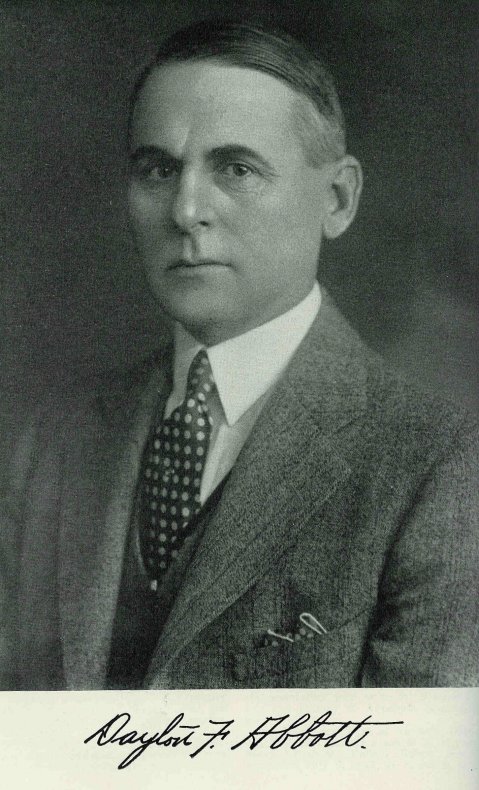
  • Dayton F. Abbott, Chief of Police
  • Martin A. Rundell, Captain of Police
  • George F. Eisenhut, Lieutenant of Police
My first inclination was to Google™ the name of the police chief. I did that, but could only assume that politics had done to his career in the major what it had done in the minor for John Kelly Stevens’ own position as sergeant. Dayton Franklin Abbott apparently was called to serve in 1911, then was out for one mayor’s term from 1914 through 1918, then in again with a change of mayors beginning in 1918. All that—and a transcription of a biographical sketch from volume five of Indiana: One Hundred and Fifty Years of American Development by Charles Roll in 1931—if you care to scroll down to the fifth listing on a web page here. Oh, and a little picture here.

Jiving Chief Abbott’s tenure with that of The Miner Studio—why do I feel like I’m doing Venn diagrams instead of genealogy here?—leaves us with a possible date range of 1911 through 1914—not much better than what we had before.

Of course, there is one other option: check the city directories. Those of you who are subscribers to genealogy services such as Ancestry.com are already familiar with the fact that they provide scanned copies of such directories. For those of you wishing to search on the cheap, though, never forget the wonders a good tour of duty via Google™ can provide you. That is how I uncovered copies of the Fort Wayne directories at Archive.org for the years 1912 and 1918. Admittedly, those were not precisely the years I had scientifically isolated through Venn diagram wizardry above. But give me a break: they were close.

If you take a look at the 1918 directory here, you can see right away that we can dismiss this year as a possibility. While Dayton Abbott was again listed as Chief—as we had seen from his biographical sketch—the 1918 directory had elevated George Eisenhut to the position of Captain. As can be surmised from the thick political atmosphere we’ve observed elsewhere in this study of Fort Wayne history, Captain Eisenhut most likely attained that status upon the change in political flavors at the last election. In other words, since the preceding mayor’s term was from 1914 to 1918, we can safely say these appointments were timed with that change in office.

The 1912 directory, however—as you can see for yourself here—handily provides the exact same listing as that gleaned from the photocopy that got me started on this subject in the first place. And, as a bonus, that particular volume of the directory listed not only the department brass, but also the entire roster of patrolmen for that year as well—including “John K. Stevens.”

And yes, I did compare all the names. If you are wondering: no, they aren’t exactly the same. For one thing, Patrolman Louis Crawley advanced from Patrolman to Sergeant—or, perhaps, in the reverse, as we’ve seen that change in rank was easily a two way street back then, providing no mechanism to help us fix the photo list’s date any more precisely. We’ll have to be happy with 1912—give or take a year or two—as our working date.

What that list gives me, though, is confirmation that both for the 1912 directory and for this contemporary roster of the police department, there was only one John Kelly Stevens.

So whichever reporter got the story wrong—whether for that birth announcement in 1904 or that death report in 1919—couldn’t have claimed a case of mistaken identity. There was only one John Kelly Stevens working for the Fort Wayne police force back then.

There. Rest my case.