Showing posts with label Law Enforcement. Show all posts

Tuesday, May 17, 2016

One "L" Or Two?


If you happen to find yourself researching the family history of a man employed in law enforcement in the small towns of nineteenth century America, you may find a wealth of mentions in local newspapers. All the better if those newspaper excerpts can be gleaned from a publicly accessible source such as the Library of Congress' Chronicling America project.

In our case, we've been perusing Dakota area newspapers from 1881 through 1904, the years our man Marshall Jackson had been living and working in Pembina County. The date range was gleaned from census records, both in the United States and in Canada, where "Marsh" moved, after his twenty-plus year stay in what had just become the state of North Dakota.

The 1900 U.S. census had indicated Marshall Jackson was serving as constable, but assertions in the Winnipeg newspaper, on the event of his death, had pegged him as a former sheriff in North Dakota. All I could find, though, was a series of articles in The Pioneer Express detailing his candidacyand subsequent lossfor sheriff in Pembina County.

Still, there were ample entries in the local paper giving every indication that he was active in local law enforcement. Take, for instance, this entry on September 19, 1902:
Marshall Jackson, of Neche, was notified to look out for Frank Forbes, an escaped insane patient of the Jamestown hospital, who was committed from Hyde Park some time since.

Marsh's name was peppered liberally among the usual small town cop stories. In one instance reported on June 15, 1900, a local farmer was approached about purchasing some cows from two men who had just come over the county line. After the deal was struck, the purchaser discovered his bargain of "a couple of cheap beeves" was really the property of a neighboring farmer, who identified them as such.

Upon that discovery, the man, now out his money and having returned the stolen property,
immediately telegraphed Marsh Jackson, county constable, of the trouble. In the evening, Mr. Jackson arrived and it only took him a short time to secure a clew to the direction taken by the thieves....

Cattle thievery wasn't the only crime to make local headlines in Pembina County. On October 24, 1902, a store in Neche was broken into and the cash register stolen. A series of other stores in town were also hit that same night. However,
One of the suspects was arrested by Marshal Jackson near Altona the next day and now occupies quarters in the village jail pending examination.

Even the more pleasant aspects of a police officer's duties were covered in the local paper. The "international picnic" of the "A.O.U.W. of Manitoba and North Dakota"held to be "one of the most successful"included among its accolades on July 6, 1900, a nod to our man:
Marshal Jackson performed his duty, and the peace of the day was not marred in the least.

This January 27, 1899, report may have been another example encompassing all in a day's work for local law enforcement.
Marshal Jackson of Neche brought over a man named Robert J. Embery to the county jail, in default of bail, under charge of assault with a dangerous weapon. Embury was in a scrap with another man and Deputy Marshal Neil McKinnon attempted his arrest when Embury assaulted him with a leaden billy.

Wait! Deputy Marshal?

If some of these news reportsalternately featuring spelling as Marshall or Marshaloffended the sensibilities of your editorial eye, you are not alone in being irked by this irregularity. Though we could have excused itjust as the swapping of "Embery" and "Embury" in the above news storyto poor copy editing, it seems there was something more at play here.

Like this example. Remember the stolen cash register reported on October 24, 1902? Here's another detail:
Marshal Jackson, of Neche, on Tuesday brought over the two burglars who went through LaMoure & Co.'s store. They are pretty tough-looking characters. One of them became a little belligerent, which resulted in a black eye for him and a broken finger for the marshal.

Oh oh. Could this have been Marshal Marshall? But I thought he was constable. He was, after all, collecting fees for his services as constable.

So far, in sketches of the big picture of local law enforcement, I had run across mentions of the office of sheriff and that of constable. I hadn't picked up on the possibility that there was also a position there called marshal. It was time to consider whether Marsh was the marshal, or whether someone else was.

It didn't take long, in Chronicling America's easy to navigate newspaper resource, to find a "clew." There, in the May 10, 1895, edition of The Pioneer Express, was a whiff of local politics to waft in our direction:
On Saturday night a caucus was called to put in nomination officers for the ensuing year. It needed not a very intelligent man to see which way the wind blew. The fight was on the clerkship and marshal.

So there was a position of marshal out in this pioneer region. The question now became: who was the marshal? Marshall? Or some other Jackson?

In that very 1895 column discussing the machinations of local politics, we find our answer. The "hottest fight for years" resulted in "a strong ticket elected" which included, for marshal, a man identified by the name of C. Jackson.

Whether Mr. C. Jackson retained his position after that year's election, I can't tell. But further inquiry led to some details which either will serve to confuse or clarify whether Marshall Jackson was ever known as marshal in these parts. It seemsat least on November 2, 1900, the eve of another electionthat perhaps the editorial staff of The Pioneer Express had finally made peace with their Ls:
Marshall Jackson of Neche has made an enviable record as a peace officer while acting as constable and marshal of Neche village. He is a teetotaler, does not drink or smoke, and is one of the most active men we know of. He will make a good record as sheriff.

It seems the predictive power of their editorial staff is exceeded only by their editorial prowess in such political matters.  


Monday, May 16, 2016

At Least a Candidate


Archived news reports can help augment genealogical research, but should come embedded with a caveat emptor warning regarding editorial errors. That, I learned long ago. And don't intend to ever forget.

In the search for details on the life of murdered immigration officer Marshall Jackson of Winnipeg, I was elated to discover the local newspaper during the years he had lived in North Dakota is now part of the Chronicling America collection of the U.S. Library of Congress. Still, I made sure to proceed cautiously in case of any potential editorial hazards.

My goal in checking each mention of Marshall Jackson's name in the North Dakota newspapers in the Chronicling America collection was to see whether the memorial comments printed in Winnipeg following his passing were indeed accurate. In particular, the Manitoba Free Press had mentioned that "Marsh" had once served as Sheriff in Fargo, North Dakota.

Already, I was discovering that that report was not entirely correct. Fargo was located in Cass County, while we have already seen that, at least in the 1900 census, Marshall Jackson was serving as constable in the town of Neche in Pembina County to the north.

While Cass County isn't Pembina Countyand constable doesn't equal sheriffI thought there might still be some truth to the matter, so I trawled through the many references to Marshall Jackson found in the Chronicling America collection to see what I could find.

Right away, I found a mention of some activity of interest. From The Pioneer Express, Pembina's newspaper, on August 24, 1900:
Marshal Jackson of Neche was in the city on Wednesday evening and made us a pleasant call. Mr. Jackson was on his way to Drayton and expected to make several calls on his way. He informs us that he expects to be a candidate for the office of sheriff before the republican county convention, and from present prospects confidently expects the nomination. Mr. Jackson's record as a police officer and constable is of the best and proves him to be a faithful and efficient officer worthy of promotion.

While the slant on that article slides farther toward editorial spin than news reporting, it does show us that Marsh at least intended to run for sheriff.

A second such insertion in the same newspaperthis time on September 7shows the man was busy pursuing his political dream.
Marshal Jackson of Neche was in town last week talking politics to some of the boys. "Marsh" is spoken of as a likely candidate for sheriff on the republican ticket.

Sure enough, in a column of convention reports gathered in the September 19 edition of the Grand Forks Daily Herald, one day after the republican county convention in Neche, Marshall Jackson's name appeared among those who had been nominated. It was now official: he was running for sheriff.

Now it was time to get to work. As election day drew near, Marsh did seem to be out there, connecting with prospective voters, according to mentions like this one in The Pioneer Express on October 19:
Marshall Jackson and J.W. Harvey have been canvassing this district and apparently are well pleased with prospects. They are both good fellows and deserve a popular vote.

It may have been too early for such confidence. The local newspaper began printing the list of candidates for all offices in late October. Marsh was running against Democrat candidate F.J. Farrow. From what I can glean from other editions of The Pioneer Express, Farrow appeared to be the incumbent.

As it turned out, Marshall Jackson couldn't generate enough support among the voters by the time of the November election. The tallynot printed in the Express until November 9showed our man gleaning a total of 1,412 votes. His opponent, Sheriff Farrow, came in at 1,759. I'll let you do the math.

Still, there's one thing I've noticed about researching ancestors and others who once served in law enforcement careers: you can find a lot of mentions of their name in the local paper. Considering I received five pages worth of hits at Chronicling America for Marshall Jackson's namewithin the limited time frame of his few years in the Dakota Territory and new state of North Dakotait appeared there was a lot more to learn about his career as constable than in his brief run for sheriff.


Sunday, May 15, 2016

Finding the Jackson Family


It isn't every day that one uncovers a murder mystery among the stories tucked inside one's family history. Even though the victim in this caseMarshall Jackson of Winnipeg, Canadawasn't part of my family (sadly, it was his murderer who was a distant relative in my matrilineal line), I wanted to trace his story to find out more about the man.

At the time of his 1917 death in the line of duty, working as part of the immigration service, Marshall Jackson lived with his family in a section of Winnipeg known as Fort Rouge. Newspaper reports of his funeral helped pinpoint his family in the census taken only one year prior to his passing. Although the household listed Marshall, his wife "Ester" and two daughters, we had seen from newspaper coverage that he also had two sonsone living in Brandon in the same province of Manitoba as his parents, the other in the neighboring province, Saskatchewan, in a place called Moose Jaw.

Rather than attempt the rather unwieldy genealogical chore of trying to find these Jackson sons at their place of residence in that same census enumerationa trying feat, considering such a common surnameI thought it might be more expeditious to wander back through the census records systematically, until I could locate a year in which they all resided in one household.

Pulling up the prior census, though, proved unhelpful. There, still in Winnipeg, were the Jacksonssans sons, unfortunately. The 1911 census showed wife Hester and daughters Gladys and Eleanor, but no sons.

Again, skipping backwards another five years to the previous census record of 1906, we find the same household. No sons.

Five years prior to that, in the 1901 census: nothing. No Marshall Jackson family whatsoever—with or without sons.

It might have seemed like we were doomed to have to go the more tedious route of eliminating numerous Jackson families in those two other Canadian locations in the hope of finding the right sons of Marshall and Hester Jackson. Except for one thing: looking at the actual digitized replica of the census page reveals much more than the mere transcription provides (at least in current formats). And on that digitized record, we could glean a few more facts to help reconstruct this family tree.

For one thing, the 1916 census showed that the Marshalls' youngest daughter was born in the United States. Because she was twenty one years of age at the time of that census, it would mean that the familywell, this daughter and her mother, at the very leastwould not have been in Canada as late as 1895.

This particular census, however, helps us pinpoint the year of immigration a little more clearlyif, however, the reporting party remembered the incident clearly.

The 1916 census record shows Marshall's wifenot a citizen at the time of her arrival in Canadato have come to that country in 1904. The same thing was reported for her two American-born daughters, indicating they must have been in the United States during the time of that country's census in 1900—thus addressing why they wouldn't have shown up in the 1901 census in Canada.

And sure enough: there the family was, in the town of Neche in Pembina County, one of the most northern counties in the new state of North Dakota.

Although the precise handwriting of the enumerator made reading the names of each family member a snap, it was somewhat complicated by his less than stellar spelling abilities, thus not quite providing us the precise names of each of Marshall Jackson's sons. However, we do have an approximation of what their names were. "Bernatt," the eldest, was fifteen years of age, having been born in North Dakota in December of 1884.

The second son, also born in North Dakota, arrived in June of 1886, bringing him to the brink of fourteen years of age at the point of the 1900 census. The only problem is: I can't read his name. It looks suspiciously like "Irl," making me wonder whether it should actually be Earluntil I succumb to pondering the possibility that it might have been Gil. I find it more forgivable to have to endure bad handwriting than poor spelling.

Of course, the girls were both listedGladys, having been born in October of 1891, and her younger sister "Ellen" in August of 1896as was their then-thirty six year old mother, Hester. Apparently, Marshall and Hester had by then been married for seventeen years, placing the year of their marriage around 1883, and the locationconsidering Hester was, by other reports, actually American and not Canadian, as this census mistakenly identified hersomewhere in the United States. Indeed, the date of Marshall's arrival in the country was marked as 1881, most likely precluding the possibility of a Canadian marriage.

Another interesting detail of that 1900 census in North Dakota was the listing of Marshall's occupation. The census reported him to be serving as constable. While not to the rank of sheriff that the Winnipeg newspapers had later reported him to beand certainly nowhere near the size of city his reported location of Fargo would have been at the timethe position of constable was a form of law enforcement officer, in some cases an elected official.

Although by this census record, Marshall Jackson had not, exactly, served as sheriff as the Winnipeg newspapers later reported, there were other indications that the paper may not have missed the mark by as much as it seems here. It was another newspaper report—this time from stateside—that provided a few hints.


Above: The Marshall Jackson household in the 1900 U.S. Census for the town of Neche in Pembina County, North Dakota. Image courtesy Ancestry.com.

Wednesday, May 11, 2016

The Other Side of the Story


Accompanied by an official of the Ottawa Immigration department, the body of Marshall Jackson, the well-known Winnipeg detective, who was killed while escorting a prisoner...will arrive in Winnipeg at 11 o'clock this morning.

That was the news report in the Manitoba Free Press on Monday, January 29, 1917, which brings us back to the other side of the story I set aside, back in January of this yearalmost exactly ninety nine years after this newspaper entry. It wasat least on the side I had been talking aboutthe story of John Syme Hogue, son of a civil engineer in Charleston, West Virginia, whose unfortunate life choices found him on death row in a prison in Ontario, Canada. The reason: murder of an immigration officer handling the process of his extradition to stand trial back in the United States.

The other side of the story, of course, would be that of Marshall Jackson, the Winnipeg detective assigned to escort John Hoguestill being referred to under one of his many aliasesback to Windsor in Ontario, where he was to oversee the transfer of his prisoner to United States law enforcement personnel at the international border.

While there are several newspaper reports which included enough details on the man to develop a sketch of who he was, the downside to that attempt is the typical rush to publish in the face of getting "the scoop" ahead of the competition. At first, the Winnipeg newspaper identified the officer as "Detective Nesbitt"until someone from the police force must have pointed out that they had no such detective by that name. For a while, it seemed the number of aliases for the reports on the now-deceased detective was doomed to catch up with the number of aliases assigned to his assailant.

It is not simply to sort out the chronologyor merely the correct identityof the slain officer that I want to pick up this thread of the narrative. As you likely have realized from following along here at A Family Tapestry, it's the stories that exert that powerful pull on meof course I want to know Marshall Jackson's story, as well.

Even more than that, though, is an additional pull this story exerts on me, personally. Because I am married to a law enforcement professional, I have had the vicariousalbeit admittedly distantexperience of knowing the impact on those on the force who have lost a co-worker who has died in the line of duty. It is an awful experience with multiple repercussions, not only for immediate family, but for those who worked with the fallen officer, and for the community in which that person once served. Whenever I hear of an officer who was injured or killed during the course of work, I can't help but hear echoes of officer safety warnings in my headthe oft-repeated kind drilled into public safety employees over the course of their career. When I read a story like Marshall Jackson's, I can't help but cringe when I realize what happened to him. Stories like his became the training material used to hopefully prevent further such tragedies from occurring.

For the rest of the week, we'll revisit this other side of the John Syme Hogue story. We'll explore what we can reconstruct of Marshall Jackson's own role in this story, his work history, and his family's story. Between newspaper reports, census records, cemetery records and other findings, this will help us understand a bit more about who this seasoned detective was who nevertheless lost his life in the course of a day's work.


Above: French impressionist painter Claude Monet's 1885 oil on canvas, "Train in the Snow." Courtesy Wikipedia; in the public domain.

Monday, March 14, 2016

Preoccupied with Occupations


While working on my husband's Snider and Gossman lines last week, I ran across a Find A Grave entry for a distant cousin who apparently got his start in radio in Minnesota, then moved to Louisville, Kentucky, where he continued what turned out to be a lifelong career in broadcasting. According to an obituary posted on his Find A Grave memorial, Ryan Halloran was considered "the last surviving member of WAVE-TV's original 'Fabulous Five.'"

Finding this reminded me of another family member—this time on my mother's side of the family—who had also been involved in radio. Though in this case a broadcast engineer, like my husband's distant cousin, my grandmother's cousin also spent a lifetime in the formative years of radio (in the case of "Jeep" Jones, it was in eastern Tennessee).

This might fall into the "oh, nice" category for those with simply a passing interest in the oddities of another person's family tree, but for my husband and I, it resonates: both of us got our start, during our formative, starving-student years, in radio.

Looking at the records of our ancestors' occupations can be enlightening. Of course, if you go back in time far enough, it seems everybody listed as his profession, farmer. Yet, even then, there were the occasional storekeepers, attorneys or dentists.

Keep in mind, though, in my current genealogical projects, I'm tracing my way forward in time, documenting as many descendants of these progenitors as possible. By the time I cross the line at the turn of the century—1900, that is—those occupational descriptors become quite varied.

Remembering, too, the discovery that great grandfathers on both sides of my husband's paternal line—John Tully in Chicago and John Kelly Stevens in Fort Wayne—served in law enforcement, I have learned to keep a close eye on that detail gleaned from census records. After all, those men ended up with a great-grandson with lifelong service in law enforcement, as well. Sometimes, our own occupational choices turn out to have been part of an ancestor's legacy.

The discovery of ancestors' occupations actually turns out to be a great find, if the career was affiliated with any organization which kept records of their members or employees. Seeking such research treasures was what led my husband and me to first query Allen County area researchers about any local police benevolent associations which might have kept historical records of the force. We were eventually referred to the Allen County - Fort Wayne Historical Society where, as it turned out, not only did the museum include a basement exhibit housed in the old jail, but their archives included a number of photographs of department personnel—including our own John Kelly Stevens.

Sometimes, such records are passed along to historical societies or county archives. Some of these seem invisible to researchers, because they are not part of readily-accessible finding aids. However, it never hurts to ask—especially if planning a trip to the area. Whether through a place of employment, a library, a museum, or even the holdings of a labor union, immigrant association or fraternal organization, it may turn out that occupational clue is the research key opening a cache of genealogical treasures.


Above: Photograph of Fort Wayne Police Force team taken in front of the then-current city hall and jail, early 1900s. When my husband does law enforcement training sessions, he likes to show this photo and have class members guess which one was his great grandfather. Knowing my husband, no one ever guesses John Kelly Stevens was the thinnest man in the lineup—third from the left is the correct one. 

Monday, February 1, 2016

Life on the Installment Plan


Just think of this as the story of one man's life sentence on the installment plan.

John Hogue, the convicted murderer in Ontario whose life was spared in an eleventh-hour reprieve by the Canadian government, may have seen his life sentence in Canada eventually reduced to a mere ten years, but that wasn't the end of his debt to society. Apparently, there were more charges to face.

Battle Creek, Michigan, for instance, wasn't about to give up on seeing justice served in the March, 1916, safe-cracking case at the Arthur B. Mitchell Billiard Hall—although authorities even ten years later still insisted that the crook's real name was James Gordon. That little event had netted John Hogue a cool $422 on his way to Winnipeg, Manitoba.

Back in 1916, it was Battle Creek's detective G. W. Colby who, in vain, had chased the suspect all the way to Toledo, Ohio, only to find he had just been released after questioning by authorities there. Now, on April 1, 1926, it was Sheriff G. W. Colby, accompanied by Calhoun County prosecutor Cortwright, who finally got his man when he traveled to Detroit to meet up with the Ontario provincial police escorting Hogue across the border. A lot had happened back in Michigan since Hogue last blew through town.

Marshall, the county seat of Calhoun County, in which Battle Creek was situated, was the scene of the trial in circuit court the morning of April 22. Since officials at the Kingston penitentiary where Hogue had been incarcerated in Canada had reported that he had been "a model prisoner," perhaps he had shown some signs of reform. In his own mind, apparently, he believed himself to be a much different man than the one who had last darkened the doors of Battle Creek, for in this case, he had "hoped for release on probation."

Authorities in Calhoun County saw otherwise for, according to that day's Marshall Evening Chronicle, Hogue was duly reminded that
the crime for which he stood charged in Calhoun County is a serious one.

Somehow, the incongruity of all that had transpired in the past ten years of Hogue's life suddenly slapped me in the face. Here, after narrowly escaping the death sentence for murder, the man has been retrieved to stand trial for a theft of less than five hundred dollars—admittedly of much more worth then than it is today, but still of no comparison to the value of a life lost—and the court chooses to remind him that the crime "is a serious one."

In the end, the judge turned out to be quite lenient, even in this "serious" case. He chose to give the minimum sentence—one year—and then was quoted in the newspaper as commenting,
With your good time you'll have to serve only about ten months. Furthermore I am going to recommend that when you are released on parole that you may live outside the state.

That, essentially, provided the green light, after serving his sentence, for Hogue to return home to live near his parents in West Virginia, "who are well to do."

What a fortunate turn of events and best-hoped-for outcome for Hogue—except for one thing. According to The Escanaba Daily Press—that spot as far away from Battle Creek as one could get and still be in Michigan—their April 1, 1926 report mentioned one other point of business:
A message today was received from Sheriff Thomas Shaugancy [sic] of Madison, Wis., indicating Stewart or Hogue is wanted there for blowing two safes in February, 1916.

If Michigan never forgets the wrongs committed against them, why would Wisconsin?


Wednesday, January 20, 2016

Picking Up on a Hundred Year Old Story


Let's begin at the end: the moral of this story—at least on the process side of the analysis—is to never start telling a multi-post-long story right before a major holiday. Like I did. Every time the narrative got rolling, it would have to be set aside for posts of another sort. First it was Christmas. Then New Year. Then, too many roadblocks with the impending date of my flight to Salt Lake City—and then a week of training at SLIG.

But now? The coast is clear, I hope, to return to the story of the man who took to blowing up safes in a half dozen midwestern cities before finally being apprehended in Winnipeg.

If you thought the close of the fugitive's drama came at the moment of his sentencing, you would be missing the rest of the story. And I want to tell that story—well, at least as much of it as I've been able to find.

So, before we pick up that narrative, let's endure a brief recap for those who spent their holidays doing things other than reading genealogy blog posts. I'll include hyperlinks back to the original posts, so you can hopscotch your way through the littered trail betwixt the cheery holiday posts of last month.

We started in the middle of December with a discovery of an odd set of entries on a border crossing report for John Hogue of Charleston, West Virginia. Only, he wasn't coming from West Virginia at the time; he was arriving in Detroit from Windsor, Ontario, in February, 1926, escorted by a deputy sheriff of Calhoun County, Michigan. The reason for his re-entry into the country was to stand trial for crimes allegedly committed in that county.

As any genealogist would, I had this nagging doubt about the document, wondering if it really was referring to my John Syme Hogue, son of a civil engineer in Charleston, West Virginia. I had to take a closer look—which led me on this wild chase to figure out exactly who this convict John Hogue might have been.

First stop on my research plan was to search for that name in historic newspaper archives. I got more than I bargained for: apparently, the man was known by several aliases. More importantly, he was wanted in Battle Creek, Michigan, for blowing up a safe and getting away with its contents—over four hundred dollars in cash. That was in March, 1916.

By May, the fugitive—never having been caught by Battle Creek authorities—was plying his craft at another safe in Madison, Wisconsin. By this time, newspaper reports were glowering over the escaped suspect, whom they believed to be named James Stewart.

In October, a case with many of the same details occurred, but this time the suspect was apprehended, and spent nearly three months in jail. Toward the end of his sentence, local law enforcement officials were informed that their prisoner, whom they had assumed was named William Anderson, was wanted in Battle Creek for a similar crime committed there back in March. The process to extradite the prisoner was initiated, and by the end of January, 1917, he was sent east on a train bound for Windsor in the custody of an immigration official. The plan to hand over the convict to U.S. authorities at the international border at Windsor was never completed. Just three miles before his arrival in Windsor, the prisoner grabbed the officer's gun, shot him, and leaped from the still-moving train.

The midnight getaway in the rural outskirts of Windsor prompted a widespread manhunt. For two days, the fugitive eluded both law enforcement officers and citizen posses assembled from several surrounding towns. In an almost anti-climactic way, an unassuming stranger stopping by a local hotel for a meal and a night's stay turned out—despite yet another alias—to be the very man who was the focus of what was billed "the biggest manhunt of a year or more."

Immediately booked into the Windsor jail, starting up the process of scheduling his trial in Ontario's Supreme Court, the suspect made his own protests about the crime just committed. He insisted his captor's gun was "hair-trigger" and that he never meant to kill the man, just keep him at bay to effect his getaway. Newspaper reporters from the several American cities in which he—under a number of aliases—had committed crimes hounded the now-found fugitive for a scoop on this emergent story.

Regardless of intent, James Stewart—a.k.a. numerous other monikers but in reality one and the same as the John Hogue whose genealogy led me to this story—appeared before the Ontario Supreme Court on the morning of March 7, 1917, and saw the conclusion of arguments, jury deliberations and the announcement of their verdict, and the sentencing all unfold before the day was over. He was pronounced guilty as charged. He was sentenced to die on the gallows that May 17.

The defense began immediately to prepare an appeal. While newspapers back in Winnipeg and throughout those midwestern American locales where the suspect had likely also plied his craft churned through all the details of the murder and trial, it seemed they couldn't quite agree on the correct name for the suspect for nearly another month. In the end, it became clear that the man sought by so many cities was indeed John Hogue. And though he had seemed to forget his family, they had not forgotten him. John Hogue's brother began his own campaign to defend his brother, going so far as to enlist the support of his state's then-current governor, John J. Cornwall.

Granted, it might be a far-fetched scenario to think the governor of an American state would be likely to agree to plead on behalf of a criminal detained in an entirely different country. But in the case of this criminal, the chances were somewhat better. Both John Hogue's father and younger brother were prominent civil engineers in the city of Charleston—capital, incidentally, of West Virginia. To say the family was "prominent," however, does not reveal the full line of connections in that family's heritage. Surprisingly, this man condemned in a Canadian court for murder was actually a descendant of one of the United States' own most revered Chief Justices, John Marshall.

Tracing that genealogical connection was where I left off with this story. While it may have seemed as if the story just fell off the table, having been pre-empted by holiday and post-holiday activities, I assure you there is more to be told. And we can pick up the trail again—this time, safe from further interruptions—with tomorrow's post.


Above: The document that started me asking all those questions, Manifest of the United States Department of Labor Immigration Service card for John Hogue; courtesy of Ancestry.com.

Tuesday, December 29, 2015

Teetering on Technicalities


Remember that saying, "Have his day in court?" Perhaps no one today takes that as a serious measurement of a legal timeline. Back in March, 1917, though, the provincial courts of Ontario may have taken that concept more literally.

While the trial of the suspected murderer of Canadian immigration officer William Jackson may have seemed like an open-and-shut case, a mere one day's hearing in court may have been a bit too brief for propriety's sake.

By the time the verdict was announced—guilty—followed all on the same day by the sentencing, the various newspapers covering the process across both Canada and the United States all had their take on what was to follow next. Ontario law in 1917 provided two sentencing options in such a case: death on the gallows or life imprisonment. Ontario Supreme Court presiding justice Sutherland opted for the more swift and final penalty, and scheduled its implementation for May 17—barely two months after the case was tried in his court.

For one thing, The Wisconsin State Journal—still miffed about the robbery committed by this same man at the Orpheum in Madison the previous May—had continued to insist on identifying the murderer as James Stewart. Only with their March 8 coverage of the verdict did they finally admit that James Stewart was only an alias.

The Evening Chronicle in Marshall, Michigan—county seat and site for the court case to which "James Stewart" was being extradited for his safe-cracking crime in nearby Battle Creek—was a little faster on the uptake, publicly admitting that James Stewart was merely an alias with their coverage on February 27. They still got the real name wrong in that article, though, fingering him to be James Hogue.

The Manitoba Free Press, back in Winnipeg where this whole extradition process began that January, finally got it right when, in their March 25 report, they announced the murderer's correct name—although altering the date for his execution, moving it up to May 10.

It had been as early as March 8—barely the day after the trial—when the convicted murderer's attorney began preparations to appeal his client's case. He felt there were grounds to do so: his contention that the presiding judge had failed to properly instruct the jury "in detail" on the concept of "culpable homicide."

Perhaps he had a point. Likely inherent in the case was the suspect's contention that the gun used in committing the crime was unpredictable—a hair-trigger response when first handled, but, as was readily evident when used the second time in the face of his impending arrest, unable to be fired at all.

No matter what the grounds for that original decision to appeal the verdict, it was through what unfolded in the process to secure that retrial that confirmed the suspect's real identity. For by the end of that same month, back in his hometown of Charleston, West Virginia, the suspect's brother had begun the process to intercede on behalf of his wayward sibling. It was Andrew Hogue who, enlisting the influence of his state's chief executive, Governor John J. Cornwall, hoped to have a new trial granted for his brother—whose name was not James at all, but actually John Hogue.

As the Winnipeg newspaper explained how things really were, back home in West Virginia, "John Hogue is a member of a prominent Kanawha Valley family."


Above: "Jeune homme à la fenêtre" (Young Man at the Window), 1875 oil on canvas by French Impressionist, Gustave Caillebotte; courtesy Wikipedia; in the public domain.

Monday, December 28, 2015

Seeking Swift Justice


What do you do when you stumble upon the fact that someone in your family tree had a colorful—or downright infamous—past? You follow the trail, of course.

That was what we began to do in the week leading up to Christmas—until the holidays insisted we set aside the series—with the story of a man known as John Hogue. No, James Gordon. No, James Stewart. Or maybe it was James Emmerson.

Whoever he really was, he had a penchant for switching surnames to go with that "James" moniker. And no matter who he was, he was now arrested for having shot a Canadian immigration officer who was in the process of escorting him back to the United States, where he was to stand trial for safe cracking in Michigan.

That was on January 27, 1917. It was no time at all when he appeared before the local magistrate in Windsor, then at a preliminary hearing on February 2. His case was to be tried before the Ontario Supreme Court, beginning on March 5, with Justice R. Sutherland presiding.

After the formalities of jury selection, the proceedings began in earnest at 9:30 on the morning of March 7.

I don't know whether the term "swift justice" was meant to be this literal, but by 5:00 that same evening, the jury retired to begin their deliberations. That, too, took surprisingly little time, and the jury returned later that same evening to announce their verdict.

Within minutes, the suspect was under sentence: he would die on the gallows on May 17.


Above: "A Backstreet in the Snow," 1895 watercolor by Irish impressionist landscape painter Walter Frederick Osborne; courtesy Wikipedia; in the public domain.

Tuesday, December 22, 2015

A Pause to Reflect


In the midst of a manhunt, pulses are racing, adrenaline is pumping and the focus is solely on the goal: catch the fugitive. Once the chase is over and the one sought has been captured, all the details begin to settle into place.

By late morning on January 27, 1917, Windsor police had captured the man who, two days prior, had killed a Canadian immigration official with his own weapon, then jumped from the train which was carrying him back to the U.S. border to face trial in Battle Creek, Michigan.

The man arrested at the Essex House hotel that morning—checked in as James Emmerson—was now booked into the Windsor city jail under a different name: James Stewart. Carefully following protocol, the police agency had searched the man and relieved him of the five dollars cash and handcuff key secreted in his pocket.

Perhaps due to the seriousness of Stewart's crime, his case seemed put on a fast track to justice. On that same day—January 27—he was seen by the local magistrate, though given no chance to plead. He was remanded for a preliminary hearing, scheduled for the following Friday, February 2. The trial itself was set to be heard in the Ontario Supreme Court beginning on Monday, March 5. If convicted of murder, according to Ontario law, James Stewart faced the death penalty on the gallows.

The slow-motion decompression that must have followed that tension-riveted two-day chase surely turned into a time to reflect. The newspapers back in Winnipeg, where the extradition journey had begun earlier that week, as well as in Battle Creek, Michigan, and Madison, Wisconsin—and doubtless those of a handful of other cities which Stewart had wronged—all churned through every detail they could turn up, seeking ever more fuel to stoke their headline-generating machine. Though The Wisconsin State Journal sniveled that Stewart was "too sleepy to talk" about the Orpheum robbery in Madison the previous year, the papers still managed to jointly piece together a mosaic of the aftermath of the chase. 

"This is what I get for being kind to you," were reportedly the last words of Marshal Jackson to his assailant. Though earlier stories had pictured Steward as handcuffed, later reports seemed to indicate that the immigration official escorting Stewart had allowed him the more comfortable traveling condition of being freed from his manacles.

For his own part, Stewart had insisted that "he was good to me," and that Stewart didn't intend to harm the marshal. He had planned to brandish the weapon merely to "show him I meant business."

On the other hand, Stewart had insisted that the weapon was "a hair trigger gun."

"I scarcely touched it when it went off," Stewart insisted, according to the Madison newspaper. Yet, when Windsor police closed in on him in his hotel room two days later, the newspaper reported that though Stewart had pulled the trigger several times, the gun failed to work at all.

In the aftermath, everything was settling back into place in Winnipeg, as well. Reporters reached editorial consensus on the identity of both the suspect and police escort—finally agreeing that he was Marshal William N. Jackson, a man born near Petersborough, Ontario, who once served as sheriff of Fargo, North Dakota, before returning to his own country and settling in the Winnipeg area. He was about fifty years of age at the time of his murder, leaving behind two grown sons and two daughters still at home with their mother. Plans were in place for the Dominion government to take charge of Jackson's funeral, with assistance by the Knights of Pythias.

Back in that Windsor jail cell, the man "too sleepy to talk" doubtless had a lot on his mind. He had just spent the last two days—cold, winter days—holed up in a hay loft four miles outside Windsor. Besides the immediate physical deprivations of the ordeal (not to mention, their emotional impact), I can't help but wonder whether James Stewart—or whoever he was—gave any thought to the family he had left behind. The ones of whose whereabouts he insisted he knew nothing were about to be the ones he would never see again.

Unlike those modern disrupters seeking their fifteen minutes of fame, it seems the last thing Stewart wished to claim was the platform being offered him by the editorial muscle of two nations. Perhaps, rather than yield to the hounding of those Madison reporters keen on his comments about that safe-blowing back at the Orpheum theater, he found a more comfortable respite, deep in the arms of Morpheus.

Monday, December 21, 2015

"The Biggest Manhunt of a Year or More"


Being a stranger who was passing through town would not normally attract much attention, especially if the town were the size of Windsor, Ontario. With a population approaching thirty eight thousand at the start of 1917, the main city in the county of Essex was bound to have visitors traveling through, often. Besides, this was that week of January when the session of the Essex County Council was being held there.

Two Leamington men had traveled from the opposite end of Essex County to be in town for the council meeting. Sitting at the restaurant at the Essex House where they were enjoying breakfast, they noticed another man enter and take his seat nearby. Being that the Leamington men were from out of town, themselves, perhaps it might have seemed unusual for them to size up the stranger, but they did.

The stranger—a thirty year old man named James Emmerson—had just arrived in town and had checked himself in at the hotel for an overnight stay. There didn't seem to be anything particularly noticeable about him, with one exception: he had a finger that had been amputated at the second joint.

Perhaps this stranger seemed just a bit too oblivious to the buzz that had gotten everyone in town into a furor. Posters with printed descriptions had been passed around the city and far into the surrounding area, urging residents to be on the lookout for an armed and dangerous man wanted for murder of a Dominion immigration official. Though bloodhounds had been called out, two days prior, to assist in the manhunt, and though they had searched for three miles beyond the point at which the assailant's tracks were first spotted in the snow, the unsuccessful chase had been called off. Posses from several of the surrounding towns, however, were still vigilant.

The Leamington men, by now having just completed their breakfast, must have cast some meaningful glances between themselves, for they quietly compared notes with what they had read of those wanted posters. One of the telltale identifiers mentioned in the posters just happened to be concerning a finger amputated at the second joint.

Rising from their table, the Leamington men strolled leisurely to the door. Once outside, though, their pace quickened as they headed straight to the city's police headquarters.

Three Windsor officers were assigned to the case, and hustled back to the hotel.

By this time, James Emmerson had finished his own breakfast, stopped at the front desk to request a call to his room at three o'clock that afternoon, then retired upstairs to his room. He had had a very full couple of days and needed some rest.

He had not been up there long when the door to his room flew open, and three Windsor police officers stood facing him with their guns drawn. Though Emmerson immediately drew the weapon he was carrying, one of the officers lunged for his right arm and knocked the revolver to the floor, then with his two partners, pinned Emmerson to the radiator and subdued him.

Having spent those last two days and nights without food or shelter, the stranger from out of town likely did not have the strength to put up much of a fight. For though he checked in as James Emmerson, the man arrested that January, 1917, morning by Windsor police was suspected to be armed and dangerous fugitive, James Stewart—the same man who had, two days earlier, murdered Marshal William N. Jackson, the Winnipeg immigration officer escorting the criminal to Windsor, just before he was to be handed over to Detroit authorities at the river separating the two cities.


Above: View of the Detroit River at the place and approximate time at which Canadian immigration officer Jackson would have handed over Winnipeg prisoner James Stewart to American authorities in Michigan. Caption from 1918 Border Chamber of Commerce photograph: "Only a stream divides Detroit and the border cities." Photograph courtesy Wikipedia; in the public domain.

Sunday, December 20, 2015

Tracks in the Midnight Snow


In Winnipeg, the crime was known as "the Robinson safe breaking affair," but the man under suspicion for masterminding it was called—at least by one newspaper account—William Anderson. Along with his accomplice, "Sheeney" Holmes, he was arrested and stood trial in that Manitoba city in October, 1916. By the time his sentence—a mere three months—was up, authorities had discovered he was wanted for a similar crime back in the United States.

To accommodate the Michigan jurisdiction which had requested his extradition, the criminal was to be transported by rail, escorted by a Canadian immigration official, to the city of Windsor in Ontario—which happens to lie directly across the river from the American city of Detroit. Then, in the intricate dance between jurisdictions not wanting to overstep the bounds of their authority, the Canadian law enforcement official would board a ferry with his charge to cross the Detroit River halfway, at which midpoint he would consummate the exchange of the prisoner with Michigan officials at the international border.

Just before Marshal Jackson was to complete that journey—the Canadian Pacific Railway train was three miles due east of its destination after midnight on January 24, 1917—his prisoner abruptly brought his manacled wrists upward, then quickly down upon the officer's head, partially stunning him. The momentary pause was all it took for the man to grab the officer's gun and shoot him with it, killing him instantly.

Shackled yet still holding the revolver, the man exited and then jumped from the moving train, apparently leaping without injury to the snowy field below. Though word spread quickly about the fugitive—over the next several hours, posses were formed from several nearby towns to aid in the search, and bloodhounds were called out in the chase—after two days, the trail was lost. Authorities speculated that their suspect had likely managed to slip away by somehow crossing the border into the United States—some even surmising that he had taken the risky route of attempting a crossing of the iced-over Detroit River.

The news traveled quickly back to Winnipeg, home of the slain officer. All in a jumble, the front page story there gave confusing reports on just who it was who had been shot. The headline said the victim was Detective Nesbitt, but in the story that followed, he was identified as Detective Jackson. The conclusion of the report, however, mentioned that there was no Detective Jackson on the Winnipeg force, and speculated that the slain was actually a private investigator in the area, frequently under contract to provide services to the local government.

Is it any surprise then—considering all the confusion in the wake of the uproar—that in the follow up report the next day, all in the same column the fugitive would also be identified by two different names? Despite the details provided by the Manitoba Free Press on Friday, January 26, 1917, concerning William Anderson and his three-month incarceration in Winnipeg leading up to this unexpected climax, perhaps owing to an editorial sleight-of-hand, one report overlaid another, and in one breath the article fingering William Anderson bluntly asserted the perpetrator was a man by a different name.

That other name, incidentally, was James Stewart—the same James Stewart wanted back in Battle Creek for blowing the safe in Arthur B. Mitchell's Billiard Hall.


Photograph above: The Canadian Pacific Railway station in Winnipeg, circa 1920where the journey began on the long trip back east for Marshal Jackson and his prisoner in January 1917; courtesy Library and Archives Canada via Wikipedia; in the public domain.   

Saturday, December 19, 2015

One More Stop


Genealogists sometimes find themselves grumbling when they discover the ancestor they're seeking may have been known by more than one name.

Think, then, of the task facing law enforcement officials in no less than six cities across the United States in seeking to apprehend the man who was known as James Stewart. That man came with at least four other aliases—and that was just the intel gleaned from his handiwork during the year of 1916.

After James Stewart blew open the safe at Arthur B. Mitchell's Billiard Hall in Battle Creek, Michigan, that March, his trail led officers to both Detroit and Toledo. With communication devices one hundred years ago much more limited than our instantaneous connections today, this was not an easy process to track Stewart's whereabouts. The effort to catch up with Stewart in Toledo—just after his release from detention by city police there—may have been a process taking days. Maybe even weeks. No wonder they lost his trail.

Though Stewart did, eventually, feel the need to skip the country—an astute conclusion reached by a fugitive sought by a half dozen law enforcement agencies—he didn't leave right away. It turned out that at least one of the law enforcement agencies hot in pursuit was the police department of Madison, Wisconsin. They didn't even realize they wanted him until two months after his escapade in Battle Creek.

And for good reason: on the night of May 7, 1916, Stewart found his way into the Orpheum Theater in Madison, broke into the box office, slid the small, movable safe into the coat closet to muffle the sound, blew it open, lifted its contents—one thousand dollars—and made his getaway. Nobody noticed anything was amiss until the next morning.

After that incident, wanted posters described the criminal as an "inveterate cigaret smoker," a gambler and "a dope fiend." Notice was posted to every law enforcement agency in the county and surrounding area. James Stewart's "Bertillon Views"—the mug shots from the scientific identification system developed by French policeman Alphonse Bertillon—were even published in the Madison newspaper.

All to no avail. The next time there was any mention of James Stewart was when he surfaced in Canada. And that was only because he had been arrested in Winnipeg, Manitoba—but not until the middle of January in the following year.


Above: Example of "Bertillon Views" of mug shot inventor, French police officer and biometrics researcher, Alphonse Bertillon, taken in 1913; courtesy Wellcome Library, London, available under Creative Commons Attribution only license CC BY 4.0 http://creativecommons.org/licenses/by/4.0/; via Wikipedia.

Friday, December 18, 2015

Wanted


With several billiard halls in Battle Creek, Michigan, back in 1916—including at least six on Jefferson Avenue—I'm not sure why the one operated by Arthur B. Mitchell became the scene of the crime, but it did.  

Being the proprietor of a billiard hall is likely an occupation bringing with it an element of the unexpected. After all, one never knows what disagreements might emerge from the smoky haze when men get testy about how the game is going.

Closing up the hall for the night, proprietor Arthur B. Mitchell likely headed home, thinking about much more mundane issues than what was about to happen at the shop he had left behind him.

Sometime late that March night, an explosion ripped his office safe wide open—at least enough for someone to lift the $422 stored inside it and make his getaway.

Right away, the sheriff—E.J. Mallory at the time—was on the case. Detective G. W. Colby and Sheriff's deputy F. M. Eddy determined their man, known as James Stewart, had headed toward Detroit. They tracked him there, only to find he had fled to Toledo, Ohio. When they thought they had caught up with him in Toledo, it was only to discover that Toledo police had indeed detained him for four hours—for some other reason, apparently—then let him go.

There were a couple other aggravating factors about this pursuit of the suspect. For one thing, the man they were seeking was likely not a man named James Stewart. Although James Stewart was the alias he had used, the man had also been known as James Gordon. To complicate matters—as was discovered over the next three months—he had also been called James Andrews and James Hogue.

The other challenge was where to look for this fugitive next. After that brief detention by the Toledo police, he was nowhere to be found. Not in Ohio. Not in Michigan. Not anywhere else in the region.

The fact of the matter was, this was no one named James at all—not Stewart, not Gordon, not Andrews. His name was actually John Hogue. And he had just skipped the country.


Above: R. L. Polk and Company city directory for Battle Creek, Michigan, showing listing of billiard halls in 1915, with Arthur B. Mitchell's business about halfway down the list; courtesy Ancestry.com.
 

Wednesday, September 25, 2013

Back to That Research Plan


After being lured away from The Plan by the appearance of yet another bright, shiny research object, I promise to return to—and keep treading down—the decided-upon research path.

That is the repentant me speaking.

The bedazzled, wide-eyed, wonder-struck child genealogist in me is still jumping on the bed, shouting, “On to Ireland!” But I know I must wait and do this thing up right—as long as it hurries up and brings me to my stated goal fast.

So, back to Captain Richard Kelly and Fort Wayne we go, to line up all our vital stats, dot all our genealogical i’s and cross all our family history t’s.

There was one point I prematurely skipped. I mentioned Richard was out of his father’s household, come time for the 1900 census. I also mentioned that he traveled with his wife to the funeral of his mystery aunt in Toledo. Let’s take a closer look at what can be found about that wife.

According to Fort Wayne marriage records, her name was Louisa Miller, and she promised Richard Kelly, “I do” on October 23, 1895. Well, that’s what one index explains—and I rather believe it, as the image of the marriage license is also viewable online.

There’s only one problem with that date: another index transcribed another record, claiming the date was actually in 1896.

Could that mean there were two Richard Kellys? Or is this another transcription problem?

Thankfully, FamilySearch.org was able to include a digitized version of this marriage record, as well. Taking a closer look at this multi-page record, apparently an official someone inserted several records under the date 1895 in the midst of records clearly listed as 1896. Granted, that “5” was a little hard to see—what do you think? Was it a five or a six for Richard Kelly’s entry?

What is wonderful about this second source of material is that each marriage entry extends for several columns of information provided for both the groom and the bride. The “Record of Marriages” begins with the groom’s name in column one. From that point, you have to pay careful attention to the column numbers to keep straight which page you are on.

For the groom, the twenty four year old Richard declared that he was the son of Timothy Kelly (which we already knew) and Mary Barrett. Now, there’s the beginning of our problems. Granted, Richard was a mere child when his mother, Ellen, passed away in 1875. Perhaps she was really named “Mary Ellen” and people had dispensed with the formality of the first name. But I doubt that.

On the other hand, whatever Richard’s mother’s real maiden name was, all I know is that it is illegible. Here’s a sample of what it looked like on the 1860 document when Timothy and she were married:


About the only thing I can guarantee is that you didn’t think it looked like Barrett, either. I’m not sure what I should attribute that surname-out-of-left-field to, but I did take a look ahead to the very end of the long line of entries, and discovered that they were married by someone also having the name Barrett. Coincidence?

Richard’s bride was listed as Louisa Miller, daughter of August and Rose Palmer Miller. She was born in New Haven, a smaller town in Allen County. Louisa had claimed her age at next birthday to be twenty five, but it might have been a touch older, if we can believe what was reported by her parents on the 1870 census.

Whenever their wedding ceremony—my guess being 1895—Richard and Louisa were together almost as long as there are census records to help us tell. The childless newlyweds opened their house to Louisa’s sister Rosa in the 1900 census, but by the time of the 1910 census, baby “Ellen” (as it was recorded in that document) had arrived. The threesome can be found in the 1920 census, despite mangling of Louisa’s name and correction of their daughter’s name to “Helen M.”

That was the year a sweet newspaper announcement gave us a peek at the nature of their relationship and social engagement. With a nod to his former career status, The Fort Wayne Journal-Gazette headlined the October 24 article, “‘Cap’ Kelly Married Twenty-Five Years.”
About thirty relatives and friends of the family gathered last night at the home of Police Clerk Richard Kelly, 127 East Leith street, to remind Mr. and Mrs. Kelly of their twenty-fifth wedding anniversary which occurred yesterday. The affair was planned as a surprise which proved a complete success. A three course luncheon was served which was followed by music and games.

By the time of the 1930 census, Richard and “Louise,” rebounding from empty nest syndrome, had taken in a boarder. By this point, Louise had reached sixty years of age, and though still working, Richard was not far behind.

Before the time of the 1940 census could roll around, Louise was already gone—passed away on January 14, 1939. While Richard could be found in his daughter’s household for the 1940 census, he was not to remain there long. He joined his wife, buried at the Catholic Cemetery in Fort Wayne, upon his passing on February 22, 1945. If the age given in his record at the cemetery was correct, a birth date calculator pinpoints his date of birth as October 4, 1871—a long and productive life, sprinkled with some journalistic attention and administrative headaches.

In addition to the acclaim he received for his law enforcement duties, Richard had one other distinction within his immediate Kelly family: he was the only one of Timothy and Ellen’s children to have children of his own. Sisters Mary and Catherine had died, unmarried, in their youth. Brothers Andrew and Timothy were also left childless—Andrew through divorce and Timothy (as far as I can tell) never having married. Even their sole surviving sister, Deborah Kelly Pence, had not had any children of her own.

Richard and Louise’s daughter, Helen, leaves us the only family trail to continue pursuing in this particular Kelly line.

Sunday, September 22, 2013

Making a Name For Himself


Historic newspaper collections sometimes help bring to life the ancestors we puzzle over. For a specific—though limited—time frame in Fort Wayne, that has certainly been the case for our Stevens and Kelly families.

Remember all those reports I found on John Kelly Stevens, the jocular Fort Wayne policeman who happened to be my husband’s great grandfather? Just from his work in the downtown area coupled with his easy-going, talkative nature, there was enough newspaper coverage of his daily escapades for me to get a good idea of what the man was like.

If you think the stack of news reports for John Kelly Stevens was helpful, consider his (possible) relative, Richard Kelly, who for a time served not only as sergeant—as John Kelly Stevens had—but also as police captain. Yesterday, I considered that very thought: all three hundred six examples of it. If being a beat cop in Fort Wayne merited journalistic attention, being an administrator in the city Police Department meant being in a glass fish bowl of editorial inspection.

Richard Kelly—youngest son of Timothy and Ellen Kelly—was not always a police officer. Like John Kelly Stevens, he started out in one of Fort Wayne’s well known centers of employment: the railroads. Perhaps because his father was foreman at the “Pennsylvania shop,” it wasn’t hard for young Richard to gain employment there. By the time of the 1900 census, as a young married man, Richard reported his work to be brakeman for the railroad.

Sometime before the 1910 census, Richard was awarded his position as patrolman with the Fort Wayne police force. While I couldn’t pinpoint the date of his employment, we’ve already seen mentions of Richard’s work as patrolman from June of 1907.

Who can explain what seemed to be a meteoric rise to the top for Richard? The earliest reports don’t seem to be included in the newspaper collections I’ve scanned. But somehow, by early 1908, he began to see signs of favor from above. The Fort Wayne Weekly Sentinel reported on March 11, 1908, that the Board of Safety had just the past week appointed Patrolman Richard Kelly as Captain of Police.

Don’t be too impressed, though. Remember, this is Fort Wayne. It all, apparently, came crashing down upon the next election. It must have been a rocky road in the interim between the November election and the change of regime that next January. Upon the election of Republican Jesse Grice, The Fort Wayne Journal-Gazette mused on November 24, 1909,
It is understood that Police Captain Richard Kelly will retain his present position under the new administration, although nothing official has been given out…

Apparently, the mayor’s office had no such intention, as the Fort Wayne Daily News subsequently noted on January 3, 1910. The Fort Wayne Weekly Sentinel affirmed on January 5: Richard Kelly was “reduced from captain to sergeant.”

Just as fast as the fall can follow the reinstatement. That, indeed, was what happened in Richard’s case. Upon the return of Democrat William Hosey to office at the end of Grice’s term, The Fort Wayne Journal-Gazette noted,
Richard Kelly last night resumed his position as Captain of Police after four years of service as sergeant.

Who knows what impact the next mayor—a Republican again—had on Richard’s law enforcement career. At some point, news reports began to refer to him as “Police Clerk” rather than as Captain, and that is what was entered for his occupation in both the 1920 and the 1930 census records. While the 1940 census listed the more generic “policeman” for occupation, I can hardly believe that for the now-sixty-eight year old widower living in his son-in-law’s household; he was probably still serving, though, as police clerk.

Through that nearly lifelong span of work in law enforcement, Richard Kelly received his fair share of mentions in the local news. Whether for surprise night raids on gambling rings, for attempted rescue of victims of drowning, train wrecks, or gruesome work injuries, or for testimony in court proceedings, his name featured prominently. As a representative of the police department, he was sued for damages by local business owners, accused of corruption—even saw his wife accused by criminals—sent to recover escaped suspects who were being extradited back to his county’s jurisdiction. He spent his fair share of time in parades as well, and represented his local chapter as a delegate to the national convention of the Fraternal Order of Police.

Somehow, after those years of service, he was transformed from the man Richard Kelly, to the public figure Richard Kelly. News reports morphed to mention him in unofficial capacities—his brother’s and stepmother’s obituaries, for instance, mentioning Captain Richard Kelly as surviving relative. Richard Kelly’s vacations, sick days, trips out of town, family illnesses, and even his young daughter’s birthday party became news because they were Captain Kelly’s trips, illnesses or celebrations.

Thankfully, that status even spun off a benefit for me as Kelly family researcher—I found reports of his trips to Toledo to see about his one surviving aunt in her last days.

What surviving aunt?

If it weren’t for the fact that it was Captain Kelly’s aunt, there probably would never have been any newspaper mention of her at all. Since it did rise above the level of “blip” on my radar, it set me off on another chase: to find out just who this one surviving aunt might be.

Not to be impartial or anything, I fervently hoped it would be a Kelly aunt and not a sister of Richard’s stepmother. I certainly had yet to uncover any link to the prior generation of the Kelly family. This was my hope to make that connection.

Wednesday, August 21, 2013

Finding Family in the City of Fort Wayne


Sometimes, the only solution to a family history dilemma is to go back to the source—in this case, the City of Fort Wayne.

Of course, I don’t mean right now (despite the fact I’d love to be there on this opening day of the Federation of Genealogical Societies 2013 Conference).

But I do mean at some point. No matter how huge a wealth of material you may find online to help round out your genealogical research, you simply must include a trip to the geographic location the family had, at one time, called home.

Our family did this several years ago. Of course, we had the added benefit of doing our legwork in a city that boasts the second largest genealogical reference collection on the continent. Even so, we spent our fair share of hours out in the summer sunshine, scoping out cemetery plots and mapping where each branch of the family had moved in the city as their economic wellbeing improved.

Now, as I struggle over why there were two puzzling newspaper entries involving a John Kelly Stevens on the city’s police force which clearly didn’t apply to our family’s ancestor, I recall the “loot” I brought home from that research trip to Fort Wayne, years ago.

Last night, I pulled out some of those files. I was thinking of a specific photocopy that might come in handy in my name quandary. The page itself is a number-coded list of names corresponding to a montage of portraits of city officials, up to and including each of the city’s patrolmen.

The portraits, as well as the composite display, were done by The Miner Studio. Unfortunately, the material is not dated, but the addition of the photographer’s credit helps somewhat to affix a more limited date range to the collection. According to “Directory of Fort Wayne Photographers 1843-1930” by John D. Beatty, readily available as a PDF file at the Genealogy Center, Charles Winslow Miner was the proprietor of the studio. The article, arranged in alphabetical order by each photographer’s surname, provides a brief history of this particular photographer on page eleven. Though he arrived in Fort Wayne in the 1890s and opened his first studio with a partner in 1894, he didn’t remove his partner’s name from the business signage until 1909.

His tenure as sole proprietor was short-lived, as Charles Miner died on May 22, 1912. According to the Bulletin of Photography, volume ten, number 253, on June 12 of that same year, it was mentioned in the “News and Notes” section that his wife had “assumed control” of the studio “owing to the death of her husband.” Along with the help of “Miss Estella Miner,” presumably his daughter, the enterprise continued in operation under the direction of Charles’ long-time assistant, John D. Albrecht.

The Beatty report asserted the business remained in operation through 1916, though under the hand of someone else—“Japanese-born Henry Y. Ozaki”—who nevertheless didn’t change the business name until 1916.

All that leaves us with a possible date range of 1909 to 1916 for the list in my possession. Not quite the precise pinpoint I was hoping for, but ’twill do in a pinch.

Another hint for the date of the listing, however, is provided by the text added under the photographs. Above the entry, “Photo By The Miner Studio,” are three names of significance:
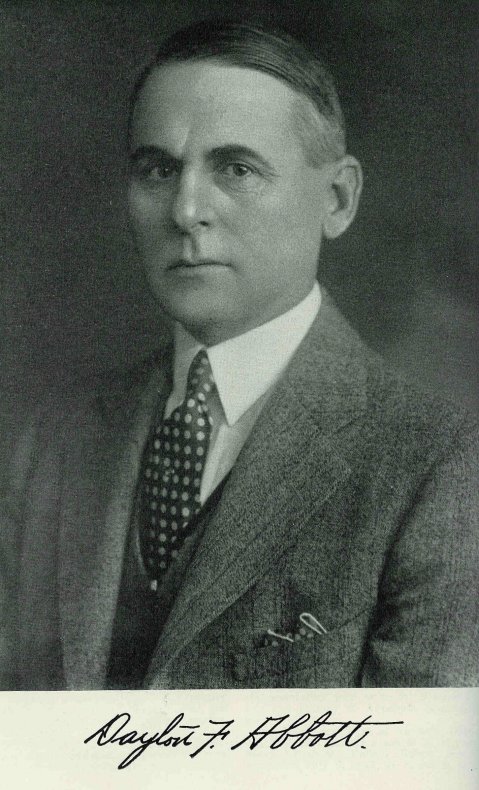
  • Dayton F. Abbott, Chief of Police
  • Martin A. Rundell, Captain of Police
  • George F. Eisenhut, Lieutenant of Police
My first inclination was to Google™ the name of the police chief. I did that, but could only assume that politics had done to his career in the major what it had done in the minor for John Kelly Stevens’ own position as sergeant. Dayton Franklin Abbott apparently was called to serve in 1911, then was out for one mayor’s term from 1914 through 1918, then in again with a change of mayors beginning in 1918. All that—and a transcription of a biographical sketch from volume five of Indiana: One Hundred and Fifty Years of American Development by Charles Roll in 1931—if you care to scroll down to the fifth listing on a web page here. Oh, and a little picture here.

Jiving Chief Abbott’s tenure with that of The Miner Studio—why do I feel like I’m doing Venn diagrams instead of genealogy here?—leaves us with a possible date range of 1911 through 1914—not much better than what we had before.

Of course, there is one other option: check the city directories. Those of you who are subscribers to genealogy services such as Ancestry.com are already familiar with the fact that they provide scanned copies of such directories. For those of you wishing to search on the cheap, though, never forget the wonders a good tour of duty via Google™ can provide you. That is how I uncovered copies of the Fort Wayne directories at Archive.org for the years 1912 and 1918. Admittedly, those were not precisely the years I had scientifically isolated through Venn diagram wizardry above. But give me a break: they were close.

If you take a look at the 1918 directory here, you can see right away that we can dismiss this year as a possibility. While Dayton Abbott was again listed as Chief—as we had seen from his biographical sketch—the 1918 directory had elevated George Eisenhut to the position of Captain. As can be surmised from the thick political atmosphere we’ve observed elsewhere in this study of Fort Wayne history, Captain Eisenhut most likely attained that status upon the change in political flavors at the last election. In other words, since the preceding mayor’s term was from 1914 to 1918, we can safely say these appointments were timed with that change in office.

The 1912 directory, however—as you can see for yourself here—handily provides the exact same listing as that gleaned from the photocopy that got me started on this subject in the first place. And, as a bonus, that particular volume of the directory listed not only the department brass, but also the entire roster of patrolmen for that year as well—including “John K. Stevens.”

And yes, I did compare all the names. If you are wondering: no, they aren’t exactly the same. For one thing, Patrolman Louis Crawley advanced from Patrolman to Sergeant—or, perhaps, in the reverse, as we’ve seen that change in rank was easily a two way street back then, providing no mechanism to help us fix the photo list’s date any more precisely. We’ll have to be happy with 1912—give or take a year or two—as our working date.

What that list gives me, though, is confirmation that both for the 1912 directory and for this contemporary roster of the police department, there was only one John Kelly Stevens.

So whichever reporter got the story wrong—whether for that birth announcement in 1904 or that death report in 1919—couldn’t have claimed a case of mistaken identity. There was only one John Kelly Stevens working for the Fort Wayne police force back then.

There. Rest my case.