Showing posts with label St. Louis MO. Show all posts
Tuesday, May 29, 2018
One Last Try
You didn't think I'd give up so soon, did you?
Susie and Juanita have gifted us with another clue and that, of course, was their names and their (presumed) relationship. Like the photo postcard of Paul Emile and Lucien, I'm presuming this portrait is of siblings—although admittedly, it could be of cousins.
Let's just assume, though, that the hundred year old photo postcard I found of the children named Susie and Juanita was a picture of sisters. Let's also assume the person who wrote the note on the back of the card mentioned the name of the older of the two girls first. And, to add to those presumptions, let's estimate the older girl to be anywhere from age four to age six, and the younger one—do I detect a bit of baby fat still lingering?—to be barely three.
Of course, all of this could be wrong. But we have to start somewhere.
You likely can guess what will come next: head to FamilySearch.org or one's favorite online repository for census records, and search for those two given names in a pattern such as the one we are assuming. Factor in the dates when that type of postcard was used—1906 to 1912—and see what can be found with a search.
I used the 1910 census because it was right in the midst of that date range. I searched for Juanita's name as the lead query, with "Susie" as sister, even though the ages were likely the reverse, mainly because I felt Juanita would be the rarer of the names. Susie, of course, could be just a nickname, but what would I use in its place? Susan? Suzanne? At that younger age, it seemed best to gamble on searching with the name exactly as the writer had given it.
Feeding those parameters into the search box at FamilySearch, I ticked the box for exact match for each of the names and clicked the search button.
Next came time to reject possibilities. There were several hits, of course, but with that bonanza came multiple reasons to eliminate some of the results. I rejected those in which Juanita was older than Susie, or in which the two names were listed in the household, but were obviously not of relatives (such as lodgers). I tossed those where the age difference was too broad—for instance, a sixteen year old with a six year old.
What I was left with—assuming all search results for the 1910 census had been displayed, which I can't be certain of—were just two possibilities. One was for a ten year old Susie with a four year old sister Juanita in Michigan. Another was for a six year old Susie with a four year old sister Juanita in Colorado.
I liked the second possibility better...until I took a closer look. Susie and Juanita Baldz were part of a mid-sized family which had moved to Colorado from New Mexico before 1896. That, in itself, would have been no problem, but taking that closer look revealed a few more details about the family. The parents were listed as speaking, for their primary language, Spanish rather than English. In addition, the father's occupation was entered as laborer, and the stay-at-home mom was overseeing a family of six children, including an oldest daughter who was herself working as a servant in a private home.
I could be wrong, but add to my presumptions the consideration that this is hardly the economic milieu into which you'd expect someone to be trifling with photographs of their children in dress-up mode. Not in that time period. Nor is the chatty note on the back of the photograph what you'd expect to be penned by someone for whom English is a second language, not one used in the home on an everyday basis.
The other possibility was that of Susie and Juanita Laraway of Grand Rapids, Michigan. Interestingly enough, the Laraway family also had six children, but I spotted something interesting about this household grouping: Susie was the oldest of those six siblings. That might explain Susie's mature facial expression in the photograph.
In 1910, Susie Laraway was ten years of age, and her sister Juanita was four. While the age range was a little wider than I had expected, if the photograph had been taken a couple years earlier, the scenario would then shift to an eight year old Susie, with a two-to-three year old Juanita.
But there is a problem with this potential solution. In the Laraway household, there was another daughter in between Susie and Juanita: six year old Frances. Why would Frances have been left out of the picture?
Not happy with either of the possibilities I found, I suppose I could try my hand at searching for the alternate names for Susie. Or check the 1920 census and see if both daughters were still residing at home. It's a snap that I can't reverse engines and look at the 1900 census, though. Depending on the time frame, it is possible that Juanita would not have been born by that date.
A rerun of the search protocol may also be in order, or to try it at another service (I already had tried my hand at doing so at Ancestry with even less promising results, but we also have Find My Past and MyHeritage).
What is more likely the case, though, is that I'll set this puzzle aside for another day. Or search through posted family trees at Ancestry to look for possibilities. Now that I've put the names up on this post, I'm a firm believer in crowdsourcing, and may just have to be satisfied with letting the search muscle of Google draw curious cousins to this post and hope for the best.
Besides, I've got other projects coming up—and soon.
Labels:
Family Photos,
Postcards,
St. Louis MO,
Unidentified Faces
Monday, May 28, 2018
Where in the World is 3006 Pine Street?
If you are like me, this holiday weekend, you are probably spending some time on the road. That means, in this era of life, that you and I head to new places, smart-phone routing device in hand (or safely stowed in a legislation-approved holder on our dashboard).
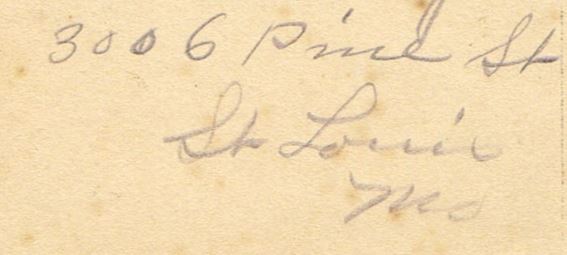
It isn't much of a stretch, when faced with an unknown address from one hundred years ago, to pull out that same cell phone and Google the address. So, still puzzling about the postcard of Susie and Juanita that I found abandoned in an antique store in northern California, I did just that. I pulled up Google Maps and looked for 3006 Pine Street in Saint Louis, Missouri.
Google Maps quickly obliged and gave me this scenario:
Pine Street, as it appears on this Google Map, was a short street abridged by the campus of Harris-Stowe State University. I wondered if the college was in existence at the time in which our photo postcard was sent. Whether it was in existence at that same location is unclear from this brief history of the college, but it was a school in existence as early as 1857. This led me to wonder whether the Ira in the letter had been away from home to embark on his college education.
That, however, turns out to be not quite the way things were, back in the early 1900s. To have left it at this assumption would not give us the full picture—let alone the full sense of confusion I've since arrived at. One thing to remember is that many cities, at the turn of that century, underwent a change in numbering system for addresses, usually to adopt a more logical layout for locating specific addresses within the city.
Judging from indications in directories for the city of Saint Louis, that may have been the case for our Ira's address. His likely was a location not far from the university, as it turns out from the last entry in this note in Gould's Red Book of the City of St. Louis for 1911:
Note for the address, 3006 Pine Street, the nearest cross-street would be Garrison Avenue. That, in the map above, would be where Olive Street runs off the top of the map by the two blue squares—a part of the campus which subsequently obliterated the extension of Pine Street in that direction. Wherever Ira once lived, it is no longer a location in existence.
Just looking up the same detail in the city directory for 1913 provided the same result. However, a curious result also pops up: when looking at the actual entries in the directory, the first address listed was for 3013 Pine Street, implying there wasn't even an address at that lower number.
That entry, however, was for the family of W. H. Gregg, providing me with a name to use to quickly locate that enumeration district in the 1910 census. Checking for the Gregg family's census entry, though, led me to realize one more thing about this elusive Ira and his non-existent address: it didn't show up in the census record, either. The census record for the even numbered addresses on Pine Street showed an entry for 3002 and 3004, then skipped to 3010 (or perhaps 3014, as the chicken scratch utilized for this record made the distinction unclear).
Just in case, I took a look around all the census pages for that neighborhood to see if college student Ira may have moved to a different apartment that year, but there was no sign of anyone named Ira in the neighborhood.
My next resort was to take to scouring the city directories for all the possible years—the stamp box on the postcard I found was used between the years 1906 and 1912—which did provide several possibilities of men named Ira in Saint Louis. Whether any of them were the right person—none of whom lived on Pine Street at any house number—would enter us into a guessing game far beyond the magnitude I'm equipped to handle at this point. We may have to suffice ourselves with hoping for virtual cousin bait to send out a strong signal. And wait for a nibble.
In the meantime, this exercise has reminded me of a couple things. First, it reminded me of how exhausting an exhaustive search can be. Not that I'm anywhere near calling this exhaustive, of course, but it was a good start.
Second—and this is more to the point—there are some issues in genealogical research which require us to know a bit about the history of the place where our relatives once lived. This is especially so if we ever hope to find their old homes, or learn more about the neighborhoods they once roamed. Discovering that little bit of family lore includes learning the history of street numbering systems and other organizational devices—did you notice the entry telling which street car line to take to access Pine Street?—to better understand how our specific ancestors fit into the larger scheme of things in the place they called home.
Labels:
Family Photos,
Postcards,
St. Louis MO,
Unidentified Faces
Friday, May 25, 2018
When a Hint is Not Much of a Hint
While there were no full names written on the photo postcard of Susie and Juanita—one of the abandoned family photographs I found in a northern California antique shop—one encouraging thing was that the card did include an address.
To whom the address belonged, though, wasn't exactly clear. It could have belonged to the "Ira" mentioned in the message posted on the back of the picture—but then, why wasn't it put on the side of the card meant for an address to be written? Could it have instead been referring to the two girls featured in the picture?
Not really sure how to approach this unclear point, I had to strike out in some direction. Going nowhere would only lead to...going nowhere.
So I chose to assume the name Ira and the address—3006 Pine Street in Saint Louis, Missouri—were the two items to pair up for my next search. Since the logo on the back of the postcard led us to discover the possible dates for the photograph—any time between 1906 and 1912—the first logical step would be to search in the 1910 census for an Ira who lived on Pine Street in Saint Louis.
Talk about an exhaustive search. Ira was apparently a popular name back then, at least in Saint Louis. There didn't seem to be any good prospects for our targeted mystery man.
Perhaps our Ira was only in Saint Louis for a few years—from, say, 1906 through 1909. Maybe he left Saint Louis just before the 1910 census enumerator knocked on his door.
All is not lost, in that case. There are always city directories, which became my next step in this needle-in-haystack process. I set my search parameters to look for every Ira in Saint Louis during the original date range of the postcard stamp box—1906 through 1912 and then some, just in case.
Talk about an exhaustive process. I scoured through the many search hits for men named Ira in Saint Louis, but out of hundreds of entries I reviewed, only a few were of people listed as living on Pine Street—and none at the specific address we were given.
This, of course, called for Plan B. I couldn't just give up at this point. The alternative was to delve deeper into the history of addresses in the city of Saint Louis, and to check out any other possibilities. This becomes the sausage-and-politics part of genealogy which is best enjoyed after the process is over, so I will spare you at least most of the gory details. But there are a few things to consider, just in case you find yourself looking at a forsaken family photograph in an antique store sometime in the future and consider the possibility that you, too, could try your hand at sending it home.
We'll check out those discoveries on Monday.
Labels:
Family Photos,
Postcards,
St. Louis MO,
Unidentified Faces
Thursday, May 24, 2018
Go For the Easy Parts First
In tackling a problem, it might seem best to go for the gusto and wrestle with the hardest parts first. After all, that might mean conquering the biggest percentage of the dilemma right at the start; it's all downhill from there.
My thinking is different: if we can tease out the information from the easiest step first, it might have the cascading effect of unlocking a few more hints to guide us further on our way to an answer.
With that in mind, I took a look at all the clues we could find from the notes on the back of a picture postcard from one hundred years ago. The easiest step—and one with a sure-fire answer—is to zero in on that tiny box where the one cent stamp goes.
If you look closely, despite the murky appearance of the middle of the logo in the stamp box, you can make out the word Artura. That particular stamp box design was used in Artura photo postcards between the years of 1906 and 1912.
While it would be nice to have a narrower date range for our search for Susie and Juanita, the stars of this photo postcard, at least it's a start. Add to that the wiggle factor of the children's ages, and it might seem a very imprecise science, indeed. However, at least we have a starting point from which to move to the next step—examining yet another obvious (though unclear) clue: the address mentioned on the postcard.
Labels:
Family Photos,
Postcards,
St. Louis MO,
Unidentified Faces
Wednesday, May 23, 2018
A Little Bit More About Susie and Juanita
When I want to rant about people who don't provide details on the pictures they've saved, all I have to do is think about the empty backs of my own family photos. And then...rant over.
With zipped lips, I'll tell you what can be found on the reverse of the picture postcard I shared with you yesterday. From there, we'll get to work to see if we have enough hints to figure out the identity of the family of Susie and Juanita.
Here's the splat of it.
It seems as if each line was made as a separate detail. Some make sense if strung together with others on the same side of the card, while other lines do not. We'll check them out, line by line in detail in the next few days, but for now, will just take in the big picture.
Susie + Juanita
taken May 18—
In there rompers
3006 Pine St
St Louis
MO
And under the section labeled "This space for address only," the handwritten comments continued:
ForBoys? Susie and Juanita?
Ira [or Ira's?] Children
often speak of you
Don't you think
they are fat fine
boys.
Labels:
Family Photos,
St. Louis MO,
Unidentified Faces
Tuesday, May 22, 2018
Susie & Juanita
The difficulty with rescuing abandoned family photographs is that they sometimes seem to include more hints than turn out to be useful, in the end. Or perhaps, the further I delve into this project, the less verve I have in completing yet another Mission Impossible. Let's see what happens with one more of the photo postcards retrieved from an antique store in Jackson, California.
This one comes complete with several details written on the reverse. At first, I thought these tidbits might be sufficient to lead us to the door of a descendant, but now I'm not so sure.
The card came labeled with two names: Susie and Juanita. It also mentioned a location: Saint Louis. Tantalizingly, it also provided a date—well, part of a date: May 18. But which year?
I had thought a name like Juanita, in the early 1900s, might not be as common as it is as a given name in the United States today. According to the name popularity rankings at Social Security, for the decade from 1900 to 1909, Juanita ranked 156th, with 3,837 American baby girls named Juanita in the entire decade. With numbers like that, we might have a bit better chance at locating just the right Juanita, even though we have no surname to partner with it.
Still, I have my doubts. Maybe I'll feel more positive about this project after we get busy exploring the possibilities. In the meantime, meet Susie and Juanita.
Labels:
Family Photos,
St. Louis MO,
Unidentified Faces
Thursday, June 27, 2013
You Are On Twitter, Aren’t You?
Those of you who are researching your own family history are
probably familiar with several online genealogy resources. We all know about
FamilySearch.org. Many of us subscribe to Ancestry.com. We may even dicker over
which of several other family history websites are superior to the rest.
When it comes to asking people about using Twitter for
genealogy, though, it seems that question still draws blank stares.
Twitter—that one hundred forty character microblogging service—is something often relegated to the mobile phone crowd. “On the go”
hardly seems to suit the image of the serious researcher, holed up in the back
reading room of a major library.
However, if you’ve never considered building your network on
Twitter, I invite you to experiment with this resource. It has all sorts of
possibilities for the synergy of crowdsourcing your family tree.
Obviously, I’ve got a Twitter account (see, I’ve even
included my Twitter handle over in the left hand column) and certainly invite
you to follow me if you are on Twitter. If you choose to do so, you and I and
many other family history fanatics can share resources with one another.
Think that wouldn’t be useful? Here’s two examples of how
Twitter has helped just this past week:
- My post on Wednesday included a link to a list of Google Reader alternatives. How do you think I found that article on Author Media’s blog? Yep. Twitter. I follow @AuthorMedia.
- Fellow blogger Jen Baldwin put out a plea for help in locating a missing historic headstone feared vandalized or stolen. Combined with a blog post and even a news report on a local station, she tweeted her message, along with a link to the television news clip. A follow up tweet was out the next day: missing headstone found!
Not only does Twitter facilitate people-to-people
connections between those with similar interests—just type in a hashtag (example: #genealogy)
before any subject you are interested in searching on Twitter to see how many
results you can find—but it also can be used to connect with other genealogy
groups.
Just recently, on behalf of our local genealogical society—you
do belong to a local genealogical
society, don’t you?—I set up a Twitter account. We are just starting this
project and it isn’t fully set up the way I’d like, but you are welcome to
visit it. Just type in @SJCoGen to get there.
The beauty of putting your genealogical society on Twitter
is that it becomes a way to spread the word about your organization and its
mission that will reach an entirely new audience—the next generation of
genealogists!
An added benefit comes with utilizing Twitter’s capacity for
list building. While I’ve yet to polish my lists up on our society’s Twitter
account, the task is off to a promising start. So far, I've built a list of all
available state genealogy societies that I can find on Twitter. Lists for local
societies, national societies, professional genealogists, special interest
groups, genealogy businesses, and historical societies will follow.
Take that a step further: do you know that you can subscribe
to follow other people’s lists? That’s a great way to discover who else is out
there on Twitter—and follow them! For instance, take a look at @michaelhait and
click on “Lists” on the left column, which will show you all the lists this
genealogist has either created or been included in. You can even subscribe to
his own lists—or follow any of the resources he has listed there.
You can take a look at the Saint Louis Genealogical Society’s lists on Twitter, too, for an example of what one genealogical organization is
doing with their tiny 140-character cyber-property.
Of course, input is not the entire picture. Twitter becomes
your mouthpiece to share what you are accomplishing with your own research or
blogging, too. Frankly, although all these Google Reader replacements we discussed yesterday are
important, I sometimes will more quickly click through to a link I’ve seen on
Twitter—including announcements of fellow bloggers’ latest posts. I’d love to
see yours mentioned on Twitter, too.
Labels:
A Process Break,
Genealogical Organizations,
Online Resources,
Social Networking,
St. Louis MO
Wednesday, December 12, 2012
Gone Over to the Dark Side
In a move that’s sure to garner me a lump of coal in my
stocking for Christmas, I’ve gone a-wandering through forbidden fields. The
struggle I’ve mounted to uncover the story behind the connection between Fort Bellefontaine
in Missouri territory and Fairfield County
in the new state of Ohio
has yielded me little. I’m still puzzled about what connected the widow
Elizabeth Howard Ijams with the widower John Whistler—and later, forged the
connection between John Jay Jackson and Elizabeth Ijams’ daughter Sarah.
Frankly, I feel as if these stubborn forebears refuse to come out of hiding.
I confess: I’ve gone looking for what others have posted
online for those intransigent Jackson and Ijams ancestors.
I know: shock and disbelief. Lectures on how you need to do
your own research. Scoldings for not relying only on source documents.
Yep. A lump of coal in my stocking. This Christmas.
So…now that we’ve gotten that
out of the way…do ya wanna know? Aren’t you just a bit curious?
I don’t know about anybody else, but when I hit a brick
wall, I’m not opposed to taking a peak around and seeing if anyone else has
found a chink in the masonry, a toe-hold or a hand up. Of course, I’m cautious
to see if I can replicate any results others have already found. But I’m not
averse to learning from my peers. After all, I’m not that good at re-inventing
wheels.
My thinking was: if I could find someone else in the family
constellation for whom documentation could be located, perhaps those papers
would reveal a hint of a trail. Perhaps another child in the family died after
the date in which states began collecting additional personal information.
Perhaps a report of a sibling’s birth location different than the other
children’s might reveal travels that I hadn’t previously anticipated.
At any rate, cut me some slack, you who are saintly
genealogists. The need to know has led me in the path of temptation, and I have
yielded.
Onward to the dubious world of online genealogy. My first
stop was to FamilySearch.org. Not to besmirch their name—I’m so grateful for
all the documents I’ve found at this resource—but here I found my first
indication of squishy reportage. Searching for Sarah Howard Ijams, no documents
popped up in the search results. However, there was an item from the Pedigree Resource File.
Alright, I know it: warning bells are going off in my head
as I speak. The file indicated Sarah was born October 6, 1798, and died February
12, 1829. Of course, no source was cited for those dates—dates I’ve already
struggled to verify. How did the supplier of this information know these dates
were correct?
Next came the marriage information. The file named John Jay
Jackson as the groom—no surprise here—and the event’s date as January 25, 1818,
in Saint Louis.
Both those latter details may actually be correct. I’m a bit more convinced now
than I was before about the marriage location in the Saint Louis area. And the year of 1818 is
more acceptable to me than the other entry I’ve seen of 1816.
Seven children are listed in this file, though unfortunately
not in date order. The firstborn arrived in 1819, and the last on December 30
of 1828. These two dates at least frame the possible time span between marriage
and Sarah’s early death. An infant’s arrival that late in the year could actually
have been what precipitated Sarah’s demise.
There are other online resources, too. Of course, the
narrative that I’ve already mentioned—that of Sarah’s mother’s second marriage
to John Whistler—included a statement that there were ten children in the Ijams family. Where are the other three?
Other online files give more of a hint as to what happened
to the Ijams and Jackson families. The disputed count for the number of
children in the Jackson
family shrinks to six in a Rootsweb file here, but reveals information on John
Jackson’s own second marriage. Another Rootsweb file, focusing more on the
Ijams ancestors, shows no descendants for John and Sarah, but provides ample resources for tracing Sarah’s Ijams family back multiple generations.
While I cannot just appropriate the information found online
as impeccable truth—I must exercise my own due diligence in checking these
lines myself—when confronted with a bewildering maze of false leads, it helps
to lift up one’s head and take a look around. Why insist on playing the
trailblazer on the edge of civilization when you can lift your blindfolds and
take a look around. Who knows? You may discover you are actually walking in an
urban jungle with a road map already in your hand.
Picture above: a print by Winslow Homer entitled, "A Merry Christmas and Happy New Year," published in Harper's Weekly on December 24, 1859; courtesy Wikipedia; in the public domain.
Labels:
Howard,
Ijams,
Jackson,
Online Resources,
St. Louis MO
Thursday, December 6, 2012
A Whirlwind Tour of a Tour of Duty
Thanks to the details of an article abstracted from the
September 28, 1876, issue of the New
Lexington Tribune, we have a general idea of John Jackson’s service in the
army during and after the War of 1812. Admittedly, there are conflicting
reports, even within this article—but for now, we’ll focus on the timeline of
John Jackson’s service.
Here’s what the tour of duty looked like for John Jackson,
based on an excerpt from the book, Pioneers
of Perry County
Ohio by 1830:
Mr. Jackson was in active service in the [Pennsylvania] Militia when it was first called on at Erie in 1812.On May 3, 1813, he enlisted in the regular Army in the 4th U.S. Rifles. On October 20th, he embarked with his company on keel boats at Pittsburgh to descend the Ohio and ascend the Mississippi bound for Prairie Du Chien. Arriving at Bellefontaine, three miles from the mouth of the Missouri River, on they went to camp for the winter….They left Bellefontaine about May 16, 1815, and landed June 19 at Prairie Du Chien…. He assisted in building Fort Crawford, which commenced work on July 4, 1816. On May 31, 1817, he was ordered to Bellefontaine where he remained until he was honorably discharged on May 31, 1818.
John Jackson evidently started out with the militia in the
state where he resided. Thanks to his father’s decision to move from his native
New York in 1804, John’s early adult years
were spent in Erie County, Pennsylvania. Like many of those serving
during the outbreak of the War of 1812, he originally participated as part of
his state’s militia, rather than in the United States Army.
John’s travels, while in the army, can easily be traced on
the map I referred to yesterday—one in which several of the forts of that era
were labeled. It is interesting to review the information on the fort he helped
build, Fort Crawford
in the old settlement town of Prairie du Chien in Wisconsin.
It is quite possible that the timing of the mission to which John Jackson was assigned was influenced by the aftermath of the British siege of Prairie du Chien, since the British did not abandon their position until having received word, in the spring of 1815, of the Treaty of Ghent.
One of the most helpful details of this narrative is that of
the time John Jackson spent building Fort
Crawford. It appears he
remained in that Wisconsin location until the
end of May, 1817. If that report is correct, the notes I’ve found online about
John’s marriage to Sarah Howard Ijams in 1816
could only mean one thing: she would have had to be with him in Wisconsin, not Missouri! Since I’ve
found absolutely no mention of any possibility of marriage in Prairie du Chien,
I suspect that 1816 wedding date would not apply to John and Sarah.
It might, however, have something to do with Sarah’s mother.
Above left: Map of the Upper Mississippi River During the War of 1812. Number key:
1: Fort Bellefontaine, site of original stop of John Jackson's company
2: Fort Osage
3: Fort Madison
4: Fort Shelby (taken by British and renamed Fort McKay; replaced by Fort Crawford)
5. Battles of Rock Island Rapids and and Credit Island
6. Fort Johnson
7. Fort Cap au Gris
Map attributed to Bill Whitaker at en.wikipedia, courtesy of Wikipedia, licensed under the Creative Commons Attribution-Share Alike 3.0 Unported license.
Labels:
Getting the Big Picture,
Howard,
Ijams,
Jackson,
Military Service,
On the Move,
St. Louis MO,
Wars
Wednesday, December 5, 2012
After the War is Over
So the War of 1812 is over by, say, January of 1815. That’s
fair enough. The question on my mind, though, is: “Where’s John?”
John Jay Jackson, who has yet to say “I do” to one Sarah Howard Ijams of Fairfield County, Ohio, is—as far as I know—still in the army
at his last post at the close of the war.
Thanks to the several online mentions
of his history, that post has been labeled as Bellefontaine, Missouri.
(I’ve also seen other mentions as Saint Louis, Missouri, which helps—mainly because, in checking Google™
Maps, entering “Bellefontaine,
Missouri” brings up the map for a
place called Bellefontaine Neighbors. Other than appreciating the bit of trivia
that this is the longest name of a city in the entire United States, that tidbit of
information doesn’t help advance my research efforts.)
That brings up a question in my mind. Where, exactly, would
Bellefontaine be? Is it the same thing as Bellefontaine Neighbors, near Saint Louis? Or is it an entirely different location?
Fortunately, perusing the material posted alongside various
online resources explaining the War of 1812, I stumbled upon a map indicating
that it most probably was the name of a fort. It was, incidentally, located near Saint
Louis—or what, at the time, was a vastly diminished version of the Saint Louis we know
today.
Not to complicate things, but I do want to mention that
there were actually two forts with
that name. The first was established in 1805, “on the flood plain below the
bluff” of a nearby river. Those of my readers who are avid shoppers might be
interested to note that the first fort was located at the mouth of what is now
known as “Coldwater Creek.” No, not the store—the river.
Owing to an inopportune shift in the course of that river—and,
believe me, these things just can’t be planned—the location of that fort today
would be approximately in the middle of the river. However, the river’s shift
in 1810 pre-dates the time span we are currently targeting in our pursuit of
John Jackson’s personal story. His time at Fort Bellefontaine would be spent at the subsequent facility.
The second fort was located above the bluff—right smart of them, don’t you agree?—and continued
in use through 1828, when decaying conditions and changing military needs
brought about the decision to abandon the fort.
Interestingly enough, the fort was replaced by an edifice
known as Jefferson Barracks. Everybody all together: “Ahhhh…”
Thus ends the historical whirlwind tour of the mystery
designation of “Bellefontaine.” The fort that was once the first United States military installation in the area
of the Louisiana Purchase has now morphed into
a county park. Knowing this does, however, provide a clearer backdrop for us to
revisit the biographical sketch of John Jay Jackson. It also provides the
setting for more of the story on John’s mother-in-law, and her concurrent life’s
events that link to that same fort and region.
Above left: wood engraving showing Zachary Taylor defending Fort Harrison during the War of 1812; courtesy Wikipedia; in the public domain.
Labels:
Getting the Big Picture,
Howard,
Ijams,
Jackson,
Military Service,
St. Louis MO,
Wars
Tuesday, December 4, 2012
Don’t Know Much About History
Despite all the good intentions driving yesterday’s
list-making exercise, I’ve discovered one drawback: in order to track the
whereabouts of one John Jay Jackson, we have to equip ourselves with a working
knowledge of the chronology of the War of 1812, the geographic ins and outs of
the early environs of what eventually became Saint Louis, Missouri, and
(possibly) familiarity with the biographies of a few military leaders.
Ah, history. We’re talking aftermath of the Louisiana Purchase, French and British animosities, and
the impact of rivers at their confluence at key times.
Right now, I’ve got Art Garfunkel’s rendition of Sam Cooke’s
1960 hit, “Wonderful World,” rolling around in my head. I’ll join in with Paul Simon and James Taylor: when it comes to the War of 1812, I don’t know much
about history, either.
Let’s take a look at some specifics which will drive our
understanding of the Big Picture behind the questions of John Jay Jackson’s
whereabouts between 1816 and 1818. Those are the two dates pinned by other
researchers as the years of the marriage of John and his bride, Sarah Howard Ijams of Fairfield County, Ohio.
This won’t be easy, and it won’t be quick. But it provides
context for the story, and we need to know that.
First of all—and you may know all this, but I didn’t, so for
those of you with excellent high school history instructors that you actually paid attention to, please excuse any
redundancy—the War of 1812 didn’t just happen in 1812.
I know—it seems counter-intuitive. A year is a year is a year.
But the War of 1812 took longer than a year to conclude. Efficiency: leave it
to the government.
The conflict began with the vote in Congress to declare war
on the British, and then-President James Madison’s
signature on June 18, 1812. See? Half a year already gone before anything
happened.
It took almost another month before the first sign of action
occurred. By the month after that, the Americans were already in retreat, and
routed again in October. Likewise, the hobbled military of the early nation limped
through the rest of 1812 and into the new year.
Just in time for the adversary to shake loose of prior
engagements, thanks to the abdication of Napoleon.
Now it’s time to rumble! At least, that’s what the Brits must have been saying. In this turf war—and keep in mind, we’re up to the spring of 1814 by this point—escalation of effort by the British met equal retaliation by the now-better-organized fledgling American military, keeping this War of 1812 going despite resolution of other international issues overseas.
Though the French and the British kissed and made up back on the continent (that’s the European continent, by the way), the Americans—who hadn’t yet received the memo—continued to rally into yet another year, rebuffing a British attack on Louisiana. Evidently, the British troops hadn’t yet heard from the home office, either—but that’s okay, because it gave General Andrew Jackson his fifteen minutes of fame with victory at the Battle of New Orleans.
That, by the way, brings this War of 1812 up to January,
1815.
That Christmas Eve treaty that called the whole thing off?
The news finally reached American shores long after the British Parliament
ratified the Treaty of Ghent on December 30. And then, of course, the
governmental process here yielded the final decision with Congress ratifying
the treaty in February of 1815.
With news traveling that slowly, how long did it take to
muster out those soldiers serving in the American troops? That’s the timeline which most likely affects our own story of John
Jay Jackson, his marriage to Sarah Howard Ijams, and what became of the rest of
the Ijams family.
But we’ll save that part for another day…
Labels:
Getting the Big Picture,
Ijams,
Jackson,
Military Service,
St. Louis MO,
Wars
Monday, December 3, 2012
Deconstructing Misinformation
I’m on a mission to ferret out what is genuine fact and what
is more likely the result of the genealogy version of the child’s game, “Telephone.”
I want to revisit the segment from the John Jay Jackson bio that I quoted last Saturday, and examine it, bit by bit. Surely there is some truth that can be
squeezed out of that seemingly enigmatic report.
Here’s what I found on page ninety-four of Pioneers of Perry
County Ohio by 1830, compiled in 2003 by the
Perry County Chapter of the Ohio Genealogical Society:
Mr. Jackson was first married in 1816 at Bellefontaine, Missouri to Sarah Howard Ijams, daughter of Wm. Ijams (sister of William, John and Joseph Ijams) who later died in 1825. In January 1818, he accompanied his wife, mother-in-law, and brother-in-law across the Mississippi at St. Louis to Bearfield Township, Perry County Ohio, where they arrived the latter part of August.
First, let’s take an excruciatingly painstaking approach and
list each of the “facts” we can glean from this paragraph:
·
The subject is John Jay Jackson
·
He was married in 1816
·
There is a place called Bellefontaine in Missouri
·
John Jackson’s wife was named Sarah Howard Ijams
·
Sarah was the daughter of William Ijams
·
Sarah was sister of William, John and Joseph
Ijams
·
Someone died in 1825 (whether Sarah or her
father)
·
A trip from Saint Louis
to Ohio
commenced in January, 1818
·
The party included John, Sarah, Mrs. Ijams and
her son
·
The party arrived in Bearfield Township,
Perry County, Ohio
·
The trip concluded late in August—presumably 1818
Next, let’s determine what directions we may now take, based
on those prompts:
·
Marriage records for John Jay Jackson and Sarah
Howard Ijams
·
Family constellation reconstruction through
other documents
·
Cemetery or probate records for Ijams or Jackson
death in 1825
·
Confirmation of date and location of marriage
·
Confirmation of date and location of death
·
Search and review history on Bellefontaine, Missouri
·
Review history on Bearfield Township,
Perry County, Ohio
Of course, thanks to the assistance of some of you reading this blog, it appears no
marriage documentation is readily available online for the Jacksons
in Bellefontaine, Missouri. On a hunch that the marriage might
actually have happened in Ohio rather than in Missouri, I’m also pursuing searching through marriage
records in Fairfield County,
Ohio, where the Ijams family
lived before 1820.
With that whole list in mind, we have quite a bit of work
cut out—and that is from just one paragraph! There is yet another whole page of
information to be analyzed.
While I’m thankful that such records preserve and pass down
information from the past—after all, the biographical sketch was extracted from
an article published in the September 28, 1876, issue of the New Lexington Tribune—I still need to
cast a jaundiced eye at all information. Information is best tamed when you
have made it your own by diligent examination of all facets. It’s not that
anyone is out to deceive you with wily designs of misinformation. It’s just
that reports can be no more accurate than the people who create them.
And people often make mistakes.
Above left: Leo Lesser Ury, "Reader with Magnifier," oil on canvas, 1895; courtesy Wikipedia; in the public domain in Australia, the European Union, the United States, and those countries with a copyright term of life of the artist plus seventy years.
Labels:
Documentation,
Genealogical Organizations,
Ijams,
Jackson,
Newspaper Clippings,
Perry County OH,
St. Louis MO
Thursday, February 2, 2012
What’s Next?
Yesterday, I mentioned that Norma Flowers Stevens and her two young children arrived from Southampton, England, in the New York City port on Christmas Eve, 1952. I still have no idea where Frank is at this point, nor where Norma is headed, but I have some guesses, based on family stories.
Being in this predicament of flying by the seat of my, er, undocumented self, I thought this might be the perfect time to recall some promises I made to myself not so long ago. You may remember my reticence at making New Year’s Resolutions; you may also remember that I did mention hoping—some time—to track down the military records for Norma’s husband, Frank Stevens.
Well, this is that “some time.”
I pulled up those links I had referred to in a post at the end of December and got to work. In the process, I found out a few things and made a few observations. Think of it as my Guinea Pig Report, in case you’d like to follow suit in requesting military files from the National Archives at Saint Louis but don’t wish to be the “experimentee.”
The first think I noticed is that the links I mentioned in that December post seem to focus on military personnel who are requesting the barest minimum paperwork (the "DD 214") in order to qualify for those special perks reserved for the men and women who have served our country in the military. As you can imagine with a grandmother who saved every paper remotely attached to her beloved family, my husband has already been the recipient of his father’s DD 214 (the current form number, which applies to his Air Force years) and its predecessor, the NavPers 553 (for the Navy years, which incidentally, in Frank’s case, ended on the publicly-available side of the Archives dateline). So, the first step to accessing the request forms for Frank’s military papers meant asking for stuff I already have—that’s just how the online request system is formatted.
I chose to use the Archives website’s online request form, as we qualified to use it by virtue of my husband being the surviving next-of-kin. By choosing that route, I noticed a few things. First, the National Archives website for the Saint Louis center almost provides the viewer with information overload. There were so many links to helpful friendly descriptions, video reports, lists, FAQs and more that I sometimes felt like I was finding conflicting directions (like where to access Frank’s post-1940s Air Force records which do not fall within the public domain date range), or that I couldn’t backtrack to a point where I found something that I didn’t know I needed until later.
A second problem—no fault of the Archives—is my computer’s recent malevolent whim in permitting Firefox to take a dislike to the Google search engine. For whatever reason this nastiness has cropped up, it seems to also be connected to the fact that, once I clicked on “Launch the eVetRecs System,” it basically brought up the screen, but with no clickable buttons after the first page. The thing just sat there dumbly while I fumbled around, trying to figure out why it “wouldn’t go.”
A quick detour to a second browser, the clunky but salvageable Internet Explorer*, brought up the fully operable screen, and I was merrily on my way.
I had already been warned—thanks to some kind souls who answered queries I had posted on genealogy forums—to ask for the full personnel file, so when I found the comment section on the online request form, I was sure to make that note.
Although the website indicates the cost of photocopying the documents in the Official Military Personnel File (I’m figuring I’m in for $60—but that’s just the Navy side of the equation, as it only lets me request one branch per order), it never brought up a secure page where I could make an online payment. That mystery has yet to be resolved—though I’m sure the slow-but-steady government agency will not neglect its duty in informing me in due time of my pecuniary responsibility.
After submitting our electronic request, the final page in the process required the signature of the properly-qualified recipient of the personnel file. Although the page the Archives provides (coded for their use) may be printed, signed and then mailed to them, another option was to fax the completed form. We took the fast route.
Before we even managed to get that signed paper in the fax machine and dial the long distance number to Saint Louis, we had already received an email from the Archives, confirming their receipt of our request. Not bad for turn-around time.
Here’s hoping they work that same magic on their turn-around time for the completed package. As far as the saga of Frank Stevens goes, his son and daughter-in-law are looking forward to reading the rest of the story.
*Ever the source of off-beat trivia, my husband one day happened upon this picture coupled with the caption, "While Firefox and Google fight for world domination, Internet Explorer sits in the corner and eats paste." Of course, neither of us can relocate that ephemeral source of internet humor in its captioned form, but Chris was able to identify the originator of the sketch. For some strange reason, that kept coming to mind during today's online difficulties. Leave it to the poor lil guy with the glue jar to be the slow-and-steady one who got the job done for me today.
Labels:
Documentation,
Flowers,
Military Service,
Occupations,
On the Move,
St. Louis MO,
Stevens,
The Forums
Wednesday, October 26, 2011
About Bill
William Henry Alfred Stevens never did care for one part of his name, and when it came time to consider naming his second son after himself, he saw to it that the egregious element did not become such a burden to his namesake. Thus, Will’s second-born son became known as William Alfred Stevens. Though it originated as a name passed down in honor of his father’s brother, William Henry Stevens, the “Henry” simply would have to go.
In time, Will’s son became simply, “Bill.” Born in Chicago in 1915—almost to the day two years younger than his brother John—Bill eventually followed his older brother’s footsteps in settling in southern California. But not before marrying his bride, Maxine Esther Novy of St. Louis, on the very day of his parents' twenty-eighth wedding anniversary, did he head west to follow his career path as a newspaper reporter.
Hardworking, diligent, it is no surprise that Bill and Maxine’s three children followed in their footsteps by becoming professional and business people in their own right. One son, perhaps following a different path, eventually sought to move closer to his family’s Midwestern origin and replicated his token to his Irish roots as the founder of “Tully’s,” named in honor of his great-grandfather, John Tully, and designed as a replica of an Irish pub, set in a small Catholic town in Kansas.
Bill and Max remained in southern California for the rest of their lives, Bill finishing his course in 1980, his wife following soon after in 1985. My regret in never having had the chance to get to know them is what inspires me to pursue whatever opportunity I find to learn more about this couple.
Labels:
California,
Chicago,
Novy,
St. Louis MO,
Stevens,
Tully
Thursday, September 1, 2011
About All Those Margarets
Oh, for the discernment to know which Margaret Tully is the one referred to in each specific instance! This Tully line starts with Irish immigrants Denis and Margaret Flannery Tully, arriving in Ontario, Canada, from Ireland sometime before 1850. This couple names one of their daughters Margaret—becoming the first of the Margaret Tullys that I find incomprehensible…or at least unfindable.
Denis and Margaret have three sons—Patrick, John and William—who each proceed to name one daughter Margaret.
Margaret Tully score at this point: five.
That is not to infer that the elder Margaret didn’t have other namesakes among her descendants. Denis and Margaret’s daughter Johanna, marrying a Ryan, names one of her daughters Margaret. Johanna’s sons James and Dennis follow suit and each name a daughter Margaret, too. And elder Denis and Margaret’s son Patrick’s daughter Margaret names her only child Margaret. Patrick’s brother John—the one in our direct family line—has one son who bestows Margaret as a middle name to his only daughter.
Think that’s enough Margarets to brew a storm of confusion?
And now, we tread tentatively into the research for today’s featured photograph….
![]() |
| Margaret Tully Dempsey |
Our subject is listed simply as “Coz Maggie Dempsey.” Maggie, of course, is nickname for Margaret. I’m fortunate to already know that Maggie is the nickname used for the mother in this family rather than the daughter, who is also baptized Margaret. Her nickname, thankfully, deviates from the norm to help alleviate mix-ups: she is usually called Rita.
So I can presume it is safe to proceed with some information on this particular Margaret.
The Margaret in this picture was born in the Canadian village of Paris, in Brant County, Ontario. Her year of birth is alternately presented as 1866 or 1868, depending on which census record you choose to believe. She emigrated from there in either 1868 or 1878, although I’ve even seen a transcription showing the date as 1888, which also happens to be the year of her marriage, in Chicago, to Michael Dempsey. (My personal favorite is 1868, for reasons I won’t delve into here.)
Margaret was the eldest child of Patrick and Mary Tully. (Mary, her mother, due to transcription issues, can be said to have sported the maiden name of either Hogan or Horan—yet another wrinkle in keeping things straight in this family line.) Four children were to follow her birth—three brothers and a sister—though I’ve had a dickens of a time trying to find out much more on these younger siblings, other than to note that they all made the move from Ontario to Chicago with Margaret and their parents.
Margaret’s intended, Michael Edward Dempsey, was actually an orphan from St. Louis. I’m not sure what brought him to Chicago, but through the years, he and two of his siblings (Hattie and Anna) crossed paths—or perhaps followed each other—as they moved from state to state.
Margaret and Michael were married at St. Patrick’s Catholic Church in South Chicago by Pastor Martin van de Laam on October 3, 1888. A couple years later, Michael’s sister Anna was married in the same parish, to James A. Davidson, an immigrant of Scottish descent who had settled recently in Joliet, Illinois.
Shortly thereafter, both couples move to Cincinnati, Ohio, where James and Anna become proud parents of daughter Adeline in February, 1893. Margaret gives birth to her own daughter in August of 1894, whom the Dempseys name (no surprise here) Margaret, or Rita for short.
Somewhere in between Adeline’s birth and Rita’s birth, the family story is overshadowed by sadness. Eight month old Adeline suddenly loses her mother, and for reasons I’ve yet to uncover, her father seems to disappear from the picture. Michael and Margaret, whether unofficially or legally, choose to adopt baby Adeline as their own, and the family unit from that time until their deaths remains intact with these four.
Along the way, briefly, they are joined by Michael’s sister Hattie until her death in 1900 in Ohio at the relatively young age of forty. Though the family moves from Ohio to California and back to Illinois, Michael and Maggie show up in census records with their two daughters—both remaining single for life, both serving as registered nurses in private duty. Though Rita passes away, not quite 47, in 1941, Adeline—the one whose mother and aunt both passed at relatively young ages—lives on to see her century mark.
For all I’ve been able to determine about Maggie from her family’s public records, there is little to nothing that I know about her private life. Though she predeceased her husband in March, 1933, I’ve yet to find even any obituary in the Chicago newspapers for her. This photograph, at least, provides a glimpse, however brief, into the life of this one Margaret Tully.
Labels:
Chicago,
Flannery,
Ryan,
St. Louis MO,
Tully
Monday, May 23, 2011
When a Loved One Has Left
Don’t tell anyone, but my husband’s older cousin Bill was our favorite relative. He was fun, did nerdy things like compete in debate and develop new breeds of long-haired rabbits. He spent a year or so in Australia, and lived for a while near the top of the “Grapevine,” the mountain-pass route between the Los Angeles region and California’s Central Valley. That’s when we really got to know him, as it was a short four-hour drive from our home to his.
Unexpectedly early and in what seemed to be a freak mishap, Bill contracted an infection that wreaked havoc on his health. A real survivor, Bill kept plugging away at life for a few more years, then sadly died at a relatively young age.
We all missed him fiercely. Obviously, his nearest relatives felt the impact the most. But after a few months, mercifully, the pain of the loss subsided, and everyone found more constructive ways to honor his memory.
One day, his oldest daughter, Sara, gave me a call. She had been going through Bill’s belongings—those odd stashes of stuff that we don’t know what to do with, but hate to throw away—and had found some pictures with scribbled notes. Some photos were so old, they were of people she barely remembered from childhood. Some, she could only guess, were relatives from a previous generation.
She had pieced together the inscriptions she had found, along with the mementos of graduations and first communions, and called me to see if I could find any more information on these people—something, of course, that I am more than glad to do.
Bill’s mom’s maiden name was Novy, an unusual name, to be sure, something that might be easy to research due to its novelty. The family had settled in St. Louis in the late 1800s, but were originally “Bohemians” or emigrants from what now is the Czech Republic.
I took a look in all the usual starting points—many of the “Beginner’s Tools” websites that I’ve already written about—and didn’t have much trouble finding lots of information. Working backwards from the mother, Maxine Novy, I found her parents, their parents and siblings, and worked back as many generations as possible in the same manner. And then I began working forward once again, looking for all the descendants.
Once I had enough copies of pertinent documents and other reports of interest, I bundled them all up and got ready to send them to Sara. I knew that she not only wanted to know more about the treasure trove she had unearthed, but that these wisps of family history could be passed down to her own children when they got older.
Before I packaged it all up and got it in the mail, I found one more piece to include. This is one of those “reading between the lines” parts of research that I love to stumble upon. Looking in the St. Louis census records in the neighborhood where the Novy family lived, in the painstakingly careful yet beautiful hand of another era, I noticed the signature of the census taker: he was a Novy. Bill and Sara’s own relative, in his own hand, left a small brush past a page of history, whispering: “I was here.”
Labels:
Novy,
Reading Between the Lines,
St. Louis MO
Subscribe to:
Posts (Atom)