Showing posts with label Postcards. Show all posts

Monday, November 26, 2018

Not Leaving Anything to Guesswork


The postcard came with a note on the back: "I gess you know who this is." Fortunately, someone thought it better to not leave any doubts as to the answer, and, as typical of the Knapp family photographs rescued from a northern California antique shop, had scrawled the response on the face of the picture.


The photograph was of a young William Knapp—only this son of William Malphus Knapp, like his father a generation previously, went by his middle name. Milton, son of Malphus, was born after his family moved halfway across the continent from Kansas to Washington. The location where the Knapp family chose to live—a farm in rural Klickitat County—was home in 1900 to his parents and five older siblings, plus one of his father's many siblings, Cornelius Knapp. I suspect that was not the only Knapp sibling to follow William Malphus Knapp's cross-country move.

William Milton Knapp made his appearance in the Knapp household early in 1903. He wasn't there long before his family decided to pull up stakes and return to the midwest—this time to Major County, Oklahoma. Unfortunately, not long after their arrival in Chester, Oklahoma, Milton's father died at age forty in 1908. By then, the younger William was barely five years of age.

The next few years saw Milton first in the household of his widowed mother and her father, Samuel Hoover, in 1910, and then ten years later, likely in the same home, living with his mother and step-father, George Banfill, in 1920.

Not long after that, Milton Knapp struck out on his own, marrying Agnes Lillian Houser in nearby Dewey County on March 21, 1922. By the time of the next census, the young couple was still living in Major County, but by then, they were joined by their two sons and a daughter. Come 1940, the family score edged upward to boys 3, girls 1 in the Milton Knapp household. By then, though, the family had been living in Alamosa County, Colorado for five years—a place which they continued to call home, apparently, until Milton's death on Christmas day in 1979.

The photo I found in that antique shop was one of a young Milton Knapp, though it's hard to determine just when the picture was taken. The postcard came labeled, "William Milton Knapp, born Dot, Wash Jan 27 1904."

Dot, apparently now considered a ghost town, was in or near Klickitat County, Washington—the place where the Knapps lived for only a few short years. It's likely that Milton barely remembered that location from his early childhood, and judging by the outdoor scenery behind him in this photo, that was hardly the scene you'd expect in tiny Dot.

In this photo, Milton was possibly in his late teens or early twenties—perhaps, judging by his outfit, posing for this picture at the time of a special occasion. If we ever find a descendant who is interested in receiving this photo postcard, perhaps we'll have the opportunity to learn a bit more about any event prompting the taking of this picture. 

 
Above: Photograph of a young William Milton Knapp, undated; found in a Sonora, California, antique shop; currently in possession of the author until claimed by a descendant of this family.

Tuesday, May 29, 2018

One Last Try


You didn't think I'd give up so soon, did you?

Susie and Juanita have gifted us with another clue and that, of course, was their names and their (presumed) relationship. Like the photo postcard of Paul Emile and Lucien, I'm presuming this portrait is of siblings—although admittedly, it could be of cousins.

Let's just assume, though, that the hundred year old photo postcard I found of the children named Susie and Juanita was a picture of sisters. Let's also assume the person who wrote the note on the back of the card mentioned the name of the older of the two girls first. And, to add to those presumptions, let's estimate the older girl to be anywhere from age four to age six, and the younger one—do I detect a bit of baby fat still lingering?—to be barely three.

Of course, all of this could be wrong. But we have to start somewhere.

You likely can guess what will come next: head to FamilySearch.org or one's favorite online repository for census records, and search for those two given names in a pattern such as the one we are assuming. Factor in the dates when that type of postcard was used—1906 to 1912—and see what can be found with a search.

I used the 1910 census because it was right in the midst of that date range. I searched for Juanita's name as the lead query, with "Susie" as sister, even though the ages were likely the reverse, mainly because I felt Juanita would be the rarer of the names. Susie, of course, could be just a nickname, but what would I use in its place? Susan? Suzanne? At that younger age, it seemed best to gamble on searching with the name exactly as the writer had given it.

Feeding those parameters into the search box at FamilySearch, I ticked the box for exact match for each of the names and clicked the search button.

Next came time to reject possibilities. There were several hits, of course, but with that bonanza came multiple reasons to eliminate some of the results. I rejected those in which Juanita was older than Susie, or in which the two names were listed in the household, but were obviously not of relatives (such as lodgers). I tossed those where the age difference was too broad—for instance, a sixteen year old with a six year old.

What I was left with—assuming all search results for the 1910 census had been displayed, which I can't be certain of—were just two possibilities. One was for a ten year old Susie with a four year old sister Juanita in Michigan. Another was for a six year old Susie with a four year old sister Juanita in Colorado.

I liked the second possibility better...until I took a closer look. Susie and Juanita Baldz were part of a mid-sized family which had moved to Colorado from New Mexico before 1896. That, in itself, would have been no problem, but taking that closer look revealed a few more details about the family. The parents were listed as speaking, for their primary language, Spanish rather than English. In addition, the father's occupation was entered as laborer, and the stay-at-home mom was overseeing a family of six children, including an oldest daughter who was herself working as a servant in a private home.

I could be wrong, but add to my presumptions the consideration that this is hardly the economic milieu into which you'd expect someone to be trifling with photographs of their children in dress-up mode. Not in that time period. Nor is the chatty note on the back of the photograph what you'd expect to be penned by someone for whom English is a second language, not one used in the home on an everyday basis.

The other possibility was that of Susie and Juanita Laraway of Grand Rapids, Michigan. Interestingly enough, the Laraway family also had six children, but I spotted something interesting about this household grouping: Susie was the oldest of those six siblings. That might explain Susie's mature facial expression in the photograph.

In 1910, Susie Laraway was ten years of age, and her sister Juanita was four. While the age range was a little wider than I had expected, if the photograph had been taken a couple years earlier, the scenario would then shift to an eight year old Susie, with a two-to-three year old Juanita.

But there is a problem with this potential solution. In the Laraway household, there was another daughter in between Susie and Juanita: six year old Frances. Why would Frances have been left out of the picture?

Not happy with either of the possibilities I found, I suppose I could try my hand at searching for the alternate names for Susie. Or check the 1920 census and see if both daughters were still residing at home. It's a snap that I can't reverse engines and look at the 1900 census, though. Depending on the time frame, it is possible that Juanita would not have been born by that date.

A rerun of the search protocol may also be in order, or to try it at another service (I already had tried my hand at doing so at Ancestry with even less promising results, but we also have Find My Past and MyHeritage).

What is more likely the case, though, is that I'll set this puzzle aside for another day. Or search through posted family trees at Ancestry to look for possibilities. Now that I've put the names up on this post, I'm a firm believer in crowdsourcing, and may just have to be satisfied with letting the search muscle of Google draw curious cousins to this post and hope for the best.

Besides, I've got other projects coming up—and soon.


Monday, May 28, 2018

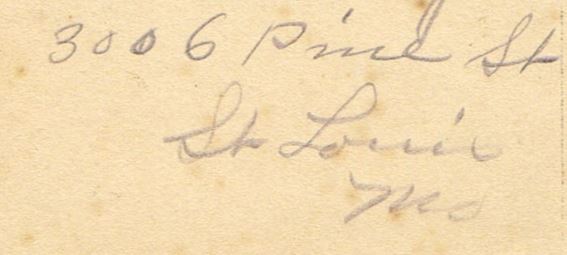
Where in the World is 3006 Pine Street?


If you are like me, this holiday weekend, you are probably spending some time on the road. That means, in this era of life, that you and I head to new places, smart-phone routing device in hand (or safely stowed in a legislation-approved holder on our dashboard).

It isn't much of a stretch, when faced with an unknown address from one hundred years ago, to pull out that same cell phone and Google the address. So, still puzzling about the postcard of Susie and Juanita that I found abandoned in an antique store in northern California, I did just that. I pulled up Google Maps and looked for 3006 Pine Street in Saint Louis, Missouri.

Google Maps quickly obliged and gave me this scenario:


Pine Street, as it appears on this Google Map, was a short street abridged by the campus of Harris-Stowe State University. I wondered if the college was in existence at the time in which our photo postcard was sent. Whether it was in existence at that same location is unclear from this brief history of the college, but it was a school in existence as early as 1857. This led me to wonder whether the Ira in the letter had been away from home to embark on his college education. 

That, however, turns out to be not quite the way things were, back in the early 1900s. To have left it at this assumption would not give us the full picture—let alone the full sense of confusion I've since arrived at. One thing to remember is that many cities, at the turn of that century, underwent a change in numbering system for addresses, usually to adopt a more logical layout for locating specific addresses within the city.

Judging from indications in directories for the city of Saint Louis, that may have been the case for our Ira's address. His likely was a location not far from the university, as it turns out from the last entry in this note in Gould's Red Book of the City of St. Louis for 1911:


Note for the address, 3006 Pine Street, the nearest cross-street would be Garrison Avenue. That, in the map above, would be where Olive Street runs off the top of the map by the two blue squares—a part of the campus which subsequently obliterated the extension of Pine Street in that direction. Wherever Ira once lived, it is no longer a location in existence.

Just looking up the same detail in the city directory for 1913 provided the same result. However, a curious result also pops up: when looking at the actual entries in the directory, the first address listed was for 3013 Pine Street, implying there wasn't even an address at that lower number.

That entry, however, was for the family of W. H. Gregg, providing me with a name to use to quickly locate that enumeration district in the 1910 census. Checking for the Gregg family's census entry, though, led me to realize one more thing about this elusive Ira and his non-existent address: it didn't show up in the census record, either. The census record for the even numbered addresses on Pine Street showed an entry for 3002 and 3004, then skipped to 3010 (or perhaps 3014, as the chicken scratch utilized for this record made the distinction unclear).

Just in case, I took a look around all the census pages for that neighborhood to see if college student Ira may have moved to a different apartment that year, but there was no sign of anyone named Ira in the neighborhood.

My next resort was to take to scouring the city directories for all the possible years—the stamp box on the postcard I found was used between the years 1906 and 1912—which did provide several possibilities of men named Ira in Saint Louis. Whether any of them were the right person—none of whom lived on Pine Street at any house number—would enter us into a guessing game far beyond the magnitude I'm equipped to handle at this point. We may have to suffice ourselves with hoping for virtual cousin bait to send out a strong signal. And wait for a nibble.

In the meantime, this exercise has reminded me of a couple things. First, it reminded me of how exhausting an exhaustive search can be. Not that I'm anywhere near calling this exhaustive, of course, but it was a good start.

Second—and this is more to the point—there are some issues in genealogical research which require us to know a bit about the history of the place where our relatives once lived. This is especially so if we ever hope to find their old homes, or learn more about the neighborhoods they once roamed. Discovering that little bit of family lore includes learning the history of street numbering systems and other organizational devices—did you notice the entry telling which street car line to take to access Pine Street?—to better understand how our specific ancestors fit into the larger scheme of things in the place they called home.

Friday, May 25, 2018

When a Hint is Not Much of a Hint


While there were no full names written on the photo postcard of Susie and Juanita—one of the abandoned family photographs I found in a northern California antique shop—one encouraging thing was that the card did include an address.

To whom the address belonged, though, wasn't exactly clear. It could have belonged to the "Ira" mentioned in the message posted on the back of the picture—but then, why wasn't it put on the side of the card meant for an address to be written? Could it have instead been referring to the two girls featured in the picture?

Not really sure how to approach this unclear point, I had to strike out in some direction. Going nowhere would only lead to...going nowhere.

So I chose to assume the name Ira and the address—3006 Pine Street in Saint Louis, Missouri—were the two items to pair up for my next search. Since the logo on the back of the postcard led us to discover the possible dates for the photograph—any time between 1906 and 1912—the first logical step would be to search in the 1910 census for an Ira who lived on Pine Street in Saint Louis.

Talk about an exhaustive search. Ira was apparently a popular name back then, at least in Saint Louis. There didn't seem to be any good prospects for our targeted mystery man.

Perhaps our Ira was only in Saint Louis for a few years—from, say, 1906 through 1909. Maybe he left Saint Louis just before the 1910 census enumerator knocked on his door.

All is not lost, in that case. There are always city directories, which became my next step in this needle-in-haystack process. I set my search parameters to look for every Ira in Saint Louis during the original date range of the postcard stamp box—1906 through 1912 and then some, just in case.

Talk about an exhaustive process. I scoured through the many search hits for men named Ira in Saint Louis, but out of hundreds of entries I reviewed, only a few were of people listed as living on Pine Street—and none at the specific address we were given.

This, of course, called for Plan B. I couldn't just give up at this point. The alternative was to delve deeper into the history of addresses in the city of Saint Louis, and to check out any other possibilities. This becomes the sausage-and-politics part of genealogy which is best enjoyed after the process is over, so I will spare you at least most of the gory details. But there are a few things to consider, just in case you find yourself looking at a forsaken family photograph in an antique store sometime in the future and consider the possibility that you, too, could try your hand at sending it home.

We'll check out those discoveries on Monday.


Thursday, May 24, 2018

Go For the Easy Parts First


In tackling a problem, it might seem best to go for the gusto and wrestle with the hardest parts first. After all, that might mean conquering the biggest percentage of the dilemma right at the start; it's all downhill from there.

My thinking is different: if we can tease out the information from the easiest step first, it might have the cascading effect of unlocking a few more hints to guide us further on our way to an answer.

With that in mind, I took a look at all the clues we could find from the notes on the back of a picture postcard from one hundred years ago. The easiest step—and one with a sure-fire answer—is to zero in on that tiny box where the one cent stamp goes.


If you look closely, despite the murky appearance of the middle of the logo in the stamp box, you can make out the word Artura. That particular stamp box design was used in Artura photo postcards between the years of 1906 and 1912.

While it would be nice to have a narrower date range for our search for Susie and Juanita, the stars of this photo postcard, at least it's a start. Add to that the wiggle factor of the children's ages, and it might seem a very imprecise science, indeed. However, at least we have a starting point from which to move to the next step—examining yet another obvious (though unclear) clue: the address mentioned on the postcard. 

Friday, May 11, 2018

Lutka's Greeting


A lot of writing on a card should be a good thing, right? The more words, the more information—at least, that's what I hoped when I chose the old photos I wished to rescue from the obscurity of a northern California antique shop's back shelves.

When the words are written in a language I can't read, though, that theory doesn't always produce the hoped for result of being able to send the little treasure home to family—especially eighty to one hundred years after the fact.

As it turns out, on the reverse of the photo postcard I shared yesterday, the only word which might be of any help turns out to be a solitary given name: Lutka.

I can't even begin to transcribe the writing, as I have no idea what would constitute gibberish in Polish, and what would be the correct rendering of an entirely different style of handwriting.

Whatever the card turns out to be communicating, my guess is that it was concerning the details of the trip to Ciecherinek, Poland. As the pre-printed words on the postcard's reverse—"Correspondance" and "Adresse"—are in French, it would be tempting to think the photograph was intended for friends or family back in France. We have to remember, though, that in previous eras, French was considered an international language—especially for diplomacy—and thus would not indicate only one country in which it could have been purchased.

Here's hoping we can learn a little more about Lutka, even if we won't be able to send her photo home to family.


Thursday, May 10, 2018

From French to German to . . . Polish?


Yet another photograph found in an antique shop in the foothills of northern California demonstrates how international was the draw of the California Gold Rush. If we can't return the postcard written in French, or identify the woman from Germany, perhaps we can try our hand at Polish.

At least, I think this photo postcard is written in Polish. We'll take a closer look tomorrow at the note written on the reverse of the picture.

If nothing else, we have a date—well, I think we have a date. At first glance, I took it to read 1939, but once I scanned and enlarged the picture, it seems to actually read 1934.

In addition, someone cut away a section of the picture to insert the word "Ciechocinek." Curiosity got the better of me, and I went searching for any clues about that name. Apparently, it is a riverside spa town south of the city of Torun in north-central Poland, known for its thermal springs.

Since Wikipedia has several current photographs of the town, I looked to see if I could find anything similar to the grand old building in front of which our subject was standing for her portrait. The Nazis had used Ciechocinek as site of a military hospital during World War II, so I thought perhaps the place might not have sustained as much damage as other parts of war-torn Poland, but I didn't see any signs of a building such as this in the photographs there.

I suspect this woman—whoever she was—had arrived for a relaxing vacation, or perhaps in hopes of having the restorative value of the saline springs provide some therapeutic benefit during her stay.

Tomorrow, we'll take a look at what was written on the reverse of this card, but unless someone here is talented in deciphering Polish handwriting, I suspect the subject of today's photo postcard will be consigned to the (unfortunately) growing stack of pictures which I will not be able to send on their way back home.


Monday, February 26, 2018

Meet Baby Fay


Thankfully, the mother sending a picture of her darling daughter—five weeks and two days after her birth, to be precise—happened to sign the photo postcard with her full name and city of residence. That makes things a tad easier for us, now one hundred years after the fact, as we try to figure out how to return the abandoned treasure to an interested family member.

We know, for instance, that the mother shown in the photograph was named Hallie Randall, and that she lived in Bandon, Oregon.


Because the photograph came on the format of an Azo postcard, we can tell from the direction of the tiny arrows in the four corners of the stamp box—all four facing upwards—that the card was used between the years of 1904 and 1918.


The photograph on the front of the card gives a sweet profile of the young mother and her infant—as we'll discover later, her firstborn. But to simply head to the United States census for Bandon, Oregon—either in 1910 or 1920—to find a Hallie Randall with baby daughter Fay, well...you knew that would be too easy. Of course there is going to be a problem with such a straightforward approach.

There was a baby Fay with mother Hallie, of course, but not where we'd have expected them. It took a little more searching—though not much—to discover not only where the family set up housekeeping, but who the baby's father was, as well as to learn that "Fay" was actually the baby's nickname. Her full name was Fayetta Mae Randall.


Above: Azo postcard from Bandon, Oregon, labeled "Baby Fay Randall and Mother," circa 1918. Postcard from Hallie Randall currently in possession of the author.

Friday, February 23, 2018

The Only Babe


What can be said about baby pictures? They may be cute, or sweet, or look oh, so cuddly. But one thing is sure: as far as the adoring parents are concerned—well, at least for the first one—that child is the only child in the universe. No one else can even come close to comparing.

That's probably how the parents of Baby Fay felt—or at least her doting mother, when she wrote that hundred year old postcard to Mrs. Henry Keefe in Red House, Nevada. "We think she is the only babe," gushed Baby Fay's mother at the end of her tightly-packed note on that tiny postcard-sized writing space.

As for the details, the undated card mentioned that Baby Fay was five weeks and two days old at the time the picture was taken. But such are mere facts. The important details this mother wanted Mrs. Keefe to know were that "She is awfully cute now. She laughs and plays and tryes awfully hard to talk."

Fortunately, this young mother included some additional facts to help determine just who Baby Fay might have been. She labeled the front of the Azo picture postcard with the baby's name "and mother." Thankfully, on the reverse, using nearly every space available to write, this mother included her own name, plus the fact that the card was coming from Bandon, Oregon.

And with just those few details, once again, we're off to explore what can be found about another abandoned family photograph—and hopefully see this one through the process all the way to a return trip home to a descendant who would welcome receiving it.


Above: Message from the reverse of an undated Azo postcard addressed to a Mrs. Henry Keefe of Red House, Nevada.