Showing posts with label Woodworth. Show all posts

Tuesday, December 21, 2021

The Rest of the (Very Short) Story


Two weeks shy of an exact twenty one years after Effie Woodworth sent her grandson a letter lecturing him on his lack of respect for a family name, she followed with another letter to the same family. Only this time, Earle Bean had been dead for over a year; this letter was to Earle's widow, Marilyn Sowle Bean. Marilyn was dealing with the dire possibility that her husband's fate, owing to Marfan Syndrome, might one day become the same story for her son.

Ironically, the letter began with Effie—the same one scolding Earle for dropping the "e" in his given name—apologizing for not remembering how to spell Marilyn's name. I'm not sure how to read between the lines on this one, but when I found it, Effie's May 1957 letter had tucked within its envelope that original letter to Marilyn's then-ten-year-old husband about his name—likely left just the way Marilyn had stored them.

Along with the earlier letter from Effie was a newspaper clipping, two columns' length cut from an unnamed and undated newspaper, held together with a straight pin. On her 1957 letter, Effie added a note, "You see I have had that clipping about 30 yrs." She was right; it was almost exactly thirty years.

Headlines to the story read "Surgical Feat Performed on Baby Here"—the "here" apparently meaning the city of San Francisco. The baby was Effie's grandson, Earle's twin brother Merle, who unlike his womb-mate, had failed to thrive in the first year of his life. At nine months, while Earle weighed twenty three pounds, his twin weighed only eleven.

I had long known Earle had a twin brother, and though I knew he had died just short of what would have been his first birthday, I never knew what happened to him. According to the news article—replicated, though without his name, in an article in the San Francisco Examiner—the surgery was to repair a ruptured diaphragm, which had caused the infant's stomach to protrude and press against his lungs.

The procedure involved a two-step process, with one surgery approaching the site from the baby's right side, pushing the stomach back into place, and a follow-up surgery would correct issues on the left side. The medical feat was brought to the attention of the press by Merle's other grandmother, Ella Bean—incorrectly reported to be Merle's own mother. Effie's letter continued with the explanation that the child's aunt—Leona, herself a public health nurse—said that physical malady was not what killed Merle, but that he had erysipelas. However, the child's mother didn't agree, and neither did Effie, who launched into a long explanation in her letter of all the people in the Woodworth family who were troubled with hernias.

Whatever it was—and Effie, with her extensive knowledge of Woodworth family history, may have trumped the professional opinion of the child's aunt—nine month old Merle may have survived the ordeal of the two surgeries in May of 1927, but by July, one week before his first birthday, he breathed his last. Whether the surgery helped, hindered, or didn't make any difference at all, Maude Woodworth and her blind and deaf husband Samuel Bean had to say goodbye to their baby boy.

In searching out the data regarding our family's story, we strive to obtain the names, dates, and places  to record each person in the family constellation. We see some living long, perhaps even living past the century mark, while others' life stories are far more brief in the telling. Yet sometimes, the only way to fully know the story is not solely by governmental documentation, but through the gift of personal recollections. Finding the treasure trove of Marilyn Sowle Bean's memorabilia at the antique store the other day affords me that peek into the minutiae of just what happened in Merle Bean's very short life.
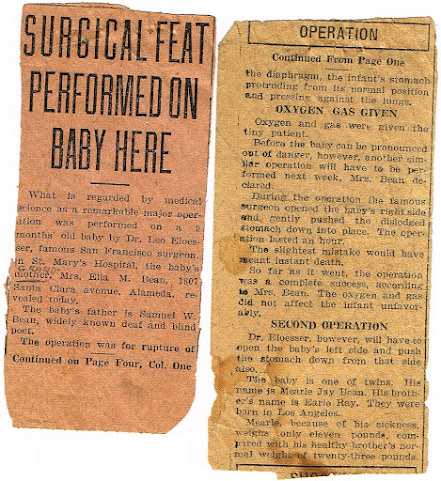

Above: Undated newspaper clipping, likely from the San Francisco, California, area, describing the first of two 1927 surgeries by "famous San Francisco surgeon" Dr. Leo Eloesser on nine-month-old infant Merle Bean to repair his ruptured diaphragm and displaced stomach.
 

Monday, December 20, 2021

About That Family Name


Kids can get so embarrassed by anything that makes them seem different than their friends. In the case of Marilyn Sowle Bean's husband, apparently it was his own name which embarrassed him. 

Given the name Earle, it seemed to have an extra letter at the end, a pretentious "e" which set him apart. Since Earle had also inherited another detail which made him stand apart from everyone else in school—he was born with Marfan Syndrome, causing his unusual height—he must have figured carving an "e" off his name was far more manageable than shedding a foot off his height. Why draw more attention to oneself than necessary?

Apparently, by the time he was about to turn ten, his maternal grandmother Effie Williams Woodworth had gotten wind of the egregious omission, and wrote to inform him of her displeasure. Her May 15, 1936, letter was sent to the boy barely three years after he had lost his mother—Maude, Effie's daughter—leaving him, along with his brother Sam, to be raised by his blind and deaf father and his paternal grandmother.

The letter may have started out like a typical note from a grandmother, with thanks for a Mother's Day gift he had made her, along with a report on how the weather had been in Oroville, California, where she had moved only the past March. She did not miss an opportunity to gently chide Earle and his brother for not writing her more often, then remind them that their dear departed mother's birthday was coming up a week from the next Sunday.

Then came the lecture.

Now Earle, I see you do not spell your name as it should be. Yours is a family name. That's why your mother named you Earle. Your brother's name was Merle. Please remember your name is Earle.
That last Earle was underlined for emphasis. Effie did not want Earle to miss her point. She then launched into the explanation: her paternal grandmother was an Earle—the twin sister "Merriette" Earle. You could tell she was quite proud of her family heritage—though I suspect her grandson did not appreciate the history lesson about to follow.

The Earles were very aristocratic people so you should feel honored. Your mother would wish you to spell it that way. My father's name was Eugene Earle Williams + where ever there is an Earle in our family it's spelled Earle.

Effie continued to regale her young grandson with examples of others in the extended family whose full name included Earle, then threw in a sentence about how the "Indians" in northern Wisconsin captured some of the Earle family—most of whom subsequently escaped—and then abruptly closed the letter with a cheery, "Well Earle, write again" and signed off "lovingly" as Grandma Woodworth.

I had long heard the story of how Earle had dropped that final "e" in his name over the protests of his grandmother, and now that I've received that package of Marilyn's saved letters, I now can read that note for myself. Saved after all those years, first by Earle himself, then by his wife Marilyn, eighty five years later it has finally made its way to me. Some family stories can be substantiated, but the proof doesn't always come easily.

Sunday, December 19, 2021

A Letter Circles Back Home


Have you ever written a letter to family, only to find it returning to you, years afterwards? That's what just happened to me.

Yesterday was the day set aside to head to the antique shop in town where a newfound genea-friend had, earlier this year, alerted me about some family photographs for sale. Since the store is soon closing for the last time, it was important for me to get down there before I missed my chance to regain some of the photographs once owned by Marilyn Sowle Bean.

On the appointed day, I met with the store's owner, who had graciously set aside all she had assembled of the remains of Marilyn's collection.

To cut to the chase on the day's outcome, I suppose I should start out with the hackneyed offering: "first, the bad news." There were no remaining photographs. While I don't quite understand the explanation, apparently an "estate liquidator"—sounds so ominous!—had come in and removed all the photographs. Just the photographs.

Just my luck.

The good news is that, despite the loose-leaf condition of the remainder of Marilyn's mementos, the store owner kept noticing the same names, figured the items all belonged to one family and had, over the years, assembled them into one collection. There were newspaper clippings, club newsletter announcements, and letters—including one letter written to Marilyn from me.

"Hey, that's my handwriting," I blurted out upon seeing the envelope. I hardly expected to find my own writing becoming part of the ephemera for sale in an antique store—at least not yet!

The letter, while brief enough to fit on two sheets of stationary, was written on the occasion of having returned from a visit to Belle Woodworth, wife of Marilyn's husband's uncle—the one whose several sons manifested some form of Marfan Syndrome which lately has prompted me to search the tree for signs of which line might have carried any genetic propensity for the disease. Apparently, that same thought had been on my mind when I first began researching Marilyn's family tree so long ago.

The Bean family was my first foray into genealogy, so I was surprised to see how much information I had already laid out for Marilyn. The letter contained only a thumbnail sketch—and most of that, thanks to the documents assembled by a Woodworth cousin in that pre-Internet era of research. But much of it has been since borne out by my exploration last month.

Besides that letter to Marilyn, there were several others, including notes from her husband's maternal grandmother, Effie Williams Woodworth, on another side of the family's history. While much of the information I've already gleaned from the online resources we now find so beneficial for research, it is the little details newly found which bring these stories to life—stories which I hope to share early next year.

We'll keep in touch, this storekeeper and I, in the hopes that something else might materialize from what used to be Marilyn Sowle Bean's collection of memorabilia. In all likelihood, whatever photos remained from her original collection are now parted out and scattered in multiple directions. But we can always hope that something else will show up from the storeroom, or when the new owner sells those photos, or...or...


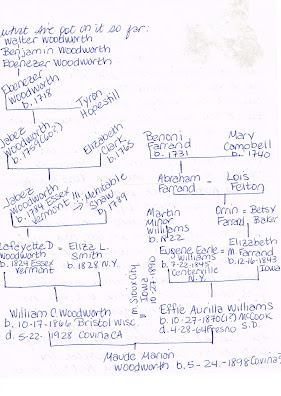
Above: Excerpt from letter to Marilyn Sowle Bean, outlining portions of the family tree of her mother-in-law, Maude Woodworth Bean.

Friday, December 3, 2021

Postscript on Marilyn's Family Photos


It was a "giving back" project which started me on a path of finding "orphan" photos and putting family history research skills to work to return them to long-lost family. Genealogists have long had a tradition of volunteering to help other researchers—especially those just starting out—because we, too, were once beginners. We call it "giving back" in gratitude for what others once did to help us, or "paying it forward," knowing that one day, we too will need a hand with our brick wall research problems.

Never did I think, however, that one day I'd find myself rescuing my own family's pictures, but that is exactly what happened when I got the message that someone had found Marilyn Sowle Bean's photo collection in a local antique store.

Finding Marilyn's photos prompted me to dive deeper into a project which I had started but long ago set aside: to find any sign in her now-deceased son's family tree of the genetic origin of the disease which eventually cost him his life. I already knew there were several cousins in the family related to Marilyn's mother-in-law, Maude Woodworth Bean, who had inherited some form of Marfan Syndrome, but that there weren't any signs of the malady in the other branches of the family.

In this past month—after a research lull following my inability to find details on the month's goal for my Twelve Most Wanted ancestors—we spent the month exploring the family related to Marilyn's mother-in-law, Maude. We made it through each of Maude's four grandparents' lines—Woodworth, Williams, Farrend, and Smith—but I can't say that I located any conclusive evidence to pinpoint that deadly heritage upon any of those four lines.

Granted, seeking early deaths in a family timeline stretching back into the nineteenth century can be a tricky business. Recorded causes of death are not as accessible in those old files as they might be in a modern death certificate. Besides, given that Marfan Syndrome wasn't observed as a separate entity until it was first described by a pediatrician—by the name of Antoine Marfan, as you may have guessed—in 1896, or even used as a descriptor of that set of symptoms until 1931, there would be no mechanism for pinpointing such a cause of death in Maude's ancestors of the 1800s.

But, of course, we could still guess. Any male descendant in Maude's grandparents' lines who died as a young adult caught my eye. However, many early deaths could be ruled out by the usual explanations of that century: injuries from battle in wars, contagion from widespread diseases among them.

But there were others whose demise still left me puzzled—such as Joel Smith, the twenty year old brother of Maude's paternal grandmother. His death in 1852 was noted only by a cenotaph erected where his parents lived in Kenosha County, Wisconsin. Looking closely at the monument, a now-barely legible line after his name and date of death states "Buried in Greenwood Cemetery NY." As you might have guessed, there is more than one cemetery in New York by that name, and no, none of them produces a record of that name when searched on Find A Grave—let alone any obituary published in a New York newspaper.

Along the way in this pursuit of Marfan Syndrome in Maude Woodworth Bean's family, we did make some worthwhile discoveries. I've built out a family tree for Marilyn—yes, her side was included in this effort—and ventured beyond just the names, places, and dates to discover the stories behind the statistics.

But there is a melancholy down side to all the discoveries: there is no one left in the family with whom to share these stories. They are all gone: Marilyn, her two children, her parents and in-laws, even those cousins whose telltale height trumpeted their inheritance of Marfan Syndrome.

On the bright side, I also learned that what once might have been a very elongated death knell—after all, we all have been handed a terminal diagnosis, it's just that some of us get down to the business of it quicker than others—may now be far from such a somber diagnosis. While still a serious consideration, Marfan Syndrome is apparently now one which has been said to allow for "something approaching a normal lifespan." That is a remarkable victory.

All told, I'll still keep working on Marilyn's family photographs. As for the research goal of pinpointing family in previous generations afflicted with Marfan Syndrome, I will keep building out Maude's family tree and learning her relatives' life stories.

But this is a new month, and with the flip of a calendar page comes yet another research goal to conquer. Though I've made the unfortunate choice of piggy-backing December's goal with that of my failed November goal, we'll still review what, if anything, can be found, before moving on to more discussion on "giving back" projects and, finally, wrapping up the month with a look ahead to the new year's Twelve Most Wanted

Thursday, December 2, 2021

Without a Will


...there may still be a way.

Yesterday, we were puzzling over why Maude Woodworth Bean's paternal grandmother, Eliza Smith, would have shown up in two places in the 1850 census. One instance was in her father Abraham's household, while the other was in the household of her husband Lafayette Woodworth's father, along with their two oldest children. Was one entry for someone else by the same name?

While it is true that Smith is a common surname in this country—and Eliza a popular given name of that time period—it wasn't necessary to mount an exhaustive search to demonstrate that there were no others by that name in Eliza's hometown in Kenosha County, Wisconsin. Noticing that Eliza's father, Abraham Smith, had died just five years after that same 1850 census was taken, I thought it might be possible that he left property behind at his passing. And where there's property to be inherited, there is usually a will.

Unfortunately, in Abraham Smith's case, his November 1855 passing was not preceded by any indications which might have prompted him to record his last wishes, for the man died intestate.

Fortunately for us, far removed from the time of that sad loss to family, it turns out that the county in which Abraham Smith died has been diligent about allowing digitization of their records, including probate records for that time period in the 1850s. From the comfort of my own home, I was able to read through the entire packet of material in Abraham Smith's file, and note key entries which will serve our research purposes.

Prime among those documents were a few pages tying family details together. First was the court record that named Abraham's oldest remaining son Amos as the administrator of his estate. As we'd already seen from the one 1850 census—the one including an entry for a single Eliza Smith, their oldest child—Abraham and his wife Amanda were parents of nine children, of which Amos was the third born. As the oldest son remaining in 1855, it fell Amos' lot to perform the duties of administrator.

The second document in the probate file for Abraham Smith was Amos Smith's acknowledgement of a petition in the probate process, a document in which is listing the names of his father's widow and children as heirs. Topping the list was the oldest child, named specifically as "Eliza F. Woodworth aged 27 years," followed by her brother Amos.

Why Eliza showed up twice in the 1850 census, I still can't say, but finding this document helps establish the fact that that Eliza listed in the household of Abraham Smith did indeed represent the same woman listed again in the census as the wife of Lafayette Woodworth.

Best yet was the third document in the probate file: a receipt signed by Eliza Woodworth acknowledging that she received her equal portion of the proceeds of her deceased father's estate.


With that collection of digitized documents easily found online, I am more confident that I've got Maude's grandmother Eliza attached to the right Smith family—a consideration which easily could have led us in a wrong research direction. But with that discovery comes another question: whatever became of the eldest Smith son, Joel? The absence of any mention of his name in his father's probate record is owing to the fact that Joel predeceased his dad by just a few years. At Joel's premature passing, he was only twenty years of age. Could this be an echo of the Marfan Syndrome which struck a devastating blow to so many of the descendants of Maude's generation in the Woodworth family?


Above: digitized copy of Eliza Woodworth's signature from a receipt in the probate file of her father, Abraham Smith; image courtesy Ancestry.com.

Wednesday, December 1, 2021

An Ordinary Name Like Smith


Surnames can have a "Goldilocks" syndrome of their own. When they are too rare, it's hard to find enough records to facilitate a family history search. When they are too common, they bring on enough of an avalanche of resources that the researcher gets flooded with more results than can be handled. It's those surnames in the middle—not too rare, not too common—that become the sweet spot we love to find.

Today, however, is not one of those instances. This is the task I've been procrastinating until the very last moment: looking for someone with the surname Smith.

As we wrap up a month of pondering the family represented by a rescued stash of photographs—the collection once owned by Marilyn Sowle Bean—we now turn to consider a woman by the name of Eliza Smith. Remember that we are seeking any sign of who in the family might have carried the Marfan Syndrome which cost Marilyn her husband, her son, and several in-laws' children. It seemed apparent that the syndrome might have come from Marilyn's mother-in-law's side of the family, one of the lines leading to Maude Woodworth Bean.

So far, we've examined the lines of three of Maude's four grandparents: Woodworth, Williams, and Farrand. Now we need to touch on the fourth grandparent, a woman by the name of Eliza Smith.

Tracing that family line backwards in time, I nearly groaned when I learned that Maude's paternal grandmother had Smith for a maiden name. Fortunately, from that backwards-in-time vantage point, it was not Smith which I had to begin my research with, but Woodworth.

Eliza Smith Woodworth's most recent appearance in a U.S. Census record was at the turn of the century—that other century. There, in her residence in Los Angeles County, California, the mother of eight children now lived with only one other person: her husband of fifty four years, Lafayette. 

At the time of the 1900 census, Eliza stated that she had been born in New York in August of 1828. She indicated that, while her mother had also been born in New York, her father had come from Connecticut.

It is probably a good thing we were able to find Eliza in the 1900 census, for if she had died any earlier, we would have had to settle with finding her back in the 1880 census, at a point which provided us with even less information on this Smith descendant. By the time of Eliza's passing in 1905, thankfully a telegram home to family back in Wisconsin prompted an article in the hometown newspaper of the region where the Woodworths once lived before immigrating to California.

It's a good thing the Kenosha Evening News chose to be so informative about this woman who left town with her family back in 1886. The article gave her name as "Mrs. Eliza Smith Woodworth," and noted that this "pioneer resident" had been a daughter of a local man named Abraham Smith. Furthermore, the obituary listed the names of all eight of Eliza's children, three of whom still remained in the Kenosha County area in Wisconsin.

This detail will be helpful in my goal of examining whether any other branch of Maude's extended family might have exhibited signs of that same Marfan Syndrome which was so devastating to her own immediate family. I'm still working my way through the descendants of each of Eliza's children. However, what I'm curious about is Eliza's collateral lines: who were her siblings?

Thankfully, it was fairly easy to locate an Abraham Smith in Kenosha County, Wisconsin, just as Eliza's obituary had indicated. Though I lamented the newspaper's lack of mention of any siblings which might have survived her—especially those who might still be living in her hometown—I did find Abraham and his apparently large family in the 1850 census. Thankfully, I might add, as Abraham died only five years later.

Abraham Smith's household did indeed include a twenty two year old woman named Eliza Smith. The only problem with that discovery was that I already knew something about Eliza in the 1850 census: that by then, Eliza was married to Lafayette Woodworth, and was already listed elsewhere in the 1850 census as the mother of two children. Why would she be listed in two places?


Tuesday, November 30, 2021

Creative Spelling


Sometimes, it takes building someone else's tree before you can get down to the business of building your own.

Right now, I'm racing the calendar to see if I can find an answer to my impromptu research question for this waning month of November, but it looks like several record keeping clerks have conspired against me through their secret weapon of creative spelling.

Taking that batch of Marilyn Sowle Bean's family photos rescued from a local antique store as my cue, I'm trying to discover just who might have passed the genetic malady, Marfan Syndrome, into Marilyn's husband's family. After all, losing three close family members at young ages—not to mention several cousins in the extended family—is more than enough to make someone sit up and take notice that this family had inherited something alarming.

So far, we've pinpointed the tendency to someone in Marilyn's mother-in-law Maude Woodworth Bean's line. Of Maude's four grandparents' lines, we've already explored the Woodworth and Williams lines, finding many long-lived ancestors, but not much of significance other than the devastating deaths of Maude's sons and her brother's sons.

We've yet to explore two more lines. One, representing one of the most common surnames in the English-speaking world, we'll reserve for consideration tomorrow—if, that is, we're able to correctly pinpoint the right Smith line for that task. The other we will face today.

The challenge right now is that frustrating clerical conspiracy to employ creative spelling when certain, assured spelling eludes the hapless governmental worker. Despite that risk, let's see what we can find on Maude's maternal grandmother, Elizabeth.

We've already noted that when Maude's mother Effie Williams married her father William Woodworth, the 1890 event in Sioux City, Iowa, was recorded in the register showing Effie's father to be Eugene Williams. It was also fairly plain to decipher the handwriting for Effie's mother's given name, Elizabeth. But for Elizabeth's surname? The best I could figure was either Ferrara or Ferrard.


Finding Elizabeth in her parents' household might have been easy, had it not been for the snare of that challenging surname. It was far easier to locate "Lizzie" as the wife of Eugene Williams in Dakota Territory, where the couple had raised Maude's mother Effie and her siblings after their dad, Eugene, obtained the land following his service in the Civil War. From the 1880 census, we can calculate that Elizabeth was born about 1844. That, plus her place of birth in Illinois to parents from New York, was about all we had to go by in finding Elizabeth in her parents' household—whatever their surname might have been.

It didn't help, unfortunately, to look at Effie's siblings' marriage records. Her brother Ernest, for instance, had a marriage record written in the clearest hand one could hope for—with a mother's maiden name duly noted as "Fairfield." Hardly a name beginning with F-e-r-anything.

There was, however, this throw-away entry in the Woodworth family's household in the 1910 census. There, living in the household of her son-in-law, William Woodworth, Elizabeth Williams was included along with two others who were not part of the immediate family. One, listed simply as a lodger, was a thirty two year old single man by the name of Calvin D. Farrand. Sure, he was identified as someone renting a room at the Woodworth's place, but could there have been any other connection?

Over years of reading census records, I've seen signs of "lodgers" and "boarders" listed as such when they actually turned out to be relatives of the head of household—but of too complicated a relationship for the enumerator to be bothered with the details. Granted, I've seen some enumerations in which cousins or uncles have been listed as such, but there have also been many where that familial fact turned up for me only because I pursued a hunch.

This is one of those cases.

Step by step, I looked for an unmarried Elizabeth in census records for a "Ferrard" or "Ferrara" surname—or anything similar. All I needed was a daughter born in Illinois about 1844, with a surname that started with F. Wildcard time.

In 1860, the most recent census in which Elizabeth would have been living with her parents, I found a fifteen year old Elizabeth living in the Iowa home of one Orren Farrand—same surname as the "lodger" in future Elizabeth's son-in-law's household. Orren and his likely wife were both noted to have been born in New York.

But then, that creative spelling conspired to work against us. Reaching back to the earlier decade, the 1850 census had a scribbled seven (?) year old Elizabeth in the home of—what was that?—Orin Farnd. The only consolation was that the location in 1850 was Elizabeth's birthplace of Illinois, the two supposed parents were born in New York, and three of the other siblings' names—Abram, Franklin, and Lyman—seemed roughly to match the 1860 report. It was time to start building a tree for this possible Farrand family.

Long story short, it turns out that this Elizabeth's brother Abraham did indeed have a son named Calvin. Though his year and location of birth didn't quite match up to the 1910 report in the Woodworths' household years later, following that Calvin's line may provide additional confirmation. It was encouraging to note, in a twisted sort of way, that this family, too, had their surname's spelling creatively rendered: Ferrand. Getting ever closer to the Ferrard that started me on this search.

So, the "lodger" named Calvin Farrand in William Woodworth's 1910 household may more correctly have been identified as William's mother-in-law's nephew. I can't say I blame the enumerator for taking a shortcut in such a case. But discovering that connection still doesn't answer my question about the actual spelling of Elizabeth Woodworth's maiden name. Was it Ferrara? Ferrand? Farrand? The impossible spelling shorthand "Farnd"? Or maybe that marriage record had it correct at Fairfield and we're chasing the wrong rabbit.

Too late to have saved me this wild chase, I realized that, though the Ancestry.com collection only provides transcripts of California death records, sometimes it is well worth the effort to track down the same record at FamilySearch.org—which is exactly what I did.

There, thanks to the fact that I had signed into that website with my own account, I was apparently rewarded with not only a transcription of all the pertinent information on her death certificate, but an image of the actual record. Preserved in a clear hand, that digitized gift revealed without question what the reporting party—Effie Williams Woodworth, herself—asserted were Elizabeth's parents' names: Betsey Baker and Orin Farrand.      

Monday, November 29, 2021

Twins in the Family


If you stumbled upon the given name Mariet in your family history wanderings, and thought maybe, just maybe, that might be a hint to look for a twin sister named Harriet, you might be on the right track. That, at least, turned out to be the case when I tore through every resource I could find online concerning the roots of Maude Woodworth Bean's paternal grandfather, Civil War veteran Eugene Williams.

It had been easy enough to locate Eugene in the 1860 household of his father, Martin M. Williams, since he had mentioned upon enlisting in 1862 that his home was in Marcellon, Wisconsin. It was a snap to deduce that the Martin Williams household in the previous census, despite being in New York rather than Wisconsin, showed the same family embedded within the extended family of one Solomon Williams.

But what about Martin's wife, Eugene's mother? Unfortunately for our search, her name was mangled in the 1850 census by an enumerator with a frustrating scrawl and a hurried attempt at correcting what might initially have been a spelling error. No matter what the entry was in reality, the name provided in the 1860 census—Mary—certainly was not the same as what was noted in 1850.

With no marriage record online that I could see—presumably occurring in the state of New York, even though the woman was noted to have been born in Vermont—we're left to poke around every other possible detail we can find. This is where search engines like Google become our best friend.

This is also, as you'll see shortly, why I never flatly discard family traditions as mere hearsay. You never know when a story might turn out to have some shred of validity to it.

Let's look first at the problem spot which left me stymied with yet another contradicting report. A death record told me that a woman by the name of Mariet Williams had died in Woodbury County, Iowa, in 1887. At that point, her age was given as sixty four, which would put her year of birth around 1823. Her place of birth was reported to be Vermont.

All that would have led a researcher to think we were moving along swimmingly, except for one tiny detail: the death report indicated that this Mariet Williams was a single woman, not married.

Granted, Mariet is not Mary, and certainly not the same as "Margett"—and keep in mind the wildcard entered into this search of the detail of a "second wife" for Martin Williams—but we need to see what we can find on this death and burial information for Mariet Williams.

The death record in Iowa indicated burial would be at Elk Point in Dakota Territory. Looking at the cemetery information on Find A Grave for the location of Martin Williams' own burial, I did a search for Mariet Williams. There was indeed a burial for a Mariet E. Williams. Though the memorial didn't include any photograph of a headstone, it provided the location for the burial: "Grave 5, Lot 59, Block 4, Section 2.

Location for Martin Williams' own burial? "Grave 4, Lot 59, Block 4, Section 2."

Granted, I can't vouch for that particular cemetery's layout scheme, but just on general principles, I'd say the two of them were buried next to each other. I'd call that husband and wife, wouldn't you?

Of course, there still is the question of whether this was the first wife or the second wife. Tracing Martin's daughter Frances to the end of her life to see what was noted for her mother's name doesn't really help. If Frances Williams Beggs had died in the county where she had last been living with her husband—Will County, Illinois—there still wouldn't have been a digital image of her death certificate, but at least the transcription would have been as thorough as it was when Charles Beggs had died on March 1 of 1931. By the end of that same month, Frances had apparently moved into the city of Chicago to be with her daughter Mima during her period of mourning. She died before that same month was out.

Cook County also provided transcriptions of the certificate information, but not as thorough a recounting of the deceased's life history as that of Will County. At least it included the name of the deceased's parents. According to the reporting party, "Mina" Beggs Neef, Frances' mother's maiden name was Elizabeth Morse

Not what we were expecting.

Could Mima have gotten her mother's information wrong? Might that have actually been the name of Frances' father's second wife? I won't say this is the first time I've seen a death certificate which included errors. But we can't just presume without a supporting argument, and that takes documentation.

First, let's reconstruct Martin Williams' timeline. According to his 1896 obituary, it reported that though he had died in Hand County, South Dakota, he had come to that location "a year or so ago" from Iowa, not directly from his former residence in Union County in Dakota Territory. Furthermore, he—but not any wife—was noted to have traveled from Sioux City to attend the 1890 wedding in Chicago of his granddaughter Addie Beggs. Sioux City, by the way, is located in Woodbury County, Iowa. And the 1890 occasion in Chicago would obviously have occurred after Martin had lost his wife, since Mariet died in Woodbury County in 1887.

What I'm lacking, in the face of this possible error in reporting on Mariet's daughter's—not to mention her own—death record, is any further information on who Mariet was. It would have helped to retrieve Martin and Mariet's marriage record, for instance, or any detail on Mariet's maiden name, but online resources were not providing what I was seeking.

Though I am death on copying other people's family trees, I certainly am not averse to exploring the way markers on someone else's well-documented genealogy. That is exactly what I did, looking for Martin and Mariet Williams as a family grouping. Someone had posted a link to a page in the 1888 publication, The Earle Family: Ralph Earle and His Descendants which, incredibly, included just what I was seeking: details on one Mariet Earle who had married a Martin M. Williams in 1844.

And yes, she had a twin sister named Harriet Earle.

The funny thing is, I'd known about that Earle surname for almost as long as I've done family history research. It all goes back to a story told to me by Marilyn Sowle Bean, the woman whose rescued photos prompted this month's research project. In one of the first successful genealogical interviews I ever conducted, years ago, Marilyn had told me that her husband's name was actually Earle Raymond Bean, but that he felt awkward about what seemed to be the pretentious spelling—Earle instead of the more common Earl—and had informally dropped the "e" from his given name.

What Marilyn never mentioned, but I suspected, was that "Earle" was actually a family name—in other words, a surname from somewhere back in the family's history. I had no idea it would take this long—so many losses before that one win at the antique store last spring—before I'd be prompted to actually find where that family name fit into the picture.

Now, though Marilyn and her family are no longer here for me to share this victory, I can see that the Earle surname would have provided eligibility to join the Daughters of the American Revolution through the patriot Thaddeus Earle, Mariet Earle Williams' paternal grandfather. It turns out that Marilyn's own mother-in-law Maude Woodworth Bean's Earle ancestry had a long heritage in this country. All I can do now is wonder if she ever knew.    

Saturday, November 27, 2021

Oh, Messy


Pinning one's research hopes upon the life events of one solitary person can become disappointing. Take the case of our Maude Woodworth Bean's maternal grandfather, Civil War veteran Eugene Williams of Marcellon, Wisconsin. Sure enough, we were able to find Eugene as a fourteen year old in the household of his father Martin in the 1860 census, but that one solution opened the door to another research problem: did we, indeed, follow the right Martin Williams through his life's trajectory?

Of course, it didn't help that Martin's Find A Grave memorial, for his burial in what used to be called Dakota Territory, led us to three different dates of death for that one man. Seeing that his obituary, which was posted on his memorial, mentioned a daughter by name, I followed that clue to see whether any hints were strewn along her life's path to help me piece together the right Williams family. (Of course, along the way, I kept my eyes open for any signs of Marfan Syndrome, my other research goal for this month.)

Though Martin Williams' obituary did not mention his son by name—that would be Eugene, if we are correct in our assumption—it did identify his daughter's married name. However, Frances Williams—or Francis, as it was often written in records—was not a helpful subject in our quest to confirm this Williams line.

From the start, records led me to wonder whether there were two girls given that name in the Martin Williams family. For one thing, discovering the Martin Williams family in the 1850 household of Solomon Williams in New York—presumably Martin's father—made it clear that there were two children likely to be his: Eugene, age four, and Frances, who had been born in New York ten months prior to that July 25, 1850, enumeration.

When we jump ahead ten years to the 1860 census, though, we find the same family of Martin Williams, as we said before, living in Marcellon, Wisconsin, with Eugene being a predictable fourteen years of age (do the math), and Frances showing up as expected at ten years of age. Only problem: Frances' place of birth was not given as New York, as we had previously seen, but as Wisconsin.

To make matters worse, the handwriting on the 1850 census rendered the child's mother's name something like Margett, while the 1860 census read clearly, Mary. Could this have been the second wife mentioned in Martin's obituary, years later? But Mary was precisely ten years older than Margett's stated age in the previous record.

Other records noted Frances' place of birth as in Wisconsin, as well, so we can't simply discount that one entry as a fluke of recordkeeping. 

Following Frances' history to glean any hint that we might be on the right track, we can see she and Charles Beggs were married in November of 1869, thanks to the 1870 census. Encouragingly, they lived in Elk Point, county seat for Union County in what was still Dakota Territory, same as our Frances' brother Eugene did. But perhaps the rugged life in Dakota Territory made recordkeeping a challenge, for I've found no digitized record of their marriage online—at least not the type to provide names of parents.

It wasn't until Charles and Frances Beggs' oldest daughter was married—by this time, the Beggs family was living in Chicago—that I found the slightest connection to the Williams family once again. From a wedding announcement published in The Daily Inter Ocean on December 11, 1890, we learn that among the out-of-town guests for the event was M. M. Williams, by then of Sioux City, Iowa. Significantly, while other guests were mentioned as "Mr. and Mrs." the Williams entry had no mention of a wife. Could this have indicated Martin Williams was present at the wedding, following the death of his wife?

Of course, if I could have located any records for Martin Williams' son's passing—with the helpful addition of parents' names—it would easily have tied the family together for us (or told us we had the wrong people altogether). As it is, this means we still need to search further.

In the midst of this mess, though, pops up one more question: no matter which woman was the "second wife" of Martin Williams, where had either of the wives been buried? For surely someone must have become the incentive for the family to return Martin's body to Elk Point Cemetery from his latest home in Hand County, South Dakota.

Actually, there was someone supposedly buried in that cemetery, with the name of Mariet Williams. Only problem: a record of her death indicated that she was not a married woman, but single at the time of her passing. Talk about messy: was that record correct?

There are simply some research questions which demand a search of records which are not yet—if they ever will be—digitized. Barring the ability to hop a plane and fly to South Dakota, though, there may be a few more clues to trace so that we can piece together a coherent story. 

Friday, November 26, 2021

A Rant About Really Old Newspapers


Why can't archived newspaper collections contain the complete holdings of a given newspaper? What's up with gaps in publication dates? Why does the very date I want happen to fall in the cracks of those missing editions? And more to the point, what do you do when you are researching a name as common as Martin Williams, and run into not one but two conflicting reports about death—but can't locate the original report to provide confirmation? 

Here's the situation. One helpful Find A Grave volunteer indicated there was a Martin Williams buried in Elk Point Cemetery, South Dakota, after his supposed death in 1882. A record of the order for a headstone for this Civil War veteran reported "M. M. Williams" had died on April 1, 1897, and sent the completed marker to the same Elk Point Cemetery.

As if to clear the air on this research dilemma, yet another Find A Grave volunteer transcribed an obituary for a Martin M. Williams who had died in nearby Hand County, South Dakota, but was buried at Elk Point Cemetery on February 3, 1896.

If all three of these entries were concerning the same Martin M. Williams, which date was correct? My tendency was to go with the newspaper report, but we all know how easily editorial errors can slip into newsprint.

The solution? Find the actual newspaper edition to see for myself. That, however, is easier planned than executed. The trouble with archived newspaper collections is that no one repository seems to have the entire breadth of a publication's history.

My first stop was to check Chronicling America, the U.S. Library of Congress collection of newspapers published across the nation throughout its history. Using the website's search engine, I could locate the publication in question easily enough—I was looking for The Pioneer Press, printed in the city of Miller, county seat of Hand County, South Dakota.

The problem was, I couldn't isolate the specific edition identified by the Find A Grave volunteer, printed on February 6, 1896. Smart me: I thought I'd experiment with using the website's advanced search function, but it told me the one thing I've become accustomed to discovering.

That date was not in the Library of Congress collection.

I could, of course, go one by one through each of the companies I subscribe to for archived newspapers—not to mention the resources for accessing newspapers for free—but I've done that before and know how frustrating it can be. So I cut to the chase and brought my question to Google—the search engine, not the newspaper collection. No more navigating gaps in collections for me.

As it turned out, GenealogyBank provided my answer, confirming the wording of the text added to Martin Williams' Find A Grave memorial. In addition, I found a "Card of Thanks" inserted below Martin Williams' obituary, signed by Mrs. Williams and Mrs. Beggs, stating

We tender our sincere thanks to the many friends who have so kindly rendered assistance and extended their sympathy during the last sickness of our beloved husband and father.

The one regrettable detail in finding Martin Williams' obituary—and confirming it with the digitized image of the original publication—was to see the list of his survivors. According to the Pioneer Press, Martin Williams left "a second wife, a son and daughter to mourn his loss." While the article never mentions the son's name, nor Martin's wife's name—that, supposedly, would be improper to do during that era—it does inform us that the daughter was a "Mrs. Beggs of Chicago."

Whoever that "Mrs. Beggs of Chicago" turns out to be, she becomes the key to confirming whether this Martin Williams was one and the same as the father of Eugene Williams, maternal grandfather of our Maude Williams Woodworth.


Tuesday, November 23, 2021

Effie Aurilla's Great-Grandmother


Our task, as family historians, is to push back ever so tentatively through the years from where our known ancestors used to live to their earlier records. So far, in exploring the Williams line of Maude Woodworth Bean's ancestry, we traced her mother, Effie Aurilla from her 1890 marriage to William Woodworth in Iowa to records of her earlier years in the Dakota Territory household of her father, Eugene Williams. But what about Eugene's earlier years?

Despite Eugene's claim to have been born in New York, we found a possible candidate for this young man in the 1860 home of Martin and Mary Williams of Marcellon, Wisconsin. Since Eugene was born in 1846, I wanted to see if I could find him in the 1850 census. Sure enough, there was a family which included a four year old boy by that name—but the family lived in New York, not Wisconsin.

Leading off at the top of the page for a town in Allegany County called Centerville, I found the impossible scrawl of a hasty enumerator who had jumbled ten people with two different surnames into the same household. The head of the household was fifty five year old Solomon Williams, but in addition to baby Frances and her four year old companion Eugene, the household included a ninety one year old man by the name of Philo Hawley and a female companion of the same surname trailing Philo by only a few years.

Somewhere in that same household was the name we are looking for—Martin Williams—exactly ten years younger than the age we had found him at in the 1860 census so many miles to the west of this New York location. Still, that would not be too alarming, considering our Eugene had claimed through most of his life that he had been born in New York. Perhaps this was home and Solomon was Martin's father.

What attracted my attention to this household was not just the jumble of names or the spread of ages, but the particular name of the woman listed right after the line for the head of this household. Her name—and I'm presuming this would turn out to be Martin's mother and, eventually, Effie's great-grandmother—was Aurilla.

Now, before you go regaling me with warnings about coincidences, let's just take a look at one thing—or at least as close a thing as we can get to actual documentation. Consider the name Aurilla. How often do you see a name like that? 

Just in case, I did a little exploring. I checked the name data tucked away in a fun little corner of the U.S. Social Security website. For the earliest year I could find listed on the site—the decade of the 1880s—Aurilla did not even make a showing in the list of the top two hundred names for girls. Looking at this from another angle, for a baby girl's name in 1885, the earliest date I could bring up on another website, the name Aurilla ranked 881 in popularity for that year. If families routinely named their babies after older relatives, those stats echo a quite limited number of honorary namesakes.

That said, while I consider this to be a promising sign that we are on to something with the household of Solomon Williams, you know we can't just stop there. We'll have to do some more exploring to confirm this hypothesis that Eugene Williams' dad was the Martin Williams who used to call Centerville—and more importantly, the household of Solomon and Aurilla Williams—home.

Monday, November 22, 2021

Connecting the Dots
Between Generations


Sometimes, it takes a leap of faith to connect the dots between generations—or a little guess work followed by thorough research and a lot of explanation. Finding Eugene Williams' roots may be one of those instances.

It has been a rather routine route to connect the family of Marilyn Sowle Bean—former owner of the photographs I got to rescue from a local antique shop—with its roots, but only to a point. Earlier this month, we located Marilyn's mother-in-law, Maude Woodworth Bean, in the home of her parents, William and Effie Woodworth. We also realized that the Marfan Syndrome which had struck down so many members of the extended family seemed to center in the branch associated with the Woodworth family, so we've been exploring each side of that family for clues from previous generations.

Last week, we focused on Effie's line, the Williams family, and discovered that her father, Eugene, had served as a very young recruit in the Union Army during the Civil War. Given the many records of the Civil War, it was fairly straightforward to trace Eugene Williams from the point of his August 15, 1862, enlistment at Portage, Wisconsin—but where was he before that point?

His records from the last years of his life at a Home for Disabled Volunteer Soldiers in California indicated that Eugene Williams had started life in New York state, but where had he been living when he enlisted in Portage, Wisconsin? Williams is a fairly common surname, making me doubt the success of a point-blank search.

If the soldier who died as Eugene Williams had kept that same name his entire life, and if the information he gave at the end of his life—that he was born in New York about 1846—kept constant throughout all the other reports he provided in his lifetime, it turns out there was only one possibility in the state of Wisconsin for such a man.


That man, at least in time for the 1860 census, lived with his parents and sister in the town of Marcellon, Wisconsin. Fortunately for us, Marcellon is a town of barely one thousand people—but that is now. Back in 1860, the entire Columbia County, where Marcellon is located, contained twenty four thousand residents, making it quite possible that there could be a name twin lurking in those numbers. For this, we tread tentatively.

Right now, our task will be to examine the possibility that the Eugene Williams found in the household of Martin and Mary Williams is one and the same as Effie's father Eugene who died in California in 1914. Sometimes, to connect those dots—and to be sure we've followed the right line—we need to explore lines which may, upon closer scrutiny, turn out to be false leads. We'll take some time this week before the holidays to examine this particular household of Martin and Mary Williams from Marcellon.


Inset above: Excerpt from the 1860 U.S. Census for the town of Marcellon in Wisconsin, showing the Martin Williams household; image courtesy Ancestry.com.

Friday, November 19, 2021

Home From Alabama
to Wisconsin — and Beyond


The early wars in American history, whether Revolutionary War, War of 1812, or the much later Civil War, may have pointed to one detail held in common between them: their soldiers, once returning home, seemed more likely to have caught the wanderlust to move on to other lands. I've traced my colonial roots moving from New England to Virginia, then beyond to South Carolina and Georgia. And my husband's War of 1812 ancestors often took their travels during years of service as cue to move west from Pennsylvania or Ohio.

In the case of Eugene Williams, at his youthful age at enlistment in the Union army, it may come as no surprise to learn that once he was discharged in Alabama at the close of the Civil War, after returning home to Wisconsin, he had the urge to travel further onward.

One factor which made that option a possibility was the availability of land. However, while soldiers from previous wars may have had the option of taking up bounty lands or land grants, those who served in the Civil War did not exactly have that opportunity, as bounty land was not given out after 1855. Still, land was there for the taking, even in the 1860s onward, and that is apparently what enticed Eugene to roam westward from Wisconsin.

Genealogists are particular keen on locating documents such as bounty land records, because for research purposes, they count as a double whammy. Not only does discovery of such a record pinpoint the ancestor by location and time period, but provide reference to military service.

On a hunch, I checked the General Land Office records at the Bureau of Land Management website for any sign of Eugene Williams after the war. Keep in mind, I had found Eugene Williams first by tracing his line backwards in time from his descendants—from Maude Woodworth's mother Effie Williams to her father, Eugene. In that journey, I discovered that in the 1880 census, Effie was living with her family in what was then considered Dakota Territory, in Union County, which is now part of the state of South Dakota.

Sure enough, there was a property record for someone named Eugene Williams in that very county—Union County. The property size was eighty acres, and by 1874, it was all his. How long he held on to the property, though, is hard to determine just now. I can tell by the time of the 1880 census that Eugene and his family were living in Elk Point City—as small a city as it must have been, considering the population for the entire county at the time—and Eugene was listed not as a farmer but as a laborer. By 1890, when his daughter Effie was married to William Woodworth, the Williams family was listed as living in Sioux City, Iowa.

Still, discovery of land records for this veteran of the Civil War provides one more way to track his life's trajectory, as well as that of his daughters and sons. As every genealogist knows, though, yet another step is calling out to us, to answer the question of where this Civil War veteran came from, before his decision to enlist, back in Wisconsin at the start of the war.  

Thursday, November 18, 2021

On to the Bright and Shiny


Some research tasks may seem rather perfunctory, especially the deeper we genealogists dig into the documentation. On the contrary, in the case of my research goal for this month, inspired by recovering Marilyn Sowle Bean's photograph collection from a local antique store, I've been attempting to pinpoint the line in her son's pedigree from which he inherited the genetic syndrome which eventually caused his death. With such a mission, the mood can sometimes turn somber, so it's no surprise that I yearn for a diversion. Stumbling upon a brief mention in another obituary caught my attention, and before I knew it, I was off chasing the kind of detail that family historians call a Bright Shiny Object.

The explanation yesterday served merely as the set up for today's pitch: background information to provide perspective on what I found regarding Maude Woodworth Bean's maternal grandfather, Eugene Williams. Now that we've established that connection, it's on to the Bright Shiny Object which pulled me away from this month's research goal.

The BSO was actually a line buried in the 1964 obituary for Maude's mother, Effie Williams. Effie, in turn, was daughter of the man we discussed yesterday, Eugene Williams. Effie had married her teenaged sweetheart William Woodworth in 1890, who had traveled home to Iowa to claim his bride and return to his family's new home in southern California. When William died in 1928, it didn't take Effie long to pack up the family's remaining belongings and move north to be closer to her oldest daughter Nieva.

Nieva had, by the time of her father's death, married, birthed two children, moved to Fresno where she and her husband Fred Searcey welcomed two more children—then lost one—and apparently divorced. Not quite one month after William Woodworth's death, Nieva was married again, this time to Joel Chamberlain.

Perhaps in all the turmoil, it seemed a reasonable move for Effie to head to Fresno to help her daughter with her young family. Whatever the reason was, we learn from Effie's obituary in 1964 that she had been a resident of Fresno since 1930.

There was one other detail to learn from that newspaper entry. Though the obituary was far less a biographical sketch than was her husband's in 1928, it provided one fact I hadn't gleaned from any other source. After mentioning that Effie was born in Jefferson in what is now the state of South Dakota, the article added this point:

She was a member of the Daughters of Union Veterans of the Civil War, Camp No. 8.

You can be sure a statement like that turned into a Bright Shiny Object for a lineage society junkie like me. Finding that, I was off, searching the website of the Daughters of Union Veterans for any sign of their member Effie Williams Woodworth—or at least a token entry honoring her Civil War veteran father.

I found nothing. No sign, even, of "Camp No. 8"—or any explanation to learn how to convert that old terminology to the current usage of "tents" for chapters.

Could that mention in the obituary just have been a family myth? I've learned it is not uncommon for families to pass along romanticized stories of their ancestors, and perhaps I had just stumbled upon such an example. Whether Effie was a member of the Daughters of Union Veterans, I couldn't say from an initial search, but yesterday's exploration into the records of Eugene Williams' last years showed clearly that he was being provided medical services as if, as a veteran, he had been entitled to them. What else could I find to support that statement?

To their credit, the Daughters of Union Veterans included a helps page on their website. Though their website also provided a tutorial for how to search a second website for veterans of the Grand Army of the Republic, the only Williams entries I could find were for other individuals. Still, the tutorial indicated the possibility that more photographs and biographical sketches would be added in the future—in other words, this was far from a complete listing. There had to be more information to confirm whether Eugene Williams had, indeed, served where his last records reported he had.

Sure enough, taking this question to the search engines—after all, what is a Bright Shiny Object for, if not to pursue?—there were several resources to confirm his involvement in the Union army. Prime among them was not only Eugene's application for a pension based on his service, but his widow's request for benefits after his death. His July 1890 original filing likely followed his attendance at his Company's reunion meeting in Milwaukee at the end of the previous August. The reason his name was included in the printed program for the 1907 reunion—as not in attendance—was likely because he and his wife, Elizabeth, had made the long journey to live in California recently enough that his address was still reported, in error, to have been in Sioux City, Iowa.

So what was Eugene Williams' Civil War story? Enlisting August 15, 1862, at Portage, Wisconsin, he served as a private in Company C of the 23rd regiment of the Wisconsin Infantry. Sure enough, thanks to a reprint of the names of men in that regiment posted at Internet Archive, we learn Eugene Williams was then a resident of Marcellon, Wisconsin, only about ten miles to the east of the town where he enlisted—a valuable clue in tracing his earlier history.

As to his experiences during the war, we don't have the privilege of preserved letters sent home like some researchers have found, but there are ample resources to trace the movements and duties of his regiment from that point until the close of the war. Wikipedia includes a brief entry on the 23rd regiment, and the wiki at FamilySearch.org provides an overview, complete with referrals to other resources. A website called the Civil War Archive provides a brief history of each regiment from each state, including Eugene's regiment from Wisconsin, and the National Park Service website includes an overview, as well. The Wisconsin Historical Society website does the same for those companies from their own state.

That whirlwind tour of available resources to trace the movements of Eugene Williams' comrades in their tour of duty was far more information than I'd need to just confirm basic details of his life, of course, but hey, this is a Bright Shiny Object, and I'm a history buff. Information is out there, if we want to learn—and are willing to test the search waters with available technological tools.

All told, at the close of the war, Eugene was discharged on July 4, 1865, in the place where he had last been serving: Mobile, Alabama. From there, it was the long trip back to Wisconsin, but that was not the last stop for this nineteen year old corporal. Yet, as easy as it was to trace Eugene Williams' movements in his nearly three years of service, finding his next steps wouldn't be quite so clearly laid out.

Wednesday, November 17, 2021

The Gift of Governmental Documentation


Every so often, tracing the trajectory of an ancestor's life story leads us straight into the midst of conflict—the kind of conflict which, though unfortunate, becomes a rich source of documentation. For our American ancestors, such was the War Between the States—or, as Eugene Williams' side of the story would characterize it, the War of the Rebellion.

Eugene Williams was Maude Woodworth Bean's maternal grandfather. Though he was born in New York, his as yet uncovered story was the reason why Maude's mother, Effie Aurilla Williams, was born and raised in what was once called Dakota Territory, but spent her later years in Sioux City, Iowa, where she met her future husband, William Woodworth.

For the young couple Effie and William, from the point of their wedding in 1890, it was off to California and the adventure of a new life together. It wasn't long, however, before Eugene and his wife Elizabeth followed their daughter's path. And with that move came the gift of governmental documentation which allows us a clearer glimpse into the wanderings of Effie's father.

Eugene and Elizabeth Williams were still residing in Sioux City by the time of the 1900 census, but by December 14, 1904, Eugene was admitted to a National Home for Disabled Volunteer Soldiers—but not in Iowa. His admission to the facility was due to heart disease, and the records indicating this also revealed that, prior to entry at the Home, the couple had been living in Irwindale, a town not far from the southern California home of their daughter and son-in-law, the Woodworths. The 1910 census revealed the identity of that National Home as the "Pacific Branch" located in Malibu township in Los Angeles county.

From the scant entries on the page of Eugene's record at the Home, we gain everything from a physical description—blue eyes, fair complexion, height of five feet and eight inches—to the cause of his death on May 11, 1914. Though a veteran's marker was supposedly placed on his grave at the Los Angeles National Cemetery—at least, according to transcribed records included at Ancestry.com—there is no photograph of such featured on his memorial at Find A Grave.

That, however, is not the information I'm keen to glean at this point, though it does need to be checked. What I'm grateful to find in that same record of his admission to the National Home was the specific details of his service in the Civil War. Learning that on August 15, 1862, Eugene Williams enlisted to serve as a private at Portage, Wisconsin, along with the details on the company he was assigned to, becomes my springboard to follow his fate from that point until the time of his discharge at the close of the war.

Details such as those afforded by this government record provide us entrance into a well-stocked inventory of historical details—the macro-history through which this micro-history traveled.

And that recounting of Maude's grandfather brings us to our stepping off point tomorrow in exploring my latest discovery in that research weakness called Bright Shiny Object Syndrome.     

Tuesday, November 16, 2021

What About the Williams Line?


Sometimes, family history research takes the form of speed searching. That certainly was the case when I took a whirlwind tour through the Williams line of Maude Woodworth Bean's maternal grandfather. My goal—the overarching goal of this month's research—is to see which line related to the Woodworths might have passed along the Marfan Syndrome which manifested itself in Maude's sons, nephews, and even grandson.

Speed searching through the paternal line of Maude's mother Effie Aurilla Williams didn't point to any lives tragically cut short in their prime—although, oddly enough, there were a couple spouses who did die at a relatively young age. However, one unexpected discovery emerged as I read through the marriage announcements and obituaries for the various Williams relatives.

Effie's brother Arthur Williams had three sons, one of whom—Ray—held a bachelor's degree in music and was noted to have served as soloist at his younger brother's wedding. (Considering this musical bent in the family, I couldn't help but wonder whether that youngest brother's name—he often went by "A. Minor Williams"—wasn't an inside joke in the family.)

The mention of musical talent in the family caught my attention for two reasons. First, the former owner of the photographs I had rescued from a local antique shop, Marilyn Sowle Bean, had a musically talented son, herself. That was the son who lost his life to Marfan Syndrome.

Then, too, in Marilyn's photographs was a picture of her brother-in-law—Sam, the poodle trainer for the Ice Follies, who also died of Marfan Syndrome—playing his guitar and singing with friends at an informal evening gathering. The family had always left me the impression that somehow such well-developed talents as this were a hallmark of the syndrome, but here was an example of musicality minus malady.

While the propensity to perform artistically may have been passed down to Marilyn's son and brother-in-law from the Williams' line, in my rapid-fire race through the Williams pedigree, it didn't appear there was any sign of Marfan Syndrome in that side of the family.

However, as often happens in such searches, there were a few other details of interest that I'd like to pause and examine. Call it the Bright Shiny Object Syndrome if you will, but before we judge such a dalliance, let's just call it productive exploration and grant a day's lenience to explore a bit more about the Williams line.


Above: Photograph of Maude Woodworth Bean's son Sam playing the guitar at an informal outdoor gathering; undated picture from the collection of Marilyn Sowle Bean.

Monday, November 15, 2021

Maude's Mom


It may have been a stash of family photographs found in a local antique shop which prompted me to tell the story of their previous owner, Marilyn Sowle Bean, but it was the tragic legacy bequeathed upon Marilyn's husband, brother-in-law and, eventually, her own son which has me searching through Marilyn's mother-in-law's family tree.

Maude Woodworth Bean apparently was a carrier of a once-deadly disease known as Marfan Syndrome, the cause of the untimely deaths of the men in the Bean family. Prompted by that—plus the serendipitous discovery of those family pictures—I've been trawling through the Bean pedigree to see if I could pinpoint which branch of the family might have contributed the unfortunate tendency.

We've already explored the paternal Bean family briefly, but having discovered the same malady in the descendants of Maude's brother's family, we've lately been seeking signs in Maude's own Woodworth family. Though over a century ago there were some childhood deaths on the Woodworth side, there certainly were also some long-lived relatives, as well. But what about Maude's mom? We need to explore that branch of Maude's story, as well.

It was thanks to Maude's father's obituary—a personal history encased within a funeral announcement—that we can glean the timeline of when William Woodworth married his wife. Though as a teenager, William had moved to southern California with his parents, Lafayette and Eliza Smith Woodworth, he did not forget the sweetheart he had left behind in Sioux City, Iowa. He returned there to marry her on October 27, 1890, and bring her home with him to Covina, California.

From the actual record of their marriage, we learn that William's bride—eventually, Maude's mother—was named Effie A. Williams. Though I've been able, from other family records, to determine that the middle initial "A" stood for Aurilla, I have yet to discover any other first name than what seems to be more nickname than formal given name.

According to the Sioux City marriage record, Effie was twenty years of age at her wedding, having said her nuptial vows on the same day as her birthday. However, from other records, it looks like she was actually nineteen at the point when she said "I do."

There was another discrepancy on the marriage register in Sioux City which caused a bit more research difficulty than the year of Effie's birth. Her father's name—Eugene—might have been clearly inscribed in the register, but her mother's maiden name looked like Elizabeth Ferrard. Or was it Ferrara?


Elizabeth it may have been—we can see that thirty years later in Elizabeth's own obituary. Unfortunately, though Mrs. Williams' obituary named her pallbearers and even the names of the soloists rendering her favorite hymns at the funeral, not one mention was made of the deceased's survivors, other than the daughter—"Mrs. W. C. Woodworth"—in whose home she had passed. It took quite a bit of exploration to realize that neither Ferrard nor Ferrara was her actual maiden name.

To explore the possibility that Marfan Syndrome may have made its appearance in Effie's family, rather than Maude's paternal Woodworth line, of course we don't need to start with her mother's pedigree. We can search first among the Williams kin. That will buy me more time to explore the possibilities for Elizabeth's maiden name. In the meantime, we'll examine what we can find on the paternal side of Maude's mother's family.


Above: Inset from register of marriages from Woodbury County, Iowa, showing the October 1890 entry representing Effie A. Williams, bride of William Woodworth; courtesy Ancestry.com.