Showing posts with label Family Photos. Show all posts

Sunday, May 10, 2026

A Mother-Daughter Remembrance


On a day such as this, people will display photographs of mothers, proudly posting them on social media. Some people might even share a three or four generation photo: baby, mother, grandmother, and great-grandmother. Me? I never had the fortune of knowing my paternal grandparents, let alone any of my great-grandmothers.

Thankfully, I have an older cousin who is prone to unearthing family records and periodically sending them to me. In the most recent package from this cousin, I found a few photos he had sent me before. I guess I can forgive such oversight; this cousin is now well into his nineties. What's important is that he knows so much about a family whose habit in past generations was to keep quiet about their origin. This cousin is indeed the relative who, if anyone did, would know the telltale details about those long-gone (and tight-lipped) ancestors.

Sure enough, this latest package inspired me to confirm those duplicates. Double-checking with some previously-sent photos located during my spring cleaning stint earlier this month, I pulled up a picture of two women with a label which, after some reflection, seemed to be slightly off.

The subjects of the picture were barely visible in this time-ravaged photograph. Thankfully, my cousin had labeled the two women, but in thinking it over, I suspect he got it wrong. He marked the younger woman, Aunt Rose, indicating in his notes that she was standing behind her sister-in-law's seated mother. But that couldn't be, I thought; now that I think about it once again, that older woman would have to be Aunt Rose's own mother.

That's when it hit me: I've had a photograph of Anastasia Zegarska all along—and I hadn't even realized it.

Viewing the photo again meant actually seeing the picture for the first time. Suddenly, I saw the lines of my dad's face in the dim outline of Anastasia's own. The forehead, the chin, the full lips—in my father's case, put to work playing the trombone for a living during the big band era. I've seen that face before. I just never realized it came from Anastasia.

Anastasia is now long gone, tragically dying by her own hand nearly a century ago. Aunt Rose, too, was a relative I never knew personally. But I can remember them, both through the age-worn photo I've encountered of them, and seen through the faces of the family I have known.

Above photo enhanced from original (but still showing darkened condition) by edits via Claude (AI) then MyHeritage. Seated is Anna Zegarska (holding a doll) with daughter Rose standing behind her, undated but taken before 1928.


Tuesday, December 10, 2024

Unintended Consequences


When it comes to researching our ancestors, perhaps we assume that they came to live in a place where they planned to settle. In the case of one woman who ended up in the county where I now live, one could hardly say that was the case. In a way, her life seemed to be a series of unintended consequences. But what do you do when your husband is struck by a passing train and subsequently dies of his injuries, leaving four young children who still need a home and care?

That was apparently the story of young Harriet Isabel Beeman, who married John Cunningham Blain in Vernon County, Missouri, in 1897. By 1899, John and Harriet welcomed Emma, the first of their four daughters, into their home, by then in Kansas. Yet, just as the last of their children—twins Vera and Vida—turned two years of age, tragedy struck the home. For some reason, John Blain, crossing the railroad tracks in town one day, failed to realize that alongside a standing train another one was passing through town.

I wouldn't have known any of this story, had I not found a photograph of young John Blain in an antique store close to my home. Once I spotted that abandoned picture, I wanted to rescue that orphaned photo and return it to family members. That story I shared here at A Family Tapestry almost exactly seven years ago. 

John's widow tried her best to seek some sort of financial recourse through a lawsuit filed against the railroad company, but ultimately lost. Following all that had befallen her, Harriet eventually turned to one traditional means women resorted to, for providing support for her children: running a boarding home in Fredonia, a nearby town in Kansas.

While that became a new residence for the Blain family, it certainly was nowhere near the place in Northern California where Harriet and her daughters ended up. The cause of her decision to move again to a place so much farther away became yet another step in what likely was a series of unintended consequence for the bereft family.

That became one of those stories of a character introduced into the timeline who dropped into their lives, made his mark, then seemingly disappeared, leaving the family far from where they had ever imagined they would be at the start of their troubles. But because of that series of events, a very unknown Harriet and her daughters unexpectedly became eligible to be recognized as First Families material in our county, arriving here before the century mark for this program. What do you do with an unexpected residence like that?

Tomorrow, we'll take a look at what reasons may have brought the Blain family so far from their home in Kansas.

Saturday, July 13, 2024

While We're Melting


The heat wave continues. While a genea-friend and I met for coffee in air-conditioned comfort, of course we complained about the roasting temperatures. But then we realized how good we had it, despite melting through week two of hundred-plus-degree weather. After all, air conditioning wasn't widespread in the United States until the late 1960s. Many of our parents grew up in homes without that luxury, and likely worked in offices or factories without it—or perhaps out in the fields under the blazing sun.

"Our ancestors had it so hard," my friend observed, considering how rough her own father's life had been. Times were different back then, yet we can hardly appreciate the magnitude of that statement because we don't even have a reference point from which to understand it.

That was also a conversation point last week during our genealogical society's special interest group meeting for members researching their Tennessee roots. Yes, I know: we're in California, but many of our members discovered a common link reaching back to pre-Civil War Tennessee, especially around Knoxville and the northeastern portion of that state. People moved when they thought life would become better for them, and many followed a similar pattern, bringing them from Tennessee to Arkansas, to Oklahoma and, once the Dust Bowl years hit, all the way out to California. It wasn't for a wonderful vacation trip to Disneyland that those folks made their long journey westward.

It's only in taking time to extract the biographical aspects of our genealogical discoveries that we begin to piece together just how difficult life must have been for our ancestors—even for our more recent relatives. Sometimes a photograph may help with the process, if it affords us a glimpse at how life really was for those ancestors. My coffee companion recited some of the details she had spotted in photographs of her parents' early years in poorer, rural regions of California.

And yet, in learning those details, perhaps it opens our eyes to the benefits of such difficulties: the skills and personal resilience developed through life's challenges. When the heat goes up, it does something to us. Perhaps it's what's left over after we've been melted down that is really what makes us what we are.

Sunday, April 21, 2024

Revisiting a Six Year Old Story


It was almost exactly six years ago when I began sharing the story of a photograph I rescued from an antique shop up in Gold Country. The picture itself was sweet, containing the cherubic faces of two young boys, the younger barely one year of age. The puzzling part was that the portrait was labeled in French, and likely dated from the earliest years of the 1900s, an odd find from a store in a small town in the northern California foothills.

At that time, I had begun what has become a habit of rescuing old abandoned photographs and researching the subjects of the picture in hopes of finding current-day descendants who might be interested in receiving the orphaned picture. In the case of Emile and Lucien Hallée, the two boys in the photograph, with barely enough details to locate a possible descendant, the generous assistance of a Canadian blogger who spread the word plus the power of social media enabled a happy ending: the photograph made its way home to family.

Ever since that point, I've been totally sold on the thrill that comes from what I call "giving back" to the genealogical community, and have returned several other photographs to family over the years. But it has only been lately that I've been able to share such stories in person. This coming Monday, April 22, I'm privileged to have that opportunity to head up to the same gold rush country where it all began in 1848 to present "The Genealogical Legacy of the California Gold Rush" to the Placer County Genealogical Society. If you're curious or want to hear that story once again (as well as others), I invite you to come along, whether in person for those living in the Auburn, California area, or online for those in time zones in which an evening presentation at seven, Pacific Time, would not be prohibitively late. The Society's website has the information to guide you in accessing the online meeting, and they are very welcoming in inviting visitors to their meetings.


Saturday, August 12, 2023

Those Unnamed Faces


It's no secret that many of us who pursue our family history possess unlabeled photographs, despite our diligence to identify each individual ancestor. We become the inheritor of those stashes of memorabilia from distant cousins and other family members who haven't the slightest idea what to do with them. A parent or grandparent dies and the next generation gets called in to help clean up "the mess." While we are excited to become the new possessor of these family treasures, that delight soon turns to dismay. "Now what are we gonna do?"

Now that I've been puzzling over the discovery of a possible new (to me) collateral line in my father-in-law's Tully ancestry, behind the scenes I've been reaching out to Tully cousins new and old. Some are fellow subscribers at Ancestry.com, and some also show their connection to this family line through DNA matches to my husband. Others have posted trees which include the Tully family of that other line I've lately discovered, that of another Dennis Tully whose wife—Margaret Hurley—did not match the name of our Denis' wife Margaret (Flannery). 

One consistent response, as I connect with these fellow Tully researchers, is that they are now the keepers of multiple family photographs with one specific problem: the pictures are not labeled. As one person put it, there is no one left who might recognize these faces. What to do now?

Granted, there are few options open to us. But at least there are some—not none. In such a case, the first idea that comes to my mind is the story once mentioned here in a comment by reader (and blogger) Miss Merry, who discovered she and someone else in her town were both descendants of two women pictured in a photo she had. The obvious answer was to share. After all, we now have the technology to make copies—better yet, to scan and digitally share what we have. We may not know much about the sister of our great-grandmother, but that sister is someone else's ancestor—someone else who would love to have that photo.

Another option I've put into practice is something I learned from "Far Side of Fifty," the blogger behind Forgotten Old Photos. She crowdsourced attempts to figure out who the subject of a photo might have been. Better yet, she'd rescue "orphan photographs" and, with the help of her blog readers, find a way to send the photo back home to family. It became obvious that, with only a few hints showing on the picture—or on its flip side—it might be possible to determine who the subject was. In my experience, just like triangulation in DNA testing, if I could find three points of information about a photograph, it might be possible to identify the subject.

One of my newly-found Tully contacts mentioned exactly this problem: what to do with those old unlabeled family photos? She suggested finding a way for all of us to share what we have. Since Ancestry.com is encouraging subscribers to collaborate on our trees, perhaps using Ancestry's own website would be one way to do so. I've known of others who have utilized social media, such as Facebook, by setting up a private group where members could discuss research puzzles, share in problem solving, and, of course, share those unlabeled family photos.

Based on my conversations just this month with the Tully connections, apparently there are several such neglected pictures in the collections several of us hold. Perhaps, coming together to collaborate, each of us might find our own family's faces in the collection of cousins we never before knew we had. 


Friday, July 21, 2023

Lingering Temptations


It seems that the Flanagan family cannot help but tempt me to keep stalking their roots. Just when I'm about to give up on learning any more about Johanna Flanagan's origin, another Flanagan shows up in the family papers. And the temptation beckons again.

Now that I've been reviewing all the papers left by another Flanagan descendant, Agnes Tully Stevens, I'm reminded of a different set of Flanagans whose names showed up in her effects. Several clipped articles on a Sister Mary Mercy may have otherwise evaded notice, but for the mention of the priest who offered her 1912 funeral mass: his name was John J. Flanagan.

Sister Mary Mercy was very likely not born with that as her given name. However, tracing back various records related to her life—and intersecting those details with the family line of the Reverend John J. Flanagan—it appears her birth name was probably Sarah Ellen Flanagan. At least, according to the 1860 census, when she was a four month old infant, she went by the name of Sarah. A decade later, in the same household, the now-ten year old daughter of James and Honora was now labeled as Ellen.

One of many daughters of James and Honora Flanagan, she was raised in Freeport, Illinois. After finding her death certificate while writing about her many years ago, I had long since known she was a Flanagan—but how that Flanagan family connected with ours, I'm still at a loss to say. After all, though she settled in the same Chicago area where Agnes Tully Stevens lived—and was buried in a Catholic cemetery to the north of that same city—her hometown was well over one hundred miles away from the south Chicago neighborhood where Agnes' Flanagan grandmother once lived.

Sister Mary Mercy's nephew, the priest, was also identified as someone from the area near Freeport, serving as pastor in nearby Rockford until his untimely death while traveling the country in 1931. Furthermore, these two weren't the only members of the extended family to dedicate their life to the service of the church. Sister Mary Mercy had two other sisters who joined orders: Jane, who became known as Sister Mary Xavier; and Agnes, eventually taking vows as Sister Mary Evangelist. 

In hopes that the mysterious Will Nellis might show up connected to this Flanagan family—or at least, the baby Kathy Flanagan whom he held in his arms for the photograph gleaned from Agnes Tully Stevens' collection—I searched through some more thoroughly-researched family trees posted at Ancestry.com. However, no sign of Will's surname anywhere in those family trees. Nor can I find any likely explanation for any connection. The scenario could have been a random snapshot of a sweet moment shared by two unrelated members of the F.A.N. Club of the extended Flanagan and Tully families of Chicago. 

Thursday, July 20, 2023

The Dog Ate my Research


Today might have been the day I posted about finding Will Nellis and Kathy Flanagan, the two unexplained subjects of a photograph found in the papers of Agnes Tully Stevens. And I am working on finding those two somewhere in Chicago.

My goal had been to look for Will under either the spelling of Nellis or Nelles, since the handwriting wasn't clear on the photograph's inscription. While there were a few possibilities—ranging from birthplace in Ireland to Canada to Illinois to, of all places, in Germany—none of them struck me as strong leads. Forsaking that effort, I tried my hand at looking for baby Kathy Flanagan, with similarly lackluster results. I even tried looking for marriage records intersecting the two surnames, all to no avail. Perhaps the best way to sum this all up is to pull out the old, sorry, childhood excuse: the dog ate my homework.

Well, that is not entirely untrue. There is a dog. And he has taken up a large chunk of my day, lately. Our family somehow inherited him during the Fourth of July fireworks mania, which must have terrified the poor animal, who then ran scared until he jumped the fence into the yard of the friend whose house and dog my daughter has been watching while he is on vacation. Rather, I should say that the dog adopted us. 

While quite a handsome animal, quick to learn and sweet tempered, he has not been an easy subject for adopting out, so to manage two German Shepherds at the same time—the friend's dog and this new "foster" dog—I've been driving into town to help with daily dog walking duties...at the other end of a twenty minute commute. That easily eats a morning's worth of research time, alone.

Meanwhile, though stymied by the Nellis and Flanagan puzzle, during my "spare" time, I did happen to run into a few other details which make me determined to follow this Flanagan connection even more. I am beginning to wonder whether my father-in-law's ancestors were conducting an early version of a One-Name Study for Flanagan, or whether there truly were other family members by that name. We'll take a look at two more Flanagan stories next, while in the background, I'll keep grinding away at finding an answer to the Nellis and Flanagan photo.

Wednesday, July 19, 2023

Determining Perspective
in Photograph Labels


When sorting through family photographs bequeathed to me from prior generations, I'm grateful for those which have actually been labeled. Even so, some of those labels leave me almost as clueless as their unmarked counterparts.

Take, for instance, the photograph I mentioned yesterday. It plainly identified the man in the picture as someone named Will Nellis. I know where I got the picture—a son of Agnes Tully Stevens had it in his possession before he died, and his wife gave it to me, hoping I could figure out the identity. My first step, before actually doing that, needs to be determining the perspective of the person who wrote that label on the photograph.

My first consideration involved speculation about the handwriting itself. Who wrote that label? I thought immediately of Agnes' own daughter, who had labeled another family memento with a tag along the same lines. That one, for another cousin, took me quite some time to figure out, despite the convenience of being provided with a name and a relationship. 

Comparing handwriting between the two photographs, I noticed that while they were similar hands, it was more likely that each was written by a different person. In order to figure out just who Will Nellis was the cousin of, I'd need to determine the identity of the person who wrote that label. Since the photograph was among several passed along to me from among Agnes' own papers, that would be the first guess. However, I need to remember that I received her daughter Pat's photos and memorabilia from that same source. Not only that, but the dimensions and appearance of Pat's photos commemorating an event in 1929, and this other one from—maybe—Agnes may reveal that they were all taken at about the same time.

For now, I'll test the working hypothesis that "coz" refers to a cousin of Agnes Tully Stevens, granddaughter of Anna Flanagan Malloy and first cousin once removed from Johanna Flanagan Lee. While Will Nellis doesn't necessarily need to be a relative from the Flanagan side, posing for a picture while holding a Flanagan baby certainly does seem to provide a clue.

It is possible that this hypothesis may remain unsubstantiated when we actually start looking for people by that name in the Chicago area, where this picture was likely taken. That, too, is an assumption which will become part of my collection of working hypotheses, as will an estimate of the date when this picture was taken. While each of these components are now merely guesses, I've got to have some place to launch this search. We'll begin by using these parameters.

Tuesday, July 18, 2023

The Reason Behind the Search


Every smart research project begins with a research question, and hopefully evolves into a smart research goal. But that may not be the start of the matter. Behind all those goals may lie a reason for starting in the first place. In the case of my research quest this month—to learn more about Johanna Flanagan Lee's family connections, both in Chicago and in her native County Limerick, Ireland—I do have an underlying reason for this goal: there are more Flanagans out there. I just don't know how they are connected.

Take, for instance, a photograph found in the papers saved by Agnes Tully Stevens, the granddaughter of Anna Flanagan, Johanna's aunt. Inheriting that stack of memorabilia years ago, I've gone through each item in the sometimes vain attempt to attach names to the family tree. But this one—a photograph—had been labeled with that family name, Flanagan. That simple penned entry beguiled me to keep searching.

The photograph was a picture of a man holding a baby. Perhaps from the 1930s or 1940s—there wasn't enough detail to pin the correct time frame—the snapshot was thankfully labeled with another clue to urge me further in the chase: "Coz Will Nellis and Kathy Flanagan."

Flanagan? Who was this? And why was it that the man received the label of cousin instead of baby Flanagan?

When I first encountered this photograph, over ten years ago, I had misread the man's name as Nevis, but it is more likely either Nellis or Nelles. Despite the passing of an entire decade, I've yet to figure out just how ol' Will would be a cousin to the family of that generation. Even if the habit of calling relatives "cousin" despite being, perhaps, once removed or more, was what was involved in this label, surely at some point I would have run into that surname. But I haven't.

For the sake of the baby Flanagan in the picture, though, it seems worth the effort to track down who this "cousin" Will might have been. Besides, how does this Flanagan baby connect to Johanna's own family, if at all? Since I'm still stuck on Johanna Flanagan Lee's roots, perhaps this serves as a timely reminder that even bright shiny objects which seem more likely to be the key to a rabbit trail than a relative may be worth the pursuit. Tomorrow, rabbit trail or not, I'll take the bait and give chase to this one.


Image above: A photograph found in the papers of Agnes Tully Stevens, labeled "Coz Will Nellis + Kathy Flanagan."

Monday, November 28, 2022

Stalking the Missing Sibling


Collaboration is an important ingredient in piecing together a family's history. Think of your ancestral story like the parable of the blind men encountering an elephant. Each man envisioned a different reality, based on his own experience. The problem was that each one's vantage point allowed for a very limited segment of the entire truth of the matter.

I've heard people tell how they were not able to discover what happened to a brick wall ancestor until meeting up with a distant cousin who knew the rest of the story. Then, together, they each were able to piece together the entire story, gathering the missing details connecting their two versions of what really happened. In one example shared with me by a local society member, she couldn't figure out where her ancestor came from—until she ran across a story online, thanks to newly-discovered DNA matches. Her matches thought a missing sibling of their ancestor had died young, when she knew he had run away from home.

I had to laugh when a McClellan DNA cousin sent me some photographs to identify recently. He was trying to find a family picture which included my great-grandfather, Rupert McClellan. His explanation for why Rupert didn't seem to be in any of the photos: that sibling had left home early, bound for Tennessee. Perhaps, my DNA cousin mused, starting his own family was why Rupert didn't seem to visit his childhood residence in Florida as frequently as his siblings had.

Well, true, Rupert did go to Tennessee—for a short while. He also went to Georgia to attend Emory University before he ever headed to Tennessee, and after that, briefly to Virginia. But I also know that Rupert was back in Florida in time for the 1910 census. By then, he was working as a dentist in Fort Meade. While Fort Meade wasn't exactly in the neighborhood of his native Wellborn, Florida, Rupert was at least back in the same state.

This exchange over family photographs with my DNA cousin gave me the experience of being the one on the other side of the story—the one with the answer to resolve the family mystery. How much easier our research would be for us if we could all find that missing cousin who knows the rest of the story. 


Wednesday, November 23, 2022

Inspiration From Family Photos


It's the day before Thanksgiving—at least, here in the United States—when so many turn their thoughts and preparations to gathering with extended family. What better time than now to warm up to a week-long mini-research project based on some virtual visits with cousins over recently-shared family photos?

It was a little over a week ago when a surprise contact from a DNA cousin brought several family photographs to my attention. I had never seen them before, so I passed along the pictures to my mother's cousin for some input. That began a conversation on family memories, prompted by seeing the faces of relatives this cousin hadn't seen in years.

Needless to say, I learned a lot about my maternal grandmother's family in that exchange. It also prompted me to revisit what I had entered in my McClellan family tree about my great-grandfather, Rupert McClellan, and his eight siblings. Since I had last worked on that line—all the children of William and Emma Charles McClellan—I have expanded my genealogy subscriptions which has brought me more information on many members of that family. But not as much information as my mother's cousin was able to provide.

It's time to revisit the McClellan family now, not only because of the additional information I'm finding online on these distant aunts and uncles, but because of the photographs now coming my way.  We'll take the next week to explore what else can be found on Rupert McClellan and his siblings.

In short, while I've already enjoyed discovering life vignettes about my great-grandfather—such as his stint serving as mayor of Fort Meade, Florida—there is much more to learn on Rupert's siblings. Of the nine children of William and Emma, Rupert was second born, trailing his older brother Frank by three years. Following those two sons was another, the short-lived William Robert McClellan. His younger brother Philip was the last of the sons until the reign of McClellan daughters—Asenah, Fannie, and Emily—came to a close with the arrival of two more sons, George and Norman.

All these McClellan children were born on the family property in Wellborn, northern Florida, a tiny rural community in Suwannee County. From 1868, the year Frank was born, until Norman's arrival in 1894, the family grew through post-Civil War and Reconstruction years, and eventually most of the McClellan children dispersed to other locations farther south in Florida, or to other states nearby.

Some pursued professions, some found themselves coupled with idiosyncratic partners, and yet others led a life cut short unexpectedly. All told, there are some family details I've yet to discover. This will be our week to see what we can find on these McClellan siblings whose faces have just now reappeared in the family photographs shared by a generous cousin.

Saturday, November 12, 2022

Continuing Cousin Collaboration


Out of the blue last week, I got an email from a distant cousin. This was a cousin whom I only met online due to our DNA match at Ancestry.com. We had quickly figured out that his grandmother was the very woman known throughout the extended family as the clan's storyteller. Once we had determined just how we connect, it seemed communication dropped off—until this week's letter.

It seems this cousin inherited a stack of family photographs, which he was busily uploading to his family tree at Ancestry. I took a look and indeed, on his site there is now a wealth of pictures of distant cousins. Now I have faces to match up with the names which I've become familiar with over years of research.

The email this week? A request for help in labeling those photos. You know how it is: we all could be a bit better about passing along this information to unsuspecting younger family members. Several faces in this collection still had no names attached. Who were they?

The one glitch in this process was asking someone like me. This cousin in question links to the Florida branch of my maternal line. My problem is that I never even set foot in that state until only a few years ago. I, the one continually bemoaning my lack of family photographs, am ignorant on such a subject. But I did have an idea.

That idea was to pass along the emailed photos to another cousin whom I know still lives in Florida. She is the daughter of a diligent family historian, and even though her researching dad is no longer with us, she has a good idea of who was who in that family.

Sure enough, the photos prompted an avalanche of information. The more we talked, the more she remembered. And the more stories I learned. I guess the result on her end was a prompt to check into those stories even further. We spent an afternoon volleying emails back and forth with details as she recalled them, leading me to discover even more as I cross checked online and added information to my own tree.

The best discovery was when this cousin stumbled upon an online memorial for another family member, posted by a funeral home. The unexpected discovery was not only a transcription of an obituary, but an actual posting of a video, the kind made to be shown during the memorial service. That video included pictures from that relative's childhood. Whoever thought a funeral video would become a source of family photos for distant cousins?

As the one cousin shared names to attach to the other cousin's family photos, I relayed the notes back to the cousin who had made the first inquiry—kind of like a relay race, only for family history. Now, however that cousin first acquired those photos, they are posted online for all interested family members to share, complete with names to go along with those faces. Collaboration can increase productivity in so many ways—and make an enjoyable way to work together with family.

Saturday, October 29, 2022

Fond Memories of Someone I Never Met


Today I want to share a story of a mother-in-law and her daughter-in-law. For those of us who grew up in the sixties, I realize the topic of mothers-in-law became the era's target for a wide range of public commentary, hardly any of which was flattering or even politely understated. Thus, any time I run across a story of a daughter-in-law nurturing a positive, ongoing relationship with her mother-in-law, I know I'm making the acquaintance of some special people.

Last week, I received an email from such a daughter-in-law. But before I can tell you about that, I need to step backwards nearly five years to a blog post here at A Family Tapestry, introducing the subject of an abandoned photograph of someone I called "The Man With the Moustache."

I had found the 1880s era cabinet card featuring the likeness of a resident of Walnut, Kansas, named John Blain in an antique store not far from my home in California. Someone, I reasoned, would like to be reunited with the photograph of this ancestor, so I began researching the history of John Blain. As it turns out, his was not a happy story, for tragedy left his wife a widow with four young children when John was only forty four.

Eventually, John's family left Kansas for California, where his children grew up, married, and had families of their own. I knew that, because my goal in reuniting this "orphan" photo with the Blain family's descendants meant I needed to research his family line. It wasn't long before I found a subscriber on Ancestry.com who turned out to be a diligent researcher of the Blain family. I sent her a note through Ancestry's messaging system, offering to send her the photograph of a young John Blain. I received an immediate reply: "As I read your message I got chills down my spine...."

My correspondent, though not a direct descendant, was daughter-in-law to Helen, John Blain's granddaughter. Now well into her nineties, Helen had never met John Blain, herself—her mother was only about four at the time of John's tragic death—but her daughter-in-law was positive Helen would remember his story. 

Helen's daughter-in-law had a plan. Since Christmas was approaching, and Helen was traveling to spend the holidays with this daughter-in-law's family, I would quickly mail the photograph so the family could present it as a special surprise gift to Helen.

The minute Helen saw the picture, her daughter-in-law told me, "The first words out of her mouth were, 'That's my grandfather!' She knew right away."

With that post-holiday exchange of emails about that unusual Christmas present, Helen's daughter-in-law sent me a photograph of Helen, holding her gift. While the photo was a wonderful way to illustrate the full-circle journey of an abandoned family portrait, I am always shy to share information on living people without their explicit permission. In this case, arranging such a written release might have been complicated, and so I left the story with a final post, calling it "On its Way Home."

This Christmas season will mark five years since that exchange, as I mailed off the photo on December 20, 2017. Thus I was somewhat surprised to see a familiar name pop up in my in-box the other day, asking if I remembered sending the photo of John Blain to Helen, and whether I still had the picture her daughter-in-law had sent me, showing a smiling Helen holding her grandfather's portrait.

This is the kind of poignant email which can be hard to receive. Granted, I never met Helen. But I still felt like I shared a small—incredibly tiny—part of her life through that recovered picture of John Cunningham Blain. When her daughter-in-law wrote to give me permission to use Helen's photo, I knew what was coming next in that email: the family had just lost a beloved mother, grandmother, and, yes, mother-in-law.

Rest in peace, dear Helen. What a story your family had to share.


Above: Photograph of Helen holding picture of her grandfather, John Cunningham Blain, given by her daughter-in-law on Christmas, 2017; photograph used by family's permission.


Saturday, May 21, 2022

Not the Same There as Here


Last week I mentioned traveling to Florida and, while there, getting the brainy idea to shop for antique photos. After all, I've had a grand time rescuing the cabinet cards I've found in antique stores up in Gold Rush country near my home in California. A little change of venue wouldn't scramble results too horribly, would they?

Think again. It's not the same there as it is here. I guess every place is different. While it is true that a location like Florida would be a prime place to gather photographs from all over North America—after all, snow birds come from Canada, too—a key factor necessary in the mix for success is shopkeepers' ability to curate available resources. Apparently, while the various shopkeepers managed to assemble some interesting collectibles, the location I chose in central Florida was not home to anyone able to amass the type of photo I was seeking.

While I have rescued photos from later periods—recall my discovery of the Irish photo album from the late 1930s—the date is not the only detail on my shopping list. My Florida shopping foray led me to more recent specimens—think Polaroids and other snapshots from the fifties and sixties—but it also included several older samples. Yet, with every format from earlier eras came a disappointment: the photos lacked the key ingredients that assist me in returning rescued photos to family members. I need a name as well as a location at the minimum to begin my search for the identity of the photo's subject.

It broke my heart, during last week's exploration in Florida, to walk away from several otherwise fine family photos from Morristown, New Jersey, for example, but even though the pictures were exactly what I was looking for, they provided none of the clues which make rescuing and returning the photos possible. Yes, several stores may include photographs in their merchandise, but not all photographs lend themselves to this type of rescue operation. Either that, or someone else has beat me to all the best sale items.

No matter what reason caused me to walk away empty-handed, the search reminded me of what fun it was to start a photo-rescuing project in the first place. I have Connie from Forgotten Old Photos to thank for the inspiration—and advice as I got started—and several resources close at hand in my own state for finding eligible samples. Perhaps now that I'm home, this would be a perfect time to take up this challenge once again. After all, people traveled from all over the continent to Gold Rush country, too.

Saturday, May 14, 2022

Finding Faces


For a while on this blog, I took up a project to rescue abandoned photographs from antique stores and do the research to return them to descendants of the subject's family. It was fun to figure out just who the face was, staring out of the picture frame at me, and even more rewarding to find a way to reconnect the item with current family members.

Now that I'm spending some time in Florida—but not enough time to drive up north to visit my distant cousins in Wellborn—I thought I might find a pocket of time to slip into an antique store here in the central part of the state.

Don't think the process will be as simple as matching a location with a spare fifteen minutes, though. Finding the right photograph takes time. First requirement in the process is finding a store which actually includes old pictures. Not every antique store does. Some areas are good for discoveries such as that—like the stores in the old Gold Rush neighborhoods near me in Northern California, my usual resource. As much as I know about those locales in California, though, I don't know about picture-rich resources in central Florida. I will be finding those most promising shopping stops by letting my fingers do the walking—through my phone's search engine plus a few well-placed calls.

What do I look for next? If I manage to find a shopkeeper who includes photographs in the store's sales items, the next task is to go to the store and look through the holdings. Some stores include only a few specimens. Others may have stacks and stacks of photos from all eras, from tin types to CdVs to cabinet cards to postcards to Polaroid snapshots of the 1950s. Some keepsakes are in pristine condition; others not so much. My task is to find the well-preserved ones which are labeled with at least two details: name and location. Three details would be optimal.

Ever heard the term, "triangulation"? It's not just for DNA matches, you know. Any time you can fix a point by orienting yourself through two other points, you are triangulating. The same principle works for rescuing antique photographs. If I have a name, a specific location (something more than, say, "Canada"), and a timeframe, it is far easier to research the person featured in the portrait.

Of course, every time I've gone through that process for someone else's ancestor, I've always thought, "If only I could find a picture of my own relatives." Well, now I'm in Florida, home of lots of my ancestors. If ever I had a chance to find any, now would be the time. I say, let's go shopping!

Sunday, March 27, 2022

Playing the Carillon


There is a game I like to play. Unlike others who enjoy the challenge of table games such as bridge, or Scrabble, or even dominoes, my favorite game puts me through the paces of exercising my genealogical research skills: I find an abandoned token of family history and try to determine the identity of those who are named in that object.

In this weekend's case, I had just stumbled upon an eighty year old photograph someone had given me in hopes I could determine its original owner. I like to return such abandoned photos to family members of the picture's subject. Thus, I'm now searching for whatever I can discover about the three people featured in a 1940 candid shot taken at the New York World's Fair.


The reverse of the picture postcard identified three names: Frances and Patricia Page, and Bess Parker. Though one of the three people pictured was obviously much younger than the other two, which one was the child, and which two were the ones in conversation as they walked along?

Sometimes, you just have to start with a guess. I've learned to compare family history to algebra: although we aren't exactly looking for a number, we are certainly working to solve for an unknown. We start with a guess, then test that hypothesis. Sometimes, we guess right. Other times, we realize our error and start fresh with a new theory.

This time, my first guess was that the youngest person was daughter of one of the others, so it seemed reasonable that Frances and Patricia would be the most eligible candidates for that relationship. But which one was mother, and which one the daughter? This is where I remember to examine the point of view of the unknown scribe writing the photo's legend: possibly an adult who was friend or relative to one of the adults in the photo. In a case like that, I'd presume such a person would list the mother first, then the daughter.

Of course, I could be wrong, but I need to start somewhere. Thus, the test began with the most reasonable document to employ in search of answers for a photo taken in 1940: that year's U.S. Census. Since the threesome was at the New York World's Fair, I presumed they—or at least one of them—lived in the New York region. I presumed Frances was Patricia's mother, guessed Patricia's age—I actually overshot that estimate—and pulled up the 1940 census to look for some mother-daughter duos.

The immediate result was the William M. Page family in Niskayuna Township in Schenectady County, New York. There, mother Frances E. Page was thirty five years of age and a native of the nearby state of Connecticut. She and her husband were parents of two daughters, one of whom was ten year old Patricia.

What are the chances, I thought, of Frances Page being related to the older woman in the photograph? That was my next step: to follow the William and Frances Page family back through time, to see if there were any connection with Bess Parker. The answer came with a document drawn up only a few years after the 1940 census: William Page's own draft card. There, almost as if knowing I would someday come looking for it, he provided his wife's name as Frances Parker Page.

Since the 1940 census provided Frances' approximate year of birth, I looked for her in the home of her possible mother, Bess Parker. There in South Windsor, Connecticut, I found a young Frances Parker in the home of her parents, Harry V. and Elizabeth Parker, both in the 1920 and 1910 enumerations. 

This was encouraging, since the 1940 census had already shown me that Frances was born in Connecticut. Still, there could be multiple people of that approximate age, sporting the same common names. I looked for additional support.

An article in the July 14, 1991, edition of Schenectady's Daily Gazette provided details not only of Frances' memorial service, but a brief story of her life. By then, Frances had recently died in Hartford, Connecticut. The obituary confirmed that she had been born in South Windsor, and that as an adult, she had lived in the Schenectady area in New York for over a decade. The article also confirmed that Frances was the widow of William Page, and was mother of a now-married daughter by the name of Patricia.

The article also revealed that Frances had been a teacher and, along with her family, had spent her summer vacations teaching at the famed Chautauqua Institution in upstate New York.

Because Frances Parker Page's obituary included the updated name of her daughter Patricia, I could then confirm the family connections from another direction. A December 1952 engagement announcement in the Hartford Courant confirmed Patricia's grandparents' names, as they had given a party in honor of the engaged couple. That announcement provided the additional news that Patricia was about to receive her Master of Sacred Music from Union Theological Seminary in New York City.

Fast forwarding through the years—remember, we have yet to lay eyes on the 1950 census, though it will be available to us in one more week—my next stop in discovering the possible identities of the threesome in the World's Fair photo was to look for Patricia's own obituary in 2015. Not only had she become an organist and choir director at various churches in New Jersey after receiving her master's degree, but she felt a calling in mid-life to return to school once again to study for a divinity degree at Princeton Theological Seminary.

While obituaries may be viewed with a doleful eye by those bereaved, they sometimes provide their own snapshot of a person's life story. Patricia's story was one which brought to life her passion for music. Harkening back to her childhood summer stays at Chautauqua while her mother taught, her obituary mentioned that her family had "many cherished memories of their summers in Chautauqua."

Even though I learned from Patricia's obituary that she had been serving as a church organist as early as her teen years, it still surprised me to discover that her talent, combined with her family's presence at the Institution, led to her employment to play the carillon at the iconic Miller Bell Tower on Chautauqua Lake.

Granted, though the pieces seem to be falling together quite neatly to propose that the three women in the photo I found were grandmother, mother, and musical daughter we've been discussing here, there are certainly other options. There could as likely have been a mother-daughter duo with Patricia Page as the elder woman. Bess Parker could just as easily have been a friendly neighbor as a relative. No matter the option, though, the best test at this point would be to contact Patricia's now-adult children and ask if this photo belongs to their family. Somehow, I feel the chances are high that the response would be in the affirmative.


Above image: Photograph postcard from the 1940 New York World's Fair, labeled on the reverse with the names, Frances and Patricia Page, and Bess Parker; postcard now in possession of author until claimed by family member.


Saturday, March 26, 2022

The Problem With Provenance


A couple weeks ago, I stumbled upon an old photograph in my files, and have no idea where I got it from. As a genealogist, I must have failed in the due diligence category, and am liable at any moment now to be hunted down by the provenance police.

Provenance?

When you look up the definition of a word used in some circles but not in everyday life, the description on the dictionary page may draw a different picture than the image that word conjured in your own mind. Take the word "provenance." Since I run in history circles, I hear that word a lot. But when I look up the definition of provenance, I see explanations like the one given at the Merriam-Webster website:

The history of ownership of a valued object or work of art or literature.

While I appreciate the definition—it was cherry picked from a wide array of online options—I have a problem with it. Yes, we talk about provenance when we trace the journey taken by treasured museum pieces, and certainly when dealing with prized artwork, but for those of us in the family history world, even our collectibles and heirlooms have a story attached to them: the story of where they came from and who passed those items along to us.

And yet...here I sit with a photograph I found, from back during the years when I rescued abandoned family photos from antique shops and sought to return them to the family's descendants. Where did it come from? How did I get it? 

I don't think this particular picture was one I bought at any antique store, but I only think I might remember who gave it to me. So much for provenance. In this case, I am sorely lacking in its details.

The photograph did provide some clues as to the three subjects featured. For one, the handwriting on the back indicated a date: June 26, 1940. Then, too, the photographer's identification on the front of the picture postcard revealed a further glimpse into the picture's story. Taken by "Movie Shots," the insignia revealed a connection to "World's Fair of 1940 in New York."


The picture itself seemed as if full of its own story. Two women walked down the middle of a street, side by side while engaged in conversation. Both carried parasols, one wore a hat. Both were clad in unbuttoned coats suggestive of the layering of clothes typical of outings during spring weather. Following close behind them was a tall girl in bobby socks, also wearing a hat. While obviously part of this threesome, the youngster had her gaze fixed on the sights along the sidewalk as they passed by nearby buildings.

Best part of this black and white picture postcard was the fact that some organized person thought to label the card with not only the date, but the name of the people captured in time, over eighty years ago. One line bore the legend: "Frances and Patricia Page." The following line indicated one more name: Bess Parker.


How can a researcher come up with anything from those clues? Names like that—both the surnames and the given names—are common enough to produce a dizzying array of multiple leads, if we are conducting a nationwide search for matches, even back in the 1940s. But I thought there might be some ways to connect the threesome. I gave it a try, guessing the possible ages of the three subjects in the photo, and beginning with the census conducted that very year.

You know how genealogical research goes: barring the proverbial brick walls that stump every one of us from time to time, one clue leads to another, and finally, produces an answer. Though I have no idea how I got this photo in the first place—alas, my lack of the story of its provenance—tomorrow, we'll check out one possibility for the identity of these three visitors to the 1940 New York World's Fair.


Sunday, December 19, 2021

A Letter Circles Back Home


Have you ever written a letter to family, only to find it returning to you, years afterwards? That's what just happened to me.

Yesterday was the day set aside to head to the antique shop in town where a newfound genea-friend had, earlier this year, alerted me about some family photographs for sale. Since the store is soon closing for the last time, it was important for me to get down there before I missed my chance to regain some of the photographs once owned by Marilyn Sowle Bean.

On the appointed day, I met with the store's owner, who had graciously set aside all she had assembled of the remains of Marilyn's collection.

To cut to the chase on the day's outcome, I suppose I should start out with the hackneyed offering: "first, the bad news." There were no remaining photographs. While I don't quite understand the explanation, apparently an "estate liquidator"—sounds so ominous!—had come in and removed all the photographs. Just the photographs.

Just my luck.

The good news is that, despite the loose-leaf condition of the remainder of Marilyn's mementos, the store owner kept noticing the same names, figured the items all belonged to one family and had, over the years, assembled them into one collection. There were newspaper clippings, club newsletter announcements, and letters—including one letter written to Marilyn from me.

"Hey, that's my handwriting," I blurted out upon seeing the envelope. I hardly expected to find my own writing becoming part of the ephemera for sale in an antique store—at least not yet!

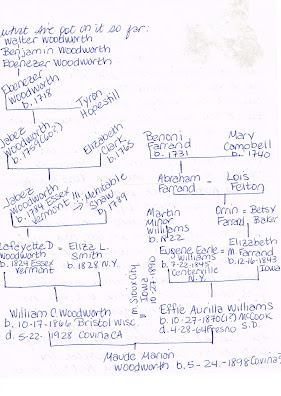
The letter, while brief enough to fit on two sheets of stationary, was written on the occasion of having returned from a visit to Belle Woodworth, wife of Marilyn's husband's uncle—the one whose several sons manifested some form of Marfan Syndrome which lately has prompted me to search the tree for signs of which line might have carried any genetic propensity for the disease. Apparently, that same thought had been on my mind when I first began researching Marilyn's family tree so long ago.

The Bean family was my first foray into genealogy, so I was surprised to see how much information I had already laid out for Marilyn. The letter contained only a thumbnail sketch—and most of that, thanks to the documents assembled by a Woodworth cousin in that pre-Internet era of research. But much of it has been since borne out by my exploration last month.

Besides that letter to Marilyn, there were several others, including notes from her husband's maternal grandmother, Effie Williams Woodworth, on another side of the family's history. While much of the information I've already gleaned from the online resources we now find so beneficial for research, it is the little details newly found which bring these stories to life—stories which I hope to share early next year.

We'll keep in touch, this storekeeper and I, in the hopes that something else might materialize from what used to be Marilyn Sowle Bean's collection of memorabilia. In all likelihood, whatever photos remained from her original collection are now parted out and scattered in multiple directions. But we can always hope that something else will show up from the storeroom, or when the new owner sells those photos, or...or...


Above: Excerpt from letter to Marilyn Sowle Bean, outlining portions of the family tree of her mother-in-law, Maude Woodworth Bean.

Saturday, December 18, 2021

A Season for Giving Back


The winter holidays come with a call for giving. Whether Hanukkah or Christmas, there is a sense of gratefulness and a willingness to give. This year, for me, is also a year to remember that this is not just about gifts, but about giving back for all that others have given me through the years.

Most of us, when genealogy newbies, can recall how someone else helped us learn not only how to search, but where to find all the hidden resources. When we turn around, years later, and help someone else, we do it remembering how others were there for us when we got started.

One way I've found to give back to others is to rescue abandoned family photographs and return them to a descendant of the picture's subject. How ironic that it turned out that someone found a photo collection once belonging to someone in my family and sent it to me. Now, I'm finding pictures in that collection which actually belong to another family—whose family, I've yet to discover.

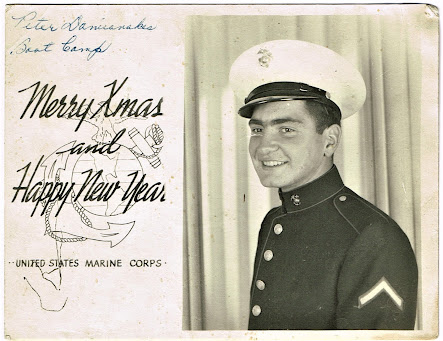
One of the pictures tucked away in Marilyn Sowle Bean's collection was a Christmas postcard from someone in boot camp with the United States Marine Corps. To the young man's photo, someone added a handwritten note: "Peter Danisanakes—Boot Camp."


Who that Peter might have been, I have no clue. Likely a family friend. This is a perfect example of how we find, in family photo collections passed down to us, relics of the F.A.N. Club of our ancestors. I can't help but think that, just as I'd love to receive a picture of one of my ancestors, someone out there—though who, and where, I don't yet know—would love to have this photo for their own collection.

I tried my hand at locating any identifying information on this Peter. Since Marilyn's family had been in southern California since she was a toddler—not to mention her husband's family, which had been in the state for generations—I presumed this Peter might have been a friend of either family, so I took a look at what I could find.

Since Peter's surname was a bit hard to decipher—was it Danisanakes?—I tried searching by various spelling variations. The closest hit I got on Ancestry.com was an entry in a 1907 city directory—much too early a year—for a J. P. Danisankes, a fruit and vegetables vendor in Oakland, California. 

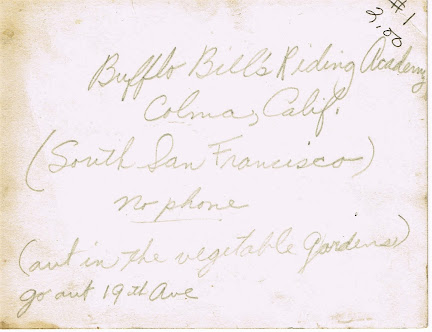
Flipping the card over to read the note on the reverse didn't help. Or maybe it did. In writing definitely not Marilyn's hand, the note read:

Bufflo Bill's Riding Academy
Colma, Calif.
(South San Francisco)
No phone
(out in the vegetable Gardens)
go out 19th Ave.  

Whether this Peter was a relative of the vegetable vendor in Oakland, I can't be sure. The spelling of the surname is different. But the odd insertion of the hint, "out in the vegetable gardens," sure made it sound more likely. The more I thought about it, the more I was inclined to think the note was written by Marilyn's husband's uncle—Bill Bean, the car dealership owner. The handwriting seemed similar, and I've seen other pictures in Bill's own collection with the reverse of the picture seemingly used as scratch paper to note business details. Most important detail: the Bean family was centered in the Oakland and Alameda County area of northern California.

When I think of all the pictures people send out to their friends over the years—high school or college graduation photos of the kids, holiday cards with the family posing, engagement announcements—I begin to realize how many of us could help others reconnect with images of their long-gone family members. They may not have a copy of those photos now, but we might. All it takes is a way to connect: to let others know what we have, and a willingness to take the step to get in touch.

More than ever, with the Internet, this is possible. We'll see whether it will happen for this photo of young Marine Peter Danisanakes.  


Friday, December 17, 2021

Saturday's the Day


Why yes, I realize it is still a week away from Christmas, but in my case, I may get to enjoy a little Christmas this coming Saturday as well. My reason to celebrate? Apparently, the antique store in town which holds the remainder of Marilyn Sowle Bean's photo collection has not yet closed.

I made the phone call yesterday to see whether it was already too late. After all, though I saw the news on social media that this particular antique shop was slated to close, there was no mention of a precise date for this unfortunate occurrence. Since travel plans had already whisked me thousands of miles away for the past week, there was nothing I could do about this predicament until I returned home.

When the phone rang this time at Hubba Hubba—yes, that is the name of the store—the owner did something she said she never does: answer the phone, herself. Usually, she lets the staff standing closer to the phone handle the calls. For some reason, this time was different.

She remembered the photos. After all, it was a collection, not just a few scattered items. Because so many were labeled, she could tell these were part of a family collection, and made sure to keep as many of the items together as possible.

There were not just pictures, but newspaper clippings and other items more suited to a scrapbook collection. Thinking over some of the details she had spotted, the owner had questions. Did one of the men own a lot of dogs? Well, yes—sort of. That was Sam, the poodle trainer for the Ice Follies. Was Marilyn's nickname Rinkie? There was a copy of her high school graduation program with her nickname written in it. The shopkeeper had evidently gotten to know her "client" well, for we had quite a conversation about the items included in Marilyn's collection.

Of course, paramount in the exchange was securing a time when I could access the collection to see for myself what is left. How soon would the shop be closing? I didn't want to miss my last chance.

"Give me a few days," the owner replied. She wanted to assemble all the pieces of the collection before I met with her. Thus it was decided: I'll be able to see what else can be rescued from Marilyn's collection this Saturday. What a long journey this personal treasure chest has taken—and if I can find any extended family members who would like to receive a particular photo from the collection, that journey may continue, long after our Saturday meeting.