Showing posts with label Hogue. Show all posts
Saturday, July 14, 2018
Off the Shelf:
Tracing Villains and their Victims
Sometimes, when I pull a book down off a shelf at my home, it's a volume which has been gathering dust for a long, long time. Other times, like today, it's a recent addition to my book-hoarding collection.
I'm not sure exactly how I stumbled upon this book by the prolific Dr. Jonathan Oates, but I suspect I first saw it at the book seller's exhibit during break time at SLIG one year. Or perhaps a fellow blogger mentioned it online. In either case, I put it on my wish list at Amazon, and a certain thoughtful someone in my family decided to make it a Christmas gift.
Fast forward to July, when I began wondering just how—and when—I could write up the outrageous story of the international crime spree of my distant cousin, John Syme Hogue, the "yeggman." That's when I remembered the reason that certain book seemed like such a good idea to read.
The book, Tracing Villains and Their Victims, provides a guide to researching one's black sheep ancestors, which is exactly what I intend to pursue in more detail than when I first posted the story of my distant cousin. There is, however, a caveat to the usefulness of this book—something I hadn't, at first, noticed. Jonathan Oates, the Ealing Borough Archivist and Local History Librarian, happens to specialize in a region far removed from that of the black sheep in my family: London, England.
Despite that drawback, the book still provides many useful resources, not only for England, but in guiding the reader through any legal system related to the British heritage. Thus, my criminal cousin, caught for his deeds in Canada, faced a judicial system, a hundred years ago, much like that of its parent nation, the primary focus of Oates' book.
Not only that, but in other research projects—for instance, reading the petty court reports for my husband's ancestors in County Kerry, Ireland, or the sentence of "transportation" for another Irish relative—I find the guidance offered in the Oates book to be helpful. The impact of the British legal system reached across the globe. Those now in Ireland, Canada, Australia, New Zealand as well as the United States can better understand our ancestors' plight at the hands of the British judicial system of the past centuries through the reading of this guide.
The key is understanding the history of the development of that judicial system. That helps us understand what our ancestors—both law abiding and law-evading—experienced. As with understanding any type of history, learning the specific details of one given time and place will paint a clearer picture of what our own ancestors expected as day-to-day risks and protections.
Of course, for those notorious ancestors that sometimes pop up in our research, a book such as Oates' can help illuminate the process by guiding us to the documents we seem to crave in our quest to fill in the blanks on these people's lives. In John Syme Hogue's case, once I'm ready to delve into the court proceedings in both Manitoba and Ontario, I'm sure I'll need a handy guide through this international—to me—system of law and order.
Wednesday, June 6, 2018
So Much to Do
Genealogy conferences can be inspiring. Sessions about how to solve brick-wall problems, or how to successfully employ specific research techniques can leave an audience encouraged to try their hand at these techniques, once back at home.
I generally come away from such conferences with a mental to-do list of new projects—or at least resurrected projects from dream lists of prior years' conferences. This year was no exception.
That would not normally be a problem. It is energizing to take on a new challenge. But this time, I'm not sure. The project that keeps staring me in the face will be a big one. Yes, I've blogged about it before, and most of the story is already laid out for me. Not, however, the research. And there's the rub.
The story that keeps calling out to me is the one about my grandmother's safe-busting fourth cousin, John Syme Hogue, the one who almost lost his neck in Canada after a rowdy crime spree through midwestern America. That's a story that would take a book to tell in its entirety.
I first picked up on the story at the close of 2015, when I ran across a document while researching my grandmother's family on Ancestry.com. Though I had my doubts when I first started work on this branch of my grandmother's line, it did turn out that a descendant of the United States Supreme Court's first Chief Justice was wanted for murder in Canada.
After I finished the blog series on John Syme Hogue, the fugitive whose fate was to be hanged on the gallows in Essex County, Ontario, almost exactly one hundred years ago, I set it aside. True, the story needed more research work, but I never got to that point. The task seemed too immense, taking in on-site research at both the governmental archives in Ottawa, Canada, and in Charleston, West Virginia—besides other tasks.
The trouble with setting aside mammoth tasks for a more convenient time is that there never is a more convenient time. Here I am, almost three years later, still wishing I had sat down and just done the work—written the book.
It was while I was reading another book that I found encouragement to get back to work. In a chapter on how to "Follow the Process" in The Obstacle is the Way, author Ryan Holiday shared a story of an illiterate man who, despite his handicap, was yearning for greatness. The young man attended a speech by well-known orator Henry Clay and was captivated.
Afterwards, the young man
tried to make his way toward Clay, but he couldn't form the words to speak to his idol. One of his friends shouted out for him: "He wants to be like you, even though he can't read."
Clay grabbed one of his posters, which had the word CLAY written in big letters. He looked at [the young man] and said, "You see that, boy?" pointing to a letter. "That's an A. Now, you've only got twenty-five more letters to go."
That young man, though unable to read or write, applied himself to the process simplified by Henry Clay's explanation, and within a year started college. Of course, at the other end of that story, we discover that that particular young man turned out to be James Pollard Espy, known in the mid-1800s as "the Storm King" for his convection theory of storms. The process, as Ryan Holiday puts it, is to "simply do what you need to do right now. And do it well. And then move on to the next thing."
So...about that book? If "even the hardest things become manageable" through utilizing "the process," then Holiday assures us, "Even mammoth tasks become just a series of component parts."
If books are made up of chapters and chapters of paragraphs and paragraphs of thoughts in word form, then perhaps those component parts aren't that big and scary, after all.
Labels:
A Process Break,
Books,
Hogue
Saturday, December 30, 2017
For Auld Lang Syne:
Reaching Back a Couple Years
It's not only this year's stories that have been cause for connecting to people around the world. Even after almost two years, I've gotten comments and emails from relatives of the people I've written about.
If you've been a reader here at A Family Tapestry for a while, perhaps you recall what I often refer to as my most outrageous family history discovery ever: the story of John Syme Hogue. Descendant of a longstanding respectable Virginia family with connections to the likes of our nation's first Supreme Court Chief Justice, John Marshall, John Syme Hogue was a distant cousin on my maternal grandmother's line.
It was not under such auspices that I first encountered John Syme Hogue's story, however. In research that chased that early twentieth century man from West Virginia across the midwest and into western Canada before his brother snatched him from the
After his brother, Andrew O'Beirne Hogue, brought him home from his last escapade, John's life seemed to settle into a surreal normalcy—hard to believe, considering all that had preceded that earlier chapter in his life. And yet, I always wondered whether those who knew John after he returned home had any idea what had transpired before that return to normalcy. I had found a way to contact some of his descendants, but sent an introductory letter devoid of any hints of that wild, earlier life, in case family members weren't aware of what he had been rescued from. I never heard back from them.
Fast forward to this past summer, and a comment which appeared at my concluding post for the John Syme Hogue story. A descendant of John's brother—that sainted sibling who doubled as best friend and sage counselor—reached out to contact me. Sure enough, he seemed to indicate that what I suspected might indeed have been the way things were: that family now may not be aware of John's incredible personal saga.
While it's no secret that what intrigues me about family history is not just the names and dates of these ancestors but their stories, I'm not simply content to hear the part of the story I've been able to uncover through document research. I want to know the rest of the story—the impact it had on others in the family, the repercussions it had in the person's life from that point onward. That's what I still hope to discover about John Syme Hogue and his descendants and relatives. I still wonder whether, when John arrived back home for good, his past history was swallowed up in a rehabilitating silence—meant all for the good, of course—but never again referred to, despite its being part of his legacy.
Some day, I hope to revisit this story from a different slant: the repercussions it had on others, both in West Virginia and in Canada. Did whatever emotional energy that originally drove him to do what he did just evaporate when he returned home? Or did he find a more productive direction in which to channel his energies? What was life like for him, once he returned home?
And, most important question in my mind, did anyone in the next generation have any awareness of what went on before John Syme Hogue returned home and took up his humble position in the family's mining operations once again?
The only ones who can reflect adequately on these answers would be the ones who actually knew him. Which is why it was such a welcome, yet out-of-the-blue, moment when a descendant of John's brother got in touch.
With blogging and the ability to connect via comments, you never know who you will find yourself connecting with. After all these years since the story actually happened, hopefully, it will become a more welcome time to reflect and recollect what family remembered of those days long ago.
Labels:
Hogue,
The Continuing Conversation,
West Virginia
Tuesday, May 23, 2017
Family Secret? Or Gossip Around Town?
Whenever I've run across an outrageous story about a distant family member—say, something like the news articles we've recently stumbled upon, regarding the young aviation student shot point-blank upon landing his craft at an airfield—I've wondered how many members of the family actually knew about the event.
Take the story of John Syme Hogue that I found a year ago while researching my own mother's line—the incredible story of the safe cracker who kept getting away, even when his luck seemed to run out and he actually shot a law enforcement officer. I tried (very circumspectly, of course) to contact current family members who have worked on that same family tree at Ancestry, to strike up a conversation in hopes of detecting whether the man's descendants were even aware of his murky past, but have had no response.
It leaves me wondering whether such news stories even get passed down by family from generation to generation. Or are these the types of stories which prompt the older generations to say, like my own father, "Aaah, you don't wanna know that."
I've heard other people mention how their parents or grandparents were reticent when it came to talking about the past, especially about family members long gone. Sometimes, it was just due to the taciturn personality of the individual being questioned. But other times? Might it have been symptomatic of skeletons in the closet?
Because this situation with Arthur James Daugherty was different—after all, I only knew about this news story as of last week because of the news clippings linked as hints to his file at Ancestry—I took the opportunity to write to the person originating the link. I can't tell how close that relationship is, but if the person is willing and able to give us a behind-the-scenes report, there are a few things I'd like to ask.
For one thing, I'm curious how many of the Daugherty family back home in Perry County were aware of what happened to one of their native sons. Was this the gossip on everyone's lips, back in Somerset, Ohio? Or was it circumspectly hushed in consideration of the grieving—and likely, surprised—family?
Then, too, I'm sure the question on everyone's mind had to be: was he guilty as accused? Was A.J. Daugherty really a smuggler? Or was he just the unfortunate innocent caught in the crossfire of misinformed but zealous law enforcement agents?
Of course, these are factors which seem to have no bearing on genealogical research—but for those, like me, who have self-styled their research as family history, these questions are quite pertinent to our goals of accessing a fuller picture of the individuals who people our family trees.
Labels:
California,
Daugherty,
Hogue,
Newspaper Clippings,
Perry County OH
Wednesday, May 11, 2016
The Other Side of the Story
Accompanied by an official of the Ottawa Immigration department, the body of Marshall Jackson, the well-known Winnipeg detective, who was killed while escorting a prisoner...will arrive in Winnipeg at 11 o'clock this morning.
That was the news report in the Manitoba Free Press on Monday, January 29, 1917, which brings us back to the other side of the story I set aside, back in January of this year—almost exactly ninety nine years after this newspaper entry. It was—at least on the side I had been talking about—the story of John Syme Hogue, son of a civil engineer in Charleston, West Virginia, whose unfortunate life choices found him on death row in a prison in Ontario, Canada. The reason: murder of an immigration officer handling the process of his extradition to stand trial back in the United States.
The other side of the story, of course, would be that of Marshall Jackson, the Winnipeg detective assigned to escort John Hogue—still being referred to under one of his many aliases—back to Windsor in Ontario, where he was to oversee the transfer of his prisoner to United States law enforcement personnel at the international border.
While there are several newspaper reports which included enough details on the man to develop a sketch of who he was, the downside to that attempt is the typical rush to publish in the face of getting "the scoop" ahead of the competition. At first, the Winnipeg newspaper identified the officer as "Detective Nesbitt"—until someone from the police force must have pointed out that they had no such detective by that name. For a while, it seemed the number of aliases for the reports on the now-deceased detective was doomed to catch up with the number of aliases assigned to his assailant.
It is not simply to sort out the chronology—or merely the correct identity—of the slain officer that I want to pick up this thread of the narrative. As you likely have realized from following along here at A Family Tapestry, it's the stories that exert that powerful pull on me—of course I want to know Marshall Jackson's story, as well.
Even more than that, though, is an additional pull this story exerts on me, personally. Because I am married to a law enforcement professional, I have had the vicarious—albeit admittedly distant—experience of knowing the impact on those on the force who have lost a co-worker who has died in the line of duty. It is an awful experience with multiple repercussions, not only for immediate family, but for those who worked with the fallen officer, and for the community in which that person once served. Whenever I hear of an officer who was injured or killed during the course of work, I can't help but hear echoes of officer safety warnings in my head—the oft-repeated kind drilled into public safety employees over the course of their career. When I read a story like Marshall Jackson's, I can't help but cringe when I realize what happened to him. Stories like his became the training material used to hopefully prevent further such tragedies from occurring.
For the rest of the week, we'll revisit this other side of the John Syme Hogue story. We'll explore what we can reconstruct of Marshall Jackson's own role in this story, his work history, and his family's story. Between newspaper reports, census records, cemetery records and other findings, this will help us understand a bit more about who this seasoned detective was who nevertheless lost his life in the course of a day's work.
Above: French impressionist painter Claude Monet's 1885 oil on canvas, "Train in the Snow." Courtesy Wikipedia; in the public domain.
Saturday, February 13, 2016
Don't Unfold the Rose
If there's anything about genealogy that captivates me, it's the stories. I want to know who those ancestors are—not just when they got here, or where they arrived.
There's the stories...and then there's the story about the stories.
Teachers used to put different terms to that. If I were teaching a class, the stories would be called "content." And the story about the stories would be termed "process." Process is how you get to the content.
In the recent series I've just completed—the story of John Syme Hogue—it's the process that's captured my attention. The story behind the story. I want to know: what did the family think, the first time they heard the story, when John Syme Hogue, senior, realized what his son had done, or when the younger John's brother Andrew decided to do something to save him.
More than that, I want to know whether anyone in the family knew about John Syme Hogue's story in the next generation. Did any of his children realize what kind of past their dad had hidden in his younger years? Did the story get passed down to the grandchildren like some kind of family legend? Or did it get added to the "skeletons in the closet" that every family has, but no one wants to discuss?
Though I've wondered about these things, I haven't been able to figure out a way to find the answers to my questions.
Yet.
As sometimes happens on a system the size of Ancestry.com, the other day, I ran across another family tree containing the very same John Syme Hogue I've been telling you about. Actually, there were several—if you are a subscriber at Ancestry.com, you can look that up for yourself—but so often, such trees are full of careless errors and mis-attributed documentation that I often pass up on using those resources.
This tree, however, was different. Equipped with ample documentation as well as photographs, the tree had both a length and a breadth that betrayed someone more than the casual dabbler behind the collection. As I took a look around this person's handiwork, I realized this was not only someone serious about family history research, but likely someone who was closely related to the very line I am pursuing.
Because Ancestry.com makes it easy for subscribers to connect with each other, I decided to send this researcher a message. To see what would happen.
That was when the moment of doubt washed over me. If I write, what do I say? Do I presume this person knows all about the family story? Or would revealing that ruin someone's day?
This was the dilemma: saying too much could be offensive, while saying too little could render my note too easily ignored.
In the end, opting for that dull, boring, bland middle of the road, I sent the message off. And waited.
It's in the waiting that minutes stretch into centuries. I can't abide that type of time warp. I want an answer now—no, strike that, I want an answer yesterday. But one just can't hurry such a thing.
I think back to those sermons preached—usually in a church service geared toward young people—when the advice is to not rush things. For all those good things anticipated by those whose lives still lie ahead of them, the advice is to just wait. The oft-offered comparison is to recall the pristine loveliness of a rose unfolding. There is no way to rush that process. To force the rose to open more quickly is to ruin an emerging work of art.
Maybe this distant cousin sought will answer. Maybe not. Though I want an answer yesterday—no, I want instant connection with not only a relative but a fellow researching confidante—that is not always possible. These things cannot be rushed.
While the story of John Syme Hogue may be over—at least, here on this blog—that's not necessarily the case with the story behind the story. There are so many more connections to be made. After all, this story needs to be told. And so does the story behind the story. But neither the content nor the process does well when we force the rose to unfold before its time.
Above: "Rose Branch with Beetle and Bee," 1741 composition by Netherlands still life painter Rachel Ruysch; courtesy Wikipedia; in the public domain.
Friday, February 12, 2016
Close Encounters of a Presidential Kind
Curious about your possible relationship to, say, Abraham Lincoln? Or George Washington? How about any president?
If you have ancestors romping around in the far reaches of your family tree—you know, those wispy twigs spiraling back to the early 1700s or so—you may be in a position to claim a connection to political greatness. Or, at least, almost make the claim.
That's what I discovered while romping around my matrilineal line—that branch that caused me to stumble down the rabbit trail of the John Syme Hogue story. Remember Margaret Watts, my seventh great grandmother? You know: the one who married William Strother back in colonial Virginia, around 1718.
Not only did William and Margaret Strother have their daughter Jane, from whom I descend, and their daughter Margaret, from whom John Syme Hogue descended, but they also had four other daughters. At least, that's as many as I've found, so far.
One of those daughters was named Agatha. And she happened to marry a man by the name of John Madison. Among their many children was a son whom they named James.
James Madison? Hmmm...
Don't get your hopes up, yet. I discovered a few things about this James Madison—like his date of death in 1812. Too soon to be the right James Madison, whose second term of office as President of the United States didn't conclude until 1817.
But this James Madison had a son, whom he also named James. This is beginning to look promising—after all, President James Madison was son of another man named James—until we realize that the dates for this son aren't quite right, either. These hopes of a presidential connection are fading fast.
But let's not give up on this rabbit trail too soon. This James Madison was a president—just not the kind of president we might have had in mind.
Our James Madison, son of John and Agatha, was born August 27, 1749. Educated at his home in Virginia in his younger years, he completed his preliminary education at a private school in Maryland, after which he attended college. Though he was afterwards admitted to the bar, he never practiced law. Instead, after serving as an instructor at his college for a while, he traveled to England, where he was ordained a priest of the Church of England.
Returning to his native land, he arrived in colonial Virginia just as the hostilities broke out in 1776.
By the next year, through a curious turn of events, the head of the college where James Madison had been teaching—a loyalist who had previously had Madison removed from his duties—no longer held his position. It was at that point that James Madison was appointed the eighth president of the College of William and Mary, the first to hold that position after the colony's separation from England. He continued to serve in that position for thirty five years, until his death in 1812.
Consecrated as a bishop in 1790, he from that point concurrently served over the Diocese of Virginia and as president of the college.
As it turns out, it was his cousin—also named James Madison—to whom the honors of the title of United States President belong. While that James Madison had a father named James, there is nothing about the details that could convincingly match the two pairs—our James Madison and his son James with James Madison, son of Ambrose, and his son, James the President.
Oh, well, since it was Agatha Strothers Madison who was related to my line, not her Madison husband himself, I guess I've witnessed another genealogical brush with greatness—a near miss, once again.
Labels:
Hogue,
Holidays and Genealogy,
Strother
Monday, February 8, 2016
Epilogue: The John Hogue Story
Though it took two months to recount, we've now covered the main points of the saga of John Syme Hogue of Charleston, West Virginia. It was certainly not the story I anticipated uncovering, once I arrived at this spot in the various branches of my own matrilineal line. Even though it did touch upon the who, what, where and when of the man's life history, it leaves somewhat to be desired concerning the why of the tale.
That "why" begins with the question of why even pursue the story in the first place. After all, if I stack my family tree next to his, the final tally is that he was fifth cousins with my great grandmother—hardly even someone she'd be aware of, much less know personally. The only link we'd share would be my seventh great grandmother, Margaret Watts, daughter of Richard Watts and wife of William Strother of King George County in colonial Virginia. And, if we recall how some members of our complete genealogical tree may not even be included in our genetic tree, that leads to the realization that John Hogue and I likely share not one shred of DNA in common.
So why pursue such a person's story? It certainly wasn't for the genealogy of it all. The litany of names and dates could have been stripped from the documentation quickly, allowing me to add each in its respective slot and move on to the next line as a matter of routine research.
Perhaps it was owing to the jolt of the unexpected or to that sixth sense of sniffing out a story. Still, why bother? After all, it wasn't my direct line.
I rather suspect it has to do with that penchant for discovering the stories of these individuals. Whoever these people are, with their labels neatly hanging on our family trees, despite those full names and complete dates, they are still as virtually unknown as if they had been pinned up on the display as nameless entities. Who cares if a person's name, five or seven generations back, was John or James or Joseph? We still won't know who he was—until we learn his life's story. That's when an ancestor becomes a real person to us.
Then, too, perhaps it was because of the unresolved drama. John Hogue's story became not only his own story, but the story of the lives of all the people his life touched—or, as the case turned out to be, snuffed out in an ill-conceived moment of desperation. His was a tangle of unresolved stories—everything from the ruined reputation of the family he left behind, to the family he tore apart in Canada, to even the young family he left behind by his death in the formative years of their lives. I want to know what became of them—each one of them and the ripple effect radiating out from their own experience. Perhaps, even now, that story continues to unfold.
The story of John Hogue reminds me of why I choose to see this research task not as genealogy but as family history. A matter of semantics for some, I suppose, but a very real differentiation in my own mind. Though these family members may, in their own cases, each have lived what might be considered, in the big picture, insignificant lives, I still want to unfold that story line to see how it played out, to follow the connections and realize the network of its impact. And, above all, to preserve what I've found and pass it on, so others may know about it, as well.
Above: "Farm with sleigh," 1900 oil on canvas by Russian painter Titus Dvornikov (1862-1922); courtesy Wikipedia; in the public domain.
Labels:
Getting the Big Picture,
Hogue,
West Virginia
Sunday, February 7, 2016
The Final Escape
While John Hogue—if it was, indeed, our John Hogue—may have survived the blast from the 1944 mining disaster up in Shinnston, West Virginia, chances were against him for long term survival in his chosen profession. Most coal miners who survived the more immediate occupational hazards of their trade would eventually succumb, likely from a more insidious and slow-acting threat to their health, whether from Black Lung disease or from other coal mining-related respiratory diseases. Even after concerted effort to improve working conditions for coal miners later in the twentieth century, the sad statistic was that, for career coal miners working more than twenty five years, prevalence of Black Lung disease was still at thirty two percent. In John Hogue's day, it was likely worse.
While I have no way yet to determine what finally claimed the man's life, the Hogue obituary, published in the Charleston Daily Mail on August 16, 1956, mentioned he died at his home—then in Ridgeview, just south of Charleston—"after a long illness."
Perhaps, given John Hogue's life story, for him to have attained the age of seventy one may have been considered sufficient. Remembering he, at one point, was not slated to have lived beyond his thirties, it may have been an outright blessing. Added to the hazards of his most recent occupation would have been the baggage of a fugitive's lifestyle and youthful indiscretions with unnamed addictive substances, all potentially detrimental to one's lifespan.
Whether seventy one—or ninety one—it is never enough for the one who is living it. Nor is it sufficient for the family members that person leaves behind. In Hogue's case, considering his 1940 marriage, you know he had to have left a young wife, and possibly also children. That, in fact, was confirmed in his obituary, noting three daughters, "all at home."
Left behind, in addition to his immediate family, was his brother Andrew, who with his wife had moved from the Hogues' hometown of Charleston to Beckley. Another brother, a military man then living in southern California, and a married sister still in Charleston, also survived him. Both his half-brothers and his unmarried half-sister from his mother's first marriage were all gone now.
With his late-life marriage and his children still living at home in the mid 1950s, the likelihood of that next generation still being with us—somewhere—sets me wondering. Do those children even know about the tumultuous past of their father? Was that reprieve and narrow escape from dying the death of a condemned man now a family legacy to be passed down through the generations? Or, like many men of that era, did John Hogue simply put all that unfortunate experience behind him—and behind the closed lips of family members who would prefer not to relive the trauma by repeating the tale?
Then, too, with a story so unusual, so incredible, I feel the pull to pursue additional contemporaneous documentation to glean every detail of the full story. Some of that would entail pulling records from archives in Manitoba and Ontario, as well as stateside in West Virginia. And, as the story itself became embedded within a larger social context of not only fading public support for capital punishment, but the escalation of concurrent war-time involvement both in Canada and the United States, it would reflect the interwoven aspects of such impacts as these.
The tragedy of the rise and fall of dynasties is usually reserved for the sagas of the famous and the powerful, but in an ancestral trajectory that arced with the pinnacle of America's first Supreme Court Chief Justice and maintained its dignity through the respected men and women taking their place in the subsequent generations of the Hogue and Patrick families, the same dynamics play themselves out in the microcosm of John Syme Hogue's lifespan. As much as he descended from a "well respected" and "long prominent" family in the Kanawha Valley region, the final token representing his life remembered was nothing more than a humble stone marking his existence in the family plot back home in Charleston. From the looks of it, one would never have guessed what that dash between the 1885 and the 1956 entailed.
Above: Photograph of the stone marking the grave of John Syme Hogue at Spring Hill Cemetery in Charleston, West Virginia. Photograph courtesy of Find A Grave volunteer Pj; used by permission.
Labels:
Hogue,
Occupations,
Outlaws,
West Virginia
Saturday, February 6, 2016
All in a Day's Work
Coal mining has to be an occupation that is not only physically demanding, but rife with hazards. In the United States alone, coal mining has historically been considered a dangerous occupation, with over one hundred thousand coal miners killed in accidents in the twentieth century, alone. Even more sobering is the statistic that ninety percent of that century's fatalities occurred in the first fifty years.
How can this procedure go wrong? Let me count the ways. Besides vehicle collisions or mine wall failures, there is the possibility of roof failure, gas poisoning, coal dust explosions or gas explosions.
When something did go wrong, it often could cost the lives of many. Take just one year in that century as an example. In 1944, from a total 453, 937 miners employed in the entire United States, nearly thirteen hundred of them died on the job. Anyone studying the bigger picture of their family history in those coal mining states of Ohio, Kentucky or West Virginia—as our family had in researching my husband's maternal line in Perry County, Ohio—will recall the newspaper headlines and accompanying photographs of somber-faced family members awaiting news of the fate of loved ones trapped down below after yet another mining tragedy.
One such example was the March, 1944, disaster at the number four mine of the Katherine Coal Company in Shinnston, West Virginia. Opened only six months prior to the incident, the mine employed about one hundred fifty men.
What was described as "a violent underground blaze" caused, in turn, "a blast so terrific that it tore up a surface area of half an acre" in the early morning hours of March 25, 1944. It all started with a spark from a machine cable, which ignited a wall of coal.
The front page of the March 26 edition of The Charleston Gazette described the unfolding story. At the point at which the explosion occurred,
One of the dead men—no one yet knows who—was piloting a motor into the mine. Tiny pieces of the motor were found, but no trace of the motorman.
Other factors complicated any hope of rescue attempts. For one, the ventilating system for the mine "was completely wrecked," while a makeshift replacement, hastily set up, was no match against danger of further methane gas leaks. A greater problem than that, though, was
the fact that the explosion, in tearing up the earth, left a giant hole through which air rushed in to feed the underground flames.
It was reckoned that the explosion "eventually reached every section of the mine." Because of the now out-of-control situation, the state Mines Chief and a special state inspector-at-large were called in, as well as representatives from the United States bureau of mines. Crack safety teams and rescue crews from surrounding areas—even from neighboring states—arrived to render aid.
Still, contingencies led to the decision that the only thing left to do was to "push the broken earth back into the hole and seal up the enormous air vent." It was estimated that it would take five to six weeks for the flames to be fully extinguished, at which time crews could be sent in to recover the bodies.
It was reported that sixteen men had lost their lives on the job that day at the number four mine of the Katherine Coal Company—about ten percent of the entire work force assigned to that location.
It was interesting to note, in reading the account of the disaster, that one of the employees mentioned in the article was named John Hogue. Whether that Mine Superintendent was the same as the John Hogue whose life story we've been following, it is hard to say. But I'd consider it a possibility.
The outcome for Hogue, unlike those sixteen others, was different but unexpected. According to The Charleston Gazette,
Mine Superintendent John Hogue narrowly escaped with his life, through the lucky break that he had returned to the toolhouse for some equipment just as the blast let go. Hogue had been in the mine superintending salvage efforts.
Hogue was standing with John Crock and John Earnest near a stove when the explosion occurred. All were thrown about thirty feet but escaped with bruises.
If this was, indeed, the same John Hogue as the coal mining engineer we know, it wouldn't have been the first time he had narrowly escaped with his life.
Labels:
Hogue,
Newspaper Clippings,
Occupations,
West Virginia
Friday, February 5, 2016
"And That's the Real McCoy"
Some wedding announcements may be more remarkable than others. In the case of the marriage of forty five year old John Syme Hogue and his seventeen year old bride, Lucille Epling, one couldn't help also notice—if one were familiar with the now twenty-five-year-long saga of John Hogue's history—his employment as a mining engineer at his new home in Mahan, West Virginia.
For those with patience to read the fine print at the back end of local newspapers, under such headings as "Notice of Judicial Sale," there is a way to reconstruct the twisted trail of purchases, leases assigned, re-sales and other hallmarks of high finance and real estate. But for those of us with less patience to learn about Mr. Hogue's employer—the Christian Colliery Coal Company—let me introduce the Reader's Digest version of the story.
However, I warn you: this detour comes with a high risk of rabbit trail sightings.
Found in a page four column entitled, "Our Neighbors," this snapshot of just what the history of the Christian Colliery Coal Company was had been provided by the June 19, 1940, Charleston Daily Mail—just months before the Epling-Hogue wedding.
The thumbnail sketch:
The Imperial Colliery company opened Mahan's first mine in 1911 under Judge Lynch Christian and Quinn Morton. Nine years later the Steel and Tube Company of America took over and sold out in 1921 to the Youngstown Sheet and Tube which in turn sold to George Daniels about 1925 or '26.
Named after Judge Christian of the supreme court of Virginia, the Christian Colliery company today is under the vice presidency and general managership of A. O. B. Hogue.
While even that streamlined description could leave
- First, the place where John Hogue was employed as mining engineer was named after a judge of the Virginia state Supreme Court, and
- Second, the general manager of that mining concern was none other than John's own brother, Andrew O'Beirne Hogue.
What I hadn't bargained for, in that brief tour of the real estate exchanges embedded in the coal mines of this neck o' West Virginia, was the very next sentence in the article.
Mahan's first settlers were the Hatfields and McCoys who followed the trail blazing Daniel Boone across White mountain from Virginia. It is still a much discussed topic that back up in the hills may be found Boone's marks on trees—crudely cut half moon designs with the outline of an axe cut over his initials.
Really? I wasn't sure how reliable it might be to glean my history lessons from the local newspaper, so I took a cursory glance at other resources about both Daniel Boone and the Hatfield-McCoy feud. While Daniel Boone was mostly remembered for his knowledge of land around Kentucky, he did, for a while, move to the region around Point Pleasant (now in West Virginia) and when nearby Kanawha County was first formed, he was appointed lieutenant colonel of its county militia.
That, however, pre-dates the famed Hatfield-McCoy feud by several decades. Yet it could be possible that the predecessors of those ill-fated families had actually been escorted into that then-unknown territory by Boone, himself.
The introduction to that Daily Mail article had quite the way of explaining the county's colorful heritage:
Tales about every phase of the famous Hatfield-McCoy feud are as prevalent on Paint Creek as ants at a picnickers' convention and it has been passed from generation to generation that the private family war had its birth in the Blue Ridge mountains of Virginia and over, of all things, an old razor-back hog.
Again, I'm not sure about taking one's history lesson from a newspaper article, but when the story continued with some verifiable details, I took the bait and hopped down that rabbit trail.
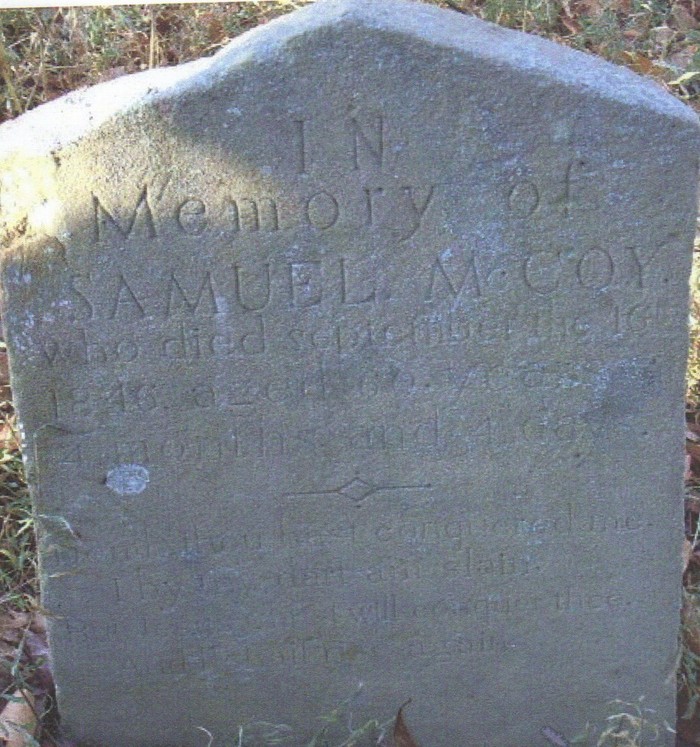
It is not every person who knows there is a graveyard on Paint creek at Sandy City in which are deposited the remains of three McCoys—once rugged mountain boys—no doubt.
The article included the name and inscription on one headstone—of "Samuel McCoy who died Sept. 16, 1846, aged 60 years, four months and four days"—so I took a look at Find A Grave. Sure enough, there was a photo of the headstone upon which could be seen those very words. See for yourself here.
The cemetery location provided another confirmation—in Kanawha County, West Virginia—as did the fact that not only Samuel but his brother James were among the McCoys listed in the cemetery's burials. (The third mention in the newspaper article described an unmarked grave which gave appearances of being for a child; the third McCoy listed in the Pratt Cemetery is someone who married a Huddleston.)
One more tidbit was shared in the Daily Mail article, a bit of hearsay providing local color:
It is told by Jim Williams, one of the creek's old timers at Mahan, that the time of the extension of the C. and O. line further up the creek (about 1910) several of the surviving McCoys sat with rifles on this small plot and made track surveyors go around the graveyard. The line originally had been right through the cemetery.
"And that's the real McCoy," the article's author concluded.
Just to the other side of this article and its accompanying photographs was another local history feature, "Paint Creek Highlights." In it, one short paragraph mentioned,
John S. Hogue, father of the present vice president and general manager of the Christian Colliery company there, was the civil engineer in charge of the location for the standard gauge railroad running up the creek to Kingston, about 23 miles from the mouth.
One wonders whether the railroad company the senior John Hogue represented in his surveying duties might have been the C. and O. I simply will have to polish up my West Virginia geography.
Above: McCoy family nemeses, the Hatfield Clan, shown in an unsourced photograph, circa 1897, courtesy Wikipedia; in the public domain.
Labels:
Cemeteries,
Hogue,
Newspaper Clippings,
Occupations,
West Virginia
Thursday, February 4, 2016
Wedding Bells . . . Again
Even for someone like John Syme Hogue, with his checkered past, one must assume the possibility of settling down, eventually, to married life. Yes, I know he already had made that momentous "I do" promise back in Michigan before his many crimes caught up with him—and for the outcome of that commitment made back in 1915, I have no further information. One must presume that that bride had seen the handwriting on the wall and had done what she must do to preserve her own peace.
That was then. This is now 1940, and John Hogue has been back home in Charleston, presumably on his best behavior after all the trials he had endured. Likely, his family—what was left of them—made sure to encourage him to remain on the straight and narrow. Perhaps a parole officer stopped by to chime in on the chorus from time to time, although I doubt those Canadian and Michigan officials would be keen on keeping up such a long-distance relationship.
By this point, Hogue would have been gainfully employed, incorporated back into his community, and taking his place as a productive member of society. At least one would presume so, as such a staid lifestyle seldom elicits such blaring newspaper headlines as had followed him nearly twenty years prior. At least, there were no longer any eye-grabbing bulletins that I could find.
Still, although it would not seem out of the ordinary for someone in Hogue's shoes to decide to remarry, the little entry in the Boone County, West Virginia, marriage register caught me by surprise. Dated October 11, 1940, application was made for the forty five year old John S. Hogue of "Kan. Co."—presumably Kanawha County, where his home would have been located—to marry a nearby Boone County resident. The bride's name was Lucille, daughter of George and Ellen Epling of Ridgeview, West Virginia. At the time the license was issued, three days later on October 14, she was seventeen years of age.
After the fact, both The Charleston Gazette and The Charleston Daily Mail made similar note of the event in brief entries on their society pages. According to the Sunday, October 20, Daily Mail in an entry headlined, "Miss Epling and John Hogue Marry,"
Miss Lucille Epling of Ridgeview, W. Va., and Mr. John S. Hogue of Mahan were married Saturday morning at the First Presbyterian church of Charleston. Rev. J. Blair Morton performed the ceremony.
Mr. and Mrs. Hogue left for a trip to Washington and other eastern points and on their return in two weeks will make their home in Mahan. The bride wore a blue costume suit, matching accessories and a shoulder corsage of orchids.
Mr. Hogue is employed as a mining engineer for the Christian Colliery Coal company.
Labels:
Hogue,
Weddings,
West Virginia
Wednesday, February 3, 2016
Send No Flowers
It's hard enough for today's ex-convict to complete his prison term and return home as a rehabilitated member of society. As impossible as it might have been, at the time of John Hogue's 1917 trial for murder in Canada, to predict he would at some point see this day, his opportunity to return home came in the late 1920s.
If you are thinking in the historical context of a bigger picture, you are realizing just what type of economy those wings of freedom were escorting him into. Perhaps in the upheaval of the stock market crash of 1929 and the ensuing depression, life in Charleston, West Virginia, took on a very guarded shade of gray for everyone alike—no matter what role they assumed in the community.
Although no mention could be found concerning John Hogue's first years after returning to civilian life back home in Charleston, hopefully, he found a place to stay, a job and some means of re-integrating into the social fabric of his hometown. In later years, newspaper articles gave the occasional glimpse that John Hogue was still there, taking his place as part of the extended family, thanks to those long litanies of honorary pall bearers at funerals or guest lists for the gala celebrations of golden wedding anniversaries of his elders or exchanges of first vows of his siblings' children.
There was, however, one sad note capturing a moment in Hogue's life in the earlier years of his return home: the funeral notices of Susan Harvie Hogue, John's mother. As is often hoped by family historians, I found one of these notices—from The Charleston Daily Mail of Saturday evening, December 30, 1933—to confirm her relationships, along with some pertinent dates for this twice-married widow.
Funeral services for Mrs. Susan Harvie Hogue, 79 years old, who died unexpectedly at her home in Brooks street Friday afternoon, will be held at the St. John's Episcopal church at 2:30 o'clock Sunday. Rev. John Gass will officiate, and burial will be in Spring Hill cemetery.
Until a short time before her death at 5 o'clock Friday, Mrs. Hogue had been in her usual good health.
Although she lived most of her life in Charleston, Mrs. Hogue was a native of Richmond, Va., where she was born in 1854. She was the daughter of Dr. Spicer Patrick and Mrs. Virginia Harvie Patrick.
In 1872 she was married to Henry Poindexter, who died in 1879. In 1884 she was married to John Syme Hogue, who died in 1917.
The obituary went on to list Susan Harvie Hogue's six surviving children: a son and daughter from her first marriage, and three sons and an additional daughter from her second marriage, including her oldest, the recently-returned junior John Hogue. All were now living in Charleston at the time of her passing, in addition to two grandchildren and three brothers.
The funeral notice went on to conclude, "The family has requested that no flowers be sent," making me wonder whether to take the bait to read between the lines—shock of suddenness? Allergies?—or just be grateful for the written review confirming the family constellation as I presumed it would be.
Tuesday, February 2, 2016
Relatively Well Off
When Judge North of the Calhoun County, Michigan, Circuit Court sentenced John Hogue on the morning of April 22, 1926, that was the last that was heard in the newspapers of Hogue's fate for quite a while. Though he had been accused of committing the same crime in Madison, Wisconsin, as he had in Battle Creek, Michigan, try as I might, I could locate no further mention in newspapers archived from Madison for the next two years.
That said, do we presume Hogue was free to return home, once he completed his term at the Jackson Prison in Michigan? And if so, what was he to expect, once he materialized after a more than ten year hiatus while engaged in the kind of escapades that would reduce a mother to tears?
Granted, the Marshall Evening Chronicle, at the beginning of Hogue's court hearing in April, had included a parenthetical mention that his parents were "well to do." But just how well were they doing at this point? Back at the stage of the urgent pleading for his life when Hogue was facing the gallows in Windsor, Ontario, a West Virginian newspaper had noted on May 10, 1917,
Hogue's parents are poor but respected residents of Charleston.
Still, that same paper, The Fairmont West Virginian, had earlier put it that Hogue's parents "are well known and respected residents," a somehow different spin than "poor but respected."
That was how the paper put it on May 2. Two days later, the elder Hogues' financial standing was elevated to "one of the leading families of the Kanawha Valley" and
at one time owned considerable property in and about Charleston.
Perhaps the Hogue family fortunes fluctuated, depending on editorial slant—or who was on board to save John Hogue at the moment.
That was back in 1917, that frightful moment when Hogue was about to face the conclusion of the matter in the shooting of a Canadian immigration officer. Now, after serving at least ten months of a year's prison term in Michigan for prior crimes committed there over a decade before, one can presume he was simply released on parole and permitted to return to his home state of West Virginia. What was he about to find there?
It might be reasonable to assume that a homecoming might be an awkward proposition. One wonders what he might find after his embarrassing absence. Still, despite what he had done in those ten-plus years, his return was more likely to be after the manner of a prodigal than an outcast.
For one thing, remember that his younger brother had been the driving force behind his rescue from the gallows. Even in Michigan, a Marshall Evening Chronicle report provided the clue that Andrew Hogue was still very much involved in his wayward brother's well-being.
Andrew Hogue of Charleston, West Va., was here today to see his brother, John Hogue, at the jail. The latter is the man brot [sic] back from Windsor, after serving nine years for murder in Canada on a charge of robbery in Battle Creek.
The awkwardness of showing up on his doorstep, back in Charleston, would have been somewhat defused by the conciliatory gestures extended by his gracious brother, no doubt. But what about the rest of the family?
With the difficulty of obtaining issues online of the local newspaper in Charleston from that time period, it is hard to gauge the reception John Hogue might have received upon his arrival home.
One thing was certain, though: there was one member of his family he would never see again. If information given on Find A Grave is correct (and sometimes there are mistakes provided on some memorials), John's sixty seven year old father—the man for whom he had been named—made it just long enough to learn that his son's life had been spared, but not long enough for the wayward child to have returned home. John Syme Hogue senior apparently passed away in Charleston on September 16, 1917.
Perhaps the elder Hogue's demise partially explains those family descriptions as "poor but respected." It would be unbearable to think that his son's escapades had contributed to his relatively early death. Then again, about the only mentions of the Hogue family I could find—other than the news of the John Hogue court case—were often linked to sales of property on the steps of the county courthouse. These, likely, provide the back story to The Fairmont West Virginian's characterization of the family as "at one time" owning "considerable property" in the Charleston area. Though possible loss of his son likely weighed heavily on the elder John Hogue, it seems it may have come on the heels of bad news of an entirely different type.
Labels:
Court Proceedings,
Hogue,
Newspaper Clippings,
Outlaws,
West Virginia
Monday, February 1, 2016
Life on the Installment Plan
Just think of this as the story of one man's life sentence on the installment plan.
John Hogue, the convicted murderer in Ontario whose life was spared in an eleventh-hour reprieve by the Canadian government, may have seen his life sentence in Canada eventually reduced to a mere ten years, but that wasn't the end of his debt to society. Apparently, there were more charges to face.
Battle Creek, Michigan, for instance, wasn't about to give up on seeing justice served in the March, 1916, safe-cracking case at the Arthur B. Mitchell Billiard Hall—although authorities even ten years later still insisted that the crook's real name was James Gordon. That little event had netted John Hogue a cool $422 on his way to Winnipeg, Manitoba.
Back in 1916, it was Battle Creek's detective G. W. Colby who, in vain, had chased the suspect all the way to Toledo, Ohio, only to find he had just been released after questioning by authorities there. Now, on April 1, 1926, it was Sheriff G. W. Colby, accompanied by Calhoun County prosecutor Cortwright, who finally got his man when he traveled to Detroit to meet up with the Ontario provincial police escorting Hogue across the border. A lot had happened back in Michigan since Hogue last blew through town.
Marshall, the county seat of Calhoun County, in which Battle Creek was situated, was the scene of the trial in circuit court the morning of April 22. Since officials at the Kingston penitentiary where Hogue had been incarcerated in Canada had reported that he had been "a model prisoner," perhaps he had shown some signs of reform. In his own mind, apparently, he believed himself to be a much different man than the one who had last darkened the doors of Battle Creek, for in this case, he had "hoped for release on probation."
Authorities in Calhoun County saw otherwise for, according to that day's Marshall Evening Chronicle, Hogue was duly reminded that
the crime for which he stood charged in Calhoun County is a serious one.
Somehow, the incongruity of all that had transpired in the past ten years of Hogue's life suddenly slapped me in the face. Here, after narrowly escaping the death sentence for murder, the man has been retrieved to stand trial for a theft of less than five hundred dollars—admittedly of much more worth then than it is today, but still of no comparison to the value of a life lost—and the court chooses to remind him that the crime "is a serious one."
In the end, the judge turned out to be quite lenient, even in this "serious" case. He chose to give the minimum sentence—one year—and then was quoted in the newspaper as commenting,
With your good time you'll have to serve only about ten months. Furthermore I am going to recommend that when you are released on parole that you may live outside the state.
That, essentially, provided the green light, after serving his sentence, for Hogue to return home to live near his parents in West Virginia, "who are well to do."
What a fortunate turn of events and best-hoped-for outcome for Hogue—except for one thing. According to The Escanaba Daily Press—that spot as far away from Battle Creek as one could get and still be in Michigan—their April 1, 1926 report mentioned one other point of business:
A message today was received from Sheriff Thomas Shaugancy [sic] of Madison, Wis., indicating Stewart or Hogue is wanted there for blowing two safes in February, 1916.
If Michigan never forgets the wrongs committed against them, why would Wisconsin?
Labels:
Court Proceedings,
Detroit,
Hogue,
Law Enforcement,
Newspaper Clippings,
Ontario Canada,
Outlaws
Saturday, January 30, 2016
Still Stewart in Their Book
James Stewart, alias James Gordon, alias James Andrews, alias John Hogue, safe blower of a decade ago and convicted murderer...
So went the opener of yet another newspaper article on the still-unfolding saga of John Hogue—this one from the Escanaba Daily Press of April 1, 1926. Though Escanaba is about as far away from Battle Creek as you can get and still be in Michigan, its interest in the Hogue case—or the Stewart case, as they still presumed—revealed just how intent the people of Michigan were in seeing that the man, whoever he was, pay his debt to society for crimes committed in Battle Creek a full ten years beforehand.
If you thought Hogue was still sitting in a cell at the Kingston Penitentiary in Ontario, you and I both missed something. Embedded within the lead to another Michigan newspaper's coverage of the 1926 chapter of the unfolding Hogue story—this time, from the Marshall Evening Chronicle on April 22—was this surprise:
John Hogue, who stood in the shadow of the gallows, and who at the last moment secured a commutation of sentence to life and later to ten years....
Somehow, I missed that last detail. To ten years? How did that happen?
Knowing that I could find all the Essex area newspapers from that time period in Ontario online, I tried in vain to locate any mention of that latest change in sentence.
Lest you assume this Hogue fellow lived a charmed life, think again. Apparently, not even he knew about the surprise in store for him upon his release from prison that year. Back in Manitoba—a place full of people who also had a vested interest in watching Hogue's every move—the Brandon Daily Sun noted on April 8, complete with the usual litany of aliases,
John Hogue, alias James Steward, alias James Gordon, pardoned murderer from Kingston, Ont., penitentiary, professed complete astonishment when turned over to Battle Creek police by Ontario officers. The transfer was made on a Detroit-bound car ferry from Windsor. Hogue declared his rearrest an unexpected and unpleasant development.
Of course, if he had been reading the Escanaba Daily Press, it wouldn't have been such a surprise to him, since back on April 1, the headline there had announced the plans, "Paroler will be arrested."
The Marshall Evening Chronicle provided the explanation for this abrupt change in plans: Hogue was charged with burglarizing a Battle Creek pool hall ten years prior. Being the county seat of Calhoun County in which Battle Creek was located, Marshall, Michigan, would be the location of the newspaper of record for that county's proceedings, and was likely keen to get the scoop on any reports concerning the long-awaited suspect Stewart, er, Gordon, er, Hogue. Once again, John Hogue would be getting his day in court—whether he wanted it or not.
Friday, January 29, 2016
Puzzling Over an Editorial Device
Delving into newspaper archives can be a great way to gain insight into the story behind the stories in a given ancestor's life—as long as you pick up the knack of reading between the lines. Still, there may be pitfalls in that approach.
That certainly turned out to be the case in pursuit of the psyche comprising one John Hogue, the man we now know as one of Canada's convicted murderers during those tumultuous years during World War I. Possibly displaced as prime headline in a news vortex that sucked national attention away to far distant current events across the Atlantic, the story of John Hogue's narrowly missing a fate of swinging on the gallows in Ontario dropped off the radar at about the time news reached home about the devastating casualties just sustained at Vimy Ridge.
Still, before that point, there was much to glean from the newspapers, and I've trawled through every report I could find. One, in particular, I want to revisit now as an example of how that hope of analyzing one's family history subject may sometimes backfire on a researcher.
This particular report on John Hogue appeared in the Brandon Daily Sun, a newspaper back in Manitoba, where Hogue had begun his long deportation journey in early 1917, and from which he had just completed a three month jail sentence. The article was datelined "Windsor, Ont., Feb. 13," shortly after Hogue had shot a Dominion immigration official in Ontario, in the course of attempting an escape.
The setting for the news story was the Windsor jail, where Hogue was being held for trial, scheduled for early March. Undoubtedly, thoughts uppermost on his mind would have been the very real possibility of a death sentence, and how that likelihood would spin out in his various relationships.
That, at least, was how I presumed it might have been. Reviewing the article now and giving it a second thought, I'm not sure it provides the same glimpse into his psyche as one might have presumed—a little fact checking persuaded me to think differently about the man's current state of mind, at least at that point.
Let's take a look at the article, and then I'll explain what I mean. From the page five article, under the title, "Alleged Murderer Disposed of Property":
James Steward, alias Wm. Anderson, alleged murderer of Marshall Jackson, of Winnipeg, who will stand trial in March, has disposed of all his earthly possessions. He has willed his diamond scarf pin to a sister, Margaret Ashworth of Evansville, Ohio; a small savings bank account deposited in a Des Moines, Iowa, bank, to another sister, of Travers City, Mich.; a valuable traveling clock to Inspector of Police Mortimer Wigle, of Windsor; a rain coat to Fred Steward, his night guard at Sandwich jail.
In addition to questions about implications for professional ethics in regard to the last two bequests, it turned out there were other doubtful details about the revelation of this criminal's first installment on last wishes.
On its face, this appears to be a wonderful opportunity to confirm this man's family circle—but if you thought that at first glance, think again. Remember, this is the man whom people were led to believe was named something other than his true identity; what makes us think he would correctly name either of the two sisters he had mentioned?
But let's, for a moment, give him the benefit of the doubt. Since we already know his true identity as John Hogue of Charleston, West Virginia, we can take a look at his family tree. As it turns out, he did have two sisters. Well, amend that: because his mother had been married twice, he had an older half-sister as well as a younger sister. However—and I know this won't come as a surprise to you now—neither of those sisters was named Margaret, let alone Ashworth. Plus, each of his sisters spent their entire lives in their hometown, back in West Virginia, not in Evansville, Ohio, or Travers City, Michigan.
Come to think of it, there isn't even any such place as Evansville, Ohio—not according to Google Maps or any Internet search. (Well, there was one result that came up on MapQuest, north of the point on eastbound Interstate 80, just before the split with Interstate 680, approaching Youngstown. But I couldn't replicate that information anywhere else.) Evansville, Indiana, yes (on the Ohio River, even); but not in Ohio. Perhaps our traveling yeggman had gotten his directions wrong.
But let's assume, for a moment, that this Margaret Ashworth was a real person. Was there anyone by such a name anywhere in Ohio close to that time period? As it turns out, there were no results on Ancestry.com for such a name in the 1920 census—but there was someone by that name in Youngstown in the 1930 census. Could that be some sort of clue?
Why did the article name one sister, but not the other? Why, indeed, did the paper include the name of a city that didn't even exist? Were these just editorial mistakes? Or can we even believe that the man had family scattered over all the midwestern United States—and bank accounts, too? Why would the newspaper's readership even care what an alleged murderer's possessions consisted of—or where they were bound after his demise?
Whether an editorial ploy or manipulative move on the part of Hogue, himself, this little display of histrionics tended to make me less sympathetic to his cause. It hatched all sorts of unanswerable questions, foremost among them considerations of the psychological aspects they might be revealing. Was this Hogue, attempting with pathos to sway the public (or at least the potential jurors), or was it simply reformist agitators seeking to disrupt the traditions of Canadian jurisprudence with a change in public sentiment?
Above all, hadn't anyone thought of the implication of such a statement before a verdict could even be reached in Hogue's court case? Why give away all one's "earthly possessions" before judgment has been pronounced? Wouldn't that have been considered an admission of guilt?
This type of agonizing over past newspaper reports may well be beyond the purview of what is meant by an "exhaustive search" for genealogical answers. To sort it all out, I'll likely resort to transcribing each of the many newspaper articles I've found, arrange them in date order, and set them aside to gel for a while before picking them back up for a final review. Sometimes, my brain needs a respite like that.
A story like this comes with baggage—a lot of context which simply can't be ignored. Although we'll need to revisit just one more stop along the way to John Hogue's commutation of execution to a life sentence, after that, it will be time to move along to the next episode in his story. You know this story couldn't just stop there.
Labels:
Getting the Big Picture,
Hogue,
Manitoba Canada,
Newspaper Clippings,
Outlaws,
Reading Between the Lines
Thursday, January 28, 2016
News of Friends and Associates
When researching the history of a man prone to changing his alias as many times as he slips across state borders, it becomes necessary to have other devices to help keep track of his whereabouts. Tracking John Hogue through the years of 1916 and 1917 from his birthplace in West Virginia to his alleged residence in Cincinnati to his various escapades in the midwestern United States and Canada seemed convoluted enough, but when newspaper reports failed to point the way, I often searched under his aliases. Sometimes, though, even they lost me.
Though the search for John Hogue's whereabouts started out as a genealogical pursuit, it certainly turned out to be much more than I bargained for. Still, I've found it helpful to take my cue from internationally-respected genealogist Elizabeth Shown Mills and her research tip to consider the "FAN Club" of the target person being researched. While that "FAN" originally referred to "family, associates and neighbors," with John Hogue essentially leaving his family behind in Charleston, I've taken to substituting that "Family" with "Friends."
Well, perhaps "friends" is too liberal an application. It might be more apropos to Hogue's situation to consider these people I've been tracing as associates. No matter which way they are classified, they help me reconstitute his story through the technique of cluster research, a concept well described by attorney and genealogy blogger James Tanner. (While his example demonstrates an application to geographical instances, my pursuit is more of a sociological exploration.)
As the newspapers of the various locales concerned with the disposition of Hogue's case in 1917 kept churning out headlines and (sometimes erroneous) narratives, I've been on a seemingly never-ending quest to catch up with all the reportage. I ran across a blurb, dated shortly after the commutation of John Hogue's sentence that May, revealing a glimpse of just what he might still have been doing, had he not been detained for that fateful deportation after serving the three month term in Winnipeg.
Recall that John Hogue, in Winnipeg, had been arrested and tried as one William Anderson, along with his accomplice, said to be named "Sheeney" Holmes. Together, they had been in the process of blowing open a safe at the Robinson and Company departmental store in town. That was back in October, 1916.
By June, 1917, while Hogue—a.k.a. William Anderson in Winnipeg—was being transported to the Kingston Penitentiary in Ontario to serve a life sentence, his buddy Holmes was apparently still hard at work, back in Manitoba. This time, the scene of the crime was Portage la Prairie—nowadays, a mere one hour's drive west on the Trans-Canada Highway from Winnipeg. The June 11, 1917, Winnipeg Free Press carried the story under the tag line, "Suspected Yeggmen Arrested."
Of course, we've already learned what "yeggmen" are. But it was interesting to note what local journalists had not yet learned about what to call one of Holmes' other associates.
Among the three men arrested as yeggmen at Portage la Prairie Wednesday is "Sheeney" Holmes, according to an announcement made on Saturday by the Pinkerton's agency of Winnipeg. Holmes was a pal of William Anderson, now serving a life term for the murder of Detective Marshall Jackson. Both men served a jail term in Winnipeg, and were deported.
Well, perhaps "Anderson" was deported. Evidently, Holmes had still been left at large to do more damage. Not surprisingly, John Hogue's associate had learned one of the basics of his trade: always travel with an alias. The newspaper article noted Holmes' reinvented self:
Holmes gave his name at Portage as J. C. Little.
One had to wonder: if John Hogue had not been deported, what would he have been up to, at that point? Likely, moving on down the road to the next likely target.
As to the other players in John Hogue's universe of friends, associates and family, it was often difficult to trace this with certainty. Even when a story seemed to provide a solid clue, often the name proved a false lead, as we'll see tomorrow with another part of this episode in the Hogue saga.
Labels:
Blog Recommendations,
Hogue,
Manitoba Canada,
Outlaws
Wednesday, January 27, 2016
Life, Death, and the Big Picture
It's the beginning of May, 1917. What do you think is uppermost on the minds of most Canadians at that time? Certainly not the botched murder trial of John Hogue in Windsor, Ontario. There were many more earth-shattering headlines grabbing national attention.
Prime spot on national news coverage at the beginning of that month went to one item: the recent developments in the World War. Though the aggressions had begun back in 1914, and though Canada—as a British dominion—had conjointly become involved at that point when Britain had declared war on Germany on August 4, 1914, it wasn't until April 9, 1917 when all four of Canada's military divisions in Europe were engaged as a unified corps in one battle. That event was the Battle of Vimy Ridge.
By nightfall on April 12, 1917, the Canadian corps was in control of the ridge, but at the cost of nearly thirty six hundred killed and seven thousand wounded.
News of the losses began trickling back home by the end of April. In the May 4 edition of The Essex Free Press—only one column to the right of the blurb on the petition-gathering drive on behalf of John Hogue—the shocking revelation of losses began to hit the public.
Almost all of those given as killed in action are dated April 9th, the first day of the big fight. To-day's list brings the total casualties announced since that date to 10,064.
Do you think, in the face of that, there would be much attention given to John Hogue's predicament?
In such a context as this, it makes the American conjecture of just what the West Virginia governor did to secure agreement in Hogue's case a more uncomfortable premise. From The Fairmont West Virginian on May 10, 1917, the very day of Hogue's scheduled execution:
Ex-Governor MacCorkle interested himself in the case, and it was through him that the congressional appeal which proved so effective was made.... Hogue undoubtedly owes the commutation of his life to the argument made by each of the West Virginia congressmen, which was that hanging him at this time might be used in West Virginia to stir up feeling against Great Britain and interfere with enlistment.
Unlike Canada, the United States hadn't embroiled itself in the war until the very month in which Canada had suffered such losses at Vimy Ridge. Indeed, the new governor of West Virginia did take on a significant role in encouraging enlistment, once America took its stand on the war.
Still, knowing the bigger picture, both in West Virginia and in Canada, it made the Fairmont reportage seem even more smug as it continued,
That argument proved a convincing one to the Governor General of Canada evidently, and proved it very promptly, for the commutation of the death sentence must have been ordered within a few hours after the receipt in Canada of the letters of appeal sent there by the West Virginia congressmen.
No matter what the reason behind the granting of clemency, one point remained: John Hogue was still a prisoner in a place not only far from home, but in an entirely different country. And he was bound to remain there for the rest of his life.
At least, that is how it seemed at the conclusion of the episode in May. There was, however, this nagging demand for justice still waiting to be resolved in Michigan...
Labels:
Court Proceedings,
Hogue,
Ontario Canada,
Outlaws,
Wars,
West Virginia
Tuesday, January 26, 2016
Life After Death Sentence
Though convicted murderer John Hogue's life was spared when numerous Canadian and American officials interceded on his behalf, he was by no means free. His was merely an exchange of execution on the gallows in the courtyard of the Sandwich jail near Windsor, Ontario, for a life sentence in prison.
Hogue's eleventh-hour reprieve arrived only days before his scheduled May 10, 1917, hanging. With the final plea having been made on May 2, the reply arrived—in the form of a brief telegram—on the evening of May 4,
word being received last Friday evening by Governor Wanless of the Sandwich jail that Hon. C. H. Doherty, minister of justice, had commuted the death penalty to life imprisonment in Kingston Penitentiary.
How did John Hogue receive the news? According to The Essex Free Press on May 11, 1917,
News that he had been saved from death on the gallows was taken to Hogue shortly after the condemned man had finished a hearty supper. He received it calmly, but after being returned to his cell talked feverishly to the guards, expressing gratitude to those who had saved him.
No explanation for the decision accompanied the message. That, however, was not to say that others weren't willing to jump in and fill in the void of that official silence. Back home in West Virginia, a newspaper in the city of Fairmont provided a glimpse at one claim—an explanation that took into account yet another overarching news trend eclipsing the minutiae of Hogue's personal trial.
Above: Aerial view of the Kingston Penitentiary, taken circa 1919 by the Bishop Barker Company. Photo courtesy of Canada Patent and Copyright, Library and Archives Canada, PA-030472, online MIKAN no. 3259972; copyright expired.
Labels:
Court Proceedings,
Hogue,
Ontario Canada,
Outlaws
Subscribe to:
Posts (Atom)