Friday, March 11, 2022

About Henry . . .
and (Perhaps) Another Brother


Determining the family relationship among various people claiming the same surname can be only a little less challenging when talking about residents of a small community—but more challenging when the timeline pushes back almost two centuries. Here we are, trying to discover the relationship between four men named McClellan in territorial Florida at the time one of them dies in 1838.

The scene: Jefferson County, claiming thirty three hundred souls at the time of the previous census in 1830. Granted, by the time of the next census, the county population increased by almost seventy five percent. Still, it was a down-home-on-the-farm kind of place where one could feel safe in thinking that two men of the same surname would likely call each other family.

William G. T. McClellan died young in 1838—young enough, apparently, to have taken even himself by surprise. He left no will to guide his widow and two young children in sorting out his business affairs. The court appointed someone by the name of Henry McClellan to serve as administrator of William's estate, and for security, named Charles McClellan and Charles D. McClellan in the same court document.

The only connection between the McClellan men I've been able to spot has been that, as documented by the governmental Bureau of Land Management, they purchased land in Jefferson County, and that they served in the "Indian Wars"—skirmishes in which all local residents had a vested interest. Those two details certainly do not assure us of their close kinship. Still, it would have been more likely, given the time and the rural nature of the region, that anyone appointed as estate administrator would have been a likely family member.

What can we find on this Henry McClellan? Again, indications that he served in a company of mounted volunteers in 1838. This, we discover because on September 18, 1892, Sarah Jane McClellan, Henry's widow and mother of four of his children, had filed for a pension on account of that service.

While Sarah Jane was indeed Henry McClellan's widow, she was actually his third wife. At about the same time as Henry had lost his (likely) brother William in 1838, he had acquired a wife by the name of Margaret Gorman. After giving Henry two daughters and three sons, Margaret died in about 1851. By December of 1852, Henry was again married, this time to Martha A. E. Hay, who became mother to at least four more of his children.

Henry McClellan also left documentation of his purchase of property in territorial Florida, claiming thirty nine acres in Jefferson County in 1839—likely the very location where his family was reported in the 1840 census.

Other than that, Henry's only other documented connection with the Jefferson County community was in operating a Freedmen's Bureau school, for which he served as superintendent and sole teacher of just under forty students.

While his life certainly had its ups and downs—not to mention a few unique details—there has been nothing to specifically verify his connection to those other McClellan men of Jefferson County. The one advantage to learning about Henry's existence through those court-appointed letters of administration, however, was that here we have a man whose long lifespan allows us to peek into later documents which do include details about his distant past.

Before we fast-forward to that point, though, let's review all the McClellans named in the various documents we've covered in this past week. First, we had the will of Charles McClellan in 1838, naming his eldest son George, and mentioning his concern for his two youngest children, Adeline and Samuel. Then, we found the letters of administration after William G. T. McClellan's passing, naming Henry McClellan as well as Charles and Charles D. McClellan.

There was one other McClellan we've yet to examine: the other one named along with Charles and William, back in the 1830 census in nearby Hamilton County, Florida. Before we move on to speculate about all these relationships, we need to see whether learning about Andrew McClellan will offer us any other clues about what ties all these McClellans together. We'll examine that last consideration on Monday.
 

Thursday, March 10, 2022

Checking the Second Charles


When two men of the same name are mentioned in the same legal document, it is tempting to assume one is the son of the other. When the jurisdiction in which they are named is a sparsely populated community, it is even more so a temptation. Still, when we discovered the two men by the name of Charles McClellan both being listed as securities for a third McClellan's appointment as administrator for a fourth McClellan man—all in the same county—it would seem likely that we are reading the names of relatives. But let's take some time this week to check this out.

The McClellan man on behalf of whom all this legal business was unfolding was the unfortunate William G. T. McClellan. Following his apparently unexpected death, the Jefferson County, Florida, court appointed a man by the name of Henry McClellan to serve as administrator of William's estate. In this process, it was required that someone serve as security for this man's service, and two additional McClellan men were named: Charles and Charles D. McClellan.

While we can presume that the senior Charles was likely the deceased William's father, what about the other Charles? Not much can be found on the man, but while the few documents found don't necessarily help us draw conclusive connections, they are a start in the right direction.

Whoever Charles D. McClellan was, if he was indeed son of the other Charles, unlike the listing for young William and an Andrew McClellan, by the time of the 1830 census, this younger Charles would have been a mere tick mark on his father's record. It isn't until we move forward in time that we locate a Charles D. McClellan in Jefferson County for the 1850 census

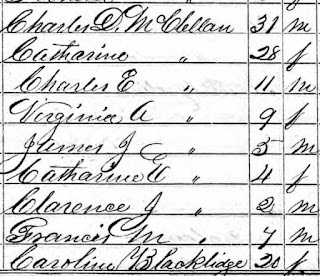
By then, census enumerations expanded from the age-bracketed tick marks of previous decades to include the name of every resident in a household. That affords us a view of a family setting, likely including a wife (Catherine) and six children. In addition, a twenty year old woman by the name of Caroline Blacklidge provides a possible hint as to Charles' wife's maiden name.


The age of the oldest child in this McClellan household—eleven—permits us to approximate the year in which Charles and Catherine were married, but unfortunately, it doesn't lead us to any verifying document.

We can see, however, that Charles D. gave his age in this 1850 census as thirty one. Thus, in 1830, he would have been a child of eleven in his own father's household. Checking back to that 1830 census for the other Charles, it looks like the age category which would have included an eleven year old indicates there were two boys of that age range in that McClellan household—a possible plus for our contention. 

Still, that would mean by the time of William's passing in 1838, Charles D. would have been only nineteen years of age—hardly an appropriate age to stand as security for another man's pledge. And yet, by that year, Charles D. was likely married and expecting his son Charles Edward, who was born the next year.

Verbal reports on census records of such details as ages can be a fluid representation, as we've all realized in chasing our ancestors. Perhaps Charles D. was older than his statement on the 1850 census. Unfortunately, we can't compare his claim with subsequent reports, for he disappeared from the public record by the time of the 1860 census. From that point onward, his wife showed as head of household.

The only other record in which I could find Charles D. was when he made full payment for property on August 10, 1850. In that document, he was specifically identified as "Charles D. McClellan of Jefferson County, Florida." Another record, showing service of a Charles D. McClellan as a private in the Second East Florida Mounted Volunteers in 1837 during the "Indian Wars," also hints at connections to the elder Charles' family, as another McClellan son, George, had served as captain of a company in that same time period. Still, nothing positive to confirm the connection. Just association by geographic region and mutual need.

While the connection between the elder and younger Charles McClellan cannot yet be confirmed, let's take a look at the other man indicated in the letters of administration of William G. T. McClellan's estate: Henry McClellan.


Above: Excerpt from the 1850 census for Jefferson County, Florida, showing the Charles D. McClellan household; image courtesy Ancestry.com.  

Wednesday, March 9, 2022

Collecting Collateral Clues


Charles McClellan's 1839 will may not have named every single one of his surviving children, but we can rest assured there are other ways to collect the details we seek. One of the best approaches is to study the stories of the others related to this family line for clues.

In addition to mentioning his concern for his two youngest children, Adeline and Samuel, in his will, my fourth great-grandfather Charles McClellan also spoke specifically about the relationship of the person he appointed as his executor: "my eldest son George McClellan." It was that son who was my third great-grandfather, so I have already gathered quite a bit of information on that son's life. It was the others in the family of which I knew very little—but being siblings of George, and children of Charles, these were identities I could ill afford to neglect. With that, it's time to attend to the due diligence of being nosy enough to snoop out details on their own stories.

But what were their names? Charles' will didn't provide us much guidance.

In a shift in thinking regarding searching digitized records, genealogical organizations are now seeing the value in making not only the principle party a searchable field, but all the other names mentioned in a document, as well. After all, if we follow the genealogical adage, "Start with yourself," by necessity we need to work backwards in time. Our first encounter of parents' names may likely be when their children are mentioned in an end-of-life document—especially as our research moves us farther away from the era of those handy birth and death certificates.

Unfortunately for Charles McClellan—but of extreme benefit to those of us researching his story—his name did come up in a matter of someone's end of life. I say "unfortunately" because of the many times I've heard elders say they never should live to see the death of their own children, and that is indeed what happened to Charles.

The document which may have revealed another of Charles' children's names was a Jefferson County, Florida, court report of the 1838 appointment of an estate administrator in the wake of the unexpected death of William G. T. McClellan.

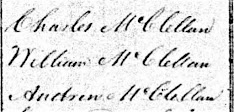
From records posted earlier in that same decade in territorial Florida, I had been able to find the name of three McClellan men, not in Jefferson County, but in nearby Hamilton County. Listed along with one Charles McClellan, in a row on the same page, were William McClellan and Andrew McClellan. 


In census records of that era, of course there was no guarantee that three men with the same surname were related to each other—or even that those three McClellan men lived near each other. Relying on just one document for family history research can be a risky proposition. But placing two or more such records in sequence may help to piece together a story.

In the case of that William McClellan in the Hamilton County census for 1830, his age fell within the bracket from fifteen to nineteen years. To find a head of household listed at such a young age seemed unusual, but that was not the only detail which caught my eye in his case. In his household was only one other person: a female also within that same age range.

As it turns out, there was a story behind those 1830 tick marks: William and his wife were newlyweds.

Well, let's rephrase that. They were newlyweds if we can buy the theory that the Jefferson County clerk was, um, maybe dyslexic and the county's Justice of the Peace perfunctory to a fault. Here's how the timeline goes.

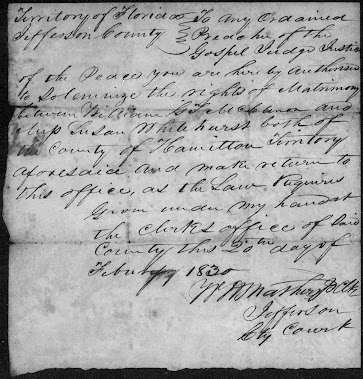
On the twentieth day of February, 1830, a young man from Hamilton County, listed as William G. T. "McClenon" made application in Jefferson County for a marriage license to wed Miss Susan Whitehurst, also from Hamilton County.


At the end of the subsequent month, the Jefferson County registers duly noted that Justice of the Peace Solomon Hall had performed the ceremony to unite said William G. T. "McClenon" and Susan Whitehurst in matrimony on March 4.

By following Susan Whitehurst McClellan through records tracing her life—she subsequently married someone sharing her maiden name—we can see that she and William had two children, a son and a daughter, before William's own untimely death.

At the point in which their tragic loss was brought to the court's attention, it is clear to see William certainly hadn't had any plans of dying; he left no will. The Jefferson County court appointed another McClellan—Henry—as administrator of William's estate, but that process came with the requirement of a bond. Standing in as security for that bond were two men, named as Charles McClellan and Charles D. McClellan, likely father and son. The document was posted in the court records on January 14, 1838, not quite eight years after his marriage to Susan Whitehurst had been recorded at the same location.

With that, we obtain clues that Henry and Charles D. McClellan might well be siblings of the unfortunate William G. T. McClellan. I say "clues" because at this point, we can only assume their involvement with William's estate was due to a familial connection. But it provides a jumping off point for us to explore these collateral lines further. After all, where these potential brothers of William—and thus, sons of Charles the elder—were born will point us to the places Charles lived before migrating to territorial Florida in the late 1820s. 


Image credits: Listing of three McClellan names listed in the 1830 census for Hamilton County, territory of Florida, courtesy of Ancestry.com; authorization to perform Jefferson County, Florida, marriage courtesy FamilySearch.org.  


Tuesday, March 8, 2022

Starting on a Journey
Going Backwards in Time


How do you trace the story of your family's history when the first step to be taken is at the end of a life which began in the late 1700s? Granted, many of the same principles apply to such a search as do to the quest to find, say, a grandfather's origin. The markers which guide us along the way, however, may take far different shapes, and sometimes be hidden in places where we'd least expect to look.

Such is the case with my goal this month of discovering something—anything—more on my fourth great-grandfather, Charles McClellan. Thankfully, there have been trailblazers—and we'll discuss them as we move through this month's research challenge—who have noted their observations as they explored this path for themselves; we can benefit from their documentation. But here, we will also need to be inventive in our exploration, and willing to step beyond the typical bounds of genealogical pursuit. We'll need to immerse ourselves, for starters, in the territorial history of northern Florida, and the sparse records about land holdings, tax payments, and perhaps some unexpected other types of information.

At the end of Charles McClellan's life, thankfully, there was a will. Not that it contained everything we could hope for. In that document, presented in court in Jefferson County of territorial Florida, not only was Charles' wife's name missing, but many of his oldest children were left unnamed. Still, the 1839 document serves as a guide.

Given that McClellan is not an uncommon surname, I might have hesitated to accept this March 25 record as belonging to the right Charles McClellan. Except there was one detail: the name of one of the executors. Along with his friend, John A. Cuthbert, Charles McClellan named his "eldest son George E. McClellan" as executors.

Specific to the details of the will, there was not one mention of a wife. Explicitly named were Charles' two youngest children, Samuel R. and Adeline H. E. McClellan, for whose well-being after his passing he apparently had great concern. Each was likely a teenager at the time the will was written, meaning they were still considered minors after Charles' passing by the end of that same year, when his final will was presented at court in Jefferson County, Florida, on December 9.

As for the others, well, the work now begins to confirm those collateral lines of my third great-grandfather, George McClellan, executor of his father's estate. Hidden in the story of those collateral lines may well be more hints about their father Charles' own origins.


Monday, March 7, 2022

"Unlock the Story"


There may be, among some people, a certain pride in being able to claim that their family tree contains the names of multiple thousands of ancestors, or that they have "made it back" to an impressively early century in their genealogical research. In addition, those details seem to be correlated: the larger the count of names, the more likely the number of generations covered is higher. But is it?

Although yes, I can affirm that I have 27,858 names entered in my own tree—plus 26,200 in my in-laws' combined tree—there are some family lines for which I struggle to say anything at all, besides perhaps a name, about a second great-grandparent. Only a second great-grandparent. That isn't very impressive.

The goal, however—at least in my book—is not to see how far back in time I can reach, or even how many names I can collect,  but how many relatives' stories I can recover. Documentation is important, true, but I'm not out to be a collector of human data points; I want to know these people as if we were sitting across a table talking while sharing a cup of coffee.

This past weekend wrapped up an impressive and generous offering to the genealogical world, which its creators called RootsTech: an online event which, in an effort to become accessible to all despite the pandemic, drew over one million digital attendees worldwide, with events accessible around the clock. (If you somehow missed the news about this year's version, there are still free learning opportunities to be had. Check here for more information.)

While there were inspirational and educational sessions too numerous to review in one page here—and plenty of bloggers who have shared in far more detail than I am providing here—there was one brief statement from one session which particularly spoke to me. So much so, in fact, that I had to stop the video—you can do that, you know, with pre-recorded sessions, but I had to wait until this main stage event was re-posted among the taped versions—and write down that one particular phrase.

The session I have in mind was the RootsTech Main Stage presentation, "The 1950 U.S. Census and You." In that multi-faceted look at what's racing toward us in less than a month now, Ancestry.com spokesperson Crista Cowan was talking with FamilySearch's Senior Vice President (Europe and North America), Stephen Valentine.

By the time Mr. Valentine joined the program, we had been treated to an overview of the amazing technological advances in handwriting recognition artificial intelligence and how this will speed up our accessibility to the soon to be released census data. True, the process will require a human-with-AI partnership similar to what we've known at FamilySearch as "indexing." But even that process has been re-imagined and fine-tuned. Now, it will not only allow volunteers to help others access the information, but allow us to help ourselves get closer to our own research goals by zeroing in our efforts where we help index within the 1950 census project—all within the "Get Involved" portal at FamilySearch.org.

Within that context, it is easy to see how much this technology will accelerate our ability to gather names, dates, and locations, adding them to our ancestors' timelines. Hopefully, though, from that point, we will step into a new realization. That was the essence of Stephen Valentine's comment in that RootsTech presentation. He reminded us: the data is not there just for us to build our tree bigger or faster, but for us to have more tools to "unlock the story."

The story is already there, but it is hidden—buried, sometimes—within the mass of data swirling around the lives of our ancestors. Sometimes, the work to sift through the volumes of excelsior packed around the gem of the issue seems wearying—even insurmountable, like my quest to learn more about the life of my fourth great-grandfather, Charles McClellan. But that innate sense of looking for the details surrounding his life—his "F.A.N." Club, how he spent his days, what was important to him—may turn out to be spot on, after all.

Those details, as it turns out from the RootsTech overviews of what's to come at genealogy services like FamilySearch, Ancestry, or MyHeritage (to name a few among many), may become easier to access in the near future. I found it excellent news, for instance, that some wills and probate records are now searchable not only by name of decedent, but also by all key names included in the document—excellent news as I search for Charles McClellan's involvement in his community and his church in early 1800s Georgia and Florida. These are the data points which, examined more closely, may help answer questions which I could not answer any other way.

Accessibility through data, sifted, sorted, re-envisioned. This will be the key to help me—and all of us—unlock the story of our specific ancestors.   

Wednesday, March 2, 2022

Hold That Thought


The plan for March: dive energetically into the pursuit of my fourth great-grandfather, Charles McClellan, discovering all I can about his life's trajectory, and gleaning clues—where solid facts are camouflaged—from his encounters with his F.A.N. Club, first in Florida, then backwards in time to Georgia and then, maybe, the Carolinas.

The detour: stopping to receive a routine Covid booster shot on my way home from meetings on Monday. Silly me; I thought it would be no worse than the other two times I had done that. Besides, I needed to do that; I'm flying east to meet up with family in a few weeks. It would be foolhardy to take a trip like that without maximum protection.

Clue: think again. Perhaps it was because I actually came down with the disease in January that my immune system roared into action. Long story short: we'll have to put that exploration of Charles McClellan on hold until I can manage to sit up longer than it took to write those three paragraphs.

I'll be back soon. I promise. In the meantime, no matter what happens, I'm glad I can watch RootsTech online, whether seated, standing, or crashed out on the sofa. Being virtual has its virtues.

Tuesday, March 1, 2022

In Search of
Charles McClellan's FAN Club


It's a new month, and time to switch research gears and step into the challenge of a different type of research goal. While most family history quests are outlined by simple statements—like, "Who was the father of Charles McClellan?"—I already know my third selection for my Twelve Most Wanted for 2022 will not be cooperative in that sort of way. I am going to have to sweet talk him into revealing his deeply-held relationship secrets.

As I put it back in December when I outlined my hopes for this month's research project, I want to learn about "the whereabouts, extended family, friends and neighbors" of the man I count as my fourth great-grandfather.

There is a reason I'm being less than specific. For one thing, having as many descendants on his research trail as I know there are for a man born on the eve of the American Revolution, you'd think there would be ample discoveries to resolve the mysteries about his origin by now. Details like where Charles McClellan was actually born, or where he married his wife—Elizabeth, the woman who has been doomed to exist in pedigree charts sans so much as a maiden name to augment her identity—have been noted as unsubstantiated in several resources where his name is mentioned. Documentation may be key, but in Charles McClellan's case, there is much that is missing.

That's not to say there are some who are sure they know who his parents were. On one widely consulted tree, Andrew C. McClellan and Sarah Rebecca Edwards are attributed as Charles' parents, with the only source to verify that information credited to a family tree on a different, subscription-based genealogy website. I can't say I'd be happy reporting that as a bona fide confirmation of fact.

Yet, neither can I assume the quest will be a simple matter of looking this up on the Internet. When I see who else has been looking—and how long they've been searching—I can recognize a tough case when I see one. That's why I'm content to try a different approach.

This month, we'll explore the places Charles McClellan once called home. More than that, we'll retrace our steps from his final resting place in territorial Florida—Jefferson County—back through his home in southeastern Georgia, where he showed up in the documents associated with another of my relatives we've already studied, Job Tison. And finally, we'll see what other associations Charles McClellan might have had that can help us construct a F.A.N. Club of all the people associated with him at different stages of his life.

To be sure, there are signs of this McClellan ancestor in several places. During this month, we just need to piece together the story, especially with an eye to possibilities that Charles' friends, associates, and neighbors might point the way to a broader understanding of who else might have been included in that McClellan family.