Showing posts with label Roberts. Show all posts
Showing posts with label Roberts. Show all posts
Friday, April 12, 2019
An Easy Job Made Difficult
One would have thought, finding a second photograph of a candidate for the Mr. and Mrs. Albert Roberts whose likeness I found in a California antique shop, that it would be an easy matter of comparing and contrasting. Nope: too much contrasting. The details are driving me to distraction. I've reviewed everything I had found on each of the three candidate couples from Iowa—ruling out the third for a vastly different time period and ages at marriage—back when I first wrote about the couples in December and January. And I believe the best course to take at this point is to move forward, blindfolded.
Yep. That's right. My eyes are likely deceiving me. Let's look at the numbers. Albert number one, living in Fremont County, was born in 1869—well, at least that's what it looked like when we consider his father's report in the 1880 census when Albert was eleven years old. Albert married widow Alice Dooley Eachus in 1889, listing his age then as twenty. She was possibly twenty six, as the register reported, and considering the 1900 census gave her date of birth as October, 1864, that would approximately support the other date.
Okay, taking a peek here, I have to ask myself: does the groom in the original photograph look like he was barely twenty? Did his bride look six years older than he was?
I suppose the answers to those questions could be debated. But here's the clincher: considering that Albert number two was married eleven years later—on New Year's Day in 1900—does that original photograph include garb which looks like something a bride and groom would wear to welcome in that new century?
Scrolling through the fashion plates of 1900 through 1909, those examples hardly look like the new threads our Mr. and Mrs. Albert Roberts might have been photographed in for their momentous occasion. Even if Council Bluffs, Iowa, wasn't exactly on the cutting edge of high society fashion, the silhouette cut by Mrs. Roberts' outfit doesn't even seem to be a throwback to the previous decade. Her style looks much more in place with the date of Albert Roberts number one's wedding: 1889.
Which begs the question I posed yesterday: could Albert and Alice have aged that much between the time of their 1889 wedding photo and the date of their family portrait? When was that family portrait taken, anyhow? In 1893, before baby Eva made her appearance in April? Perhaps that was why Alice seemed heavier than in her bridal pose.
Then, too, a time span of only four years seems to have weathered poor Mr. Roberts quite a bit, considering the change in his appearance from the wedding picture to the family portrait. Was that twenty year old already sporting a comb-over? Could he have gone that prematurely bald as young as his mid twenties?
These nagging questions push me to wonder whether the Mr. and Mrs. Albert Roberts whose photograph I found in California might well have been a totally different couple who just happened to stop in at the Sherradan studio to sit for their portrait on their way to an entirely different destination. For all I know, this could have been a couple spending the weekend in Council Bluffs from Omaha. Or Sioux City. Or Des Moines.
Some suggestions which arose from the first time I explored this question included checking other online resources for family trees and seeking other sources for family photographs. I'm in the process of exploring trees at MyHeritage, FindMyPast, FamilySearch, WikiTree and Geni, especially seeking anyone with family photos of the second Albert Roberts. While I certainly have not completed that process, I haven't yet gotten any leads. And though the Fremont County Historical Society has been kind to allow me to post my query—as well as the photo I found—on their Facebook page, I haven't found anyone there yet who has other family photos, especially for that under-represented second candidate for the Roberts couple.
It appears this is still a work in progress...
Thursday, April 11, 2019
What About the Children?
Here we are, still puzzling over the identity of an antique photograph found in Sonora, California—despite the Council Bluffs portrait being labeled with a specific name: Mr. and Mrs. Albert Roberts. But now, we have another photograph, thankfully supplied by a descendant of one of the Iowa men by that specific name, with which to help determine the correct identity of our Mr. and Mrs. Roberts.
While we can't yet be certain, with this new version of our couple, whether we are looking at a portrait of the right Albert Roberts family, there are other ways to solve this identity puzzle than by relying on a side-by-side of either adult. After all, besides the issue of the effect of aging on appearances, different photography studios could have specialized in techniques that produced wildly different results, through lighting, positioning or placement of subjects. Different lighting can make eyes seem more deeply inset, for instance. Broad shoulders or a wide forehead can seem much less imposing when the body is angled slightly away from the camera lens.
In the photo we viewed Tuesday from a descendant of the first candidate for Albert Roberts—the couple from Fremont County, Iowa—not only was the opportunity to view the picture a gift, but the portrait came with three bonuses: the three young children included in the portrait.
If those girls were indeed Lillian, Mayme and Ola, as indicated on the back of the cabinet card, we certainly can find out more details about them. This, however, requires us to do a brief review of the personal history of Mrs. Roberts, who happened to be a widow before she married Albert Roberts.
Alice Roberts was the former Mrs. John W. Eachus. Together, they were the parents of Lillian Eachus, born in California in 1884, and her younger sister Mayme, who arrived in the Eachus household in 1887. Those girls were but five and two years of age when their mother married Albert Roberts in 1889.
The third child in the photo—nicknamed Ola, but born Ruby Viola Roberts—joined the ready-made family in the spring of 1890. Thus, if Ola was the little cherub dangling her feet from the lap of her father in the photo we viewed the other day, figuring out her age—two? three?—and that of her older half-sisters would help us fix a date for the photograph. And if that date we devise seems to align reasonably with the style of the cabinet card shared with us and appear to be a few years more recent than the style of photograph we viewed for the Roberts' presumed wedding photo, we might be able to claim relative confidence from simply the dating of the two photographs.
The main reason I say that: the other option for Mr. and Mrs. Albert Roberts would not be quite as cooperative a fit as this option. You'll see what I mean by that tomorrow.

Above: Inset of a young Lillian Eachus from the family portrait of Albert and Alice Roberts, undated, taken in Riverton, Iowa; photograph in private possession of a Roberts family descendant; used by permission.
Wednesday, April 10, 2019
Side by Side
In determining the correct identity of a couple whose photo was labeled only as "Mr. and Mrs. Albert Roberts," there aren't many easily found clues to guide us. Thankfully, an Ancestry.com subscriber and fellow researcher has shared the photo of the Roberts couple from Riverton in Fremont County, Iowa—not far from the Council Bluffs photography studio where the picture I found was taken. We've had a chance to take a look at that family portrait and compare it with the one I found in an antique store in northern California. But I still have my doubts.
Since I first posted the picture here at A Family Tapestry long before the winter holidays, even I had to go back and review what I had found. I checked my notes on candidate one for Albert Roberts, as well as candidate two and candidate three. In the end, I admitted I was partial to the possibility that the right couple was the first couple, Albert and Alice Roberts. But I still wasn't sure.
There are little nagging thoughts, like the one Wendy mentioned yesterday: it would help to have two photos of the subject facing the same direction for the side by side comparison. It's really hard to determine what is hidden by a camera angle.
Another thought is that, of the couple in their younger years, it seemed the one with the darker eyes was the wife, whereas in the subsequent pose, it was the husband. Other aspects had changed as well—for instance, those...ahem...few pounds we all tend to put on, moving from eligible bachelor or young ingenue to married couple, making slender faces look more rounded. And yet other comparisons can lead us astray, such as the detail of the pouf of curly hair framing the face of a woman—indicator of hair quality? Or sign of the hairstyles of the era?
Just to help settle the issue in my mind, one step I take—well, to tell the truth, that I have my computer-graphics-inclined husband take—is to view a side-by-side comparison of the subjects. Sometimes, that helps. In other cases, it doesn't leave us any worse off than we were before. Take a look and see if this helps you move your opinion in one direction or the other. Same woman, different year? Or different women?

Above: Photo on left from Sherradan photography studio in Council Bluffs, Iowa, found in Sonora, California; photo on right courtesy of reader Jim from his family's private collection; side-by-side comparison courtesy Chris Stevens.
Tuesday, April 9, 2019
The Problem with "Mr. and Mrs."
Finding an antique photograph with a name is always an enticing moment for me. I wonder: with just the name—and perhaps the location of the photographer who created the portrait—can I find a way to return this abandoned item to descendants of the family?
In many cases, since I've taken on this challenge a few years ago, I've been able to do so. See, those genealogical research skills come in handy.
And so it was, last summer when a friend and I drove up to the foothills of northern California—think Gold Rush country—and found a stash of such specimens at an antique store in Sonora. My only mistake, at least with one candidate I found to purchase, was relying on the name of the husband without any regard to how helpful a wife's name might have been in the process.
You know that old-fashioned etiquette: a woman wouldn't dare let herself be seen outdoors without cover of that title, Mrs., along with (at the very least) two initials representing her husband's given names. To be called by one's own name? Scandalous, at least for a proper married woman.
And so, I picked up the photograph of a young Mr. and Mrs. Albert Roberts, never dreaming that the Council Bluffs, Iowa, portrait could represent one of three different Albert Roberts couples living in the vicinity of that midwestern city.
Granted, I made a valiant attempt at isolating the right Mr. and Mrs. Albert Roberts. I scoured newspaper entries. And more entries. I hounded local historical societies for dates of the photography business. I borrowed likenesses from Find A Grave volunteers. And, of course, I stalked other Roberts researchers at Ancestry.com.
One such researcher was gracious enough to answer my unusual request. I wasn't sure that my photo's Mr. and Mrs. Albert Roberts were one and the same as those in his family tree, but what I did know was that if he had any photos of his Mr. and Mrs. Albert Roberts, it might help me determine whether to rule out one of the three possible couples in the Council Bluffs area.
At first, this respondent doubted that anyone in the family even had a photo of this ancestor couple of theirs. But then, as Life has a habit of doing, circumstances changed. In the wake of an unfortunate loss in his wife's family, she had been sifting through old family photographs in preparation for the funeral, and came upon a photograph she never thought she had. You guessed it: it was a picture of the Albert Roberts family.
Though the photo was taken of a somewhat older couple—by then, with three children—the clothes seemed to indicate they were from about the same time period. The names of the children match up with one of the Albert Roberts families I had researched, as well.
Oh, for access to one of those computer programs that creates a graphics sequence of "aging" a face of a younger person. All we have to go on, here, is our imaginations, but see what you think. Here, with permission of their second great-granddaughter and her husband, is a photograph of Albert and Alice Roberts and their daughters Lillian, Mayme, and Ola.

Monday, April 8, 2019
Back to Work
There's nothing to restore normalcy, after a tumultuous episode, quite as effectively as just getting back to the old routine. As it just so happened, while I was hissing and moaning about the woe-is-me blow-up last week, I had not one but at least three contacts who replied to my ages-old inquiries. While one was a likely distant cousin wanting to compare research notes, two others were from strangers—well, fellow genealogy fanatics whom I haven't yet met—who replied to my messages inquiring whether an antique photo I rescued might be of interest to their family.
I'll take my cue from one reader who kindly nudged me with the tempting proposition to explore whether his family's Mr. and Mrs. Albert Roberts might be one and the same as my mystery Mr. and Mrs. Albert Roberts. Now that I'm done—hopefully—with sulking and pouting, I'm following up with his suggestion to check out the photo his family found. Maybe this is the right couple...and maybe it isn't. Hopefully, you will get a chance to weigh in on that verdict this coming week.
The other contact was someone related to another photo I had found in an antique store up in Sonora, California. I had contacted this researcher via the Ancestry.com messaging system back during the winter holidays. That being such a busy time of year, I wasn't surprised when I didn't receive any reply to my (admittedly odd) request. But when I got no answer in January, then February, then March, well, I figured that was a bum lead. Not so, judging by a message I received just this weekend. Now I have another story to go back and review, in the process of answering this new message.
There are other photographs I had purchased from that Sonora antique shop—photos yet to be shared with you on A Family Tapestry—but between preparations for my southern research course at SLIG and then my research trip to Florida, there just wasn't any place to insert posts on mystery photos. No matter how fun it is to help these abandoned photos find their way back home to family, I had some other stories to tell. Maybe at this point, while I'm catching my breath and re-establishing my genealogical and organizational equilibrium, following up on these timely messages would be just the thing.
We'll revisit the story of Mr. and Mrs. Albert Roberts from Iowa, tomorrow.

Friday, January 11, 2019
Finding a Friend at Find a Grave
It is never easy to foretell how complicated the path will be from rescued photograph to reunion with family members. Having a name and a location may seem to be the golden ticket, but as we've seen with Mr. and Mrs. Albert Roberts of Council Bluffs, Iowa, it hasn't helped much so far.
While digitized documents, easily accessible online from virtually everywhere, make the search infinitely easier than it ever has been in the past, there is only so much you can do, in the case of dual candidates for the same name. That's why, now that I've checked all the census records, vital records, and newspaper entries, it's time to move on to less typical resources.
One resource I've found helpful is to trawl through all the posted family trees I can find online. I look for direct descendants, of course, but I also keep an eye out for more photographs of the ancestors I'm seeking.
One such photo I ran across wasn't on Ancestry, though. I found it on Find A Grave. It was a photo of Mr. and Mrs. Charles Edwin Parkison. While it is unlikely that you've followed the minutiae on another person's family tree closely enough to recognize that Parkison name—actually, two Roberts descendants married someone by that surname—this particular Mrs. Parkison was the former Ruby Viola Roberts, also known as Ola.
Looking at the photo of Albert and Alice Roberts' daughter Ola, I wasn't sure she resembled either of the people in the photograph I had found, out here in northern California. But just in case I was mistaken in that first assessment, I decided to write the Find A Grave volunteer who had posted the portrait. My main reason for contacting her was to see if she had any other photographs—a picture of Ola's parents would be just what would do the trick—but I also asked her for permission to post the photograph of Ola and her husband here. That way, you can see what you think for yourself, so take a look below.
Of the few Find A Grave volunteers I've contacted, there has always been a prompt reply. Reaching out to connect with fellow researchers at Ancestry.com has not been quite as productive. Still, there are time—many times—when I need to connect with a direct descendant of the subjects of the photos I've found. All I can do is reach out and hope.
There is, for instance, a photo posted on Ancestry of what might be the father of the second candidate for our Albert Roberts. But since I haven't heard back from the researcher who originally posted the picture, I haven't received permission to post it here. You can, however, take a look at the original site, if you are a member of Ancestry.com. See if this picture resembles our Albert Roberts enough to peg him as Albert Marion Roberts, son of James Roberts.
Of course, I prefer any researcher who actually answers messages. This puts me in the odd position of hoping that the identity of the photo I found of Albert Roberts turns out to be the oldest of the three Alberts we've discussed so far. But I can't just conduct a thorough search based on such likeability factors. It's likely this search will find itself grinding on in the genealogical equivalent of sausage-making. And you know what I've said about that...
This Albert Roberts, whoever he is, will likely have to wait until those interminable behind-the-scenes searches finally draw to a conclusive end. Moving beyond any Roberts identities, as for what we'll be discussing next week, I have some travels planned.

Above: Photograph of Albert and Alice (Dooley) Roberts' daughter Ruby Viola Roberts and her husband, Charles Edwin Parkison of Riverton, Fremont County, Iowa; used by permission of Find a Grave volunteer and second great-granddaughter of Alice Roberts' brother, George Dooley. His family photo, also shared with us thanks to this same volunteer, is posted below, with Ola's Uncle George seated on right.

Thursday, January 10, 2019
Doh!
I can't say how many times I've seen the list of photographers in one particular blog I follow daily. Do you think I'd remember that resource when struggling to identify when a specific studio was in operation? All together now: "Of course not!"
After all this time of working on the portrait of a "Mr. and Mrs. Albert Roberts" taken in Council Bluffs, Iowa, it finally occurred to me that I should seek out more details on the studio in which the picture was taken. Locating a sequential collection of city directories for Council Bluffs was not giving me the stretch of years I was seeking, so I turned to the local library's reference desk for answers.
In reply to my question, Ben Johnson, a Council Bluffs librarian, informed me that, according to the 1894-1895 city directory, a Mr. Charles H. Sherraddan and family were living at 625 Willow Avenue, but that the studio in question was called Riley & Sherraden. Mr. Sherraden apparently had a partner, C. A. Riley.
With that tip, I was off, searching for any details I could find on both Charles Sherraden and C. A. Riley. It wasn't long until I realized the partnership was not a long-lasting one. While some photographs in several different online collections contain labels with the two names together, there are several with just the Sherraden name, as was the picture I found of Mr. and Mrs. Albert Roberts.
Remembering that the blog I follow—The Cabinet Card Gallery—includes an index of posted topics, specifically kept by photographer's name, I scrolled through that blog's listing to see if either Charles Sherraden or his former partner, C. A. Riley, were listed.
Unfortunately, they were not. But that didn't keep me from searching for other such locations online. Just as I discovered for the many Facebook groups dedicated to rescuing abandoned photographs, there are several online resources sporting information on photographers of the earlier decades of the craft.
One such resource is the similarly-entitled Cabinet Card Photographers, where I found an entry for Charles Henry Sherraden, as well as a separate listing for his former partner, Clarence A. Riley.
The twin timelines published there served me well. For one thing, they allowed me to isolate the dates in which the photographs taken by Sherraden would likely be labeled specifically and only with his own name.
Those dates, however, are all across the board. Charles Sherraden, for instance, was listed as a photographer in Council Bluffs in the 1880 census, and likely operated his own studio up until his partnership with Clarence Riley in 1893. By 1895, though, Riley had opened a separate studio, and we can presume that Charles reverted to use of the Sherraden name for his studio following that date.
One item of particular note on the Sherraden timeline is his departure from Council Bluffs for Salt Lake City in 1900. In that year, he was listed both in the census for Council Bluffs in June, and in the city directory in Salt Lake City (though not as a photographer). From that point until his death in 1908, he remained in Utah.
During a span of business operation as lengthy as Sherraden's, his studio labels certainly changed a great deal. Examples of Sherraden studio labels can be found in a number of locations—Council Bluff's own library's collection, and in unexpected other places like the Snoqualmie Valley Historical Museum in North Bend, Washington. There, three samples, undated, of unidentified women, may come from different time periods in the Sherraden studio's history, with one, in particular, seeming to bear a similar label to the one in our Roberts portrait.
Still another resource led me to more photos taken at the Sherraden studio. Archives West, the Orbis Cascade Alliance, pointed to three Sherraden pictures in the Couch-Derickson Family photograph collection. The three of interest to us were dated from 1890 through 1898.
Now that I was on a roll finding bits and pieces of Sherraden work, how could I stop without checking out ArchiveGrid? Once again in this little here, little there story, I found a reference to a Sherraden photograph now held by the Sonoma County library, not far from me here in California. Though the photo itself bore a different logo design than the one in my possession, it was similar in layout—simply the surname on the left of the lower border, with the city listed on the lower right. Unfortunately, the archive had dated the photograph as having been taken anywhere from 1881 through 1900, not providing us any help in determining how to date our own mystery Sherraden portrait.
It may seem as if each detail is so small as to be insignificant, but collecting enough of these clues may lead us to an answer if we are persistent enough. We can't just rely on gathering the history of this one photographer, of course, but there may be other tidbits of information we can find, if we continue digging deeper with those local resources.
Wednesday, January 9, 2019
Creating a Personal Finding Aid
for Local Research
One thing I learned from growing up at the far reaches of one of the world's largest cities is that cities have really neat historical resources. Like libraries. And museums.
It took me a little longer than my childhood years in the New York City metro to realize there were other repositories that come in handy for research, as well. Words like "archives" had to get added to my growing lexicon as my interest in family history expanded. The coming of digitized records seemed to flood me with additional resources, but sometimes blinded me to the possibility of finding tucked-away gems in real life.
Now that I'm living in a much smaller city—our town's population ranks us just above Saint Louis, Missouri, in size—it seems I've forgotten how much can be found locally to help with local research. In my own town, for instance, I've known about the private collection at the Haggin Museum, our local art and history museum, and, of course, the county's record collection at the county historical society's museum.
But how many other things do we know because they got lodged in our brain seemingly by osmosis? The drip-by-drip learning that comes with living in a community for decades is a type of learning we take so much for granted that we dismiss the value of it. And yet, it took me a visit to the bank our genealogical society uses for our financial business to get my memory jogged about their hundred and fifty year history, despite being aware for who knows how long that this bank has a phenomenal archive of local photographs and other memorabilia. I just didn't think to put two and two together.
There are several such research gems tucked away in our county—the kinds of places you just gotta know about. They aren't places with a world-class public relations program; in fact, they often operate on a shoe-string budget powered by true believers who provide the energy and determination to kick-start a noble mission. Sometimes, the only way people find out about such places is to stumble upon them.
Over the course of the years I've worked with my local genealogical society, for instance, I've been introduced to our city's chapter of the Filipino American National Historical Society, and the Chicano Research Center. I've learned about the history and heritage-preserving missions of several other local organizations, as well. That's what comes from living in the same community for so many years.
But let's suppose we need to learn about such tucked-away gems in another community. Say, what about researching in a place where we've never tried our genealogical hand before? Like Council Bluffs, Iowa, home of the Sherradan photography studio where the portrait of our mystery Mr. and Mrs. Albert Roberts was taken, well over one hundred years ago.
To proceed in searching for my answer on the identity of the right Albert Roberts, it would help if I knew more about the research resources tucked away in the Council Bluffs area. Of course, I can contact the local library's reference librarian, scope out the local genealogical society, determine whether there is a historical society with a photography archives—and all that, I have done.
But we can push beyond those usual first stops on the research circuit. I've had excellent success, in working on research projects in other regions, by just posting an inquiry on those old-fashioned online genealogy bulletin boards, where some kind soul has mentioned a local research gem not generally known by outsiders. I've also learned, once finding an answer, to also ask, at that location, where else I can find more stuff just like what I've just found. After evaluating all the tips myself and eliminating those which really didn't pan out as useful leads, I've added the useful discoveries to my own list of finding aids, just in case my family history questions lead me back along that path again in the future.
You may hear the term "finding aid" used by archivists, and it may sound like a far-reaching notion for the "little ol' me" researcher. But don't put yourself in that box. The family history questions you are tackling are just as informative as any other researcher's history quest. Despite perhaps having a more limited sphere of influence, the information you find on the actions taken by your ancestors still can be discoveries that make a significant difference for you and your generation of their descendants.
Creating your own personal finding aid for new locations you are researching doesn't have to be as complex as this example from the Society of American Archivists, but the format can give you an idea of what people generally find helpful in such a researcher's guide. While places such as the United States' own National Archives consider finding aids as indispensable tools, even the National Archives acknowledges that finding aids can be created by "private organizations and parties." Why not us?
So, as I struggle with this research roadblock in identifying just which Albert Roberts is the right identity for the antique photograph I found, I may as well lay a foundation for return trips for further research in Council Bluffs. One never knows when such a tool will come in handy again.
Besides, in the making of it for this first attempt, it will enable me to broaden my horizons and reach out to people with pockets of specialized knowledge that I may never otherwise have encountered. I'll be out there, asking questions about where I can go to find answers about my specific research question. The path may take a few twists and turns, but at the end of the process, if I keep both my research journal and a record of the resources I've discovered, I'll be better prepared to tackle such a problem again. Better yet, I'll also be able to pass along the advice to others who could use the help.
Research as if you lived there all your life. Then share, when you finally stumble upon the answers.
Tuesday, January 8, 2019
Since Everyone's on Facebook
Well...maybe not everyone. But enough people to help put that six degrees of separation idea to work, at least for reuniting antique photographs with their family members.
Before I ever started puzzling over which of three potential candidates were the true contestants for the likeness of Mr. and Mrs. Albert Roberts of Council Bluffs, Iowa—will the real ones please stand up?—I had been working on an adorable picture of a toddler whose family likely had lived in the Reno, Nevada, area. Stuck once again, I decided to see what would happen if I posted the photo on the Facebook page for the local genealogical society.
As things turned out, there was no local genealogical society from northern Nevada with a Facebook page (or group). But there was the Nevada state society. So that was where this adorable, lost cherub made her appearance last November.
In response, I discovered another researcher after my own heart, who has been reuniting lost photographs with family members for the past twenty years. Naturally, I used the opportunity of bumping into her online to ask for tips. After all, she'd been at it for far longer than I have.
Her suggestion? In a private message, she advised: "try posting on some of the FaceBook pages dedicated to lost treasures.''
I started searching for that term on Facebook, and pulled up several such groups. Hey, there are a lot of people doing this very same thing. I found Lost and Found Genealogy Pictures, a group started in 2018 which now has over seven thousand members. A similarly named, but much older group, Genealogy: Lost and Found, has grown to five thousand from their start in 2013. Not to confuse things, another group, founded two months before the previously-named group, sports the name Genealogy: LOST and FOUND—and a follower base of seventeen thousand.
As it turned out, there are several such groups on Facebook, dedicated to offering a stage for people who do what I do: rescue abandoned family photos and find a way to send them back to descendants. Once I found them, I did the only reasonable thing I could: I joined them all.
At about the same time I met this researcher with the twenty year track record of rescuing old photos, someone else—turns out, one of the group admins—posted a comment below the picture I had shared, suggesting that I check out another Facebook group called From Shrubs to Trees, an appropriate moniker.
Then came the holidays. Not much of genealogical progress is made then. But with life after New Year's, the Facebook queries are rolling out. While each post becomes only another drop in a churning ocean of—who are we kidding here? Let's make that another needle in a mile-high haystack—at least it's one more attempt at a miracle reunion than we've had before this point. Maybe someone, somewhere...
The more I talk, the more I think I'm talking myself out of confidence. What did that song say? I have confidence in... Well, maybe, sometimes, I don't. And in cases like that, it's back to the drawing board and more research tactics again. There are still other ways to find our answer.
Monday, January 7, 2019
Now, Where Was I ?
It's Plough Monday. Time to get back to work!
It took some revisiting of old posts to remind myself of where we left off before the holidays. It was on the Friday before Christmas that I had reviewed the third possibility for the true identity of a man named Albert Roberts—a man who stopped in at a photography studio in Council Bluffs, Iowa, to have his portrait taken with his wife.
I'm still trying to figure out just who that "Mr. and Mrs. Albert Roberts" might have been, so I can return that hundred year old photograph to family. We have one possibility of a man born about 1869, and another of a man with the same name, who was about ten years younger than our first candidate. A third Albert Roberts, partially by virtue of his later birth in 1896, seems most likely to be eliminated from the roundup. So we are now left with a fifty-fifty chance at making the right guess.
Guessing, however, is not what we are here to do, of course. So now what?
For one thing, despite all the holiday festivities, I did manage to check out a few potential routes to right answers. I did a thorough search for family trees on Ancestry.com which contained either of these two couples, to see if any were maintained by close relatives of either of the Alberts in question. One of these has, thankfully, responded to indicate willingness to help us explore this puzzle further. The other trees, unfortunately, were not posted by descendants or close relatives, so I didn't even contact them.
Another route I am taking is to contact the county libraries, as well as genealogical and historical societies, to see if there is any photograph collections there which could help with comparisons. Thankfully, one helpful person—who happens to be connected to such photograph repositories—has indicated willingness to help, as well.
And so, the search grinds onward. Besides reaching out to these organizations and individuals, however, I've learned that there are a few other ways to seek potential answers. For one thing—and I have been reminded of this in past searches—not everyone keeps their tree on Ancestry. Witness one of my first photo-sleuthing stories about Penrose Hawkes and the mystery photo album that turned out to come from County Cork, Ireland: that answer came, initially, through a family tree posted on Geni.com. (Though the person didn't reply to my posted message—which I had to join Geni.com in order to even send—the discovery was of the right descendant, and I did eventually send the album to her, though it was through the Cork Genealogical Society's Facebook group that the nexus was successfully made.)
And again, most recently, I was reminded to look for answers in places like the universal tree kept on FamilySearch.org, where the researcher who discovered the unburied cremains of the Civil War veteran we discussed prefers to post her discoveries.
There is one other way I can circumvent this research brick wall. I can try seeking people who might have more knowledge of the unnamed Mrs. Albert Roberts. Though I don't have her given name—or this search would have been over by now, wouldn't it?!—I do have candidates for each of those names. If anyone is researching any family lines for those two maiden names, perhaps they might have access to photos of the young Mrs. Roberts to help us evaluate which one is the right candidate.
Now that the holiday season is over, we have a full list of items to attempt in completing this photo puzzle. One by one, we'll check them off, as well as check out another possibility—but I'll save explaining that idea for another day.
Friday, December 21, 2018
One Last Possibility
While we've been exploring the details regarding three different Iowa men named Albert Roberts to determine which one might have been the man in the antique photo I found, this last Albert is actually the only one who actually lived in the city in which that photograph was taken. Our third Albert Roberts was the one we found whose few newspaper mentions gave us an address right in Council Bluffs, itself.
The only thing is, out of all the gossipy news tidbits we've found for all three Alberts, those newspaper entries for this third Albert also gave us one of the more curious of the accounts. Looking closer at that May 8, 1919, notice in the Evening Nonpariel, shows me that this one will also take some reading between the lines to ferret out the real story.
For one thing, this was not just another sweet story of the now-grown kids coming home to visit family for the holidays. It was an article placed among the legal notices. A notice of referee's sale, it began with the official sounding "In the District Court of Iowa, in and for Pottawattamie County."
The plaintiff was none other than our third Albert Roberts. Part of the public announcement read,
Notice is hereby given that by virtue of a decree of the district court of Pottawattamie County, Iowa, entered on the twelfth day of April, 1919, in the above entitled cause, the property hereinafter described was partitioned and the undersigned was appointed sole referee and authorized and directed to sell the following described real estate at public sale....
The undersigned referee was a man by the name of William Arnd. The property was described by lot numbers in the city of Council Bluffs. The sale was to be held on the seventh day of June "at the front door of the court house" in the county seat, Council Bluffs.
It was the defendants who gave me pause to consider this routine legal notice more closely. The list of names included was long and curious. For one thing, the surname Roberts figured prominently. In addition to a couple, named individually as Fannie Binns and "I. M. Binns, husband of Fannie Binns," there were Dwight Roberts, Emmet Roberts, and Frances Roberts, all specifically designated as minors. One last defendant was listed as "Mrs. Nellie W. Roberts, guardian."
To see the rest of the story, we need to research the family tree of our third Albert Roberts, plaintiff in this case filed in 1919. This Albert, married sometime before he completed his draft registration in June of 1917, declared himself a divorced man to the 1920 census enumerator, and yet was father to his firstborn son, who arrived November 28, 1921—and, unfortunately, died only ten days later. The child's mother—and Albert's second wife—Josephine Anshutz Roberts, was herself, at the time of the child's birth, only sixteen years of age.
Albert—the only one of the three candidates for the Albert Roberts in our photo for whom we had a middle initial—himself was born in Nebraska in 1896, son of English immigrants Henry and Sarah Jane Fletcher ("Jennie") Roberts. Albert Lee Roberts was the youngest of six siblings, three of whom were still living at the time of the 1900 census. His two older siblings still remaining were William Edwin and Fannie Louise, each of them born in the 1870s, long before Albert's arrival in 1896 (or 1894, as both his 1925 Iowa state census entry and his Social Security Application indicate).
Of those two siblings, William Edwin was not long for this world, either. Also born in Omaha, William married Nellie McGill, another resident from that city, returning to her hometown in Des Moines, Iowa, for the December, 1893, nuptials. Over the years, William worked for the railroad, but in 1915, he was the victim of a brutal attack by a drunken man. Though he survived the attack, it left him "subject to spells of absentmindedness, when he wandered about in a dazed condition." From that point on, William was unable to work.
At some point in mid-November of that same year, William did not come home as expected. His Council Bluffs family, concerned for his well-being, put two and two together when they heard reports that a man had been killed by a train in nearby Omaha. His oldest son Dwight, heading to Omaha, confirmed that the reports were indeed of the missing man.
This was not the only unfortunate story in Albert's brother William's brief life. While William's oldest son had indeed remained in Council Bluffs, William's wife had already left him, taking the other children—Emmet, Henry, and Frances—sometime after the 1910 census, returning to her family's home in Des Moines before the state census in 1915, when she declared herself to be divorced.
Not long after William and Nellie had tied their ill-fated knot in 1893, William's sister Fannie Louise had also gotten married. Hers was an event in her home state of Nebraska in September of 1896, when she said "I do" to an Iowa man named Isaac M. Binns. Though they remained for a while in the Omaha area, by 1904, they had returned to Isaac's former residence in Montgomery County, Iowa, where they remained at least through 1910.
Such was the family history of Albert Lee Roberts' siblings. To add to all this woe, by 1917, Albert's mother, Sarah Jane Fletcher Roberts, died intestate. She apparently held property in her own name, for her husband was still alive, not following her until May of 1918. In March of 1918, Isaac Binns filed as principal, along with his brother-in-law, Albert Roberts, and William Arnd, for an administrator's bond to settle Sarah's estate.
In the midst of all these misfortunes, sometime just before the 1920 census, a question came up about several lots in the city of Council Bluffs which somehow involved these siblings—or their remaining family members. Perhaps precipitated by their father's death in 1918 and the settling of the elder Roberts' estate, the legal notice was posted and the referee's sale scheduled.
No more mention was made in the local newspapers—at least that I can find—of that family difficulty. After that point, there was a brief comment, upon the 1926 arrival of another tiny child of Albert and Josephine Roberts, of how small the baby's birth weight was—followed by the not-surprising sad announcement of the funeral service for "Wauneta Louise" Roberts barely four months later.
It was a photograph placed online by an Ancestry subscriber, combined with the World War I draft registration description of Albert's appearance—medium height, medium build, with blue eyes and dark brown hair—that tended to dissuade me of any possibility that Albert Lee Roberts was the Albert Roberts in my photograph.
But I believe the clincher really is the dates involved in this Roberts family saga. While his siblings—all born in the 1870s—might have played the part in a wedding with the clothing styles of the photograph I found, Albert Lee's likely marriage in 1920, combined with the appearance of his second wife in the Ancestry.com photograph, convince me that, even though he was a Council Bluffs resident, this Albert's arrival on the scene was too late to make him a candidate for the true identity of the man in the photograph I found.
While that conclusion eliminates Albert Lee Roberts from the running, as far as photograph identity goes, it still doesn't answer the question of just who that couple was in the photograph I found. There are a few other options remaining in this search, but since we are so close to Christmas now, I'll set aside that chase for another time after the holidays.
Thursday, December 20, 2018
Considering a Second Possibility
Let's examine the second man who could possibly be the Albert Roberts in the Council Bluffs, Iowa, photograph I found. This man was a little younger than the first Albert we've already discussed—that Albert was born in November of 1869—as our second Albert made his arrival sometime around 1878.
That date, however, is an estimate based on the age he gave when he filed for his marriage license on January 4, 1900. Just like the Daily Nonpariel had mentioned in Council Bluffs on January 11, 1900, this Albert Roberts had married Hattie Eshelman in the county to the east of Council Bluffs, which is Cass County, Iowa. Apparently, his bride, daughter of Joseph and Julia Eshelman, was a lifelong resident of Noble Township in that county.
The couple didn't remain in Cass County, however, for we find them, only five months later, back in Adams County, evidently the place of Albert's own birth and home of his parents, James and Ann Slitty Roberts, who were listed only one entry below Albert and Hattie in the 1900 census.
That information helps us locate the right Albert Roberts—at least for the consideration of that second possibility for the photo's Albert—in the 1880 census. There, we find him in the Adams County household of James and Ann Roberts, and discover that he was the youngest of all his siblings, which included two brothers and four—yes, count them, four—sisters.
It wasn't long after Albert and Hattie were married in January, 1900, that they were joined by what turned out to be their only child. A daughter, whom they named Maude Ethel, was born to them on October 5, 1900—a fact we don't realize until stumbling upon her name in the 1910 census. At that point, the Roberts family was still living in Adams County.
Though the Daily Nonpariel did mention, on the occasion of their fiftieth wedding anniversary, that Albert and Hattie Roberts had been residents of Atlantic in Cass County since 1917, the first documented instance showing their new residence shows up with Albert's registration for the war, which he completed in 1918. From that card, we learn that he was employed as a mechanic in Atlantic, and had set up the family's residence at 409 West Tenth in the same city. From the point of the 1920 census onward, we can assume the Daily Nonpariel had the report of his residence in Atlantic correct.
This is the Albert for whom the delightful listing of attendees at their July 1922 family reunion provided so many relatives' names. As tempting as that genealogical gift might be—especially since I will have to find some descendants who would be willing to weigh in on whether their Albert Roberts bears any likeness to the one in the photo I found—I have my doubts that our second Albert and his wife Hattie are best candidates for the identity of the photograph I found. For one thing, their marriage occurred in 1900, while the previous Albert we examined was married in 1889. That leads to another question, one far removed from genealogy but apropos to a conversation about history: what is the timeline of the one fashion item, worn by the woman in our photo, whose popularity waned with the end of the 1880s?
It can be a fun detour—at least for fashionistas and costume designers—to review the many versions of the bustle. Yet, no matter how modest the style of the dress worn by Mrs. Albert Roberts in our photo, it may have been a fashion more suited to a 1889 wedding date than one in 1900.
There is, however, one more consideration: we still have a third Albert Roberts to learn about before we make any final decision on whom to eliminate from our roster of possible couples. We'll take a look at the third Albert tomorrow.
Wednesday, December 19, 2018
Was Mrs. Roberts a Widow?
It was among those many newspaper clippings regarding Albert Roberts, the man in the Council Bluffs photograph I found, that I discovered one unusual detail. It was in one of those brief, gossipy newspaper mentions of doings about town, that I spotted one puny phrase that seemed out of place:
Mrs. Lillian Cowger and son, Edward, of Omaha spent Sunday with her mother, Mrs. Albert Roberts.
The sticking point in that April 20, 1914, entry in the Council Bluffs Evening Nonpariel is one idea: the woman and her son, traveling from Omaha, went to visit her mother. Not her parents, despite both Mr. and Mrs. Roberts being alive and living in the same place, but only her mother.
Clearly, by 1914, Mrs. Albert Roberts was already married, but the three oldest daughters, at least as far as we could see from the 1900 census, were named Leta, Eva, and Ola, not Lillian.
There was a second little detail which confirmed that glitch I noticed in the newspaper mention. The household of Mr. and Mrs. Albert Roberts of Riverton also included two other people, at least in the 1900 census. Those two people were listed as twelve year old Mamie Eachus and fifteen year old Lillie Eachus.

The two Eachus girls were listed as daughters in the Roberts household, but no one else in that group of eight people had the surname Eachus. Since Alice was the likely reporting party, she (or the enumerator) may have incorrectly listed the relationship from her own vantage point, rather than as relationship to the head of household.
Looking at the marriage record for Alice and Albert Roberts seemed to muddy the waters even more. The August 13, 1889, event showed the correct information for Albert Roberts: twenty year old son of Thomas Roberts, as we have already seen, whose mother's name was Amanda van Horn. The record showed he had been born in Henry County, Iowa, and that this was his first marriage.

When it comes to the entry for Albert's bride, we encounter some confusing information. Her name, first of all, is listed as Alice Eachus, and the entry shows this to be her second marriage. And yet, her father's name is given as Charles E. Eachus, and her mother's as M. A. Roberts, the very surname of the man she was about to marry.

If Mamie and Lillian Eachus were indeed Alice's daughters and not Albert's, did this mean they were born to an unmarried woman? That seems highly unlikely in that era—especially twice for the same woman. What was the name of Alice's first husband? If not Eachus, then what?
Since we already have spotted a Mrs. Lillian Cowger coming from Omaha to visit her mother, Mrs. Albert Roberts, let's see what can be found for that Lillian Cowger. After all, Lillie was often a nickname for Lillian. It's possible that Lillie Eachus and Lillian Cowger could have been the same person.
As it turned out, learning to read between the lines often helps resolve research dilemmas. There was an additional curious entry for the Albert Roberts household, this time from the 1910 census. The Roberts household included a line for someone named Lillian. Her surname was listed as Roberts and she was listed as a daughter-in-law, not a daughter. Her entry also stated that, at twenty six years of age, she was a widow. She was mother of one child. And yet, there was no listing for that child.
There was one other problem with that entry: a widowed daughter-in-law presupposes a now-deceased son, and yet the Roberts' only son, Stanley, was still very much alive—and, at that point, only twelve years of age. Unlikely he would have been the deceased husband of Lillian, let alone father of her child.
Moving to other indicators of just who this Lillian might have been, the easiest tell would be to pull up her own marriage record. Don't assume it would be easily found, searching for the Roberts surname, however. The record not only helps put every name in its proper place for Lillian, but helps us unearth the hidden story about her mother.
Married about a year and a half after that first appearance as Lillian Eachus in the Roberts' 1900 census entry, Lillian Elizabeth Eachus' December 2, 1901, event united her with a Riverton man whose scrawled name on the record looked like Ern. P. Cowger. More to the point, Lillian's parents' names were given as John W. Eachus and Alice Jane Dooley.
Was Alice Jane Dooley Eachus, then, the woman who became wife of Albert Roberts? If so, who was John Eachus, and what became of him?
One thing to note, from Lillian's marriage record, was that she was not born in Iowa, as the 1900 census had led us to believe. She was born in California. Her mother—and possibly Alice's parents, as well—had earlier moved to the Reno, Nevada, area, which is where John Eachus died.
While I can't locate the actual newspaper report from any online repositories, an Ancestry subscriber had transcribed a December 10, 1888, article from the Daily Nevada State Journal. Under the headlines, "Coroner's Inquest," the news item detailed the testimony obtained during the investigation and stated, in part, regarding John Eachus that,
the unfortunate man was lying on the track, but when he was discovered it was too late to stop the engine, although every effort was made to do so. As soon as the engine was stopped...the engineer went back and found the body, but no signs of life being evident, he started off for Reno and informed parties of the occurrence. Coroner Brown departed on a special to the scene of the accident, and found the unfortunate man alive but sinking rapidly. He was brought to Reno where he died Sunday morning at 3 o'clock.
Based on what we found in the 1900 census, we can piece together the rest of Alice's story. Widow Alice Eachus and her two daughters returned to Iowa, after that tragic 1888 episode, and by 1889 had married Albert Roberts.
Still, that does not give us the right information for Alice's own parents, who obviously were not surnamed Eachus. It takes moving to Alice's own death information to uncover that. Sure enough, at the point of Alice Roberts' death in 1927, we discover her father's name was indeed Charles E., as Alice's marriage records had revealed—it's just that her maiden name wasn't Eachus. It was Dooley. And her mother's name? Not quite M. A. Roberts, as we saw in Alice's marriage record. But close: it was Lydia A. Roberts.
That leaves me with one more question, though. Remember, I'm still trying to determine which of three couples named Mr. and Mrs. Albert Roberts is the right identity for the photograph I found bearing that same inscription. Does the Mrs. Albert Roberts in the Council Bluffs picture look like a woman older than her husband? Does she look like a woman who had already been widowed? Or do we need to consider the family stories of the other two men named Albert Roberts?

Above: All clippings of documents are courtesy of Ancestry.com; excerpt of an unidentified Mrs. Roberts from photograph labeled "Mr. and Mrs. Albert Roberts," which photo is currently in the possession of the author until claimed by a direct descendant.
Tuesday, December 18, 2018
A Look at the First Albert Roberts
Once we've clustered all the information we can find on an individual, it's time to look more closely at the details, search for supporting documentation, and see what additional clues that process will bring to us. Of the three possibilities we isolated for the Albert Roberts in the antique photograph I found from Council Bluffs, let's look first at the Albert Roberts from Riverton, Iowa.
We can fairly easily locate an Albert Roberts in the 1900 census, living in Riverton. A small city of less than seven hundred people in 1900, Riverton is located in Fremont County on the southwestern corner of the state of Iowa, two counties to the south of Council Bluffs.
We already know, from reading the newspaper mentions of Albert Roberts' name, that he had a daughter named Leta and a son named Stanley. He also had other daughters for whom we only know their married names. One is Parkison, another is Edwards. And the record for the Albert Roberts in the 1900 census seems to bear that out.

If this is the right Albert Roberts from Riverton, Iowa, we can glean a few other details right away. First, of course, is learning the possible name of the "Mrs. Albert Roberts" as she was labeled in the photograph I found; now we can call her—possibly—by her first name, Alice.
We can also gauge Albert's age by the birth information given, reporting that he was born in November of 1870. In addition, Albert and Alice were married around 1890. And, sure enough, they had a son named Stanley, just as we had learned from the newspaper reports.
As for all the mentions of a Roberts child called Leta, we can assume she was the daughter born in 1889, entered in the 1900 census under the name Milleta (or possibly Malleta). It takes a little additional searching to locate which daughter ended up being the Mrs. Parkison from the newspaper entries. She was likely Ruby Viola (nickname "Ola"), born April 23, 1890, who married Charles Edwin Parkison, as we can see from their son Lyman's marriage record many years later.
Looking forward another ten years from that 1900 census, the Albert Roberts household was again easily found in the 1910 census record. This time, two new individuals join the family. One is six year old daughter Edna. The other is Albert's father, a seventy eight year old widower named Thomas Roberts—definitely a helpful piece of information for our purposes.
Using that key of Albert Roberts' father's name, we can more accurately locate Albert as a son in his father's family in the 1880 census. From that vantage point in the Thomas Roberts household, we can spot Albert's sister Minerva, the Mrs. Cowger who came to assist Albert in those difficult days leading up to his wife's death in 1927.
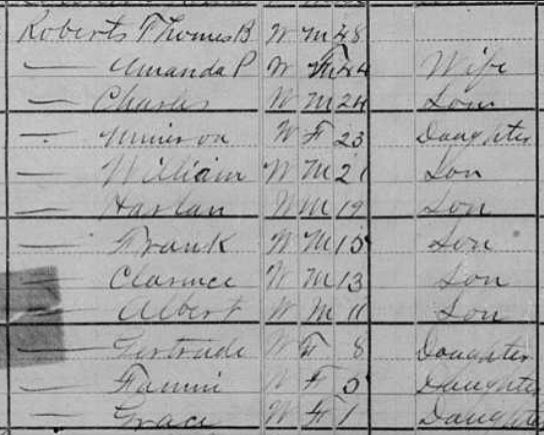
We also gain a vantage point of now knowing the universe of sibling names for this Albert Roberts, helping us to demonstrate that these are not the same siblings as were listed in the family reunion report for the Albert from Atlantic.
Yet, before we move on to examine that second Albert Roberts, there is one more question I have about the Mrs. Albert Roberts in the case of the Riverton family. Not only had the newspaper coverage included a strange mention—of a "Mrs. Lillian Cowger" coming from Omaha to visit her mother—but the 1900 Albert Roberts household included two girls identified by a different surname. There is more we need to know about this Alice Roberts.
Images: Upper, from the Albert Roberts household entry in the 1900 U.S. Census; lower, from the Albert Roberts household entry in the 1910 U.S. Census; both images courtesy of Ancestry.com.
Monday, December 17, 2018
Clustering Clues
When it seems like there are too many details coming at us, in the course of one "simple" search, it's time to see if we can group the various clues into categories. In the case of the Albert Roberts identified in the hundred-plus year old photograph of a young couple in Council Bluffs, Iowa, the resultant hits obtained when searching for that common name likely indicated at least two, if not three, different men.
Last week, we took a look at a synopsis of all the mentions of the name Albert Roberts in Council Bluffs newspapers from about 1900 through the mid 1950s. Now, let's cluster the details into groups, particularly linking relatives' names with each of the different Alberts. From that point, we can begin to see what other documents can lead us to further clues on each of these individuals who share that same name.
From what I can see of the newspaper reports so far, my guess is that there are three different Alberts. Let's call one of them Albert from Riverton, the second Albert from Atlantic, and the third—the only one with a middle initial—Albert L.
Here's the picture that emerges on each of the three Alberts.
Albert from Riverton:
- Has a daughter born January 4, 1900
- Possibly has a step-daughter named Lillian, who married a Mr. Cowger, lives in Omaha, and has a son named Edward
- Also happens to have a sister named Minerva Cowger
- Has a daughter named Leta who lives in Omaha by the 1920s
- Has a daughter named Lillian Fouts and a granddaughter named Alice Elizabeth
- Has a daughter who married Lee Edwards
- Has a daughter who married Ed Parkinson about 1908
- Has a daughter who married Chauncey Parkinson, and a granddaughter named Nellie
- Has a son named Stanley
- Lost his wife, who died about 1927
Albert from Atlantic:
- Married Hattie Eshelman on January 10, 1900
- Has a sister who married H. S. Leonard, and who died in September of 1937
- Has a sister who married a Mr. Neary
- Has a sister who married a Mr. Hully
- Lived in Grant through 1917
- Was a resident of Atlantic since 1917
Albert L.:
- Was plaintiff in a court case in Council Bluffs in 1919
- Living at either 1905 or 1908 Third Avenue in Council Bluffs in 1926
- Has a daughter who was born in 1926
- Had a daughter named Wauneta Louise who died in 1926
While it may be possible that Albert L. Roberts was one and the same as either of the other Alberts, I believe the fact that his daughter was born so much later than the other two Alberts indicates that he was a younger man than they were. In fact, it is likely that, if we were to place the three Alberts in age order, I'd choose Albert from Riverton as the oldest of the three, followed by Albert from Atlantic.
Now that we have the three men sorted out, we'll start taking a closer look at each of them as we begin building their family constellations and personal histories through documentation, beginning with Albert from Riverton, tomorrow.
Friday, December 14, 2018
A Second Albert
...and possibly a third.
In trying to zero in on the possibilities of which Albert Roberts might have gone to Council Bluffs, Iowa, to get his picture taken with his wife, I've gleaned every available mention of the name in the local newspaper from the 1880s through the mid 1950s. Yesterday, we took a look at the abbreviated timeline we could extract from the newspaper mentions for one Albert Roberts who lived just outside Council Bluffs in a city called Riverton. Today, we'll apply the same process to all the other Albert Roberts I found mentioned in the same newspaper over that same time span.
At first, I thought we'd be dealing with just one other Albert. Now that I've constructed this other timeline, I'm wondering if we are adding two other men with the same name.
As we did yesterday for the Albert Roberts from Riverton, here's the rundown on what I found in The Daily Nonpariel, beginning with the first mention of that name in 1900. Only with today's entries, I'll include the approximate (or estimated) location for each man mentioned.
- January 11, 1900: Albert Roberts and Hattie Eshelman are granted a marriage license on January 10 in Atlantic
- July 18, 1917: Albert Roberts and wife "of Grant" visit his father, James Roberts; no location specified (assume Council Bluffs)
- May 8, 1919: Notice of Referee's Sale, Albert L. Roberts, plaintiff, against Fannie and I. M. Binns; minors Dwight, Emmet, and Frances and their guardian Nellie Roberts, defendants; property (identified by city lot numbers, not addresses) to be sold on the courthouse steps in Council Bluffs
- July 21, 1922: Roberts family reunion held in Elliott, Iowa, at former home of Mr. and Mrs. J. F. Roberts, who now live in Long Beach, California; surnames of relatives in attendance included Roberts, Neary, Hully, Berg, Proctor; included in the Roberts siblings was Mr. and Mrs. Albert Roberts of Atlantic; missing from the celebration was a sister, Mrs. H. S. Leonard, prevented from attending due to heavy rains and bad roads
- July 22, 1926: A daughter, weighing only three pounds, was reported born to Mr. and Mrs. Albert Roberts of 1905 Third Avenue, an address in Council Bluffs
- November 26, 1926: Funeral service for Wauneta Louise Roberts, daughter of Mr. and Mrs. Albert L. Roberts, from the home—this time, address given as 1908 Third Avenue—with burial in Walnut Hill Cemetery
- September 9, 1937: Funeral service in Grant, Iowa, for Mrs. H. S. Leonard of Elliott, Iowa; surnames of sisters listed were Hully and Neary; Albert Roberts of Atlantic was listed as a brother
- January 12, 1950: Fiftieth wedding anniversary celebrated in Atlantic for Mr. and Mrs. Albert Roberts; they had been residents in Atlantic since 1917
Now that we've uncovered a list of names to include in the various Roberts family constellations, that will help lead us to the right families. Simply logging on to a genealogical website and searching, say, the 1900 census for anyone named Albert Roberts in Council Bluffs, for instance, might not lead us to the right person. For whatever reason, when I first jumped in to this search, that was exactly what I tried, without any helpful leads.
Next, I'll cluster names associated with each Albert Roberts to see what groups emerge. We'll take a look at the results next week. Some will yield more obvious connections—like the first and last entries on today's timeline, for instance. Others will require additional research to corroborate the casual mentions in the newspaper itemized here. Hopefully, out of this mess of data, we'll gain some clues to lead us to the right identity for this Council Bluffs photograph of Mr. and Mrs. Albert Roberts—but be prepared for more questions to sprout, as well.
Thursday, December 13, 2018
Speed Dating Council Bluffs
As I sit, poised to give you the run-down of all the instances where I've found the name Albert Roberts in the Council Bluffs, Iowa, newspapers from one hundred years ago, I find an announcement for a free webinar advocating nearly the same exercise as I'm currently slogging through. The only thing is: while I'm working on one name in one location which may turn out to be reporting the identities of two different men, this workshop focuses on tracing one name through many locations.
The free webinar I'm referencing is a presentation by Dr. Jan Joyce, to be offered the evening of next Wednesday, December 19, by the Southern California Genealogical Society. I was particularly encouraged by one line in the SCGS promotion of the event:
With an exhaustive search resulting in negative evidence, the case can be proved of one person.
Did someone say exhaustive? I know I'm exhausted after going through those thirty-plus newspaper clippings from the Council Bluffs newspaper, in search of any mention of Albert Roberts, the man who, with his wife, posed over one hundred years ago in a photography studio in Council Bluffs, Iowa. Now I have the photograph, rescued from an antique store in northern California, and I want to return it to family—but to the family of which Albert Roberts is the question.
From my vantage point, mid-search, I'm already convinced there were at least two gentlemen by that same name in the vicinity during the time period of my focus, from the mid 1880s through about 1950. Still, I could only glean a bird's-eye view of that timeline, because of gaps in the collection for Council Bluffs held by GenealogyBank, my main resource for the local newspaper.
Today, let's go through a Reader's Digest version of the entries I found. To spare you the exhaustive part, I'll focus today on what I could glean about the Albert Roberts who lived in Riverton, a city outside Council Bluffs in nearby Fremont County. The earliest entries I could find, unfortunately, did not start until 1900.
- January 7, 1900: Daughter born January 4
- April 6, 1901: Mrs. Roberts sick and under doctor's care
- February 24, 1910: The Roberts' daughter is "some better"
- April 20, 1914: Mrs. Lillian Cowger and son Edward visit Mrs. Roberts; from Omaha
- July 18, 1922: Mrs. Lillian Fouts and daughter Alice Elizabeth visit from Omaha
- July 26, 1922: Albert Roberts to Omaha, visit daughter Leta, who is sick; returns home with granddaughter Alice Elizabeth Fouts
- August 7, 1923: Before moving to Fremont, Nebraska, Mrs. Lee Edwards and baby visit her parents, Mr. and Mrs. Albert Roberts
- June 2, 1925: A family reunion is held on the Albert Roberts farm; surnames of those in attendance include Hatton, Scharay, McKissick, Jones and Beam
- June 4, 1925: Storm damage on Albert Roberts' farm, barn roof damaged
- November 9, 1926: Birthday celebration for Albert Roberts; visitors include families of Edward Cowger, Lillian Fouts, Lee Edwards, Ed Parkinson
- December 29, 1926: Guests at Lee Edwards' home include Lillian Fouts and daughter, Albert Roberts and son Stanley, Ed Parkinson family, Mrs. Chancy Parkinson and daughter Nellie, and Leta Roberts from Omaha
- January 4, 1927: Mrs. Albert Roberts sick, perhaps "gall trouble"
- October 18, 1927: Minerva Cowger visits brother Albert Roberts; returns home following Mrs. Roberts' death
- October 24, 1927: Edward Cowger family visits with his grandfather Albert Roberts
- January 12, 1928: Albert Roberts and daughter Leta and Mrs. C. M. Parkinson and daughter Nellie visit relatives in Farragut
- February 5, 1930: Mrs. Minerva Cowger caring for brother Albert Roberts and daughter Leta and son Stanley, then returned home to Farragut
- September 30, 1932: Albert Roberts critically ill; Daughter Mrs. Lillian Fouts visiting him
- October 21, 1932: Albert Roberts in critical condition; daughter Lillian Fouts called here from Omaha
- November 2, 1932: Mrs. Minerva Cowger of Farragut visited; brother Albert Roberts in critical condition
- June 12, 1958: 50th wedding anniversary celebration of Mr. and Mrs. Edwin C. Parkinson, married at the home of the bride's parents, Mrs. and Mrs. Albert Roberts.
With that span of fifty eight years, we now have a list of all the mentions of that name, Albert Roberts, associated with the location, Riverton, Iowa—enough, in fact, to build a viable family tree. Whether that is the right Albert Roberts, however, is yet to be seen. Unfortunately, the photograph I found only showed us that he and his wife got their picture taken in Council Bluffs. The Albert Roberts from the photograph could possibly be one and the same as this man mentioned so many times from nearby Riverton. Or he could be someone else.
Fortunately, there were plenty of newspaper mentions of another Albert Roberts, this time from Atlantic, Iowa. Tomorrow, we'll take a look at those other mentions, as well as some local news articles for which no location was given.
Subscribe to:
Posts (Atom)