Showing posts with label To Tell the Story. Show all posts

Wednesday, April 15, 2026

Thankful for the Third Generation


As I work my way through the family tree of Revolutionary War Patriot Lyman Jackson, I'm realizing what a challenge it is to confirm anyone's line of descent during the earliest years of this nation. To trace any of the descendants of his ten sons or three daughters, one would have to rely on court records, tax records, land records or other obscure documents in those years predating death certificates or even post-1850 census enumerations.

In the case of this Jackson family, though claiming a fairly common surname, they had one thing going for them: Lyman Jackson's grandchildren were quite willing to keep the family's stories alive. We've already discussed how helpful it was to find the story of grandson Lysander Jackson, in whose published biographical sketch he was sure to credit the accomplishments of his grandfather, the senior Lyman Jackson. I've since run into other Jackson grandsons' stories preserved in biographical sketches in county history books from the late 1800s.

I'm thankful for the willingness of that third generation to keep those Jackson family stories alive for future generations. It puts me in mind of a quote I ran across recently—which itself models the illustration of the importance, yet fragility, of passing along a comment from one person to the next.

The quote, as I most recently heard it, was from fellow genealogy blogger Randy Seaver. He had shared it in a presentation he had made in northern California, not far from my own home. Speaking to the Genealogical Society of Santa Cruz County, Randy reminded us that "it only takes three generations to lose a piece of oral family history."

This thought he had credited to another genealogist, Judy Russell, who had shared that quote in her keynote presentation at the fourth annual RootsTech conference back in 2014. Recapped by Judy Russell in her own blog, The Legal Genealogist, she mentioned finding the quote in an article published at the end of 2013 in Examiner.com by a Texas genealogist, Judy Everett Ramos.

That, however, was not the fountainhead of that provenance trail. Judy Everett Ramos, in turn, had drawn her inspiration from the actual source of that quote, a longstanding archivist at the National Archives in Fort Worth, Texas, named Aaron Holt. The cogent part of that statement, going back to Judy Russell's blog post, was

it only takes three generations to lose a piece of oral family history. ...It must be purposely and accurately repeated over and over again through the generations to be preserved for a genealogist today.

As I work my way through this one Jackson family's story from colonial times through the nineteenth century, I'm realizing how key that third generation was in ensuring that their ancestors' stories were preserved for the future. Whether in oral transmission or preservation in writing, their stories have not been entirely lost because someone chose to pass those details along to yet another set of descendants who were willing to do their part. 

Saturday, November 15, 2025

Sucking Story out of Statistics


The trouble with researching these formerly nameless Polish ancestors from generations past in my father's history is that they come to me devoid of any family stories. Sure, these are people who had names which went with the routine BMD dates we genealogists tend to harvest, but who were they, really?

In contrast, when I research my maternal lines, a great many of them came not only with statistical data but with stories—those precious stories passed down from generation to generation which, when it was my turn to hear them, convinced me to take my place in that long line of family historians who shared.

Sharing story was perhaps not part of the Polish tradition—not, at least, for those poverty-stricken immigrants fleeing the harsh living conditions of their homeland. I remember when I first started delving into genealogy online—in those early days of "listservs" and forums—I ran across a discussion on why those researching their Polish roots couldn't find story. The consensus, back then, was that the Polish were so desperate just to keep themselves alive that they didn't have the luxury of time to regale each other with stories of those who had gone on before them. Hard work can suck the life out of even the living.

So now I—and those countless others descended from Polish immigrants—have been left with not much more than copies of the church and government documents meant to keep count of the souls and taxpaying bodies of their charges. It is quite impossible to accurately extrapolate sparks of life from those dull, dry numbers. And, truth be told, those numbers often represented lifespans which were painfully brief, telling a story of its own, full of sickness, suffering, and sorrow.

What were these people like? I'm tempted, much like Randy Seaver of Genea-Musings has done, to harness Artificial Intelligence to research the backstory of the time frames and territories where my Wojtaś and Zegarski ancestors once existed. While that might lend me some understanding of just how bad life might have been for my ancestors, I doubt it could confirm details about individual personality quirks or, say, escapades of my ancestors in their youth. But it might be worth the try. Whatever such an experiment might yield, it would certainly offer some background with which to understand these people and their choices which led them here to a life in a new land.


Monday, May 26, 2025

Memorializing Family


Today, Memorial Day in the United States, is one day set aside to honor those who died while in the line of duty in military service. A custom which began after the Civil War, when families decorated the graves of their lost loved ones—hence the original designation as Decoration Day—the day now also honors the memory of those who have fallen in subsequent wars and military engagements.

Though my husband's family includes many members through the generations who have served in the armed forces, they have very few relatives who have actually died while in service. But as I explore the family's collateral lines, I find more and more who had harrowing stories of service to share—or, more the case, didn't share those stories much farther than their own immediate family.

I've lately been exploring the Miller lines of possible siblings of my mother-in-law's brick wall ancestor, Lidia Miller Gordon. In the extended family of one DNA match, I ran across an old news article concerning one such distant cousin, who had—finally, after five years of confinement—just been released from captivity as a prisoner of war during the Vietnam conflict.

The newspaper report included one detail about those five years: the veteran's younger brother had enlisted, served, finished his tour of duty and returned home, all before his brother regained his freedom. If the news could have been shared with this brother in captivity, the family didn't want to do so, for so many reasons. While both brothers eventually lived to tell about their experiences, what a burden it must have been to suffer through. These types of stories need to be memorialized, too—not just hidden away in a newspaper article now long forgotten that only a genealogist would stumble upon.

Then, too, there are stories of military loss that were so traumatic at the time that those closest to the tragedy could not bring themselves to speak of it. Though even the thought may be painful for those who lived through the loss of their loved one in service, eventually it will become important to share those stories. The rest of us need to hear them, to be informed of them, to learn from them. Despite the pain. Despite the grief. We mourn with those who grieve—and gain a different perspective of what it was like to live through that loss. We never know until we are told. Share the story. Pass it on. That story is worth living through the generations.

Saturday, December 14, 2024

Walking Uphill Both Ways in the Snow


We joke about the stories of perseverance shared with us, long ago, by the older generations in our family. "We had to walk to school"—for miles, they would claim—"In the snow." 

"Uphill. Both ways," we would snicker under our breath. Yet, the message was clear: those generations had to pay a price for whatever benefits they derived.

Not so much any more. Our moment in history has birthed Karens qualified to complain about slights and oversights which people of previous centuries could only dream about enjoying. In exchange, our decade's stories of hardship and endurance pale in comparison.

It was a little more than a decade ago when The New York Times columnist Bruce Feiler published an article he called "The Stories That Bind Us." In short, he cited psychology studies which demonstrated that, even in the wake of distressing situations, young people who know about their family's past experiences prove to be more resilient despite additional stressors.

That brief article in the Times back in 2013 became Feiler's most-read piece of writing in the next decade. One of the psychologists he cited in the article—Robyn Fivush, Ph.D., by then a professor at Emory University—noted in Psychology Today ten years after the 2013 article a recap of the studies she and colleague Marshall Duke, Ph.D., had been working on since 2001. Simply put, 

If adolescents knew more about their family history, where their grandparents went to school, how their parents met, and even difficult events such as a terrible illness that a family member suffered, they showed more positive outcomes.

The key was family stories—the kind we gather as we chase those elusive ancestors to the far reaches of our pedigree charts. The Emory University researchers compiled a list of twenty questions from their Family Narratives Lab which they dubbed the "Do You Know?" list. Most of the questions focus on immediate, first-hand knowledge of relatives personally known by the adolescents in the studies—siblings, parents, grandparents—but some questions reached further. Ethnic or national heritage featured in one of the questions, as well as this peculiar gem: "Do you know about a relative whose face 'froze' in a grumpy position because he or she did not smile enough?"

One can imagine recollections of grand-uncles or great-grandmothers seeping into memory for respondents answering such questions, recalling family stories of relatives who served in a world war or endured the Holocaust. But as the generations move onward to brighter times, our stories seem to lose their vigor. Immigration to the "New World" doesn't now entail the baggage of past centuries' difficulties. We don't have loved ones succumbing to diseases which, pre-advent of penicillin, once meant a death knell. We don't even walk to school any more. In the sunshine.

We live in an era now which, for the most part, does not produce the stories of overcoming hardship which shaped past generations—and became the psychological legacy of grit and determination which shaped their descendants. What, then, happens to the source of endurance for the next generation? 

Friday, August 30, 2024

Frames of Reference


We may bemoan the fact that, despite our best efforts at research, we still don't really know that much about our ancestors—even our closer ancestors. In the case of the only grandmother my father-in-law ever knew, despite the personal connection, there still wasn't much to pass to the next generation about her family's story.

I gave that realization some thought today. Not that I'm the only one to face that difficulty—in the resources we've found this month, it appears I am in good company in my complaints about lack of detailed information. In a 2019 presentation to the Besancon Historical Society, the speaker discussed the "problem"—a sparse supply of "sketchy" stories. Over the generations, that bare-bones story of immigration was "either forgotten or more often simplified."

I am wondering whether that case of the vanishing immigration story might rather be due to the effect of frames of reference. In the speaker's case at the Historical Society, the example was given of simply saying one's ancestors were "from Paris," or even more generally, "from France." I am wondering whether that might be more of a factor of a speaker declining to explain details which would have been beyond the listener's frame of reference. Why go into detail when the detail would be meaningless to the listener?

An example from my own experience resonates. When I first moved to California from the New York City suburbs where I spent my high school years, I never answered the question, "Where are you from?" with a specific answer. I'd generally say New York and leave it at that. Only if I knew the person I was talking to was also from that area would I go into further detail. Otherwise, it would be extraneous information, easily discarded.

How were those ancestors to know that one day, we would have powerful computers with search engines able to ferret out the slightest details, not only of current events and locations, but also of now-nonexistent villages halfway around the world? How could they have even known that generations after them, people would have the time and inclination to dig up those details of the life they had left behind—and good riddance, as far as they were concerned in many cases.

People share information with their audience based on their perception of the listener's frame of reference. Imagine what you'd say to an inquisitive grandchild, after a long day of work in the field, in answer to the question, "Where did you come from?" The answer to Besancon's grandchildren in Indiana might likely be, "Oh, from far, far away, but in a little village much like this one here."

This puts a different spin on the usual complaint about not listening to our elders' stories until it was too late to ask them; if we did ask when we were younger, the answer might be framed for what was seen as appropriate for younger ears.

True, in many cases, we didn't stop and stay to hear any stories when we were younger, but we also might not have had the framework to build upon the references made in the telling of that tale. If all we know about France is that it is across the Atlantic Ocean and has a city named Paris, the clarity of details like "Besancon" might be lost on us. But then, how many of us have taken care to tell our own stories in the detail we wish we had received from our ancestors? Perhaps it is human nature to gloss over the details we think our listener would see as "TMI"—too much information.

In all the letters my father-in-law's family preserved from Theresa Blaising, their grandmother, it is evident that she was writing about happenings very much in the present. Perhaps, by that point as an elderly woman, she was the last one surviving of all her siblings. That immigration story was likely far from her mind—certainly much farther removed than a widow's concerns about living life alone, far from family, during a World War.

Perhaps we need to go more lightly on our ancestors when we complain about their lack of information about where they once lived or any of the other details we crave about our family's history. That doesn't mean we shouldn't try to piece together the story—and sometimes we can be quite successful in such endeavors. It's just that, in Theresa Blaising's case, there wasn't much story to gather.

With the coming week, we'll be into a new month, pursuing a new ancestor. We'll set Theresa's story aside, noting what was gained from this month's search and drawing up a list of what is still needed to reach back to another generation in a future attempt. On Monday, we'll move to another ancestral puzzle from my father-in-law's Irish family.

Saturday, June 29, 2024

A Sense of Place


I just spent the night in a hundred year old hotel downtown in the city we're currently visiting. Somebody with lots of investable money and sharp business sense repurposed what would otherwise have disintegrated into a city eyesore, by providing a sense of place which combines the elegant ambience of the hotel's 1920s birthright with delightfully modern conveniences. Added bonus: the hotel was originally the brainchild of a local businesswoman, for whom the hotel was originally named, and her inspiration was carried forward in this reincarnation by respected design firm Stonehill Taylor.

You can easily glean a sense of place for this storied building in the writing of those who've stayed at this hotel perched on the well-known route of New Year's Rose Parade. Granted, recounting the history of a place—how it came into being, and who was behind the metamorphosis—is a type of handling we'd more likely expect for well-known destinations, and by entities skilled in crafting that type of public relations outreach. But what about the farm where your great-grandfather grew up? Or the shop your family managed during the Civil War? 

When we are pursuing the story of an ancestor, it helps to develop a sense of place concerning where that family member once lived and worked. Especially when the building is no longer in existence, it can be challenging to recreate the sense of place that ancestor might quickly have recognized: the sights, the sounds, even the smell of the rooms or during a special time of year.

It is now so much easier to gain access to pictures of those special family places than it was in pre-Internet times. I remember, during the earliest years of online genealogy forums, mentioning that I was traveling to Chicago to visit family, and receiving requests to drive by an ancestor's home to grab a photo to email to a forum member. Now, if you're lucky, a county governmental office might have put such files up on their website for anyone to see. Or a local historical society might have a picture in their archives.

Pictures, however, are just the start, if you want to paint the scene in a way that helps others gain that sense of place for your ancestor's home. Some agricultural records—schedules from censuses, for instance—or tax records can help gain a sense of just what that ancestor's daily routine might have included. Building from there, local history books—many which are now uploaded to Internet Archive, for instance—can give a more general sense. And don't forget the reminder of what we call the "F.A.N. Club": your ancestors' neighbors and associates may have information tucked away in archives which would tell much the same story, an ingredient you can blend in with your own family's information.

I remember older relatives sharing stories from their childhood, another glimpse into the past that, while sometimes prone to mistaken assumptions, can also be helpful in gaining that sense of place. My mother would share stories about hearing her elders mention that the floor of their Tennessee ancestors' home was only a dirt floor, for instance, or how those elders on the Florida side of the family would spend lazy summer evenings out on the front porch, droning on about politics. When I looked into the facts which I could glean from documentation, the records did support those recollections—and gave me a fuller sense of the place where those ancestors' once lived, and the sense of the lifestyle they kept.

We often focus so carefully on the details required in a pedigree chart—the complete names, dates of birth and death—and introduce the same for spouses, in the case of a family marriage. But when we're done, what else can we discover about a relative? What can we learn about those ancestors so we can bring their story to life in a memorable way and pass that story down to future generations. While the newspaper reporter's rule of thumb—the who, what, where, when, and how or why—can be helpful, I also like to rely on those five senses we all respond to. Being able to incorporate sights, sounds, smells, tastes and feelings to the story of the ancestor you want to remember can go a long way in bringing that ancestor's story to life. And allow it to become memorable.  

Saturday, April 20, 2024

Granny Hobbies: Do We Make the Cut?


Recently, I read an article by one writer I follow online, who was reflecting on something he had read in another writer's blog. The topic he had shared was about what's called "granny hobbies." The originating writer, in a blog called Working Theorys, explained granny hobbies like this: hands-on and thumbs-off. Hands-on, because these are hobbies which are all about creating something. Thumbs-off, to signify being as far removed from online activities as possible, especially if mindlessly consuming social media posts.

The list provided by the original writer encompassed the kind of activities you might presume would be in such a list: cooking, gardening, knitting, playing board games. What I found interesting was to see how the second writer augmented that list of granny hobbies: he included genealogy.

Great. Now we can officially claim family history research to be among those in the domain of senior citizens? While I prefer to see people of all ages finding themselves fascinated with their family's stories, I do have to grant these authors one concession: there are benefits to the act of creating and the discipline of mindfulness about those creative processes.

If there is now a movement returning to such beneficial hands-on activities, I suppose I don't mind the moniker of "granny" hobbies. By its description in these two online articles, it apparently is something seen in a positive light. And there is certainly plenty to say for the therapeutic benefits of working for pleasure with the end goal of creating something of beauty or value. Preserving one's family legacy—at least the intangibles of personal and family history—can apparently not only give us something to pass down the generations, but it can serve to benefit ourselves and others in the doing of it, as well.

Saturday, December 9, 2023

What if There Weren't any Stories?


Learning the life stories of ancestors helps us understand them better. Perhaps that's why I feel such a need to focus on the stories. And it doesn't take long to find yet another story to share from the family tree—at least it seems that way.

Once I say that, though, someone inevitably responds to that statement with the question: What if there weren't any stories in their family's past? 

Most of the people who present me with that question usually rehearse their ancestral heritage: just "plain ol' farmers" who had no claim to fame, who spent their entire life working the land. What gets discounted with that frame of mind is the fact that, no matter how "average" or "boring" a life might seem to be, it can still come with the ups and downs, the disappointments, the hopes, the small triumphs, the perseverance-in-spite-of that made that person what, in the end, he or she turned out to be.

My dad, for instance, was a rather quiet man. I knew he had been a lifelong musician—well, except for one brief moment in his life when he tried to work at a "real" job—but because he never talked about himself, I never learned, for instance, about his chances for significant recognition for his talent, or even the sad episode in his younger years of losing a firstborn child. Now, of course, thanks to digitized records, I can find stories such as these—or at least learn how to read between the lines when the script remains silent—and begin to see him in a more three-dimensional light. Where no story seemed to exist, multiple story lines begin to appear.

When we examine the process of how a family member evolved into the person we may later have come to know them as, it makes it slightly more possible for us to understand—or, if you will forgive the term, how we can relate to that person from previous generations. That process, incidentally, is what is filled with stories. We just need to find the way to discover the details, follow the unfolding of the situation, ask questions and learn from what we observe—whether from family diaries and letters, from newspaper reports or old photo albums and scrapbooks, or even from dull, dry, government records. The story is there; it's our task to find it.

Sunday, September 3, 2023

Simply Plodding Along


As exciting as unexpected breakthroughs may be, most of genealogy involves simply showing up and doing the work, step by step. One name at a time, one document added each step of the way, and eventually the virtual paperwork takes shape in the form of a family tree.

That's mainly why, every two weeks, I step back to take a look at what's been accomplished in the past fourteen days of simply plodding along. A mere spark to re-ignite the joy, perhaps, but it keeps me moving on.

Most days, nothing exciting comes to pass. Knowing that the discovery of that new Dennis Tully line this summer could possibly lead to a mushrooming of my father-in-law's tree, I wasn't exactly surprised when I saw 458 new names added to the tree in the past two weeks, but it certainly was encouraging to see. My in-laws' tree now has 33,798 documented individuals listed. It's taken a little here, a little there for years to get to that point—but that's the point of it. Bit by bit, it all adds up, but each step of the way was really a tiny effort.

Sometimes—like yesterday, when I mentioned Ancestry's email alerting me to a new DNA match—there is a pleasant surprise. While I'm not working on my own parents' tree right now, that DNA match actually belonged to my mother's family. Adding that newfound relative to the tree actually garnered a total of seven new names, something I hadn't even expected right now with my research focus elsewhere. My parents' tree now has 33,907 names in place, all documented.

As I race through this new Tully line in my father-in-law's tree, I've been treated to "meeting" some new ancestral relatives. Many of them led average lives, but some had interesting stories, making me wish I could have had the chance to sit down with them and have a long talk about family history.

I suppose that is our collective regret in family history: loss of the many stories we may have missed when ancestors took them to the grave. Hopefully, despite the protective shield of privacy for the living, there may be opportunities to gather some of those family stories yet. 

Friday, March 10, 2023

Researching Matters Which
Make Life Worth Living


We spend a great deal of time in genealogy, assembling a paper trail denoting the dates in which our ancestors were born, got married, and died. Perhaps you can call those BMD details our stock in trade. But think about that for a moment. Think about what you did yesterday, or last week, or on your last memorable vacation or achievement. If those are the matters which make life worth living, why aren't we pursuing those stories in our ancestors' lives?

I've been in Florida this week, which means having an opportunity to visit with relatives I haven't seen in quite some time. Earlier this week, that opportunity included sitting down to lunch with my eldest paternal cousin, my link to a previous generation of people whom, despite being my grandparents and their generation, I have never met—not even as a baby. This cousin, about to turn ninety years of age himself,  has been my link to the details of their lives, my eyes into the recent past of my family history.

I've always had questions about my paternal grandparents. That grandfather, you may remember, was such an enigma. Spending most of his life being tight-lipped about his origin—or claiming simply that he was Irish, if anyone pressed the issue—my grandfather turned out to have a family history originating in a separate ethnicity (Pomeranian) from the north of Poland.

I've often wondered how someone could pull off a ruse like that. My grandfather had to have come to the United States at a very early age in order to avoid any telltale foreign accent, but where those passenger records might have been, I still can't tell. At least one document claimed he was born in Brooklyn, a believable lie, considering he spent his entire life in New York City.

Lunch with my cousin last week came with much conversation about just what that grandfather was like. But I assure you: the details never mentioned dates of birth, marriage, or death, or any other dry recitation of the facts of his life. My cousin's face came alive when he recounted memories of his grandfather juggling for the kids—or in front of any audience. He talked about our grandfather's best friend Leo, who was a professional wrestler, and how they liked to hang out at the beach.

One of the things that always puzzled me about my grandfather was how he seemed to slip through the cracks, slide through life without being noticed—at least by authority figures who would have demanded he behave differently if they learned of his Polish roots during a war era in which he would otherwise have been required to register as an enemy alien. I had always characterized him as a chameleon, able to blend in with his surroundings so as to never call attention to himself.

That sort of image, I found out this week, paints a very different picture than what the man was in real life. Since my cousin knew our grandfather personally, I asked him that question point blank. Was he really a chameleon?

"Oh, no," was his immediate response. The man was gregarious, fun-loving, ready for a good game of poker with the gang. Not exactly the type to cultivate a low profile.

As he let the recollections unfold before his eyes, my cousin almost seemed to be narrating what he saw in his own memories. On my part, I gained a clearer picture of just what my grandfather was like as a person—his day-to-day life, his likes and dislikes, his personality.

Once we ascertain the BMD details of an ancestor's life, all we have gained is the license to say we are sure we know who we are talking about. But what are we really saying about that person? We've identified the right person. Beyond that, we may have absolutely no idea what that person was like, just that we are talking about the right individual.

It is priceless to be able to step beyond that inaugural point, to learn who that person really was in real life. After all, those stories reveal what each ancestor was like, his or her preferences and dislikes, the character quirks and foibles. Considering that, thanks to the DNA we share with those ancestors, some of those tendencies are actually passed down to us genetically, through this examination of ancestral stories, we can connect the dots from the personality traits we know we have to the specific ancestor from whom we gained that tendency.

When I reassemble my schedule from the last week, thinking of all the conversations and interchanges I've experienced in just that short time period, I can see all the life infused in those events. When I don't have such an accounting for my ancestors, that is precisely what I am missing from the story of their lives. Sure, finding an ancestor's diary—or even photographs—gives us a first step to enter into reconstructing the story of their lives. Beyond that—or in spite of not finding such treasures—all that is left to us as researchers is to infer what we can by reconstructing the details of their day-to-day life.

Of course, no one would demand such an effort for, say, an application to a lineage society, but for my own journey through my genealogical past, I'll opt for that conversation any day.

Saturday, October 15, 2022

"The cuticle of his left index finger"


So I'm reading this book. Not that I've suddenly caught up on all my reading—my last volume vanquished was published in 2006—but this book actually made its debut a mere year ago. And yes, it was only on the second page of the preface that "the cuticle of his left index finger" arrested me.

Imagine that concept in context for a minute. The actual setting gives more of the feel of the moment:

...the only person at a poker table who has identified the tell of the dominant player. While other players are calculating the mathematical odds of having the winning hand, he's staring into faces. He's watching his rival to see how many times he blinks and whether he picks the cuticle of his left index finger.

I want to be that person. Only, instead of reading poker players, I want to read my ancestors. Their faces. Their eyeballs. Yes, even what they're doing with their hands. Ferreting out those "tells," I want to get into the stories of my people.

The book, by entrepreneur Luke Burgis, is Wanting. I don't supposed you'd have been interested in it if I had begun with an excerpt like this: "Mimetic theory sheds light on what motivates economic and political and personal tensions...." But that is what the book is all about.

While I have already learned that "mimetic" refers to "imitative" and that people learn "to want the same things other people want, just as they learn how to speak the same language and play by the same cultural rules," I will see how that mimetic wanting locks people into "cycles of desire and rivalry that are difficult, practically impossible, to escape."

Hopefully, I'll see even more than that. I'll start peering into the few artifacts I can find from my ancestors' lives, looking for signs of those pried-loose left-finger cuticles and other expressions, not so much of that ancestor's life, but how he or she experienced that life.

Ideas can become regenerative. Reading a book is not simply a matter of reading a book. Opening a book is opening a volume of thoughts—thoughts captured and repackaged by someone else but from which my own can glance off, ricochet through my mind, gather connections, and emerge a re-invented creature. I'm sure I'll learn something from Luke Burgis' book. I may even experience something valuable. Far more important, though, is what I do after my mind passes through the author's prose. Reading books, after all, is for inspiration.


Sunday, August 28, 2022

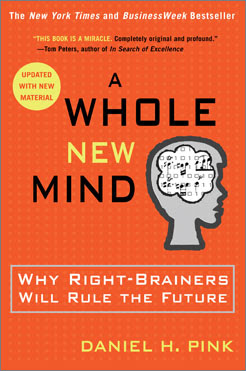
Off the Shelf: A Whole New Mind


My latest read is one long in coming: a book written by a favorite author back in 2005, then updated with an "annotated edition" the following year. It's now 2022. I'm a little behind in my reading.

I already knew I needed to pay attention to this writer. Long ago, when I finally considered what I want to be when I grow up, I settled on becoming a free agent. Not that I knew any free agents. The term simply expressed how I wanted to design my life, so I co-opted the phrase from the world of sports.

Then, come to find out, former speech writer Daniel Pink brought that very idea to life in his first book, Free Agent Nation. I was sold. I've been reading Pink ever since—or, at least, assembling a collection of his works on my overladen bookshelves.

The 2006 edition of A Whole New Mind has especially fit this month's reading list for another reason. While I've always found the concept of "Story" compelling, and the wonders of what long has been called "right-brain" thinking fascinating, Daniel Pink has found a way to blend these two of my candy sticks into one 286-page collection of quotable material.

If I were my English-teaching mother, I would have handwritten each of those passages on index cards and taped them all over my office wall. Consider this from Pink:

We are our stories. We compress years of experience, thought, and emotion into a few compact narratives that we convey to others and tell to ourselves. That has always been true. But personal narrative has become more prevalent, and perhaps more urgent, in a time of abundance, when many of us are freer to seek a deeper understanding of ourselves and our purpose.

He fingers these story strands even more carefully and, in the examination, observes that we "see this yearning for self-knowledge through stories in many places"—including, as you may have guessed, "in the surging popularity of genealogy" where we use the many tools now available to us to extract the facts of our ancestry and reshape them into those narratives we call family history.

The book, true to its title, delves far deeper than just the aspect of Story. The author explores our collective history as a culture having moved from an industrial age through an information age and onward into a "Conceptual Age." There, the successful will meet the challenge of blending "left brain" analytical reasoning with "high concept and high touch" gifts of the "right brain." Hence, a creative, synthesizing world in which we learn to employ our whole mind.

For me, though, the book's inspiration is in the mingling of creativity's roots. Pink cites what he calls the "six senses" which will shape the future: design, story, symphony, empathy, play, and meaning. Beyond inspiration, the book includes resources to help readers pursue those concepts in a practical manner. I felt a surge of family pride to notice, for instance, that his recommendation of the "granddaddy of American story-telling festivals" was the National Storytelling Festival in Jonesborough, Tennessee, home of my Boothe, Broyles, Davis, and Tilson lines. And an eerie sense of connection to wonder whether my English teacher mom in her later years might have served as a substitute instructor in the author's own high school classes in Columbus, Ohio.

Unafraid to share the work of others and point us to a rich collection of resources, Daniel Pink weaves this abundance of inspiration with equally-enriching factual detail. Still, for me, the gift from this volume is Story—even when he shares about this from the talents of others. Consider this quote I'd otherwise never have discovered from author Barry Lopez's book, Arctic Dreams:

If stories come to you, care for them. And learn to give them away where they are needed. Sometimes a person needs a story more than food to stay alive.

Doesn't that pinpoint exactly where we're at?  


Sunday, August 14, 2022

Telling the Story—Whether Old or Young


It is a rare occasion when a young person chooses to attend any of our local genealogical society meetings. Still, that is often the topic of discussion among those involved in promoting the pursuit of our families' history. Face it: if we don't have younger generations willing to step up and take our place as family historians, the stories we've worked so hard to preserve may possibly be lost to any interested future generations.

Being painfully aware of that possibility, I found it encouraging to run across a newspaper feature earlier this month about a thirteen year old student who, as part of a 4-H project, completed charting five generations of her family tree. That accomplishment earned her a spot at the Ohio State Fair, as well as appearance of her photo and feature article in her local newspaper.

Following in the footsteps of her mother and grandmother, Phoebe Cydrus began her student project four years ago, learning how to research online as well as interview living family members and document the lives of her ancestors. She is likely the youngest member of her county genealogical society.

Although those of us involved in local societies often bemoan younger generations' "lack of interest" in family history, that "lack" may not actually be the case. Rather than disinterested, young genealogists may instead be part of an invisible-to-us phenomenon. My own family history research has certainly benefited from the assistance of a young genealogist. And it is not hard to find signs of other young people involved in our favorite avocation, as well. We just need to know where to look to find them.

Take, for example, Ireland's Daniel Loftus, who bills himself as a "Teen Genie" on his website and has been active in blogging, on social media, in organizing fellow Gen Z researchers, and in launching genealogy-related initiatives. In recognition of his leadership role among his peers, the Allen County Public Library's Genealogy Center recently invited Daniel to speak on "Building a Bridge Between Generations."

Perhaps it is because of our own experiences that we know to look for others who share that designation of "young genealogist." When I hear people raise that familiar refrain about "lack of interest," I can't help but remember my own story. I was one of those young people who always wanted to know about my family's story.

It may be when we now see others stepping into the shoes we once wore that a connection lights up. That's how I felt when I ran across a mention of a blog post called simply, "A Love Letter to Young Genealogists." Even closer to my heart was blogger Kelly Wheaton's specific advice offered in that letter. "Don't forget you are part of a very old story," she reminds those young genealogists out there, wherever they are. "Once upon a time I was you," she reminisces, and closes with some advice:

...if you indulge me just a bit more—please focus on the stories. They are the most important things you may hear—you may not know it at the time—but trust me: every one you record will be a gift to future generations.


Wednesday, September 30, 2020

"Local Experts in This Common Frailty"


When it comes to livening up family history, you've just got to hand it to newspapers: they can provide the best stories—if you can find any. When I search in archived newspaper collections for ancestors, besides focusing on the predictable dates of birth, marriage, or death, I always make a second sweep of possibilities on a given ancestor's name by formulating search parameters wide enough to capture those stray mentions of the individual anywhere in the midst of his or her lifespan.

Some lives, of course, are boring and predictable, and not much can be found to add any color to such biographies. In the case of Mark Falvey, ancestor of one of my husband's Falvey DNA matches, he did merit a few appearances in the Springfield, Massachusetts, newspapers of his time.

Even though we can find a mention of an ancestor, though, the news articles mentioning our ancestor may not provide much in the way of substance. Still, we may be able to glean inferences, or compile details to assemble a clearer picture of day to day occurrences and attitudes about life for our relatives of previous generations.

Take this one article I found about Mark Falvey from page six of the Springfield Republican on January 27, 1890. Not much about the family can be gleaned from that particular entry in the Monday edition, other than the name of the street they lived on, and that the Falveys had been attending a church event the previous Saturday. Yet this brief paragraph provides a snapshot, a "day in the life of" moment to give a sense of what life was life for this particular family in the community they called home. 

In the Republican's review of events from Hampden County on that day was this brief paragraph:

A young man, who gave his name as Albert Smith of Holyoke, was captured Saturday morning under suspicious circumstances in Mark Falvey's house on Dwight street, which he had entered while the family were attending the mission in progress at the church of the Holy Name. One of the family returned unexpectedly and caught Mr Smith in the act of dodging under the bed in a chamber where he had been going through a bureau drawer, and the interloper was promptly delivered up to the police. No stolen property was found on his person, but a pocket-book which had been in the drawer was found under the bed, and it will probably go hard with young Mr Smith in the police court this morning. When taken to the police station the culprit tried to play the part of a drunken man, but the local experts in this common frailty declare his imitation poor.
 

If nothing else, reading our ancestors' newspapers can give us a sense of how their newspaper represented daily life in their community—and, in some cases, a humorous twist in that editorial point of view.

There are, of course, other times when the fortunate researcher can locate an article on an ancestor which provides much more than a wry chuckle. The occasion of Mark and Bridget Falvey's fifty-first wedding anniversary, which we'll review tomorrow, was such an example. 

Sunday, August 30, 2020

The New New Normal


Running errands in town yesterday, it occurred to me that, without giving it much thought, I was wearing my mask even when I didn't have to worry about any hovering hulk standing closer than the socially acceptable six feet away. But that wasn't because I'm a naturally compliant person—don't fool yourself on that one. It was for sheer self-interest that I donned my smoke-filter-equipped facial fashion statement. If COVID-19 ushered in the age of The New Normal, the California fires brought to us a new new normal.

Two weeks and counting, the twin infernos in northern California continue to make their impact on our atmosphere. The dog days of August could not possibly be the same as in past memory; everyone with any sense made sure that even their pets were inside, escaping the smoke. Who knows what life has been like on the outside; air conditioned artificial reality can make one forget it is still summer.

And where has that summer gone, anyhow? How did it escape us? The New Normal has a way of making us forget.

That actually is a misnomer. It isn't The New Normal. It's more like the new new new new normal, at least according to a New York Times publication, or its brief synopsis at Wikipedia. Which makes me feel less disappointed in myself that I didn't snap up the advice, at the beginning of this year's first New Normal, to journal the daily gyrations of life upon the onset of the pandemic. History in the making, and I missed my opportunity to tell of it. Maybe New Normal, The Sequel will be my chance to get with the documentary program.

And yet, I believe future generations will have ample opportunity to steep in the chattiness of our current age. If I don't save a pandemic diary for my descendants, they will hardly be at a loss to know what life was like in 2020. The generations I would have loved to know more about were those whose culture kept them tight-lipped and silent in the face of the tragedies they surmounted. In their new normal, they believed the best way forward was to say nothing of what was behind them.

We lack for that. Perhaps it's not in knowing what happened in any generation's experience that we mourn the loss of--we have, after all, the archived news reports of countless decades—but what we are missing is what the people who matter the most to us thought about what was happening to them. There is history—that recounting of the events with world-shaping impact—and then there is our story, the story of the people we call family. How history shaped the lives of those we love.

When I research my family lines and wonder about why an ancestor chose to do what he did, or why she was born in one country but died in another, what I'm looking for is not just a family's history. It's a yearning to have a relationship with people we never met, but who simultaneously infuse our every waking—and even sleeping—moment through the genetic strands they unwittingly bequeathed us.

Those choices we make, those actions we take, those moods which overpower us--where did they come from? I can find a specific segment on a chromosome, "paint" it on a digitized diagram approximating relative locations, and, if fortunate enough, be able to pinpoint which ancestor was the benefactor of that genetic pattern. Perhaps, as an echo of the stronger impulse impelling adoptees to find their birth parents, we who obsess with our genealogy may well be experiencing that same call from ancestors we never knew—and yet, know all too well through our own genetic signature.

It is that silent cry for relationship with those now-gone relatives that makes me wish for a token of their thoughts. I want to know what their new normal was, in crisis after crisis which swept through their life's timeline a hundred years ago or more. It isn't really just so I can glean the correct date or birthplace to enter on a pedigree chart; it's some token—some confirmation—of their reality that I can meld with my own. An impossible pursuit, perhaps, but worth the chase. After all, some of us do have ancestors who kept a written narrative on their way to a new normal.

Friday, April 17, 2020

Wisps and Snippets
of the Digital Preserve


The story of Luther and Lucy Fischer hit me just right when I discovered it last week, thanks to a comment on a Find A Grave memorial for Luther, but something else occurred to me, as well. After all, Luther was first cousin to my great-grandmother, Sarah Ann Broyles McClellan. Wouldn't they have known each other? Wouldn't that close connection have incorporated that detail into the broader fabric of our family's history?

The conclusion I arrived at, after mulling this one over for a while, was: no, they likely would not have known much of each other. Here's why—and a mental exercise you might attempt as you navigate the twists and turns of your own family's branches.

First of all, though Luther's mother, Sarah Rainey Fischer, and my great-grandmother's mom, Mary Elizabeth Rainey Broyles, were sisters, that doesn't mean they were lifelong neighbors. Sarah Fischer raised her family in their native Georgia, and though she temporarily moved from her hometown in Coweta County by the time of her first marriage, her return home for the birth of her first child happened to nearly coincide with the birth of her own sister Mary.

Then, too, when Mary was old enough to marry, both her parents had already died, and she was under the care of her aunt and uncle in another county further removed from home. It was in that county—Muscogee County—where she wed distant relative Thomas Broyles and removed even farther from her Georgia home to live on his property in Tennessee. In a brief six years—by the time her sister Sarah had remarried and given birth to all but the youngest of the Fischer children—Mary had already died in childbirth by 1877.

By then, Luther was barely six years old. His cousin, my great-grandmother Sarah—perhaps named after this very sister of Mary—was not yet three years of age. While my great-grandmother remained in her father's home in Tennessee until a few years after her marriage, there was likely little chance for her to visit her mother's side of the family after her father remarried. Once my great-grandmother left Tennessee as a married woman, she and her own young family settled in Florida.

There are likely many other such stories of disconnected family lines. And there are likely just as many reasons why families grew apart over history. Every reason from the call to migrate westward to the dynamics of large families and their inherent age disparities from oldest child to youngest yield cousins who may have known next to nothing about each other.

Yet, some of those cousins—and, multiplied over generations, their descendants as well—were the recipients of the disparity in bestowing details of the family that others never had the privilege to know. Think of everything from saved letters to journals to photographs to heirloom furniture or keepsakes. Or something as simple as a preserved memory. Some cousins got the goods; others lost out—or never even knew what they were missing.

When I see traces of these tokens in the wisps and snippets we family historians manage to share with each other—online, across the miles—I realize this may be the only way some of us get to learn more about our families. Ours may have been a legacy of the cousin who moved west and never got to grow up with the children of aunts and uncles, a connection so close yet made so distant due to unavoidable circumstances.

Virtually, now reaching out through the ether, we are snatching these vanishing wisps and preserving them in a form tangible enough to pass along. We save them, and wait. And hope that someone else—perhaps through a Google search—will stumble upon that memory, preserved in place through our efforts. When we meet, we and that distant cousin of whom we previously knew absolutely nothing, we digitally multiply those artifacts of a separated family, sharing yet never losing what we've inherited, in the wonders of online genealogy. Those are the connections which most keep me in awe of the happenstance of this digital preserve of our heritage.

Sunday, March 15, 2020

The Stories we Tell Ourselves


Most people may not realize it, but the stories they recall about their families can have a stronger impact upon their life than they think. The message we glean from our family history can come to define us, as well as identify our ancestors. That, of course, can become a force for good—or, in other cases, a personally destructive force. And yet, some of that effect can be owing to the spin we choose to put on the facts.

There's no doubt our family's history can have an impact on us—especially that of our most recent past. Some of those family history details were not merely facts set forth on paper, but episodes we lived through. We recall the stories, sure, but we also remember the emotions connected to those events. More importantly, though, is the evolution of those stories to where they become part of the self-definition shaping who we are.

The power of stories—stories of our own family's history—has often been acknowledged for its ability to build up...or to hold back. From the point in 2013 when New York Times columnist Bruce Feiler published his reflection on the strength of families in "The Stories that Bind Us," he pursued that essence of family stories. Bottom line, he realized,
The single most important thing you can do for your family may be the simplest of all: develop a strong family narrative.

In that relentless pursuit of the power of stories, Bruce Feiler relied on research by a wide spectrum of academics, and also by continuing to reach out, himself, to people across the continent to glean their examples and illustrations about the stories in their lives. In one of the 2010 studies influencing Feiler's writing, researcher Robyn Fivush noted,
Adolescents who report knowing more stories about their familial past show higher levels of emotional well-being, and also higher levels of identity achievement, even when controlling for general level of family functioning.

More recently, that same researcher commented that "stories about our family tell us who we are in the world and who we should be." Stories about our grandparents, for instance, "provide models of both good and bad times, as well as models of overcoming challenges and sticking together."

Bruce Feiler, convinced still about "the power of personal stories to give us strength in challenging times," has moved on to issue his latest book about what he calls "lifequakes"—those personal disruptions that rocket us into unexpected life transitions. Life is in the Transitions could not have come out at a more timely season; in fact, the wait until the May 12 issue date may be more of a stretch than some now going through those "lifequakes" would like to see.

While I obviously do not know exactly what this champion of the value of personal narratives might say in his latest book, I suspect a world in flux right now would like to hear it—and as soon as possible, too. Right now, someone who is very close to me is struggling with the news of a diagnosis of cancer. Already, I can see in the stories she is telling herself that the battle may not really be with the medical issue in her body, but with the narrative she allows to run through her mind. Those stories are vital. The ones we choose to rehearse the most will shape our future.

Those are not the only stories we have to draw from our reserves of family memories. There are others, of course. Some, though positive and uplifting, we oddly manage to forget; it's others in our family who need to be there to remind us that, yeah, those things happened, too. From the collective family reserve of stories, we can remind each other of those story riches, rub them into each other's memory like psychological salve and let the healing balm do its work.

Many of those stories may not be written down anywhere, but they are still there, stored up in our memories. Those are the family treasures that get applied when the need calls for them, but we can preserve them, hold them in reserve for the times when we best can apply them.

More than writing these stories down for later recall, though, is the importance of developing the skill of knowing when to apply a story—and which one will best achieve its purpose in uplifting the family member who needs to change which story is playing in his or her head. Knowing how to shift gears is one skill; being able to apply that direction-changing motion is yet another art.

No matter what, where, with whom, or why, though, we need to develop a healthy respect for the power of those stories. While yes, we need to preserve our family's oral heritage to pass on to the next generation, we need to understand the power of those stories which are now playing in our heads, and the imperative to change the story channel when the need is there for a more empowering narrative, then reach down in all that store of heritage to bring up just the right jewel.


Saturday, March 14, 2020

The Stories They Told Us


As far as I know, my mother only had two children. I say that because even the most sainted, apple-pied mothers among us have been revealed to have birthed unexpected others. We've learned that DNA can now tell us those most hidden of our ancestors' secrets.

That said, our mothers can turn out to be two totally different people in the eyes of their descendants, even when they were ever-present and always accounted for. We discover that when we learn how different the stories told to us turn out to be, when compared with the stories told to our siblings.

I've been thinking, lately, about one such eye-opening experience when I realized that the stories my mother had told my sister were totally different than those she shared with me. Not that I'm inferring that my mother fabricated events or experiences, but simply that the course of conversation with one person can lead to revelations which were never shared with another person.

Think about it: if you have specific interests, it would be no surprise to learn that, in the course of conversation with others, your favorite topics would naturally come up as subjects to discuss—if the others in the conversation shared that interest. If, in moving to another group holding no interest in common with that first group, it wouldn't be a surprise to learn that the topics discussed with that second group would be quite different than those in the first.

Since my sister and I are two totally different people—I have a bent for the creative, pursuing music and writing, while my sister is all about business and finance—it is no surprise to learn that the same woman who was mother to both of us would nevertheless engage in totally different topics of conversation when she visited each of us in our adult years. Yet I never gave that dynamic much thought until my sister nonchalantly mentioned something about my mother in one of our phone calls a few years ago.

"What?" was my immediate response. "When did she tell you that?" I had never heard such a thing.

It might sound as if my mother were two different people from an incident like that, but it's likely that you may have experienced the same thing, too, if you have siblings. I can think of moms who drag themselves to their kids' sporting events—all the while secretly hating the dust mixed with sweat under the roasting sun—leaving their children to assume that their mother loved baseball. Or dads who would never otherwise have stepped inside a theater to experience a ballet performance, if it weren't for the fact that his little cherub was up on stage with the rest of those angels in tutus for this year's iteration of The Nutcracker.

All that to say, last week I was teaching my beginning genealogy class and going through the usual routine of urging students to begin their research by gathering the oral history of their family from family members. When we were younger, we could perform such information-gathering exercises by reaching out to parents and grandparents, aunts and uncles. But this was a lifelong-learning class comprised of retirees, many of them who can no longer discuss such questions with their parents. Some of them are now left with only their siblings—sometimes, only the younger siblings who weren't around in those early years to even have met the older relatives.

In that case, I suggested, ask your siblings about what they do remember. After all, if the stories my mother told my sister were so different than those she shared with me, if the two of us piece together our joint memories, we'll have a more complete picture of the person my mother actually was.

Not only is that relative someone each family member experiences differently, but each of us interprets our memories differently, too. As detectives have learned, in questioning witnesses to crimes and other traumatic events, one person may notice a specific detail in the episode while another witness might focus on a totally different part of the scene. It's not that their memories are flawed, but just that each person takes in a different picture as the event is unfolding. Because the same process impacts our observations about everyday life as well, it makes sense to share our family stories with each other as we compile our reflections on our recent ancestors.

I sometimes view compiling a family history much the same as seeing an artist create a scene in mosaic form. Each tiny chip of tile or glass, while in itself merely a flat color, is worked into the broader picture to not only create the nuances of an accurate portrait, but to reflect the flavor of each beholder's subjective experience in the portraying of that life. Preserving the full aspect of the stories our parents and grandparents told us means inserting that multi-faceted mosaic of viewpoints we gain by encouraging the others in our generation to contribute to the process.


Friday, December 20, 2019

The Prescription of Writing


When life begins feeling rudderless, I've found grounding through an old tradition: journaling. Especially with the upheaval of recent family changes, it's been a comfort to preserve thoughts and feelings, no matter how fleeting—not just to record them, but to find the best way to communicate them.

As much as I love having found old letters and diaries related to my ancestors—and as much as I bemoan not having more than just a few slim notebooks of my own mother's scribblings—I have been entirely remiss in not keeping a more regular habit of journaling the thoughts and events in my own life. Assuming there is anyone looking back from their vantage point of the next century, those future great-grandchildren would find precious little to help them piece together the lives of my generation's cohort.

Taking pen in hand and applying those remembrances to paper is far different than blogging one's thoughts in digital format. While it is true that paper does disintegrate over time, online records are as fleeting as the electrical impulses that carry them—and as fickle as the ownership of their dot-com hosts. I've even read one author's musings that the tools we use in our writing influence the style of our output. Consider Hemingway's staccato delivery—both in terseness and manual typewriter production. The fluidity of longhand expression on a writing pad may do more for the psychology resident in the prose than we think.

And so, I find a prescription for writing—the old fashioned way, in my journal—to be a habit I'd be happy to reacquaint myself with at this juncture in life. After all, it seems quite disconcerting to realize that, but for one lone cousin, that generation in our family—and all their memories—is all but gone for good. To be sure, writing about them won't bring them back, but it will go a long way toward enabling the next generation to pass along their remembrance to our family's future generations.

Thursday, December 19, 2019

Why we Need Memories


Five days before I got the phone call, my older sister most likely had her deceased husband on her mind. As she has done every year since his passing six years ago, she likely told everyone who would listen how much she missed her beloved Frank. And why not? He was her everything.

Not that there weren't any others. My sister had a large family of devoted children who loved her dearly—and several grandchildren and great-grandchildren who returned that radiant love.

But on this day of the phone call, she no longer had to recall how very lonely she was.

Even though some phone calls are not unexpected, they still can be difficult to comprehend. Or accept. It's hard to acknowledge that someone is gone—irrevocably so. Perhaps that's why it is so helpful to remember those many stories of life, rather than to be left staring at a gaping emptiness.

And so, I turn from sharing stories here of relatives long gone to take some time away to reflect on someone who has, so recently, gone to join them.