Showing posts with label Weddings. Show all posts

Tuesday, March 24, 2026

Hinting About Marriage


There will always be complications encountered by those pushing back through the generations in search of their family's history. That, at least, has become the case with Polly Firth, sister of my fourth great-grandmother Sally Firth. If she wasn't married twice, as one record I just found seems to indicate, then she has a name twin. I need to determine which one is the case for my ancestral line.

No sooner had I located a marriage record for Polly in her home county of Brunswick in Virginia than up popped an alternate proposal. On its face, it seemed likely that Polly Firth might have been married twice. A closer look, however, steers me clear of such an assumption. Here's what showed up as I searched for details on Polly's life.

First was a hint at Ancestry.com, indicating that Polly was married to someone named John Burch. To top that off, the record supposedly also contained the clincher that Polly was daughter of someone named Thomas Firth. Yes, I agreed, both my fourth great-grandmother Sally and her sister Polly were daughters of someone named Thomas Firth.

Following that hint was another. This time, the resource was a page gleaned from a book called Related Royal Families. This two-volume genealogy was compiled by Marilu Burch Smallwood and published in 1966. The book can be found at the FamilySearch Library. As a copy of the book was also scanned by the University of Virginia and can be digitally searched through Hathi Trust, it is fairly easy to access.

The Ancestry hint dropped me squarely at the top of page 154, where the first sentence asserts: "John Burch Jr. born 1758 died 1796 married Polly Firth." The entry goes on to explain that a transcription of Brunswick County marriage records had indicated that Polly Firth, daughter of Thomas, had been married to John Burch on May 30, 1782.

Indeed, there were other Ancestry hints providing transcriptions of this same assertion. Fortunately, some of those hints included the "FHL Film Number" which could lead me directly to a digitized copy of that same Brunswick County record from 1782. Naturally, I wanted to check that out.

Copying the film number, I logged on to my account at FamilySearch.org, clicked the "Search" tab to select "Records" from the drop-down menu, scrolled down the page to select "More Options." That opened up a new dialog box, where I zoomed straight to the option near the bottom, "Add Record Options." I selected the wordiest choice, "film/fiche/image group number (DGS)," and pasted the FHL Film Number I had gleaned from the Ancestry hint.

Up came an option, into which I entered the names I was seeking. Sure enough, it led me to a May 30, 1782, marriage record for John Burch and Polly Firth. And Polly's father was entered as Thomas Firth, just as the Ancestry hint had noted.

But could this be right? Could this actually be our Polly Firth, daughter of Thomas? How many father-daughter pairs of the same name could there be in a county of, at the time, twelve thousand people?

I couldn't say why, but something seemed off about this record. I decided to retrace my steps and review all the information I had gleaned about Polly and the Firth family. After all, despite lack of all the usual documentation we rely on for finding family later in the nineteenth and twentieth centuries, what little I had already found included a few pertinent details.

The first record was the 1794 will of Polly's father, Thomas Firth. In that will, as I've already noted, all the Firth daughters were listed by their maiden names with the exception of one: Betsey Rawlings. If Polly had married John Burch in 1782, her father would have listed her by her married name, since he drew up his will subsequent to that wedding—even if her husband had died before her father's wishes were set to writing. She was, however, entered simply as Polly B. Firth.

There was, however, a second issue which surfaced as I reviewed the documents I had found. In the later marriage record for Polly, in which she was married to Howell Duggar in December of 1795, a note inserted in the record stated that on that date, Polly was twenty one years of age. If so, that would fix her year of birth at about 1774. Someone born during that year would only have been eight years of age in 1782, when our Polly supposedly married this John Burch. If, jumping back to the Smallwood genealogy, John Burch's wife had a son named Bazell in 1786, our Polly as his mother would have been twelve years of age—an unlikely scenario.

What seemed like an easy-to-accept suggestion from Ancestry turns out to be, at best, the case of name twins. Yes, finding two daughters in the same locale named Polly claiming a dad named Thomas Firth may seem to be a stretch, but apparently in Brunswick County, Virginia, it is far more likely that that was so, than that an eight year old child was given in marriage, even if it was to a descendant of royalty.

Monday, March 23, 2026

Digging Into the Duggars


After finding a document regarding an exchange of property which named several children of Thomas Firth, my fifth great-grandfather, I was curious about one couple who didn't seem to fit into that profile. That couple was Howell Duggar and his wife Mary. Based on the pattern which seemed to be emerging from the connections in that document, I wondered about the possibility that Howell Duggar's wife might be another one of Thomas Firth's daughters.

Admittedly, contained among the signatures at the bottom of the indenture was one woman who signed her name as Polly Duggar, not Mary, as was named in the text of the legal record. Since Polly has traditionally been used as a nickname for Mary, regardless of the variance, I thought that was still a promising sign. 

Thanks to FamilySearch.org's Full Text Search, it didn't take long to uncover a marriage record from the Firth family's home location, Brunswick County, Virginia. The date on that record was December 21, 1795—about a year and a half after Thomas Firth had signed his own last will naming Polly Firth as one of his daughters.

The marriage register indicated specifically—and in quotes—that by the point of her marriage, Polly was "21 years of age."  On that December day in 1795, Polly was to become the wife of Howell Duggar, revealing the connection that had later included his name in the property exchange we had seen yesterday.

In 1799, as Thomas Firth's executor, Aaron Brown, wrapped up distributions from the Firth estate, Howell Duggar's name was once again mentioned, along with the husbands of Thomas' other daughters. And yet, as clear as those records may seem to be, there was one problem caused by these discoveries: there are other indicators showing that Polly Firth, daughter of Thomas, had been married before this point to someone by a different name.

Guess that means it's time to take a closer look at those other documents.

Thursday, March 12, 2026

Revisiting Virginia


Over fifty years after the fact, Thomas F. Rainey reported that he had been born in the state of Virginia. While the sole location of any documents I had been able to find for this third great-grandfather of mine had been the state of Georgia, where he had married his wife and raised his family, I've now been able to connect him to someone who had died in Mississippi. But Virginia? What were my chances for finding Thomas by searching through an entire state?

The 1850 census showed that Georgia resident Thomas Rainey had reported his age to have been fifty three at that time. Hence, a birth year of approximately 1797, right? At that point, Virginia's population would have been around eight hundred thousand. What were my chances of finding him in a crowd that size?

I decided to look, anyhow. But not for Thomas, himself. Instead, I tried my hand at searching for his father whose gift—at least to me—was the more unusual name Isham.

One item that stood out for me in that quixotic search was a marriage entry in a Virginia ledger preserved from Brunswick County. Dated July 31, 1794, it named Isham "Raney" as the groom. Granted, I still had my doubts that he would be the only person with that name among eight hundred thousand residents. But seeing the name of the bride made all the difference.


Her name? Sarah Firth. The very name represented by the middle initial "F" in Thomas Rainey's own name.


Image above: Line item entry from the Brunswick County, Virginia, marriage ledger as transcribed by The Virginia State Library; image courtesy of FamilySearch.org  

Wednesday, January 21, 2026

Double Checking


While puzzling over the will of Sarah Kenyon Heslop—and reviewing the links provided in a comment by fellow genealogy blogger Patrick Jones of Frequent Traveler Ancestry—it occurred to me to double check the hints I had found for Sarah's apparent brother James Heslop, both of whom were descendants of John Carter.

I'll admit: yes, I want to focus on the female descendants of my fifth great-grandfather John Carter, but let's just say I got sucked into a beguiling rabbit hole. Finding James Heslop's will right next to Sarah's slapped my curiosity upside the head. I had to piece together this family line of a man who, dying at age seventy nine, was still waiting to see whether his wife would bear him an heir.

The story, as I'm sure you suspected, involved a marriage later in life for James. Over at Ancestry.com, looking at hints provided ample choices for wives' names, making me wonder whether any of them referred to our James Heslop in Spotsylvania County, Virginia. Fortunately, the transcription at Ancestry.com offered for the 1851 marriage of James Heslop and Lucy Ann McCalley gave a film number for the digitized record, held at FamilySearch.org. 

Sure enough, signing in at FamilySearch and heading straight to the catalog to perform that search led to an entry labeled "Marriage Books 1795-1970" for Spotsylvania County, Virginia. The bad news: the actual entry bearing that film number was a collection of "photostat copy" records. I'd have to poke my way through the thumbnails to find the right entry.

First step was to find an index, which told me that I could find James Heslop on page thirty one. Poking my way through the thumbnails once again, I located the page number and began scanning the entries to find any mention of James Heslop.

At the bottom of the righthand page, I found him. Only in this entry, James was listed as marrying someone named Lucy Brown—and the date was far from the 1851 date I had expected from the Ancestry entry. This entry was, unfortunately, undated, but it followed an entry dated January 30, 1813—not anywhere near 1851.


This, I'm presuming, could be James Heslop's first marriage. This first Lucy might have been the mother of William, James' heir according to his will, should the second Lucy Ann have failed to give her aging husband any children. This first Lucy may also have been the mother of the other son mentioned in James' will: Isham. Of either of those suppositions, though, I'd need more information before I can enter them as fact.

I did, after much more wandering, locate the promised marriage record for James Heslop and Lucy Ann McCalley in 1851. Let's just say the ministers in Spotsylvania County must have entered their marriage records when they got around to it. This Heslop marriage was part of a list of several line entries of such ceremonies.


There are so many gaps in the life story of James Heslop and his wives. To fill in the blanks, I'll need to locate a few more court documents—if, that is, I don't first haul myself out of this tempting rabbit hole and get back to business as promised.

Wednesday, May 28, 2025

About That Other Lydia


Whenever we encounter conflicting assertions about a branch of our family tree, there is no route that possibly can be taken—at least, if we want a tree that reflects documented, correct information—other than to inspect all that can be found, according to each version of the "truth." In the case of that "other" Lydia, wife of Benedict Palmer of Mercer County, Ohio, that is exactly the task we need to attend to today.

Here's the assertion that got me started on this chase: a Find A Grave memorial for someone named Lydia Palmer, who was buried in Ellis Cemetery in Montezuma, Ohio, a tiny village in Mercer County that even today claims a population under two hundred people.

Nestled up against the state border with Indiana, Mercer County is on a road leading from Columbus, Ohio, to Fort Wayne, Indiana. From Perry County, where Lidia Miller lived, to Mercer County would be a trip of almost two hundred miles. If Lidia Miller, the widow of William Gordon, were indeed one and the same as Lydia Palmer, it would help to assemble records documenting the transactions that made that assertion a reality.

Let's check first to see what we can find on Lydia Palmer before her death in 1895. As early as 1860, I could find a census record for Lydia and her husband Benedict Palmer in Montezuma. The household included two daughters and five sons, with the oldest being named Jerome and the youngest, at one year of age, designated as his father's namesake, Benedict. The senior Benedict was noted to have been born in Delaware, while Lydia claimed to be an Ohio native.

The difficulty with the ages indicated for these children—Jerome listed as being twenty years of age in that census, meaning a birth year in 1840—was that "our" Lidia had given birth to her one surviving child, Adam Gordon, only a year prior to that. Not to mention, Lidia's husband, William Gordon, died at the end of 1840, certainly not in enough time for her to have remarried and brought another son to full term in the interim.

Looking for marriage information on Benedict Palmer, I did find a marriage record dated in February of 1839—the same time as our Lidia's son Adam was born—not from Mercer County where I had found the Palmers in 1860, but from Fairfield County, not far from Perry County. Benedict's wife's name, however, was listed as Catherine Hovermill.

Thinking this might have been a different Benedict, I went looking for someone by that name in Fairfield County. When I located him in the 1850 census, Benedict Palmer was indeed living in Fairfield County—but his wife's name wasn't Catherine at all. Despite the scrawl of the enumerator's handwriting—and his propensity to use abbreviations for names—the resultant entry for "Benidic" Palmer's wife looked far more like Lydia than Catherine.

It was time to branch out to more recent records—hopefully, those of the type which would include names of parents, such as death certificates. Remember that youngest son from the 1860 census, the one named after his father? I found what might—or might not—have been his death record. However, this Benedict Palmer died in Iowa, not Ohio. The informant, his wife, stated that her husband was born in Iowa, not Ohio. To complicate matters, she also reported that his father was born in Ohio—not Delaware, as we had seen from census records. 

The biggest problem, however, was that while this Benedict's death record noted his mother's name to have been Lydia, her maiden name, according to her daughter-in-law, was Barker.

Wrong Lydia? Don't be too sure. I kept looking—thankfully. Among the marriage records turning up in searches was one for a wedding performed in, of all places, Perry County, back where we had left our own Lidia Miller Gordon. On May 1, 1842, Benedict Palmer and Lydia "Gorden" stood before a Justice of the Peace, who solemnized their marriage.

To complete the tale, I'll need to look for any record of what became of Benedict's first wife, Catherine, who was evidently the mother of the oldest son, Jerome, whose burial was also noted with a Find A Grave memorial in Montezuma.

And that youngest son Benedict? Though he died in Iowa, he was indeed buried back in Montezuma—and, despite her provision of incorrect information on her husband's death certificate, so was his wife Rachel.

Thanks to an unexplained entry at Find A Grave—one which, without that documentation, seemed to make no sense at all—we now have the rest of the story, as far as Lidia Miller's life went. The birth dates for the sons of each husband, while seeming to contradict assertions about this marriage, made much more sense, once we followed through to find documentation to tell the full story.

Now, I'm left with far more to do on this month's research project. Besides documenting these discoveries for the family tree, I'll need to add the line of descent for children of Lidia's second marriage. Then, because those descendants may mean additional discoveries among perplexing DNA matches, I'll need to pursue that angle, as well—all before the close of this month, if all goes well.

Monday, August 26, 2024

Where's John?


Digging into naturalization records, then looking further back to corresponding passenger records, can be a chore. That's the process I need to tackle next for the siblings of Theresa Blaising, third wife of John Kelly Stevens, and the only grandmother my father-in-law ever knew.

There is, however, one problem I faced before jumping into that task. When I listed the reported dates of immigration for Theresa and her siblings last week, I noted what I found on her brothers Henry, Lawrence, Phillip, Louis, and August, but where was John? He was clearly part of widow Mary Blaising's family in the 1870 census, but disappeared from enumerations after that point.

I could have assumed that, like many children during that time period, he died young, but there was one detail standing in the way of such an easy answer: his mother's obituary. There, in that June 13, 1907, entry in the Fort Wayne Evening Sentinel, included among Mary's seven surviving children was "John, of this city."

So he didn't die young—not, at least, before his fifty first birthday. Where was he during all those years since the 1870 census?

In a connect-the-dots moment, I found the answer. Using a different approach, I thought I'd go back to records I had found on John Kelly Stevens, Theresa Blaising's husband, to see if there were any mention of her relatives. It is unfortunate that John Kelly Stevens and Theresa Blaising never had any children in common, for I'd be curious to see who they might have named as godparents, which could have yielded a clue. But it turned out there was another document which provided some help: their marriage license.

Thankfully, preceding John and Theresa's June 14, 1887, wedding in Allen County, Indiana, their marriage license indicated that, upon "being duly sworn," another man stated that he was acquainted with both John K. Stevens and "Tresia" Blaising, the couple about to be married. That man was named John B. Blaising.

Even better, looking through the other marriage licenses in that register, the very next one listed the information for another couple married on that same day: none other than John B. Blaising and his bride, Mary Fisher. Reciprocally, John K. Stevens vouched for them.

So why, if John Blaising was there in Allen County all along, did I miss him in other records? I suspect confusion about the Blaising brothers may have been owing to a French naming tradition. While some research guides indicate that at that time, the French might give a child multiple given names, only one of those names would be used in daily life. Also, during that era in the mid-1800s when the Blaising children were born, names were typically drawn from the Roman Catholic Church, making each child the namesake of a Catholic saint. In some cases, those names took the form of compound names, such as Jean-Baptiste (John the Baptist).

I have often spotted examples of compound names as well as multiple given names, especially those beginning with Jean, or in English, John. This may have been the case for the Blaising family, for I've found indications that some of John's brothers actually were listed with an initial "J" in some American records. While that initial "J" would never have been found in the French tradition, I noted, for instance, John's brother Louis' death certificate and headstone listing him as "Louis J. Blaising," and brother Phillip Blaising showing in the 1930 census in Crestline, Ohio, as "John P. Blaising." Could each of these be revealing an original French version as Jean Louis or Jean Phillipe?

If this were the case, perhaps it is no wonder that, awash in a multitude of sons named Jean—or John in English—the American governmental record keepers became confused. And John B.—whatever that initial "B" might have stood for—became lost in the multitude of French given names.

But now, however, he's found, thanks to his inclusion in his brother-in-law's marriage license.

Tuesday, March 5, 2024

About the Reverend


The search was on to discover my roots—specifically, the mother of my orphaned second great-grandmother, Mary Elizabeth Warren Taliaferro Rainey. Because the name Taliaferro kept showing up in what I could find about this family, I was fairly certain that was M.E.W.T. Rainey's mother's maiden name. However, in looking around the page where the younger Mary Elizabeth's marriage entry had been made in Oglethorpe County, Georgia, I noticed some interesting details.

For one, the name of the minister who performed the marriage ceremony for young—and I do mean young—Mary Elizabeth and her beau Thomas F. Rainey was Nicholas Powers. The Reverend Powers had signed a statement indicating that he had performed their marriage ceremony on June 9, 1818. Remembering that Mary Elizabeth had, in later years, reported her age such that her year of birth would have either been in 1804 or 1806, I did the math. Yep: this girl was either fourteen or—worse—twelve at the time of her marriage to Thomas Rainey. Surely, that couldn't be correct.

That marriage date was gleaned from one Oglethorpe County record, but there was more than one entry for Mary Elizabeth's wedding date. In another ledger, listing only the date and names of bride and groom, the entry date for Mary and Thomas' wedding was given as May 30, not June 9. Could that have been the date when the marriage license application was made? 

While puzzling over that discrepancy, my eyes wandered over the page. What should I spot, just below the Rainey and Taliaferro entry, but another Taliaferro entry. This one also was dated the same: May 30, 1818. The Taliaferro in question for this entry was someone named Mary, but rather than Mary E., as our Mary's record had been entered, this other Mary was "Mary M."

And the groom? The Reverend Nicholas Powers, himself.

Of course, the next question was: who was this Mary M. Taliaferro? She couldn't have been a sister of our Mary, I reasoned. It would be unlikely to see two sisters with the same given name. Perhaps this was an entry for two Taliaferro cousins who coincidentally got married on the same day—or at least applied for their marriage license at the same time.

As it turned out—at least, if we can trust this clue at Find A Grave—the other Mary was someone named Mary Meriwether Gilmer. The reason she was identified in her marriage record as Mary Taliaferro was that she had been the widow of someone named Warren Taliaferro. On the same day that the Reverend Nicholas Powers applied for a license to marry the widow Mary Taliaferro, Thomas Rainey had applied to marry the exceedingly young daughter of that same widow, and her future step-father had performed the ceremony ten days later.


Above: Entry from the marriage records of Oglethorpe County, Georgia, showing the entry dated May 30, 1818, for Thomas F. Rainey and Mary E. Taliaferro immediately above that on the same day for Nicholas Powers and Mary E.'s mother, Mary M. Taliaferro; entry courtesy Ancestry.com.

Monday, March 4, 2024

Meet M.E.T.


It is always wise to start with what you know, when launching a search for the unknown predecessors lying behind those brick wall ancestors in your family tree. At one time, my third great-grandmother, Mary Elizabeth Taliaferro was one of those mystery ancestors. Only because of the help gained by using the mitochondrial DNA test was I able to break past the point before that, when all I knew about my second great-grandmother was that she was an orphan from Georgia who married Thomas Taliaferro Broyles and moved to Tennessee six years before her untimely death in 1877.

It wasn't easy to find the orphan's parents. Before DNA, all I knew, thanks to an entry in a family Bible, was that my second great-grandmother's maiden name was Mary Rainey—and even the spelling of her surname was suspect, due to handwriting issues. Eventually, the discovery that the daughter lived with her older brother Thomas in the 1870  household of one Charles Taliaferro in Columbus, Georgia, led me to the previous census record where, in 1860, the two siblings lived in a household headed by one Mary E. Rainey.

The older Mary was, at that time, apparently widowed, for there were several young people living in the home with her—but no husband. In typical fashion for the 1860 census, the household was itemized, giving the names of the men below the head of household, then the women who, in bookend fashion, followed—first the oldest daughter Martha, then the youngest daughter, "Mary W. E." 

The problem was that looking for the family in the previous census meant that baby Mary Elizabeth Warren Taliaferro Rainey would not be included in the household, since the 1860 census had indicated she was born about 1851. Noting the names of the older children, though, I pushed back to the 1850 census to discover baby Mary's father's name: Thomas F., same as the brother with whom she had been living after her parents' deaths. From there, I also obtained a copy of the elder Thomas' will, filed in Campbell County on June 7, 1858 which, although not identifying the other children, did name two daughters, including—thankfully—Mary Elizabeth Warren Taliaferro Rainey.

Now that I knew her parents' identities, it was time to learn more about them. Unfortunately, I haven't learned much about Thomas, husband of the elder Mary Elizabeth and father of the longer-named daughter. As for his wife, Mary Elizabeth, I discovered through her husband's will that, in addition to naming his wife as executrix, the same Charles Taliaferro in whose household I originally found the younger Mary Elizabeth and her brother Thomas living had been named executor of the elder Thomas Rainey's 1858 will. That, combined with the repeated reference to Warren Taliaferro, both as name of the couple's deceased son and the appendage to their youngest daughter's name, sure seemed to point the way to a Taliaferro surname for Thomas Rainey's wife.

As it turned out, there was an 1818 marriage record recorded in Oglethorpe County for one Thomas F. Rainey and his bride to be, Mary E. "Talafero." What was concerning, though, was that if the bride was indeed our Mary E. Taliaferro, she would have been quite a young bride. Based on the ages given in the 1850 and 1860 census enumerations, she would have been born in either 1804 or 1806.

The initial thought might have been, given the different location of the county, that this was not our Mary. However, it was the name of the minister which hinted we might have the right bride, after all. This minister of the gospel signed his entry in the court records as Nicholas Powers. Like many other clues we find in family history research, this name had more than one connection to Mary Elizabeth's family, as we'll learn tomorrow. 

Wednesday, October 18, 2023

Found my Voice Again


I can finally talk again! It took lots of googling for answers, reviewing and testing information—which in this case hadn't seemed to work—but now it appears I can finally talk back to everyone again in comments you've left on A Family Tapestry. Seems it was a function of some default settings on Safari, the browser I've been using since switching from my old clunker PC to a new Apple laptop. While my first—and second, and third—foray into problem solving didn't seem to do the trick, that option to try, try again worked in my favor, and by last night, I was able to pipe up and leave a reply to the comment by "kdduncan."

What Kathy had suggested was to go to FamilySearch.org to look up the marriage record for my Aunt Rose and her third husband, Julius Hassinger. I did just that, and quickly located an entry for the 1933 New York City marriage.

The record provided, however, was only a transcription, not a digitized copy of the actual document. Still, as Kathy had mentioned, it divulged information on the parents of the couple.

Well, let me amend that: Julius Hassinger's father and mother were explicitly named. From that transcription—assuming it was correctly copied—we can now say that Julius' father was named John, and his mother was identified as Agathe Geisen.

For Rose, however, reading an entry for her father which included only a first name did not follow a pattern as helpful as that for her husband-to-be. The bride's name was listed as Rose Kober, a name which we already have learned was her married name from her by-then-deceased second husband, George W. Kober. Having her father identified only by his given name told us very little, as we simply can't assume the missing surname was Kober; to eliminate that possibility, though, would have required us to trace Rose's history back past the first two marriages. In other words, the blank for the bride's father's surname leaves us in the same position in which we had started: with no usable information at all.

On the other hand, the name provided for the bride's mother did help somewhat. According to the transcription, Rose's mother was named Anna Segar. That entry at least resonates with one I had found on the death certificate for my own paternal grandfather, Rose's brother. On that record, which I had sent away for years ago, his mother's name had been listed as Anna Zegar—close enough to have been, perhaps, a matter of writing down, slightly incorrectly, what had been heard.

But reading "Julius" for the bride's father's name on the transcription of a document detailing her marriage to a man also going by the same name? There is room for doubt here, in my opinion.

Still, the suggestion was well taken, and one good turn—around a records resource, that is—deserves another. So I looked up Rose's previous marriage to George Kober to see what the reported parents' names might have been. There was no surprise regarding George's parents. He was a junior, and sure enough, the transcription for his 1915 marriage to Aunt Rose indicated his father's name was also George, although his mother Pauline's maiden name was mangled as "Heutton" (it was Hutton). But the main point of this search showed a confirming detail: again, Rose's father's first name was given as Julius.

Once again, no surname was given for Rose's father, the presumption being that her own surname must have been her maiden name. This, of course, was incorrect, for her marriage to George Kober listed her under her first married name, Miller. Looking for Rose's connection to a father named Julius Miller would have produced as many helpful leads as our previous assumption of a surname of Kober for Julius in the Hassinger marriage license. Yet looking for a record of Rose's first marriage would have produced quite a challenge, seeking an unnamed Miller coupled with a bride of unknown surname.

There is, of course, another approach to untangling this research dilemma. Now that I've discovered Rose's date of death in New York, I can try to obtain a copy of her own death certificate, which should also contain the names of her parents. That would be a prudent step in a sound research plan, but in the case of researching New York ancestors, it is a plan which brings up some roadblocks of its own.

Sunday, October 15, 2023

Extending Family


This past week, our family has been in Kansas, where my daughter was able to help with wedding preparations for her second cousin once removed. Only a genealogist's child could relate to a label like that. Perhaps more than the average family historian, I've had to reach even farther than that to place my DNA matches in their right position in the family tree. It's no surprise, then, to see how large my family trees have become, over nine years since sending the original DNA test away for lab results.

Right now, that means my parents' combined family tree has grown to 34,846 documented individuals. In the last two weeks alone, I've added 323 more names to that tree, mostly by reviewing the ThruLines results linked to my mother's Tilson line. And I've hardly scratched the surface with the results yet to review just in that Tilson family.

Because this month's Twelve Most Wanted research project focuses on a relative in my father's ancestry, most of my work has involved my own family tree, but I did check out a couple details on my in-laws' tree, mainly because the bride-to-be relates to us through my father-in-law's family. While that tree grew by a modest two additional names, the total number of individuals in that tree also reaches far and wide at 34,021 names. Lots of distant cousins documented there.

While new additions to our DNA accounts at all of the five companies where my husband and I have tested have grown ever so slowly—only two more matches for me in the past two weeks, and a miserly one match for my husband at Ancestry, for instance—there are still plenty of unidentified DNA cousins yet to place in their proper place in the family tree. I'd say I've still got my work cut out for me in making sense of that ever-extending family.

Tuesday, October 10, 2023

When Rose Met Julius


It was on a vacation in 1933 that Rose met Julius. She, the recently widowed Mrs. George W. Kober, had made arrangements that summer to visit friends in nearby Garden City—twenty miles from her home in Woodhaven, less than an hour's journey by train. Perhaps her friends, sensing she needed to get out of the house where she and her husband had lived in New York City since their 1915 wedding, had suggested she come to visit them. After all, it had been well over a year since George's 1932 death. Perhaps a change of scenery and some fun activities with friends would do her good.

That, at least, was the story told in two New York newspapers which announced her wedding. "Vacation Romance Leads to Wedding," announced the Society page of the Long Island Daily Press on December 13, 1933, noting that the Saturday, December 9, wedding was held in Long Island City. The article, while providing Rose's age—fifty eight at the time—and address in Woodhaven, said little about the groom. That he was "with the post office" in Garden City, and that this was his first marriage, was all the paper gave of the man's identity, while details of Rose's previous marriage filled a paragraph.

To have captured a pertinent detail such as Julius' age might have helped me find what became of the couple after their marriage celebration. At least the names of the witnesses had been provided in the article, though Mrs. Emily Kollshdorf and Charles Peters are not names which I had seen before in family circles—details to add to Aunt Rose's "F.A.N." Club.

A second article in The Richmond Hill Record seemed merely to repeat the details I gleaned from the first newspaper. I found no other search results for Julius Hassinger, though that is not to say there aren't others out there. However, seeing mention of the wedding taking place further east on the island, plus the groom's residence in Garden City, seem to indicate the couple may have set up residence outside New York City limits. Perhaps I should widen the scope of my searches. And test out some "what if" scenarios. Nothing else has divulged whatever became of Aunt Rose.

Monday, August 28, 2023

When Boy Meets Girl


Were you one of those children who clamored to hear just how your dad met your mom? It seems so many people have a soft spot for boy meets girl stories. I'll admit I was always curious about such details concerning my own parents—but right now, I'm more interested in how some of my ancestors met. Top that list with the ancestors who seemed to make such details a well-kept secret.

Since I've been researching my father-in-law's roots this month, one couple on my need-to-know list is the newly-discovered line of Dennis Tully who, after his arrival in Canada, married another Irish immigrant named Margaret Hurley. This Dennis is, as far as I can tell, a newly-discovered son of my father-in-law's ancestor who was also named Denis Tully.

My thinking was that if I could find this Dennis' marriage record—and if I were extremely fortunate—perhaps it would reveal the parents' names for both bride and groom. Unfortunately, I have no idea how or where Dennis met Margaret, let alone when. My best guess, based on the birth dates of their children, would be about 1856.

It occurred to me that I've been down this path before with the extended Tully family. It was a few years ago when, thanks to some DNA test matches, I discovered that there was another son of our Denis Tully and Margaret Flannery. This son, Michael, was not in his parents' first census record after the Tully family moved to Canada, but did show up on the subsequent census in 1861—not in the same household, but at least on the same page as his father.

I never had discovered how Michael met his wife—here's a groaner: she was also named Margaret—so I decided to revisit that family line to see if I could figure out a way to locate such details. I looked first for Michael Tully prior to his marriage to Margaret, and found a likely candidate in the 1851 census. This Michael Tully was a sixteen year old laborer listed in the household of an Irish Catholic couple named John and Bridget Moore. Along with Michael was another boarder named Ann Welsh—a surname which, back at the Tully household of Michael's parents was the same as that of a family living nearby.

This Michael, in 1851, was residing in a town called Brantford, which at the time was part of the same county as the home of Michael's parents—the village of Paris in Brant County. A distance today of twelve kilometers from town center to town center would prove an easy trip, even back in that era.

If that were the right Michael Tully, then could Brantford be the place where Michael met his future wife Margaret? Her maiden name was Dowd, which could present some spelling challenges. I looked to see what could be found in the census just following their likely 1856 marriage.

Though I did find a family named "Doud" in the 1861 census, living in nearby South Dumfries township—which in the 1850s did include a portion of Paris—it didn't appear by their ages that this Margaret would have fit in, though the proximity to Brantford looked promising. Another Dowd family in Hamilton also caught my eye, but didn't seem likely, either. Of all the Dowds which were listed in the 1861 census for Canada West, none seemed likely. 

Though my test run with the question about Michael Tully didn't produce any helpful clues, I did try the same exercise for Dennis and his bride Margaret, looking in the 1861 census for her likely family. Granted, in researching this family line, I've stumbled upon results peppered with spelling permutations like Horely and Earley. Notwithstanding that caution, I could find no detail which could help me figure out how Dennis could have met Margaret.

Sometimes, those boy meets girl stories may only survive through the years when the storytellers in the family pass down the tale from generation to generation.

I'm still looking for that Tully family storyteller.

Tuesday, August 22, 2023

Not Gretna Greens


Where do you find marriage records for your ancestors when the ceremony doesn't seem to have occurred in the place where either bride or groom called home? The presumption is to look for the closest "Gretna Green" and check the records there.

I've been holding out for a marriage record for Dennis Tully, that Irish immigrant to Canada whose wife Margaret's maiden name didn't seem to match up with records I had for my father-in-law's Denis Tully. My goal in looking for Dennis' marriage to Margaret Hurley is the hope that their record would reveal something I've yet to find back in Dennis' Irish birthplace: names of parents.

Since there is no record that I can find anywhere near County Tipperary, where our Tully family originated in Ireland, I am presuming the ceremony was conducted after the bride and groom arrived in Canada. And yet—so far—no document. That's when the notion of checking Gretna Green possibilities taps me on the shoulder.

The concept we've since labeled "Gretna Green" goes back to a law passed in England in 1753 prohibiting underaged couples from marrying without parental permission. Since laws are apparently made to be circumvented, sure enough, English couples soon discovered they could get around that requirement by marrying somewhere other than England. Conveniently, Scotland at that time had no such restriction, and enterprising lovers slipped over the border to Scotland to exchange their vows. The first town they found where they were free to do so was called Gretna Green.

The name of that tiny village, Gretna Green, soon came to be the label for any place where couples eloped to avoid marriage restrictions imposed in their own hometown. And genealogists eventually learned that, when unable to locate the marriage confirmation for their ancestral couples, they could consult a list of cities which were considered to be Gretna Greens. The FamilySearch wiki, for instance, provides a map of known locations in the United States, as well as a chart which begins, "If your ancestor is from..." (fill in the name of a family city or region), "Then check here...."

Though the chart mainly focuses on United States cities and regions, I noticed there were several entries for Canada, including one for Ontario locations where couples might slip across the border to, for instance, Port Huron, Michigan. 

While that thought might have been tempting for me—Dennis Tully did have some descendants who either married in Port Huron, or even settled there—I still believe that would not be a likely scenario for Dennis Tully and Margaret Hurley, themselves. There are a few reasons I think so. For one thing, each of them was Catholic, and baptismal records I've found for some of their children indicate their intention to follow the tenets of their religion, which would include the Catholic sacrament of marriage—hardly a ceremony they would leave to the closest blacksmith across the border in Gretna Green.

Then, too, while the Gretna Green concept was alive and well long before the time in which Dennis and Margaret would have married—their oldest child was born in 1857, so likely a year prior to that point—the area in Canada in which they settled would not have lent itself easily to slipping across the border. While it is true that the region in which they settled later saw traffic to the United States through places like Port Huron, I would be more interested in confirming the time period in which such movement would have likely occurred—a much later time period, I suspect.

Another reason I'm not capitulating to the Gretna Green concept just yet is that I haven't thoroughly searched the marriage records for the possible locations where either Dennis or Margaret may have settled in the 1850s. Taking a look at the overview for marriages in Ontario, Canada, in the FamilySearch wiki, there are far more resources than just what can be found for our couple—nothing, incidentally—at Ancestry.com. Even so, there may be gaps in what is available in microfilms at FamilySearch, itself, though I won't know until I grind my way through all of the available resources there.

Even so, there are limitations to the microfilms which are available. Many records prior to 1869—and our couple's wedding would fall within this range—were gleaned from church records, not civil records. And even if we could find the right record for the right couple, despite some later records I've found in Ontario with all the information I'm seeking, chances were high that the record itself might be sparse

Fortunately, FamilySearch provides a list of "What else you can try" if initial search attempts bring up nothing. I will likely be checking out the links provided on this list, too. But first, I'll narrow my search to the places where I've been able to find Dennis in the earliest years after his arrival in Canada West. The first possibility would be in Blenheim, where a young, single, man by that name was living with another Irish laborer, two Catholics living in the midst of a page filled with Protestant families in the 1851 census. Could he have met Margaret there? Or did he meet her when he settled in Warwick in Lambton County? Or even in Paris, Brant County, where his possible father lived—and where, later, his first child was born?

These are the three main possibilities I'll be checking as I search for that elusive marriage record for Dennis Tully and Margaret Hurley. It makes more sense to look at those locations—or the geographic region closely surrounding those locations—than to strike out to intuit which Gretna Green location might have been the favorite spot for eloping couples in the late 1850s in Canada.

Monday, May 8, 2023

Cheat Sheet: Searching for Shortcuts


One thing about researching family history in the digital age: we can speed up the search process by manipulating the data we seek. Granted, "browse only" files can seem to slow down the research process, but there are plenty of other files available online which are fully searchable.

Thus, while I am plowing my way slowly through the oldest of browse-only probate records for Fairfield County, Ohio, there may be a shortcut for finding the answer to my question about the unnamed daughters in William Ijams' will.

William had died in Fairfield County in the early months of 1816, but tax records indicated he had settled there much sooner than that. He had arrived there from his family's home in Maryland and, as often was the case, William Ijams' family did not travel there alone. According to what I've found in some hundred year old local history books, William—along with his wife and children—had made the move west with at least two of his brothers.

Thus, when I strike out, riffling through hundred year old documents for a shortcut to my question's resolution, I do need to take care that I don't grab a record for a collateral line in this extended Ijams family, rather than a record for William's own descendants. This family did tend to recycle favorite names from generation to generation.

Finding a collection of Ohio marriage records at Ancestry.com, I put the digitized record set through its paces to see if I could compose a cheat sheet for my research question. I narrowed the search to show results from Fairfield County only, as that was where William and Elizabeth had settled with their family, and only for the surname Ijams, including the usual spelling variants. Then, pulling up the resultant list—there were fourteen marriages listed—I then culled the results for only the brides with the maiden name of Ijams.

Out of those fourteen marriages in that search result, six entries were for brides surnamed Ijams (or a spelling variation). Of those six, I recognized only one.

That entry was for Comfort Ijams, the known sister of Sarah, my mother-in-law's third great-grandmother who faced an untimely death in 1829. Comfort had married Edward Stephenson—alternately spelled Stevenson in other records—in 1811.

Since the other Ijams marriages in that list of possibilities included some names of grooms which I recognized from among William's sons and grandsons, I further culled this list based on the years of marriage given for the descendants I knew. Though the list included dates as late as 1841—another clue to keep in mind for future research—I noticed the marriage dates for those descendants I already knew hovered closer to the turn of the century. With that in mind, I looked specifically at the Ijams brides married before the date of their possible father's death.

Here, then, were the possibilities left to me. Marrying late in the year of 1804 was Mary Ijams, wife of Walter Teal. And, following a year after Comfort's wedding in 1811, someone named "Rabecca" Ijams married James Beck in 1812.

Just as a simple experiment, I'll take some time this week to see whether either of those women—Mary or Rebecca Ijams—lived long enough to produce documentation which links them to the right Ijams family. While this is a roundabout way to find my answer, it may turn out to be a faster route than wading through page after page of browse-only probate records for the same county.

Wednesday, March 16, 2022

Margaret's Marriage


If the two young children of the deceased Charles McClellan were living in the home of someone named Margaret Stephens, could there be a connection, despite the different surname? After all, by the time we found Charles' orphans Adeline and Samuel in the 1850 census, they had certainly attained majority age and were free to live elsewhere. Why did they stay?

More to the point, who was Margaret Stephens? We can see from that same 1850 census that Margaret also had three young people with the same surname living in her household: twenty year old Mahalia Stephens, fourteen year old James C. Stephens, and fifteen year old Elizabeth H. Stephens. While each of the three younger Stephens residents were born in Florida—a logical expectation, given they were living in Jefferson County, Florida—the census revealed that Margaret herself was born in South Carolina.

Also of help to us in our broader search for the roots of the McClellan children's deceased father Charles is the notation that both Adeline and Samuel were born in Georgia. Since Jefferson County shares a border with the state of Georgia, that is not surprising news. However, that detail will help guide us as we trace the orphans' father's roots before his family settled in territorial Florida.

If Adeline and Samuel were born in Georgia, that most likely meant that their father was once also in Georgia. But what about Margaret? Could she have been connected to this family as well?

As it turns out, there was an application filed by someone named Margaret E. Stephens for a widow's pension, based on the service of her husband in the war of 1812. While not much information was written on the document other than the veteran's name—Benjamin Stephens—four captains' names from the Georgia militia were provided, under the line for "service." That line, incidentally, was edited to add the word, "alleged."

Still, that's a clue: to look for a marriage record for Benjamin Stephens and a bride named Margaret, somewhere in the state of Georgia.

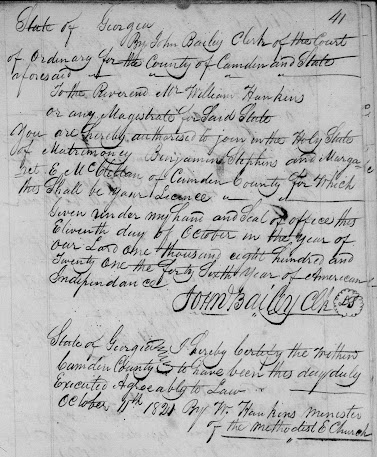
With the help of digitized and searchable records, that was easily found:


On October 11, 1821, in Camden County, Georgia, the Reverend Mr. William Hawkins of the Methodist Episcopal church performed the ceremony uniting Benjamin Stephens and Margaret E. McClellan as husband and wife. By the 1830 census, though, Benjamin Stephens and his young family had moved across the state line to Jefferson County in territorial Florida, and by 1835, Benjamin was involved in land transactions in the same county, according to the Bureau of Land Management.

What became of Benjamin, Margaret McClellan's husband, is not yet clear, though it is obvious that by 1850, his wife and children were on their own. As for Margaret, though we've yet to find any record identifying her specifically as daughter of Charles McClellan, we at least can feel fairly confident that, as the surrogate mother for Charles' youngest children Samuel and Adeline, Margaret was likely their older sister.

What is most helpful about this discovery is that it outlines for us the route that brought Charles McClellan to Jefferson County in those early days before Florida statehood. Let's step first across the state line to Georgia to see what can be found in Camden County, the place where Margaret married Benjamin back in 1821.


Above image of the October 1821 marriage license for Benjamin Stephens and Margaret E. McClellan of Camden County, Georgia, courtesy of FamilySearch.org.

Friday, January 14, 2022

Taking a Second Look


When stuck on a research question, as I am with my fourth great-grandfather Job Tison, it sometimes helps to go back and take a second look at all the documentation already gathered. When we focus on one specific research question—as I had in the past, when looking at Job Tison's probate case to examine the specific listing of slaves named in his records—unrelated details may fly by our eyes unnoticed. Sometimes, the very facts we are seeking now turn out to have been there all along. This time, looking with fresh eyes, we can sometimes unearth those details from their camouflaged position.

Now that I'm stuck on Job Tison's personal details—specifically, what documentation can I find to pinpoint where he came from in North Carolina, if those reports are indeed true—I'm more than willing to go back and check everything I've already gathered, in minute detail if necessary. And as I go, I'm thinking things through—for instance, with his timeline.

Supposedly, Job was born in 1770. And reports of his later life in Georgia portray him as having come there from Pitt County, North Carolina. But "coming from" and nativity are not always the same detail. All I know is that the man ended up raising a family in Georgia and leaving a messy probate case in Georgia's Glynn County which took decades and additional family deaths before it was resolved.

In my own record, Job's oldest child had shown as a daughter, Sidnah, who became part of my direct line upon her marriage to George Edmund McClellan and subsequent move to a new life in northern Florida. That is not exactly the case, however. Besides Sidnah—"Sidney," born about 1806—there was an older son, Aaron. But there was also an unnamed daughter listed in Job's will, a child who had predeceased her father—but not before marrying a man by the name of Carter and bearing him two children.

Those two children were remembered by name in their grandfather Job Tison's will. Thankfully, they can now be found by name in this transcription of Job's will, as well as another published abstraction of the same. The granddaughter, named Eliza, and her brother Job, named after his grandfather, were likely born to a Tison daughter named Naomi, who married a Matthew Carter in Wayne County, Georgia, on August 4, 1811.

Think about that for a moment. If Naomi Tison was married in 1811, she could likely have been born sometime around 1791 or a few years afterwards. Where did her parents live then? Could there have been additional children before Naomi, as well?

Looking back over other resources I had found in the past, I noticed this one entry in another of Job Tison's granddaughters' D.A.R. application summary. Unlike the others printed in the Lineage Book of D.A.R. charter members, this particular entry had neglected to include the simple letter "m" signifying "married" before a date published in the granddaughter's entry. Thus, the line concerning her grandparents read:

Granddaughter of Job Tison (1770-1824) and Sidnah Sheffield (1776-1855), his wife, 1790...

and then continued with the other ancestors in the D.A.R. member's line. Not seeing the "m" before "1790," my mind just glossed over the significance of that date.

So...if Job and Sidnah were married in 1790, where did that occasion take place? And were there any additional children born before the listing I now have, beginning with son Aaron's birth in 1803? A gap between the 1790 date of marriage and that of the birth of the first child I have listed (1803) seems unusual for that time period.

An insignificant mere letter like the missing "m" may not seem to you to be worth the attention I'm giving it. On the other hand, realizing that was the date of marriage, it now opens worlds to me in my quest to find an answer to my research question. Granted, since Sidnah Sheffield's father seemed already to be living in Georgia, the marriage likely occurred at that same location. But just in case, I'd like to trace not only where any earlier children might have been born, but any other sign of a household headed by someone with that name—Job Tison—anywhere besides his eventual home in Georgia.


Monday, November 15, 2021

Maude's Mom


It may have been a stash of family photographs found in a local antique shop which prompted me to tell the story of their previous owner, Marilyn Sowle Bean, but it was the tragic legacy bequeathed upon Marilyn's husband, brother-in-law and, eventually, her own son which has me searching through Marilyn's mother-in-law's family tree.

Maude Woodworth Bean apparently was a carrier of a once-deadly disease known as Marfan Syndrome, the cause of the untimely deaths of the men in the Bean family. Prompted by that—plus the serendipitous discovery of those family pictures—I've been trawling through the Bean pedigree to see if I could pinpoint which branch of the family might have contributed the unfortunate tendency.

We've already explored the paternal Bean family briefly, but having discovered the same malady in the descendants of Maude's brother's family, we've lately been seeking signs in Maude's own Woodworth family. Though over a century ago there were some childhood deaths on the Woodworth side, there certainly were also some long-lived relatives, as well. But what about Maude's mom? We need to explore that branch of Maude's story, as well.

It was thanks to Maude's father's obituary—a personal history encased within a funeral announcement—that we can glean the timeline of when William Woodworth married his wife. Though as a teenager, William had moved to southern California with his parents, Lafayette and Eliza Smith Woodworth, he did not forget the sweetheart he had left behind in Sioux City, Iowa. He returned there to marry her on October 27, 1890, and bring her home with him to Covina, California.

From the actual record of their marriage, we learn that William's bride—eventually, Maude's mother—was named Effie A. Williams. Though I've been able, from other family records, to determine that the middle initial "A" stood for Aurilla, I have yet to discover any other first name than what seems to be more nickname than formal given name.

According to the Sioux City marriage record, Effie was twenty years of age at her wedding, having said her nuptial vows on the same day as her birthday. However, from other records, it looks like she was actually nineteen at the point when she said "I do."

There was another discrepancy on the marriage register in Sioux City which caused a bit more research difficulty than the year of Effie's birth. Her father's name—Eugene—might have been clearly inscribed in the register, but her mother's maiden name looked like Elizabeth Ferrard. Or was it Ferrara?


Elizabeth it may have been—we can see that thirty years later in Elizabeth's own obituary. Unfortunately, though Mrs. Williams' obituary named her pallbearers and even the names of the soloists rendering her favorite hymns at the funeral, not one mention was made of the deceased's survivors, other than the daughter—"Mrs. W. C. Woodworth"—in whose home she had passed. It took quite a bit of exploration to realize that neither Ferrard nor Ferrara was her actual maiden name.

To explore the possibility that Marfan Syndrome may have made its appearance in Effie's family, rather than Maude's paternal Woodworth line, of course we don't need to start with her mother's pedigree. We can search first among the Williams kin. That will buy me more time to explore the possibilities for Elizabeth's maiden name. In the meantime, we'll examine what we can find on the paternal side of Maude's mother's family.


Above: Inset from register of marriages from Woodbury County, Iowa, showing the October 1890 entry representing Effie A. Williams, bride of William Woodworth; courtesy Ancestry.com.

Tuesday, October 19, 2021

The Value of Collateral Lines


One way to accomplish an end run around a research "brick wall" is to study the siblings of the ancestor who has us stymied. While this technique will not always provide the answer we'd hoped for, it can sometimes lead to valuable information.

Right now, I'd really like to find more information on the family of my second great-grandfather, Franz Jankowski. I already know that Franz had married Franziska Olejniczak—but I knew this only because of their mention in their daughter Marianna's own marriage record. I have not yet been able to locate their own record—if, indeed, the names were entered (or transcribed) correctly for their daughter's wedding.

Still, from their daughter's record, we can see that Marianna was likely born about 1862, somewhere in Poland. That, however, was the age given for Marianna in the transcription of the church record, which presented her as a seventeen year old bride. Looking to the civil record presents a different picture. In that record, Marianna was listed as being ten years older, which calculates to a year of birth in 1852.

That earlier date might have been a less problematic issue, had I not discovered a collateral line for my great-grandmother. Scouring the marriage transcriptions listed online at the Poznan Project, I discovered another daughter of Franz and Franziska named Stanisława. This daughter, according to her own marriage record, was not married until 1894. According to the civil record, she was born in 1871.


It was encouraging to find a sibling for Marianna, one whom I could—hopefully—trace through the decades to see whether any further mention might be made about her parents and other family members. And that I did, following StanisÅ‚awa and her husband, Franz Janczak, from their home in Å»erków, part of present-day Poland, to a new home in Buffalo, New York—until research stalled with her early death and some puzzles about her children, of which I had already written.

The problem, though, was in some dates. Noticing Marianna's issue with the disagreeing dates of birth—either 1862 or ten years earlier—made me wonder about a sister born almost ten years after that later date, in 1871. Yes, that large a time span could be possible, especially given larger families of that era. It could also hint at a birth order for Marianna's siblings, possibly putting her at the top of the list. It would be helpful to find any indication of other siblings in the family line.

Thus, back to the Poznan Project to see whether I could locate any other marriage transcriptions listing those same two parents for either a bride or a groom. There was one: a woman by the name of Antonie Jankowska, daughter of Franz and Franziska. Even younger than Marianna's sister Stanisława, she was about to become bride of Joseph Karcz in 1898.


Above inserts: transcriptions of marriage records for members of the Jankowski family in Żerków, Poland, courtesy of the Poznan Project.

Monday, May 17, 2021

In his Brother's Footsteps


Item: I give and bequeath to Joseph Henry Harrison my nephew and son of [J.] H. Ijams all the balance of the proceeds of my real, personal or mixed estate of which I may be possessed at my death and which shall remain after paying the above specified legacies as named in this will.

It was 1845 when Isaac Ijams drew up his will, granting legacies to his wife and her son—Isaac's stepson, as he had no children of his own—and bequeathing the remainder to various nephews living in the extended Ijams family's adopted home in Fairfield County, Ohio.

Not forty years later, the youngest of his brother Joseph's sons—also named Joseph, who received the most generous proportion of his uncle's estate—was dead. But in that dash between the junior Joseph Ijams' birth in 1840 and his death in 1882, he lived a life which gave to others in three widely removed locations. His was a legacy which sprang from following in the footsteps of his own brother's example. And, oddly enough, it is likely from that younger Ijams descendant's life that we even know how to pronounce that unusual surname.

At the time of his uncle Isaac Ijams' passing, the junior Joseph was barely five years of age. How his uncle would have been prescient enough to foretell the child's future, I can't say—or perhaps specifically due to the generous legacy the younger Joseph was about to receive, it made such a future possible for the boy.

As it turned out, not only his uncle's generosity, but the influence poured into his life by others in his family likely shaped his shortened life. For whatever reason, by the time of the 1850 census, Joseph Henry Harrison Ijams and his family had left Fairfield County, where the extended Ijams clan had migrated from Maryland, to settle in Ohio's Morgan County. There, as had occurred to his older brother, the family of Joseph's future spouse had also settled—although by 1850, his future bride was a mere three years of age.

Predictably, when Joseph's family later moved from Ohio to Iowa City, Joseph moved with them. By the time of the 1860 census, Joseph was in his brother William's household, along with the extended family. At age nineteen, he was listed as a student, and we discover from other records why: Joseph H. H. Ijams was attending classes at the University of Iowa.

At the close of the upheaval of the American Civil War, Joseph could be found in Washington, D. C., where he was in the employ of an organization then known as the Columbia Institution for the Deaf and Dumb. That was in 1865, after he had been appointed as an instructor and moved from his teaching position at his brother's school in Iowa City to the nation's capital.

The Columbia Institution was then under the direction of Edward Miner Gallaudet, son of the renowned educator, Thomas Hopkins Gallaudet, for whom the college-level division of the Columbia Institution later took its name as Gallaudet College and, eventually, Gallaudet University.

Joseph did not remain at his instructor's post in Washington, D. C., for long. An opportunity beckoned when, at the close of the war, a similar institution in Tennessee decided to re-open its doors. By 1867, Joseph was listed as principal of the Tennessee School for the deaf in Knoxville.

On June 29, 1868, in Knoxville, Joseph made some matrimonial promises to the young girl who had, back in 1850, lived in the same county in Ohio as Joseph's family. 


The wedding vows were solemnized, likely, by Mary Aiken's father William, a Presbyterian minister.


The young Ijams family grew with the addition of their firstborn son in the following year, and three more children by the time of the 1880 census. For the youngest, however—Caroline, born in June of 1882—Joseph would not even amount to a hazy memory; by the Christmas holiday of that same year, her father would be suddenly gone.


Above image of Isaac Ijams' will courtesy of Ancestry.com, and images of the Joseph Ijams and Mary Aiken marriage record courtesy of FamilySearch.org.