Thursday, March 17, 2022

For Their Pal "Charly"


When scouring centuries-old documents for signs of one's fourth great-grandfather, it kinda pulls one up short to see the venerable old man referred to—in legal documents, no less—as "Charly." But that is indeed what was written in the best crumbling old record I could find on Charles McClellan in Camden County, Georgia.

Granted, I'm not yet convinced I'm following the right migration trail, as I attempt to backtrack on Charles McClellan's life before he was last sighted in the 1830s in territorial Florida. Finding record of the marriage of a possible daughter, Margaret E. McClellan, in Camden County, Georgia, was my most promising clue. But what other signs can be found of any McClellans in Camden County?

Since Margaret McClellan's marriage to Benjamin Stephens was recorded there in 1821, the most logical next step would be to look for signs of her father in the 1820 census. When we look there, the results are not promising. There are no McClellans in Camden County's enumeration for that year.

Well, not exactly. There are two possible entries, though, if you are open to the kind of loose record keeping, which has given us variants such as McLellan and McClelland.

It is probably really stretching things to consider as a sloppy McClellan what indexers at Ancestry.com affirmed the 1820 enumerator's handwriting was recording. The verdict at Ancestry? "McClynory."
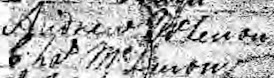

On closer inspection, my own (unreliable) eyes detected something more akin to "Chas McLenon," similar to the entry right about it for Andrew McLenon. A fold in the paper alongside what looked like a possible meandering tear didn't help matters. I decided to see what other records from the early 1800s could be found online for Camden County.

I turned to FamilySearch.org's catalog, a rich repository of digitized records from around the world. Alas, though clicking to select only records available online, for some reason the many records resulting from my search were available only in person, not online. Too impatient to wait for any apparent glitch to resolve itself—normally things don't work that way on the site—I abandoned the catalog approach and instead opted to select the tab "records" for my search.

While the 1820 census image at Ancestry at its best made reading the surname difficult, it was clear that the given name was abbreviated "Chas." Because the one company's indexer had trouble deciphering the surname, I decided to try the wildcard approach, and searched only for "McCle*" in the surname field.

Right at the top of search results—was FamilySearch now reading my mind after my failed attempts at finding online access to land records in the catalog?—was an entry in a collection called "Georgia Headright and Bounty Land Records 1783-1909."
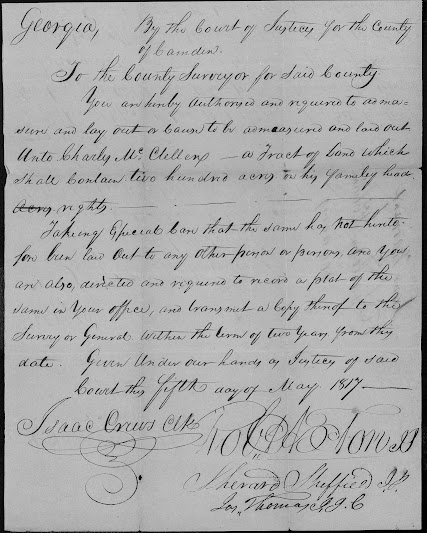

The document began officially enough:

Georgia, by the Court of Justice for the County of Camden,
To the County Surveyor for Said County.
You are hereby Authorized and required to admasure and lay out—or cause to be admasured and laid out Unto Charly McClellen—a Tract of Land which Shall Contain two hundred acres on his family head rights...

This certainly was no "Chas McLynory." But..."Charly"?

The instructions which followed that introduction were written on the fifth day of May, 1817, and were signed by the clerk and three other county officials. One of them, reassuringly, happened to be a familiar name: Sherrard Sheffield.

This becomes a moment in which I finally see Charles McClellan's "F.A.N. Club" coalescing. Sherrard Sheffield was brother-in-law to Job Tison, the Georgia man I mentioned yesterday who requested Charles McClellan to serve as witness to his 1824 will in nearby Glynn County. And it was Job's daughter Sidnah who married Charles' son George, a few years later.

After that point, Charles, George, and both their families moved from that southeastern corner of Georgia for the territorial land of Florida. That, we've already witnessed. But it is in the other direction in which we need our research to take us now. Next week, we'll take a look at what the various McClellans' records show us about where they might have originated before their 1817 documentation in the state of Georgia.


Image: Above excerpt from the 1820 U. S. Census for Camden County, Georgia, showing "Andrew McLenon" and "Chas McLenon" courtesy Ancestry.com; document below from "Headright and Bounty Land Records 1783-1909" digitized record collection at FamilySearch.org.  
Wednesday, March 16, 2022

Clues in Camden County


It is sometimes more of a challenge to research our ancestors while moving backwards in time. Not everyone dwells on where they came from, but many will lay out broad hints of where they intend to move to in the future. We don't, however, have the luxury of learning either detail from my fourth great-grandfather Charles McClellan, and need to rely on close scrutiny of any clues scattered in his path.

Right now, we've learned that a possible daughter of Charles—Margaret E. McClellan—married a man named Benjamin Stephens in Camden County, Georgia. Since at the end of his life, Charles lived in Jefferson County, Florida, that was a help to discover. But what about Camden County? Could that be a possibility for the previous stop on the McClellan migration pathway?

We already know, from another branch of my family, that Charles McClellan had shown up as a witness to the will of Job Tison, Charles' son George's future father-in-law. Job Tison, at the time of his death, lived in Glynn County, one jurisdiction to the north of Camden County. One could hardly be expected to serve in such a capacity for a mere stranger passing through the area; Charles McClellan living in Camden County could reasonably be expected to know someone in nearby Glynn County. After all, one generation before that, Charles' friend Job had married a woman whose father was buried in another nearby county, Wayne, in an area now considered part of yet another Georgia county, Brantley.

The wedding of Margaret E. McClellan and Benjamin Stephens, as we already discovered, occurred in Camden County in 1821. By the time of the 1830 census, Margaret and her young family were already enumerated in territorial Florida, giving us the latest date estimate for the McClellan family's presence in Camden County. But what could be the earliest date of their arrival? After all, Margaret—if, indeed, she was Charles' daughter—was said to have been born in South Carolina, not Georgia.

Records for Camden County in those early years seem to be sparse. For one thing, the region's earlier history seemed to be rocky, with threats from the British offshore, and from across the river—and international boundary—to the south as the Spanish claim was relinquished to the British and then, ultimately, to the Americans as neighboring Florida became a territorial possession of the United States.

One encouraging clue was that of the history of Camden County's main town, Saint Mary's, Georgia. Originally a Spanish settlement, founded in 1566, local inhabitants drew up a charter establishing the town as part of the state of Georgia in 1787. Looking at the area now designated as the Saint Mary's historical district, it is interesting to note that a Methodist Church was founded there in 1799—and that this particular church was considered to be the "father of Florida's Methodist churches."

Why for Florida churches, if it was located in Georgia? This gleaning from local history may serve to point us to the way that Charles McClellan was once directed, arriving in Camden County with the end plan of continuing on to Florida. Yet, if he were indeed there in Camden County before his (supposed) daughter's 1821 marriage, wouldn't he be in the preceding year's census record? There, it turns out, we encounter another problem.

Margaret's Marriage


If the two young children of the deceased Charles McClellan were living in the home of someone named Margaret Stephens, could there be a connection, despite the different surname? After all, by the time we found Charles' orphans Adeline and Samuel in the 1850 census, they had certainly attained majority age and were free to live elsewhere. Why did they stay?

More to the point, who was Margaret Stephens? We can see from that same 1850 census that Margaret also had three young people with the same surname living in her household: twenty year old Mahalia Stephens, fourteen year old James C. Stephens, and fifteen year old Elizabeth H. Stephens. While each of the three younger Stephens residents were born in Florida—a logical expectation, given they were living in Jefferson County, Florida—the census revealed that Margaret herself was born in South Carolina.

Also of help to us in our broader search for the roots of the McClellan children's deceased father Charles is the notation that both Adeline and Samuel were born in Georgia. Since Jefferson County shares a border with the state of Georgia, that is not surprising news. However, that detail will help guide us as we trace the orphans' father's roots before his family settled in territorial Florida.

If Adeline and Samuel were born in Georgia, that most likely meant that their father was once also in Georgia. But what about Margaret? Could she have been connected to this family as well?

As it turns out, there was an application filed by someone named Margaret E. Stephens for a widow's pension, based on the service of her husband in the war of 1812. While not much information was written on the document other than the veteran's name—Benjamin Stephens—four captains' names from the Georgia militia were provided, under the line for "service." That line, incidentally, was edited to add the word, "alleged."

Still, that's a clue: to look for a marriage record for Benjamin Stephens and a bride named Margaret, somewhere in the state of Georgia.

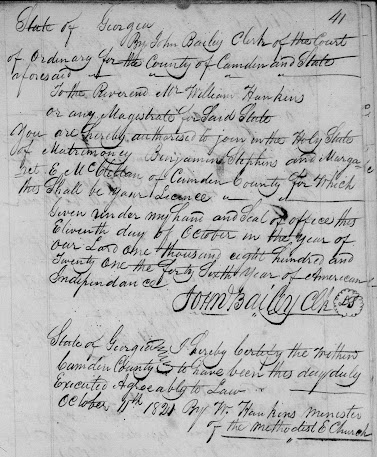
With the help of digitized and searchable records, that was easily found:


On October 11, 1821, in Camden County, Georgia, the Reverend Mr. William Hawkins of the Methodist Episcopal church performed the ceremony uniting Benjamin Stephens and Margaret E. McClellan as husband and wife. By the 1830 census, though, Benjamin Stephens and his young family had moved across the state line to Jefferson County in territorial Florida, and by 1835, Benjamin was involved in land transactions in the same county, according to the Bureau of Land Management.

What became of Benjamin, Margaret McClellan's husband, is not yet clear, though it is obvious that by 1850, his wife and children were on their own. As for Margaret, though we've yet to find any record identifying her specifically as daughter of Charles McClellan, we at least can feel fairly confident that, as the surrogate mother for Charles' youngest children Samuel and Adeline, Margaret was likely their older sister.

What is most helpful about this discovery is that it outlines for us the route that brought Charles McClellan to Jefferson County in those early days before Florida statehood. Let's step first across the state line to Georgia to see what can be found in Camden County, the place where Margaret married Benjamin back in 1821.


Above image of the October 1821 marriage license for Benjamin Stephens and Margaret E. McClellan of Camden County, Georgia, courtesy of FamilySearch.org.

Tuesday, March 15, 2022

What Became of the Orphans?


In Charles McClellan's 1839 will, recorded in territorial Florida's Jefferson County, we can see his deep concern for the two youngest of his children about to be left behind at his passing. From this, we can assume Charles' wife had already died, thus after Charles' inevitable passing, leaving Samuel and Adeline McClellan orphans.

Since my goal with this month's research is to see whether I can trace Charles backwards in time from this point in his life—about to die in Jefferson County, Florida—I'm curious to learn whether the story of what became of these two children can help me find anything on Charles' own roots.

We already know that it would be unlikely that those two named children, Samuel and Adeline, would be named in the upcoming census. In 1840 as it was in 1830, only the head of household was identified by name; all the rest in the family were itemized by age-bracketed tick marks. Of course, two other McClellan men had been mentioned by name in 1830, but despite their young age, each man had recently married, thus forming their own household. Still, it was unlikely that Samuel McClellan would have been of an age to do so, just one year after his father's passing.

The next option was to explore the 1850 census. That was the point at which the enumeration broke loose of its name restrictions to include mention of each individual in a household by name. That became my first chance to look for orphans Samuel and Adeline McClellan.

While it could have been possible that either child would, by then, have been married, and possibly also moved away from Jefferson County, it did turn out that there was a household containing both McClellan names. Samuel McClellan in the 1850 census was listed as being twenty eight years of age, and "Adaline" showed as a twenty five year old.

The two McClellans showed up in a Jefferson County household headed by a forty five year old woman named Margaret E. Stephens. The question then becomes, who was Margaret Stephens? Was she a relative? Why were both Samuel and Adeline living in her household?

Checking ahead to the next census, the 1860 report showed "A. E. McClelon" living in Margaret Stephens' Jefferson County home, along with a presumed son of Margaret who had shown in the previous census as well. The thirty five year old woman with the initials could likely have been Adeline, as we can see her father had shown her name as Adeline H. E. McClellan.

To see whether there was any connection with Margaret Stephens—after all, she could just have been an enterprising widow running a boarding house—we need to explore what can be found on her first, before drawing any conclusions that it was a relative who took in the bereft orphans after the loss of their father. 

Monday, March 14, 2022

When Family Records Get Tangled


My March research goal: learn something—anything—further about my fourth great-grandfather, Charles McClellan. It was relatively easy to see that the man died in territorial Florida about 1839; we have his will filed in Jefferson County.

That, however, was a discovery which brought with it problems, foremost of which was that the man's overarching concern for his two minor children obliterated any felt need to mention the names of the rest of his family. Now, we know him only as Charles, father of Samuel and Adeline. Oh, and father of George, since Charles appointed his "eldest son" to be his executor.

What about the others? Looking at the lines of other McClellan men in the region, mentioned in each other's various legal documents, I can see their names appearing in tandem from time to time, but that doesn't assure me that they were truly brothers.

Take, for instance, the 1830 census for nearby Hamilton County, Florida. In that record, as we've already discussed, there were three listings for McClellan heads of households: Charles, William, and Andrew. Charles, we've already explored, and likewise William. But what about Andrew?

Finding these names mentioned in more than one northern Florida county bothered me. What if the young Andrew showing up in the Hamilton County census record in 1830 wasn't the only Andrew McClellan in existence in the region? I had to check out the possibilities. But looking at the three counties in which I've found at least some of those McClellan men—in Hamilton, Madison, and Jefferson counties—I couldn't spot more than one Andrew McClellan.

Let's see what we can find on this third McClellan man listed in that 1830 census record. For one thing, his was one of the smallest of households, containing one man between the ages of twenty and twenty nine, and one woman somewhere between the ages of fifteen and nineteen. Newlyweds? According to one local history book, Andrew McClellan married Christianna Watts in Hamilton County on December 10, 1829, a matter of months before the 1830 census was taken—but that will be a document retrieved during an in-person visit, as it doesn't show in any online resources I've checked.

And yet, by 1840, there was no sign of this young Andrew McClellan in Hamilton County. By the time of that later census, though, there was someone by that name and approximate age heading a family of six in nearby Columbia County.

Looking at land records for Andrew McClellan, one can begin to sense my concern that there was more than one man by that name in the region. The search results at the online source for the General Land Office Records of the Bureau of Land Management showed no land acquired by Andrew McClellan in either Hamilton County or Jefferson County where the other McClellans had lived, but in Madison County and Suwannee County.

Of those land acquisitions, the Madison County ones were earlier transactions in 1835 and 1837. And yet, in 1840, the only Andrew McClellan listed in the census in northern Florida was living in Columbia County, not Madison. Then, from 1844 through 1848, there were further land transactions, this time listed in Suwannee County.

But wait! Suwannee wasn't established as a county until 1858. How could it be listed as the location of a land transaction occurring in 1848?

Likewise, the earlier records started to make me question the listings. Notice that Jefferson, Madison, and Hamilton had their beginnings in the same year: 1827. Could a land record from the 1830s have gotten the geographic designation wrong? Perhaps it is time to dig a little deeper into the interface between how records were recorded at the Bureau of Land Management as compared to the county formation in territorial Florida. Perhaps there was lag time, or even an attempt to identify the land's location by the subsequent geographic description.

As for Andrew McClellan showing up in the 1850 census in Columbia County, I can cheer that the names of his household members were individually identified—and sigh from the relief of realizing that wherever he lived in Columbia County, it was likely the same piece of land which, with the county boundary change in 1858, became the newly-formed Suwannee County. From that point, we can follow Andrew and Christianna through each decade—with the exception of the missing entry for the post-war 1870 census—and find them still in Suwannee County.

That, incidentally, was the same county in which another McClellan lived: George, the son of Charles named as his executor, back in his 1839 will. The only other document I can find Andrew linked with any of the other McClellan men we've been researching concerned that mutual struggle experienced by all northern Florida settlers, the series of battles called the Indian Wars. In that time period, we can find an application for a military headstone for Andrew McClellan in which, following the many handwritten notes affixed to the official document, it is clear that someone was having trouble locating any record of Andrew's service. 

On the back of the application, someone wrote in the comment, "2nd Lt," and identified Andrew's service with "Capt George E. McLelland's Co."


Seeing that inscription brings up a point—likely the same difficulty which not only faces us as we explore this McClellan family, but also was encountered by the record keepers tasked with confirming Andrew's service in the first place. In researching this line, I've seen that surname represented as McClellan, McClelland, McLellan, and McLelland. Sometimes, the initial "c" is substituted by an apostrophe: M'Clellan. Or the "Mc" handled as a prefix, or entirely optional to include at all. Can they all be representing the same name?

Whether Andrew served in 1836 in George McClellan's company as friend, neighbor, or family is hard to tell from the few documents available to me at this point. Because Andrew's 1880 passing was far beyond the dates of the other McClellans' deaths, there is no expectation to find their names affixed as witnesses or even executor of his will—though the reverse may be true for other McClellan men who predeceased him. More searching to come before we exhaust that point.

That Andrew had a long life, though, presents its advantages. He lived past the point at which census enumerations switched to name all individuals in a household, and even to the point of listing relationships between members of a household. Andrew and Christianna were still around for the 1880 census, living in their married daughter Mary's home, providing not only a link to the next generation, but an indicator that I had missed this daughter entirely in previous enumerations.

That type of entanglement I can welcome with open arms. That is the way we are able to knit family lines together over the generations. That, in fact, brings me back to that original will—the one in which Charles McClellan was so emphatic about the care of his two youngest children. After his passing, what became of Samuel and Adeline? Perhaps following their story will help weave this family together in ways we haven't yet discovered.


Above image from the Application for Headstone or Marker for military veterans, application made on October 2, 1956, on behalf of Andrew McClellan (1810-1880); image courtesy Ancestry.com.    

Sunday, March 13, 2022

Indexing Re-Invented


For the longest time, I set aside a regular time to volunteer as an indexer to make the digitized records at FamilySearch computer-searchable. As of this year's RootsTech conference, we've now discovered that indexing is no longer the volunteer process we've come to expect. It has been re-invented.

The sleek new package, redesigned with an eye to encouraging volunteers to take action, is now dubbed "Get Involved." Even better, it has been reinvented with volunteers-on-the-go in mind; to participate, you can download the app to your smart phone and tap in to volunteer opportunities in those fleeting downtime moments of everyday life. Like, while standing in line at the grocery store.

Well, I don't know if I'm that driven, but I did give the "Get Involved" program a whirl on my laptop, almost immediately after hearing about the reconfigured site during RootsTech. I guess a whole bunch of other conference attendees got the same idea at the same time, for the tab on the FamilySearch website disappeared for a while last Saturday night. Rest assured, it is back, and fully capable of showing its stuff in a test drive.

In a matter of moments, a volunteer can confirm or edit a batch of twenty names already transcribed via artificial intelligence handwriting recognition—the same computer action which will make harvesting the data from the 1950 U.S. Census a much faster process than even the volunteer victory over the 1940 census transference to computer-ready searches. All it takes—well, besides a free FamilySearch.org account—is the ability to compare notes from an identified name in a document with the "answer" the AI computer came up with. The volunteer's simple response? Either click "match" or "edit." If "edit," type in the correct response, then click "submit." If really stumped, there is always the out of clicking the third option, "unsure."

Those who are old hands at indexing may have noticed that the website tab to gain entry to select projects has been changed from the label "Indexing" to the more energetic "Get Involved." 


Under the drop-down menu, if you select "My Opportunities" and scroll down the page to the box labeled "Review Names," that is where the action begins. You can choose specific surnames to search, or a specific location—right now, only documents from the United States and Latin America are available—or just choose to work on whichever project has the greatest need at the moment. The app will serve up twenty names and ask you to compare the selected option with information in the original document. It's amazing how fast you can work through a batch of names.

Everything looks ready now for some serious volunteer action, once the 1950 U.S. Census is released on April 1. The only thing I'd like to see implemented in this re-invention of the old indexing site is the ability to form groups—teams of volunteers from the same location, like a local genealogical society—just as we used to do in the old indexing section of FamilySearch.

Once the 1950 census indexing gets rolling, I think it would be more fun for a group to see how much its members can tackle, and to see, cumulatively, how much we've accomplished for the common good. The new Get Involved app is making great strides in enabling us to collectively make more documents searchable—and thus usable—but gaining a sense of how we are all doing, together, to make that difference can be a far more powerful encouragement than just providing an easier way for volunteers to help out.

Saturday, March 12, 2022

A RootsTech Re-Wrap


It's been a week since RootsTech wrapped up its run for 2022. Generously, the RootsTech team made this year's event as accessible as last year's—and even more so now, as we can still access our play lists from the previous year, along with the current year's offerings.

Unlike last year, the "advantage" for me with this season's conference was that I was a captive audience. Coming down with an illness that same week which slew me—or at least knocked me flat on my back—had its advantages, at least in the matter of timing. I had no choice but to watch; I couldn't get up to do much more than lazily stare at my computer screen.

There was, however, much more than that, as far as benefits went. Now that I've had a week to mull over everything, here are some observations.

The first detail that struck me about RootsTech was how accessible beginner training was. From a selfish point of view, that might not seem a plus, but besides the outcome of nurturing newer genealogists, viewing the stuff which might seem old hat to us can still be beneficial. In the midst of all that "yeah, yeah, I already know that" material turned out to be quite a few helpful tips. While we may think we know a lot, there's always someone else who might turn up with a new way of approaching a problem that might not have occurred to us in our entrenched expertise.

There is also an aspect that I like to refer to as "learning by osmosis." That is the principle I try to employ when I write about my research escapades, becoming the genealogical guinea pig to share the experience in hopes that others will glean new resources or approaches to genealogical puzzles we have in common. At RootsTech, what I found unfolding in my mind, as I listened to speakers, were ideas on how I could modify someone else's research approach to fit a puzzle I hadn't yet been able to solve. There is something about listening to others talk through their difficulties that provides us with the creative problem-solving juices to oil our own mind's machinery. Insights often beget insights.

Now that I'm back on my feet, I suppose the remainder of my playlist will face the same fate as the one from last year's event: still waiting to be watched. That's the truth of the matter, as it stands now. But perhaps I'll heed that little realization, that light bulb that turned on while flat on my back last week during RootsTech. Sometimes a little down time to let our subconscious problem-solving mind tackle the details can turn out to be a good thing. It certainly did revitalize some research efforts for me—and I'm looking forward to sharing those little sparks in the coming week.
