Showing posts with label Kyte. Show all posts

Monday, July 7, 2014

A Little Collection of Americana


It took yet another trip over the weekend before I could achieve my Fourth of July goal. The bonus was that there were three additional pieces to add to my new Southern Potteries collection when I returned to the antique shop on the day it finally was open.

If strike one was forgetting to check the shop on the evening when we were first in town and strike two came when I drove back on the Fourth of July—a twenty minute drive to the north of my home—then I’m certainly glad that my third trip was a charm and not my chance to strike out.

The prize was the platter and serving bowl I had spied while in town on another errand last week—two pieces of Blue Ridge china made at the company where my grand aunt Chevis Davis Chitwood Kyte once worked as a decorator in Erwin, Tennessee.

The unexpected bonus was the discovery of a serving piece and salt and pepper shakers in an entirely different pattern, also a design of Southern Potteries, Inc.


While collecting pieces of Blue Ridge China may be all the rage in some circles, that is not why I succumbed to the notion of becoming a collector. My purpose is not to learn everything there is to know about the many unique patterns which sprang from this creative enclave—and believe me, there are some who are well versed in every permutation—but simply to have and to hold a piece of my own family’s heritage. When I look at these faded pieces with their crackled glaze, I see not the product lines of a commercial entity, but the handiwork of someone just like my aunt, working where she used to work, doing what she used to do, day in and day out in her own hometown.

If genealogy as a concept could ever become converted to something tangible, this is it. Getting my hands on those pieces of china is like reaching out to touch someone in my family whom I never had the chance to know.

Friday, July 4, 2014

As American as Apple Pie


While you may be busy today, occupying yourself with picnics in the park—or barbecues in the backyard—I am fervently hoping to add one unusual item to my holiday to-do list: visit an antique shop.

Yes, I know there are traditions more American than that, made to fill up this national day of celebration. Come to think of it, unlike some people I know, I find antiquing is not even my cup of tea. Or, ahem, grande caramel frappucino. But for this holiday weekend, I am going to add that one item to the list.

I have a specific reason for this task: I’m hoping, in some small way, to commemorate an ancestor I’ve never met, personally, whose life has lived on in the childhood stories I remember from my mother: my grand aunt, Chevis Davis Chitwood Kyte.

My daughter has long been trying to talk me into driving to a town to the north of us, to browse through the antique stores downtown. It was just the other day that I finally agreed to join her. I had something specific I needed to find. We were on a mission, and she knew just the place to accommodate my hope to quickly accomplish that goal.

But you can’t just rush into an antique shop, grab your selected item, slap some money on the counter and run out the door. There is an ambience to the place that must be respected, a protocol to heed. Life inside the doors of an antique shop must move at the proper pace.

While I was following my daughter—the one more experienced in such antique-shop decorum—I tried to feign interest in the, well, junk (don’t kill me yet—I promise this will be a worthwhile divertissement) cluttering the aisles and closing in on me from the walls. I couldn’t help but notice two out-of-place pieces of pottery on a humble wooden stand.

I picked one up to have a closer look.


And then, turned it over, just in case.


If you have been journeying with me through the research on my family tree that I have been journaling all along here, perhaps you recall the story of my grand aunt Chevis. It was she whose rather painful life experiences ended in an early death from cancer. These life experiences, I’m hoping, were somehow assuaged by the beauty Chevis created at her job at the pottery company in her hometown Erwin, Tennessee. You may recall the post I wrote about that same Southern Potteries company.

I never had inherited any pottery from that cheerful collection of now-renowned folksy artwork—believe me, after my own aunt passed away last November, I looked carefully through all her collectibles, hoping there was a piece to commemorate our common relative. The style of the artwork, however, was imprinted in my mind’s eye. One never knows, ya know?

Fast forward to that moment when I—stranger in an antique shop, trying not to look to my left or my right, fixed solely on the task I had come to accomplish, spending not one penny more—walked past those two items. They were marked with the right name, but something was wrong. There was a smear on the wording. The familiar logo wasn’t included. But the style…the style seemed right.

I can be a tightwad when it comes to spending money unintentionally. Besides, I’m a researcher. So, what did I do? Resist the urge to buy—and promise myself I’d research the identifying stamp further when I got home.

Last night, it just so happened that we were joining friends for an early Fourth of July concert in the park in that very same town to the north. Afterwards, we planned to wander the downtown area, which on Thursday evenings is converted to a farmer’s market and street faire. I promised myself I’d take a detour into that antique shop, in the hopes that those two Southern Potteries pieces were still there. After all, these two are my piece of America. My roots are intertwined in the history of that company.

Of course, I got caught up in the moment, and forgot my mission for the evening. But I’m already determined to make another trip. Part of me is hoping the two items are still there, and that I can still buy them at the reasonable asking price. The other part of me is nagging, “But why are they so cheap?”

That’s the part of me that I will be telling, “Shut up.”

Wednesday, January 29, 2014

A Flower-Filled Remembrance


Flowers were not only part of Chevis Davis Chitwood Kyte’s daily routine—hand-painted on dishware for her employer, Southern Potteries—but they made a significant statement at her last public remembrance.

After her passing on November 15, 1942, the Johnson City Press ran her obituary in preparation for her funeral. Unlike any such obituaries I’ve known from life up north, this Tennessee notice included the name of every single person involved in the program. That, for those of you who have never seen such a custom published in a southern newspaper, included the following count:

  • Six active pallbearers
  • Twenty eight honorary pallbearers
  • Forty three flower bearers

Flower bearers?

For a northerner unfamiliar with any such custom, reading that list seemed overwhelming to me. I felt like the entire town had come together to bid Chevis a final goodbye. It made me wonder what was so special as to merit such attention for a funeral.

Then I realized that, perhaps, this was a regional tradition I was unfamiliar with. I’ve since seen other such mentions in Tennessee obituaries—though, admittedly, not to such lengths. A quick perusal of the terms “funeral” and “flower bearers” yielded several pages of search results online, so the tradition is apparently still alive in many circles.

Since I feel fairly safe to assume that nearly all those whose names were published on that list are no longer with us, I’ll print the announcement in its entirety so you can share my amazement. (I’m generous that way.)

If you happen to be of a similar southern persuasion, please feel free to educate me—and the rest of the readers here who might be of like northern handicap—by filling in the blanks on this custom: how does it work? Does it signify anything special? Is it just an honorary listing—or do these people take a specific role in the ceremony?

            ERWIN—Nov. 16.—Mrs. Chevis Kyte, 48, died at her home on Catawba street at 3:30 Sunday morning, after she had been in declining health for the past year.
            Surviving are one daughter, Mrs. Emma Lee Engle; a son, H. M. Chitwood; her mother, Mrs. Cassie Davis, all of Erwin; two sisters, Mrs. Mabel Martin of Newark, N. J., and Mrs. Lummie Moore of Tela, Honduras; one brother, Jack Davis of Columbus, Ohio, and two grandchildren.
            Funeral services will be held at 2:30 p.m. Tuesday at the Church of Christ, of which she was a member. The Rev. Lonnie E. Dever, church pastor, assisted by the Rev. F. Roderick Dail, will officiate. Burial will be in Evergreen cemetery.
            Active pallbearers: Carl McInturff, Guy Robbins, Roy Tucker, Herbert Toney, Fred D. Booth and Luther Hurd.
            Honorary pallbearers: Ross Jones, Bert Wilson, R. O. Bailey, Dave Hartsell, Harry Campbell, Grant Martin, C. W. Davis, J. B. Engle, Ernest Stallard, Jim Turner, Bill Tucker, J. Q. Jones, Arh Beckelheimer, R. L. Hensley, L. C. Roberts, T. H. Peters, W. W. Ryburn, Sam Brown, S. B. Stallard, O. L. Harvey, M. P. Blankenship, Charles H. Ervin, E. E. Clouse, Claude Jones, Will Burnett, W. W. Erwin, R. T. Bailey, Claude Gouge.
            Flower bearers: Mesdames Fannie Fox, Pauline Morgan, Dolly Six, George Maddox, Charles Hicks, Ola Swingle, Florence Updike, George Dishman, C. W. Davis, Ross Jones, R. O. Bailey, Dave Hartsell, W. H. Allen, Guy Fritz, Harry Campbell, Grant Martin, Ernest Stallard, Jim Turner, John Suggs, J. B. Engle, W. R. Cox, O. L. Harvey, Guy Robbins, Carl McInturff, Arch Beckelheimer, Sam Brown, Ed Clouse, Annie Tinker, Claude Jones, B. W. Head, J. C. Rule, L. C. Roberts, Lee Johnson, Roberta Keesecker, Nannie Ray, W. M. Erwin, W. W. Ryburn, Cassie Smith, T. H. Peters, Claude Gouge, Sara K. Gentry and Misses Maude Tucker and Mary Johnson.

Tuesday, January 28, 2014

Receiving Pain - Revealing Beauty


example of one of the identifying stamps used by Southern Potteries for their Blue Ridge dishware in the 1930s until the 1950s
Although it is an inspiring theme, the concept “Beauty from Ashes” does not exactly represent the outcome of Chevis Davis Chitwood Kyte’s short life.

But it has a kernel of truth in it.

When hearing that phrase, you may be tempted to relate it to the Phoenix, the mythical bird arising from its own ashes. Unfortunately, there wasn’t any such happy ending to Chevis’ own life.

However, despite the pain Chevis experienced in her life, ironically, the job she had to obtain to support herself and her two remaining children after her divorce paid her to create beauty and bring it into the lives of her customers.

As last Tuesday’s post showed, Chevis died of cancer on November 15, 1942. If you were sharp enough to notice it in her death certificate—as reader Wendy of Jollett Etc. had mentioned—you saw Chevis worked as a decorator for a pottery company.

The specific pottery company Chevis was employed by gives an interesting perspective on her own life. I first discovered the connection while taking my time, wandering through her entry on the 1940 census record. There, I discovered one of those recording flukes—apparently the census enumerator didn’t exactly follow directions there—that allowed me to discover the specific name of the company where Chevis worked.

It was a name that has become well known in some circles.

Southern Potteries listed as place of employment for Chevis Davis Kyte in 1940 census

While Chevis’ home town—Erwin, Tennessee—was mainly a railroad town, there was one offshoot from the Carolina, Clinchfield and Ohio Railway that provided a divertissement from that form of employment: their subsidiary, Southern Potteries, Incorporated.

hand painted dish from the Blue Ridge dishware collection of Southern Potteries Incorporated during the 1930s through 1950s
By the time Chevis needed to seek employment there, she had joined the ranks of approximately three hundred other local workers who had all been specially trained in the freehand painting process that gave the colorful products their competitive edge. By then, the company had assumed its better known Blue Ridge name and emblem, and was seeing its distinctive wares marketed in showrooms in major U.S. cities.

The whimsical dishes, no one piece exactly the same as another, became so popular that—long after Chevis’ passing—the company grew to employ over one thousand local area residents, all working in some phase of the production process to create and deliver those hand-painted wares.

With changing market conditions negatively impacting sales, the Erwin plant eventually closed in 1957, but by the 1980s, collectors revived interest in the Blue Ridge pieces, and examples of the cheerful folk-art style work can now be found on several websites.

I can’t help thinking about Chevis when I see these delightful patterns. Bold and colorful, they seem so carefree—an emblem of a lifestyle so many of us wish we could enjoy. And yet, truth be told, the life Chevis lived was anything but carefree and bright. I often wonder if her work became the creative outlet she used to assuage the pain she surely bore, or to provide a therapeutic haven from the many reminders of her life’s troubles.

God knows she surely needed it.

Blue Ridge dishware collectibles from Erwin TN circa 1930s


All photographs above courtesy Brian Stansberry - Creative Commons Attribution 3.0 Unported License; further information provided via Wikipedia files for the Blue Ridge stamp here, the single plate here, and the two plates here.

Monday, January 27, 2014

Remembering Another Daughter


Could it be? A life without upheavals, dreadful illnesses, or unforeseen tragedies?

With only official documents to rely upon in piecing together the life and times of my grand-aunt, Chevis Davis Chitwood Kyte, by the time of her youngest child’s birth, I found little to indicate anything like the problems she had encountered in past family relationships.

I’d like to exclaim, “Thankfully!” but I have no way of knowing that for certain.

However, here’s what I know about this child who would have been my mother’s fourth-oldest cousin.

Luther and Chevis Kyte’s youngest daughter was born March 2, 1919, in Erwin, Tennessee. They named the girl Emma Lee.

You would think searching for records for a name as simple as this would be fairly straightforward. But that’s not the way it’s been. Besides the spelling struggle between Kite and Kyte—Kyte winning by the time of the 1940 census—and that of Chevis’ own unusual name, there was the additional issue of the baby’s name: Emma Lee sounds exactly like the more widely used Emily.

But starting off with a listing as a son? The 1920 census was no help with this unexpected entry. Thankfully, relying on the names of others known to be in the household—mainly Chevis’ son from her first marriage to H. M. Chitwood—guided me to the right records.

I assure you, the infant listed in that 1920 census as “Ema Lee” was in no way a son.

With the arrival of the 1930 census, the child was now properly listed as a female, but with the rigid adherence to listing first names for given names, the household showed father as Franklin—settling, at least for that year what his preferred name was for that initial “F”—and mother as Mary, Chevis’ actual first name.

The baby? Now eleven years of age, she was listed as Emily. Can’t really fault anyone for that spelling guess.

With the 1940 census taken in Unicoi County, Tennessee, on April 16, I was curious to see how the household would be listed. Not because of the couple’s divorce, or even in question of how the surname would be spelled—it was Kyte that year—but because by now, Emma Lee had turned twenty one years of age.

Despite the discovery that FamilySearch.org indexers had decided to read Emma Lee’s mother’s name as “Cherie” instead of the correct Chevis, thanks once again for being able to search by her son’s Chitwood surname, I was able to locate the correct entry. There, as if nothing had changed, her daughter Emma Lee was still listed in the household.

With no circled “X” listed at this address to indicate who had provided the household’s information to the census taker, I suspect the neighbors were deputized to provide the gossip gospel truth, so help them, God.

They got it wrong.

Apparently, unbeknownst to those neighbors, Emma Lee had fallen head over heals in love with a part time employee at her mother’s place of work and, two months prior to the date of the 1940 census, she and Clifford J. Engle had visited the county courthouse to make application for their marriage license. On February 11, the Reverend John C. Blalock solemnized the rite of matrimony and pronounced the couple husband and wife.

By the summer of 1941, another generation began as Clifford and Emma Lee welcomed their firstborn son into the fledgling household.

Do I know anything more than this about that individual who would be my second cousin? Not really. Nor do I know much more about his parents. Unless this line is plagued with some of the name-changing and initials-swapping habits of the other Tennesseans in this line, I can assume that Clifford J. Engle was exactly that, and suppose that I’ve found his entry in the 1940 census, likewise listed as single and at his parents’ home. I can also presume that a 1944 World War II enlistment record belonged to him. Other than that, beyond the 1940 census, there aren’t as many governmental documents available online.

As for Emma Lee, the only other information I can glean of her life comes from her obituary. She was eighty five at the time of her passing. She lived and died in that same small town in Tennessee—Erwin—as her mother and maternal grandmother. While nothing was mentioned in the obituary about her husband, the memorial mentioned the thirty six years she had worked as a waitress in both Florida and New Jersey. Perhaps that little detail speaks volumes about how life went for her.

Beside her son and her half-brother, she had no other survivors than several unnamed nieces and nephews, and her life was commemorated through a private memorial service. There wasn’t even any mention of a burial location where she could be remembered.

Sometimes, when I recall my curiosity upon first discovering the Davis family Bible, I wonder if any of these relatives or their descendants had any idea that a blood relation they never knew about would someday be asking questions about them. Who were they? What were they like? What happened to them? Why haven’t I ever met them? My mother and aunt were certainly at a loss as to how to respond to such questions, especially when confronted with them from the mouth of a child. They really didn’t know the answers.

Perhaps families really do drift apart—after all, how many people do you know who are not family historians yet know their second and third cousins? I may be unusual, but I find myself carrying these names around in my heart, wondering where they are, what has become of them. Call it an intangible link, like some kind of ethereal DNA—after all these generations, I still feel the pull of that connection.

Saturday, January 25, 2014

Postscript on a
Frustrating Name Change


Sometimes, it’s just wiser to close the book on a research pursuit and promise yourself to revisit it at a later time. Perhaps that would be a more profitable approach, at least as far as time management efficiency goes.

But you know those research rabbit trails. They exert some tremendous pull.

So, before we move on from Flavius, or Franklin, or Luther, the elusive Mr. Kite (or perhaps Kyte), I need to slip in two additional bits of documentation.

In the midst of the Great War, it just so happens that, among the many men filing for exemption from the draft on account of their support for family dependents, there was a man in Erwin, Tennessee, who claimed he was born in Elizabethton, in nearby Carter County. His name—at least according to that particular document—was Luther Kite. While never naming his dependents, he stated, one day in June, 1917, that he was responsible for the support of a wife and child, which he accomplished through his employment as a locomotive fireman for the C. C. & O. Railway, Erwin’s local line.

With a flourish—much different from that affixed to his marriage license only six months previously—he added his signature to the bottom of the government form.

We at least gain an idea of his appearance from this preserved piece of micro-history: he was tall, slender, and had light brown hair and blue eyes.

Quite a few years after this point, what appears—at least from the details about his birth—to be the same person emerges, back in Tennessee, following passage of the federal legislation that established the Social Security program. Those who sought to play this new game needed proof of their age. Along with so many others who were born before government records took note of such occurrences, Luther Kite returned to his home town to prove he was born there.

Sporting a different spin on his name—this time declaring himself to be Franklin Luther Kite—but still toting around that same birthday, he made the necessary legal arrangements to obtain a delayed certificate of birth from the Tennessee Department of Public Health.

By then, the year was 1954. Calling for the notarized, signed affidavits of an aunt (Mary, who interestingly signed her name as Kyte) and a neighbor (Minnie Sims), Luther officially established his first name as Franklin from that point onward.

By the way, he also gave, as his current address, a street in Jacksonville, Florida.

Why doesn’t that provide sufficient ammunition for me to blow my doubt away? I mean, after all, the birth dates match. The place of birth matches—well, at least the county. Who cares if the guy lived a life of many names?

But then, take a look at his signatures.

Admittedly, pledging your life away in marriage could make anyone’s signature shaky.


Could it be the flourish of an in-your-face attitude at the draft board that added the panache to his 1917 signature?


What about the straightforward, steady hand applied to his routine request for governmental verification at the Tennessee Department of Public Health?


Is he? Isn’t he? Is he? Isn’t he? I feel like I’m Alice in Wonderland, singing along to the Mock Turtle’s jingle for the Lobster Quadrille.

And with that, I’m putting this merry chase to bed for a long winter night’s break.

Friday, January 24, 2014

A Lingering Look


Sometimes, genealogy research takes on an aura that some of my D.A.R. friends might call steeping one’s tea. For others—like my husband, the consummate grill master—the preferred analogy might be to that of marinating a great steak. In the face of genealogical brick wall challenges, whether you prefer to liken your research style to a reserved, tea time pace or take it with a Chicago steakhouse flair, you know you will have to park that need for speed.

Sometimes, you’ve got to get out of that research rat race and wander around the data. See the sights. Smell the smells. Poke around those facts that just don’t make any sense, and see if they’ll release any of their secrets.

Right now, I’m stuck on determining just who this man was who married my grand-aunt, Mary Chevis Davis. Granted, I initially was sidelined years ago when some kind soul in Florida mailed me a copy of an obituary for an F. Luther Kite—with right birth date included—who turned out to be married to someone totally different.

It didn’t help, of course, that his wife’s name in no way lined up to the one I had on record.

It also didn’t help that the man, himself, had shown up in records throughout the years sporting different names. Kite versus Kyte. Luther. Franklin. Flavius.

Flavius? Where did that come from? The Roman Empire has been long gone.

So, I took a walk around the digital data neighborhood, taking in all the sights I could see. Granted, it did cause me to wander a bit, but a little research exercise never hurt anyone.

Since I had—thanks to the 1940 census, subsequent to a divorced Luther’s return back home to Carter County, Tennessee—a copy of his mother’s death certificate, I spent a stretch of time getting familiar with every line on that document. Real familiar.

Granted, though Maggie Kyte’s death record only provided those blasted initials for her father’s given name, at least it gave me a glimpse of Maggie’s maiden name, as well as her mother’s maiden name. Combining those details into search terms, I looked for a Simmons household in Carter County, Tennessee—the place where the family arrived after moving from their home in Virginia—that had a mother named Mary, a daughter named Margaret, and a father with any name starting with either a J or an F.

Though we are so spoiled now with instantaneous research results at the click of a digital button, that became an order which could not be filled, at least not for the 1880 census. I did, however, find a Simmons household that included a father with the right initials and a daughter Margaret with the right age and place of birth.

Only catch: J. F.’s wife’s name was Susanah.

While that didn’t fit the picture I was seeking, since I was in wander mode, I took my time and checked out all the details. One of the first things I noticed was that the oldest son in the household—a young man by the name of Edgar—was eighteen years of age. That in itself might not seem unusual to you; after all, the father in this household was forty four, himself.

But his wife claimed an age of thirty.

Either Susanah was being coy about her age—you know what they’ve always said about not asking a lady her age—or she was not the mother of Edgar.

Coy or precocious, the woman also listed her place of birth as Tennessee, when the entire rest of the family was born in Virginia.

I’m thinking Susanah didn’t have that first baby at the age of twelve. I’m thinking this was a case of a step-mother for Maggie. And isn’t that grand, considering I’m still on the search for Maggie’s mom, Mary. I’m ready to move on to the next document.

Not so fast—there are other details to see before jumping to the previous census record, the first of which is the fact that Maggie’s dad’s name didn’t quite align with the initials given in her death record for her father’s name. Instead of J.F., this census reversed the order.

But, hey, this is Tennessee. When it comes to names, that can happen around there.

J.F. or F.J., I want you to take a look at the details in that 1880 census record. Not only is the order of the initials reversed, but the census taker actually provided a full first name.

You’ll love this: it was Flavious.

Granted, that’s what happened to one census record for Maggie’s son, the younger Flavious. One census record, apparently, does not a name make, though, for the former junior Flavious had quickly re-invented himself as Luther, then later as Franklin, as the decades rolled by.

So, if Luther’s maternal grandfather was identified as Flavious in 1880, what did the record say for him in 1870?

Thankfully, a little consistency reigned in the 1870 census, for once again, Maggie’s dad was identified the same—this time spelled correctly as Flavius J. Simmons. The 1870 canvasser for Carter County must have been a Roman Empire aficionado. Or at least he knew how to spell.

That’s not all I found by hanging around all the documents strewn on the trail of Luther Kite. Taking the slow way around these records, I spotted one last detail: the name of the informant on Maggie’s death record.

Do you remember my remark about other discrepancies, over the years, on the census records for Luther’s immediate family? In one decade, his sister was named as Sina, while in a previous record, she was marked in as Lena. I presumed Lena would be the correct version—but taking one more look at her mother’s death record, I saw that, apparently, her name was Sina, after all.

By the time of Maggie’s death—October 21, 1943—Sina was married and signed her name to the report using both her maiden and married surnames. Being that this was after that magic point of 1940, she spelled her maiden name as Kyte rather than as Kite. And she indicated her married name was Blitch.

There was one more bit of trivia about her entry there. For address, Mrs. Sina Kyte Blitch indicated she lived in Jacksonville, Florida.


Now, you may not find it at all significant that Luther’s sister had moved that far away from her home in northeast Tennessee. But I do. You see, the obituary I had found for the possible rest of the story about F. Luther Kite indicated that he had died in Duval County, Florida. In a city named Jacksonville. By the time he had died in 1973, his former wife Chevis had been long gone, having succumbed to cancer in 1942, so it would be quite possible that he had remarried.

There was something, however, about all the unexplained name changes and spelling changes that cautioned me to doubt that finding. In the end, I tossed the obituary, not even entering it into my records.

Now that I take the time to think it all over, I’m not so sure that was the right thing to do.  

Thursday, January 23, 2014

A Mother’s Line


Sometimes, after a rush of serendipitous finds on the genealogy research trail, it’s time to take a breather and straighten up the database. I don’t know about you, but leaving loose ends like blanks where parents’ names belong for so-and-so who married my ancestors simply won’t do. I need to tie up those details and put them in their proper place. Even if I can’t rightly say the name of Mary Chevis Davis’ husband, at least I can explain who he was son of.

At least, that’s the excuse I’m sticking with, as I wander up this inviting rabbit trail in pursuit of the man Chevis married. Mr. Kite—or Kyte—did, after all, leave an open door of invitation, as far as further inquiries go, by splitting up with his wife and moving back home with his mom.

Armed with his mother’s name, approximate age, and place of birth, what would you expect an inquiring genealogist to do?

And so, the chase is on!

I looked first for a death certificate for Maggie, the mother of Chevis’ ex-husband, Luther Kyte. After all, when we last saw her in the 1940 census, she had already reached the age of seventy two.

As it turns out, it wasn’t long after that census was recorded that Maggie Kyte met her end—you notice, in keeping with the unexplained family surname spelling change that descended upon us with the 1940 census, that Maggie was now listed as Kyte and not Kite, as had been recorded in years prior to that time—and fortunately, there is a copy of her death record online.

The 1943 document showed the date of her passing as October 21, in Carter County, Tennessee—the same place as was listed in the 1940 census. Unfortunately, the record shows she was divorced at the time of her passing, so no husband’s name was entered. I still feel fairly confident of our discovery yesterday of a husband named either James R. or J. Robert, and will tuck that little detail away for further investigation.

What does get added to the record here are Maggie’s own parents’ names. According to her death record, her father was listed in the Southern style—initials only—as J. F. Simmons. Initials or not, I’ll take that: it reveals Maggie’s maiden name, which will help. Her father came from a place called Craig, Virginia—the same place where Maggie, herself, was born, agreeing conveniently with the 1940 census record.

Armed with the knowledge of Maggie’s maiden name, I next turned to the task of locating her marriage record to Mr. Kyte—or Kite, attached to either James or Robert for a given name.

Of course, nothing is ever so simple. There was a Maggie Simmons in the marriage records for Carter County, Tennessee. But she was marrying a man by the name of William Campbell.

I’m sure you’ll agree with me that you can change Kite to Kyte, but it would be quite a feat to convince any researcher of the possibility of converting Kyte to Campbell.

Hitting that unexpected roadblock, I hoped against hope that something akin to Chevis Davis’ own experience might have happened to Maggie: remarrying after an untimely death of a young husband.

Checking again, it did turn out there was a marriage for a James R. Kite to a Maggie Campbell. Of course, this should really be subjected to further scrutiny—after all, there may be more than one James Kite or Maggie Campbell up in those northeastern Tennessee hills—but this is a rabbit trail, after all, not just to see whether it would be possible to connect the Carter County dots in this way, but to verify that Maggie, wife of James Robert Kite, was daughter of J. F. Simmons.

Why? Because I have something to show you about that specific J. F. Simmons.

Tomorrow.

Wednesday, January 22, 2014

Searching for the Real Name


Finding Chevis Davis’ second husband in the 1940 census—back in his native Carter County, Tennessee, in his brother Tyler’s home—produced a second discovery: Luther Kyte’s mother was also listed in the household.

The 1940 record showed the two Kyte brothers’ mother’s name to be Maggie M. Kyte. That little piece of intel just might help unscramble the enigma of Luther’s AKAs.

And so it does…somewhat. Looking for Luther previous to his marriage date to Chevis Davis Chitwood—December 17, 1916—leads us to a likely 1910 census record in Carter County. With mother Maggie declaring her age to be seventy two in the 1940 census, she should show with an age of about forty two for the earlier census. A double check would be the fact that she stated in 1940 that she was born in Virginia. And those two details bear out in that 1910 census, revealing to us her husband’s name—J. Robert Kite in this case—as well as confirming the name of the son in question as Luther.

One document alone won’t do it for me, though. I have to look further. So let’s roll back the clock yet another decade and see what can be found. There in Carter County, at age thirty two and born in Virginia, is “Margret M.” This time, her husband reports his name not as J. Robert, but as James R.

Sometimes, I wonder if these Tennesseans’ name changes are trying to tell me something. Who are they running from?

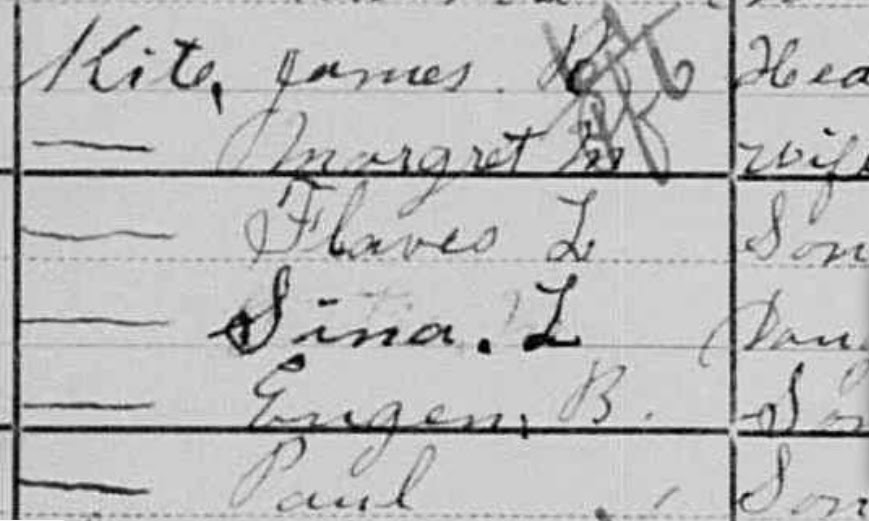
Setting aside the notion that Margret's James R. might not be the same man as Maggie’s J. Robert, let’s take a look at the rest of the roster. Of those showing in the 1910 census, the children old enough to have been listed in the 1900 census, besides Luther, would include his sister Lina and brothers “Boydn” and Paul. If you make large allowances for handwriting or misinterpreting oral reports and assume that Lina in 1910 was actually Sina in 1900—and that “Boydn” was really the middle name for Eugene B.—it appears that the family unit portrayed in 1900 matches that of the one I’m looking at for 1910.

If so, I want you to take a long look at the oldest son listed in the 1900 census. Notice the entry is not for the name Luther. It appears to be written Flaves. Considering this is the same census taker who shrunk the syllables for Margaret down to “Margret,” would it be possible to assume the poor government functionary was attempting the spelling of a name quite foreign to him? Could that be an inept approximation of the name Flavious?


If so, there: I feel vindicated. I knew there was a Flavious in the works somewhere in this man’s record.

But if that is so, why the name switch to Luther? More than that, where did the name Franklin come from in his later records? Changing the spelling of Kite to Kyte I can handle. Luther could simply be a middle name—and we’ve already seen that middle names are fair game in this neck o’ the woods. But Flavious to Franklin? That encroaches upon the realm of aliases in my book.

And makes me wonder what the back story is.  

Tuesday, January 21, 2014

“I” Before “Y”: A Census-Taking Chronology of Spelling Aberrations


In 1920, it definitely was “i.” 1930, too.

But come the 1940 census, Mary Chevis Davis and her second husband—maybe he was Franklin, maybe he was Flavious, but he definitely was Luther—saw their surname spelling changed. That was the decade they made the switch from “i” to “y.”

Not that they did it together. It took checking on two census records in two different Tennessee counties to find that out. You see, by then, the couple had decided to try their hand at the increasingly prevalent legal arrangement known as divorce.

I found Luther first, listed as F. Luther Kyte in Carter County. He was living, at the time, with his younger brother Tyler and his family, according to the 1940 census, with a big “D” inked in next to his age to confirm his marital status. Since the census asked for each respondent’s place of abode in the previous five years, it appears that Luther was in Carter County in 1935 as well, helping to narrow down the time frame in which the big split might have occurred.

Finding Chevis wasn’t so easy. For one thing, her given name of Chevis must have confused some present-day transcribers at FamilySearch.org, where she was indexed as “Cherie.” I had to find her by using her children’s names as search terms. Yet Chevis, too, had seen her surname switched to Kyte. Despite living an entire county away from her husband’s family, for some reason the Unicoi County census takers must have gotten the same memo. Kyte it was. Kite was out.

Of course, we don’t yet have the 1950 census to see if this spelling change was going to stick—though with two separate census workers simultaneously making the same spelling switch, it makes me wonder what might have been behind the change. It certainly wouldn’t be a story as obvious as some of my mother-in-law’s relatives in Ohio, who changed the spelling of their surname from the phonetically-rendered Schmeltzer to Smeltzer in an attempt during World War II to show their allegiance to their American homeland and not the land of their forebears. The Kite—or Kyte—family had been in Tennessee, as far as I could see, since before the Civil War. What was it about the 1940 census that would make them decide to get fancy with their surname’s spelling?

It was a switch that stuck, at least for one party of that ex-couple. Chevis kept that “Y” in her name. It showed up in her death certificate that way, as well as on her obituary and headstone.

As for her former husband, I’m not sure. I’m still searching through all the Kite and Kyte records for any possible Luthers, Franklins, and even Flaviouses who might match up with the few details I have on the man—if, indeed, even those items are correct.

Monday, January 20, 2014

Chasing the Elusive Mr. Kite


Shortly after Mary Chevis Davis Chitwood was abruptly widowed, she found herself saying “I do” to a man from neighboring Carter County, Tennessee. What, exactly, his name was, I can’t say. But I do have quite a paper trail of possibilities.

My starting point for all Davis family research was the family Bible, once kept by my great-grandmother, Martha Cassandra Boothe Davis. She, in turn, had passed it to my grandfather, Jack Davis. That was when I had first copied the data from its register in the center of the thick book. Upon my grandparents’ passing, the book became the possession of my aunt. Upon losing her last November, the Bible found its way to me.

Cassie Davis must not have been a careful record-keeper, as I’ve since found in comparing her notes to official governmental documents. Her notes on her daughter Chevis’ second marriage were particularly unhelpful. At one point, she entered her new son-in-law’s surname as “Kite,” but on another page, wrote it as “Kyte.” To complicate matters, at one point, she simply listed his first name as Jack, though he also went by initials F. L.

Trying to ascertain the truth of the man’s name by wandering out into the world of digitized records bore that scenario out—no, actually added more confusion to it. The 1920 census showed him as Luther F. Kite—other than that pesky detail of a middle initial, the same spelling as shown on the Unicoi County marriage bond, which he signed with that precise spelling, on December 17, 1916.


Yet, the 1930 census presented an entirely different picture. Perhaps it was because the census canvasser for that decade was a stickler for details—after all, they were supposed to list first names first. Chevis showed up in that document, predictably, as Mary C. One can only hope to infer from her husband’s entry as Franklin L. that he, too, preferred to be called by his middle name.

By the time of the 1940 census—a change which I’ll delve into tomorrow—suddenly, both Luther and Chevis had their surname spelling changed to Kyte, perhaps bearing out that alternate spelling version that surfaced in the Davis family Bible.

It might seem to you that I’m being overly demanding in my aggravation over these details. After all, in genealogical research we’ve all encountered entire centuries of records that dealt fast and loose with ye olde spelling. So am I fussy about all this in records of the early 1900s? I don’t think so, of course.

There are a few reasons for this. First, finding some other records showing his name to be not Franklin but Flavious, upon encountering any new documentation, I couldn’t be entirely sure I had located information on the right Mr. Kite. Or, um, Kyte. Then, too, just as I had encountered with this name problem when researching Chevis’ first husband—having the popular surname Chitwood—there were a lot of people with that same last name, at least in the state of Tennessee. How was I to be sure I had the right Flavious/Franklin/Luther Kite/Kyte?

Even at the point of discovering what I thought was his obituary, years later, upon receiving a copy of the newspaper article, I had doubts this was the right man.

Sometimes, you just have to do the best you can in research, up to a point, then close the books on the pursuit with the caveat that you need to revisit the quest at a later time, when more information becomes available to you.

That was what I had to do with my research, years ago, in Chevis’ case—until the 1940 census became available and I discovered some changes that may confirm that I had found the right obituary, after all.

Sunday, January 19, 2014

Over So Soon


With one mighty strike, Chevis Davis Chitwood’s husband was felled from his position at the local railroad company. As quickly as he came into Chevis’ life, he went out.

Perhaps it was from grief—or the suddenness of the traumatic news—that Chevis was unable to provide information as basic as her husband’s parents’ names. Each line in the death certificate was filled in with the same word: “unknown.”

I had, from the Davis family Bible, a note that H. M. Chitwood was born in a place called Oakdale, Tennessee. Oakdale was quite a distance from the town of Erwin where the Davis family lived, making me wonder if it was solely on account of his railroad work that Harvey Chitwood was even in town at all.

The date of his birth—at least the version I’ve found in our family Bible—was May 3, 1875. Of course, there are documents out there disputing the record-keeping skills of my great-grandmother, so I’ll have to do some more work to confirm that.

I’d like to think the date of Harvey M. Chitwood's death was etched in stone, but apparently, his burial site at Jobe Cemetery has no headstone to mark it. Unlike the family of my husband’s relative who suddenly lost his life in a similar manner, Harvey Chitwood’s wife was not in any position to pursue redress from the as yet unnamed railroad company implicated in her husband’s violent end. With a baby due in a matter of months, the poor widow probably had too many other pressing financial needs to provide any type of permanent memorial for her deceased husband.

Life, of course, does go on, and for Chevis, either time healed all heartbreak, or financial desperation pressed her to seek a union more practical than romantic. Whatever the truth of the matter, on December 17,1916, the former Chevis Davis Chitwood became the new Mrs. F. L. Kite.