Friday, July 7, 2023

Thankful for What Others Share


Every time I see a document which another researcher has shared on Ancestry.com, it reminds me how thankful I am that others are willing to share the details they are finding. At the beginning of this month, while struggling with just how I am going to discover more about my father-in-law's mystery relative, Johanna Flanagan Lee, I stumbled upon three such shared documents. Hopefully, they will lead to further helpful discoveries.

The documents were copies of baptismal records. While the copies included the entire page from a register, unfortunately the copy did not include the location of the records, though the subscriber's notes indicated the record came from "Holy Family Church." This could possibly be the parish known as Church of the Holy Family, which opened its doors in Chicago in 1857, primarily to Irish immigrants.

Helpfully, the three baptismal records shared by this subscriber were for sons of a couple named John Lee and Johanna Flanagan—and the names and dates matched up to the three eldest sons of John and Johanna.

While it is nice to have an idea about birthdates, there is one more detail which can come in handy in Catholic baptismal records: the names of the sponsors (or godparents). For these Irish-born parents, I am hoping they might be recent enough immigrants to not have forgotten the naming patterns prevalent in their homeland—and even more so, the tradition of choosing siblings or in-laws to stand in as godparents.

While I can't vouch for one of the sons, the sponsors listed for the other two sons give me hope that there might be some clues embedded in these shared documents. For instance, for the third-born son, John James Lee, one of the sponsors was someone named Catharine Flanagan. Who was she? Any chance this was a sister of Johanna, herself a Flanagan?

Even more interesting to me was the discovery that the godfather for their second born son, George, was a man named Edward Flanagan. In the many years I've tried to grapple with this Johanna Flanagan Lee puzzle, I have run across that name, Edward Flanagan. Ever since the earliest years of this blog, when I wrote about discovering that William Flanagan had a niece named Johanna, I had learned that there were other family members buried in the family plot along with William. Besides Johanna, there had been someone named Edward.

Whether Edward was Johanna's father or a brother—or merely someone else far from home, bearing that fairly common Irish surname—I haven't been able to discover.

Yet.

However, there is a concept in genealogical circles known as reasonably exhaustive research. It is prompting me to follow suit and see if I can discover just who this Edward Flanagan might have been. Will there be more than one Irish immigrant by that name in Chicago? Of course there will be, but if I can isolate just one who demonstrates a connection to the Flanagans related to Johanna, that might lead me to some answers on this family's specific roots back in County Limerick.


Above image: Excerpt from baptismal records of "Holy Family Catholic Church" in Chicago, posted by an Ancestry.com subscriber, showing the June 22, 1877, entry for George Aloysius, son of John Lee and Joanna Flanagan.

Thursday, July 6, 2023

On a Search and Rescue Mission


In my mind's eye, I can still see the records I had once retrieved and saved, the first time I worked on the family of Johanna Flanagan Lee. In that mind's eye, I could see them stored in the file folder with the block letters LEE on the label.

You already know what I discovered when I actually went and pulled out that old folder: not what I was expecting. 

Of course, that is not entirely true. I did find some documents, like the rudimentary half-sheet records upon which Cook County entered the basic facts of Johanna Lee's 1909 passing, and that of others in her family. I found photocopies of old newspaper pages with obituaries for Johanna, her uncle William and aunt, Anna Flanagan Malloy.

That is not the entirety of what my mind's eye was telling me. Thus enters the agony of storing family history records on paper. The tangibility is a plus—but the finding of them presents the downside of taking "paper trail" a bit too literally.

What I remember was a faxed record from the office of the cemetery where the family was buried, outlining the names and dates of each person buried in that family plot. Depending on whether I could find another employee at that cemetery willing to go above and beyond to replicate that record for me, I could possibly get that information again. But there is one detail I'd like to zero in on, record in hand or not. That detail is the name of another Flanagan buried alongside Johanna and her family.

If I remember correctly, that other person in the family plot was named Edward Flanagan. Who was he?

Tucked away in another corner of my mind is a blip of a memory that I had actually created two file folders labeled Lee. Could it be that I never combined the two? I'll be checking, now, to see whether there still is a second folder, just in case that missing material I remembered is still filed away.

In the meantime, now that I've found that handful of Cook County records for the Flanagan family members again, I may as well follow suit with all those helpful Ancestry.com subscribers who have uploaded documents to share online. No fancy scanning equipment necessary now; just pull out my phone, digitize and upload. 

Wednesday, July 5, 2023

The Chokehold of the Only


It might seem that researching the ancestry of an only child would make life easier for the earnest family historian, but I'm beginning to differ with that assumption. Give me eight collateral lines to work with any day, in exchange for a mysterious single child of unknown origin. Only children put my research progress into a chokehold.

Such is the case with my research task this month. Until I find any further clues, I have to assume that Johanna Flanagan was an only child. Likewise for her cousin Catherine Malloy, whom I actually know was an only child, due to her parents' history. Catherine I can trace a little bit more easily than Johanna, because both she as an adult and her mother before her had the habit of saving every piece of personal papers possible—and eventually passing every such scrap down to the child in the next generation who inherited that same pack-rat proclivity.

But even Catherine's own mother became a mystery to me. Though I know Anna Flanagan Malloy had siblings, I don't know how many. One I know for sure also made the immigrant journey from Ireland to Chicago, but as far as I can tell, he never married and never had any children, effectively leaving me Anna alone to turn to when trying to research her Flanagan forebears.

There was one other possibility to turn to in this Flanagan gene pool: a shadow figure whom we can, by necessity, assume was the father of Johanna Flanagan. What his name was, or what became of him, I can't tell. Nor do I know whether he had any children other than Johanna, thus leaving us in the same research predicament once again: the research chokehold of the only child.

If I could discover the identity of Johanna's father—and thus, Anna's brother—perhaps that would lead to information on other lines of descent in the family. Whether those possible relatives became immigrants to America or remained in Ireland does not matter as much as the fact that it would release me from this research chokehold. I'm operating on the theory that there has to be an answer to this research dilemma somewhere.

Back in my original genealogy file cabinet—yes, back in the days when everything was kept on paper and had to be stored somewhere—I had a folder with the first clues about Johanna's family. This would be a good time to revisit the details stored in that folder—the clues which started me on this research trail. Tomorrow, we'll see if revisiting this research brick wall with fresh eyes might point us in a new direction.

Tuesday, July 4, 2023

Gaps in the Story


Since today is the American holiday known as Independence Day, here's another little puzzle prompted by history's timeline. Why do Americans pin the date of their independence from the British on July 4, 1776, when the culmination of the war wasn't officially settled until September 3, 1783? Nor did the war which brought about this settlement begin after that 1776 declaration; it had been raging for over a year beforehand.

Along with the realization which we discussed yesterday—that things take time—I'm beginning to draw another lesson from our nation's founding which I can borrow for inspiration in the face of family history research frustration. We find ourselves celebrating at the moment of decision, the point at which we decide to draw a line in the sand and take a stand for what our goals will now be. Never mind the immense amount of hard work ahead of us, or the difficulties we've already endured before this point. 

Sure, pinning the celebration near the beginning of the process can end up becoming disheartening in the deep midst of the battles, but that is a decision made in retrospect. I'm not sure American colonists were partying quite as heartily as we've done in subsequent years when they were facing the threat at their doorsteps at that moment. Nor were they seeing the answers come immediately after saying it should be so. It took a lot of work, sacrifice, and risk before anyone could say it was all over but the shouting.

I don't mean to trivialize that tense episode in history by making such a comparison, but when we stake our claim on filling in the gaps in our own family's story, we need to remember that research can sometimes be a battle. Sure, it's not quite the battle faced in real war time, but it is a struggle with missing documents, mis-ascribed credit (or even blame) in family myths, and even the dark side of unknown family secrets.

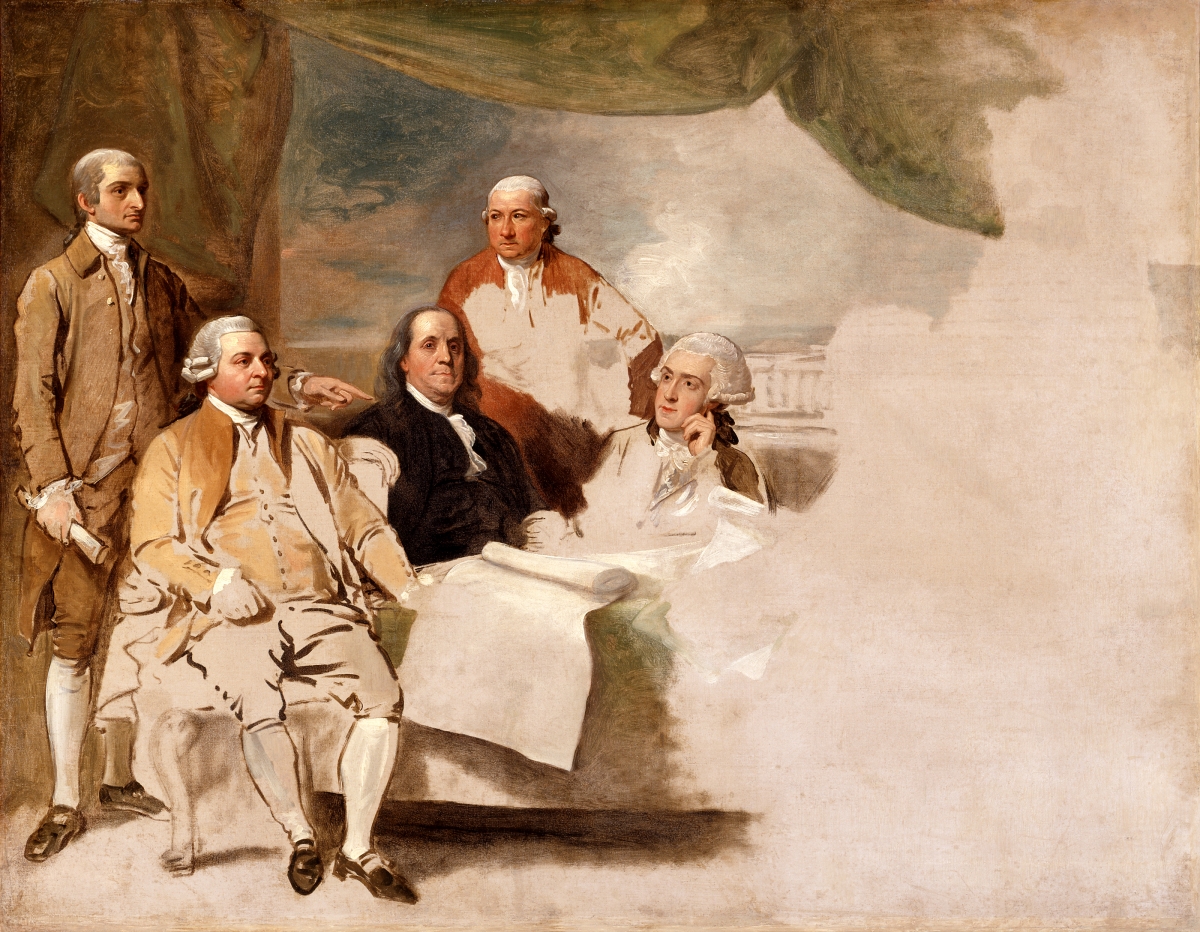
There is a painting which was commissioned on the occasion of that momentous treaty to end the war between upstart colonists and the power to which they had once owed allegiance. Intended as an oil on canvas by British-American artist, Benjamin West, the painting shows the American delegation—John Jay, John Adams, Benjamin Franklin, Henry Laurens, and William Temple Franklin—supposedly posing at the point of signing the peace treaty. The rest of the sketch, however, is left with uncolored gaps; the British commissioners refused to pose for the portrait. The painting was left unfinished.

That gap-ridden picture is sometimes the appearance our own battles take on, when we haven't quite concluded our own research conquests. An ancestor refuses to sit down and tell us just how things really were. Perhaps the paperwork was destroyed, or stolen, or burned in some tragic episode maddeningly tangential to our own family's timeline—or precisely because of the choices our forebears made, themselves.

What do we do to move on? After all, the events were completed. We just want to know what happened. But if someone's non-cooperation keeps us from framing that lovely oil portrait, we need to remember the facts of the matter and our end goal. The war has already been won. That has already happened quite some time ago. We just want to document it officially. And we will find a way. Even if we can't get everyone to sit down and smile pretty for the picture.


Image above: "American Commissioners of the Preliminary Peace Agreement With Great Britain 1783-1784." Unfinished oil on canvas by British-American artist, Benjamin West; courtesy Wikipedia; in the public domain.

Monday, July 3, 2023

Thoughts Leading up to Independence


When we celebrate Fourth of July tomorrow, what Americans are really celebrating—well, besides parades, barbecues and fireworks—is the holiday we also call Independence Day. Pinpointing the whole of the independence saga on one day, though, boggles my mind. I've had some thoughts on that, lately. And yes, even this will have something to do with genealogy.

July 4, 1776, bears the brunt of the entire unit of history Americans celebrate as the fulcrum of our independence, but the story unwinds much slower than one discreet twenty-four-hour episode. As my pastor shared in his sermon on Sunday, our founding fathers didn't simply wake up one morning and decide it was a good idea to revolt against one of the world's superpowers. This was the culmination of a multi-year process filled with letter-writing, petitions, negotiations and appeals—all to little avail.

Even pinpointing the date—July 4—as a representation of this culmination of diplomatic efforts is not entirely accurate. Though the founding document representing that declaration of independence was adopted on July 4, the motion to take that stand of independence was taken to a vote two days earlier with the Lee Resolution. And the calligrapher's handwritten copy of the document, drawn up after Congress ordered it done on July 19, was not officially signed until August 2. Even a declaration can be a matter of process, and processes take time.

Perhaps, for those of us who study the immigration of our colonial ancestors in the 1600s and 1700s, we have adopted the mental image that trans-Atlantic travel was so primitive and hazardous as to seal our ancestors' fate to never return to their homeland again. That, as I discovered a few months ago while working on my mother-in-law's colonial Maryland Howard family, was not actually the case. If business needs arose which required travel to, say, courts in London, return trips eastward were taken just the same as the previous voyages westward to the colonies. Likewise, those tasked with the necessities of dealing with political difficulties in the colonies also found themselves traveling across the ocean in both directions, such as Benjamin Franklin and his missions in London on behalf of the colonies. 

Thus, perhaps family history researchers burdened with our modern outlook concerning the hazards of colonial travel need to free ourselves of that mental image of the tearful departure of immigrants never to be seen by their loved ones again. That may have been the story of my father-in-law's ancestors from Ireland, perhaps fitting that image shared in the 1868 book, Illustrated History of Ireland, but it is not the sole story of all immigrants to America.

Thoughts like these awaken in my mind the possibility that, if such were true for those key individuals during the many years that went into the founding of the United States of America, perhaps we can take such details as cues to rework our mental image of our own ancestors' travel stories.

Trans-Atlantic sailing trips, which might seem perilous to our modern fail-safe mindset, might not have represented the final goodbye for our ancestors. Adding to that thought the safety of travel in groups—recall the researcher's moniker, the FAN Club—we may be able to discover more about our ancestors when we realize that many traveled with their friends and family members, not to mention their close associates and neighbors from back in their homeland village.

But the main lesson to me, as I ponder the elongated time line of just how long a sequence of events combined to bring us Independence Day on the Fourth of July, is that events take time to formulate and put into practice. It may seem romantic and oh-so-twenty-first-century to up and travel halfway around the world at the spur of the moment now, but it took time and much consideration before our eighteenth century ancestors actually made the move to the New World. Likely, for each step of their journey, they left a paper trail of hints for us to follow. To find those hints, though, we need to re-think all the steps that might have gone into that process of saying goodbye. It never took only one short day.


Image above, depicting the tearful departure of emigrants from Ireland, from an engraving by Henry Doyle for the preface of the first edition of Mary Frances Cusack's 1868 book, An Illustrated History of Ireland from AD 400 to 1800; courtesy of Wikipedia; in the public domain. 

Sunday, July 2, 2023

Orland Park and Fourth Cousins


What is it with Orland Park and my husband's fourth cousins? I've heard of the "FAN Club"—those Friends, Associates, and Neighbors we need to keep our eyes on whenever our ancestors slipped from view—but that was for those time periods we are researching which were far earlier than our current era. How did my father-in-law's Irish ancestors who immigrated to Chicago all manage to have descendants who decided to move to Orland Park?

Orland Park, a village at the far reaches of Chicago's suburbs, was originally settled by log-cabin-building pioneers in the 1830s, but that is not what constituted this FAN Club activity I'm talking about. I've been documenting all the descendants of Johanna Flanagan Lee, my research project for this month, and I've traced where many of them ended up, several generations removed from when that original couple—Johanna and her husband, John Lee—settled in Chicago.

With only a few exceptions—mainly those who either moved to California or entered an academically demanding profession—descendants of the Lee family moved to the Chicago suburbs. That's not surprising, considering the quality of life amenities which can be gained in the suburbs. But why did so many Lee descendants end up specifically in Orland Park? Those are distant cousins who probably aren't even aware of their relationship to each other.

Since Orland Park is a village of less than sixty thousand people, I wouldn't have heard of the place, myself, except for one detail. Keep in mind that my father-in-law, a Chicago native, had several brothers who remained in the area and raised their own families there. Having gone to visit those uncles in Chicago, over the years I've picked up a familiarity with some of the suburban areas there. And eventually, one of the uncles did indeed move to Orland Park, which is probably the only reason why I ever had heard of the place.

With Johanna's descendants, though, the story is quite different. There is no way I'd ever have known Johanna. She was born about 1849 and from her youth, lived in Chicago until her death in 1909. It is only when we get into Johanna's great-grandchildren's generation that we enter the realm of possibly having met them. And that's where I get that eerie feeling that, visiting family in Orland Park, I may have crossed the path of my husband's many fourth cousins in that same town and never realized it.

Granted, the impetus behind this discovery can be attributed to DNA testing. If my husband hadn't tested, I wouldn't have been on such a search to discover all the descendants of those Irish ancestors. Thus, in building out my father-in-law's tree as far as those fourth cousins, I'd never have found those Ancestry hints showing me that, yes, yet another distant cousin has settled in Orland Park.

There is probably some sort of cognitive bias which makes my brain perk up and take note when a familiar town name shows up for a distant cousin's residence. On the other hand, it does seem odd that the same place name shows up with such frequency. The choice of a place to live couldn't be chalked up to something in our genes, could it?


Saturday, July 1, 2023

O Canada


While I am hunkered down behind bolstered windows in defense against our current hundred-plus degree heat wave, I can still hear the continual popping of fireworks in anticipation of our celebration of Independence Day. That, of course, won't occur officially until Fourth of July, but there are those who can't contain their exuberance.

While our American fireworks displays may be premature for next week's holiday, there is one similar event which does occur today for those who live north of the U.S. border: July first is when our northern neighbors celebrate Canada Day. This is a day celebrated by parades, festivals, air shows, concerts with renditions of "O, Canada," the national anthem—perhaps, not unlike the upcoming celebration of their neighbors to the south, even with fireworks displays.

Working on my father-in-law's Irish immigrant Flanagan ancestors reminds me that this was the family which eventually married into another Irish immigrant line, the Tully family. The Tullys, however, did not follow the "usual" route in fleeing the disastrous famine conditions in Ireland; they traveled first to Canada, settling in Ontario before heading south across the border to Detroit and, later, Chicago.

Thus, a tiny part of my father-in-law's ancestry can claim Canada in their roots as well as the United States. And I will always remember joining in renditions of "O, Canada" on July 1, despite owing allegiance to the Stars and Stripes forever. Not only are the two countries neighbors but deep within our roots, many of us are family, too.