Tuesday, February 15, 2022

Not to Complicate Things, But . . .


Trying to trace an ancestor through times and locations in which record-keeping was not, ah, shall we say a precise science can be frustrating. Just as I closed my post yesterday regarding just what, exactly, my second great-grandmother's given name might have been—I had settled on Catherine, plain and simple—what should I find but yet another indicator that maybe, just maybe, that wasn't exactly the name she went by.

Oh, groan.

I happened to recall I had purchased a book from the series, "Images of America," which featured a scrapbook-style approach to recounting the history of the town of Erwin, Tennessee—home of my Davis roots—and thought I'd flip through the pages to see if any of my kin might have been included. They were. In fact, there were two photographs which featured the very woman in question, and each was labeled clearly, "Cassa Laws Davis."

Just like she figured in the 1860 census—at least, if my presumption is right—the wife of Thomas Davis was labeled in this book not as Catherine but Cassa. Yet, nowhere else did I find her under that name. Unless, of course, there were two men by the name of Thomas Davis in the vicinity, I think we can safely presume there would be one wife of Thomas Davis for us to concern ourselves. Granted, Davis is a common surname, but even in 1880, the first census following the formation of Unicoi County, the population for the entire county was only 3,645, making it hopefully less likely that there would be duplicate Thomas Davises of the same age residing there.

Finding discrepancies in records regarding the target of our search can be disconcerting. After all, my goal for this month is to discover the identity of Catherine's parents. But that can't easily be done without knowing her own specific identity. Is she really Catherine? Or Cassa? Whatever became of the report that her first name was actually Sarah, with Catherine as a middle name? Each variation added to the mix means a search for yet another identity.

To complicate matters, we don't have specifics on something as simple as the circumstances of her birth. The 1860 census shows "Cassa" as born in Tennessee in 1840. Ten years later, her year of birth in the state had been moved back to 1835. But by 1880, her year of birth had been restored to 1840, yet the location had jumped the border to North Carolina—with the added information that both her parents had been born in that other state, as well.

It is fairly clear, by looking at the photograph of her headstone and that of her husband, that we are looking at two sides of one monument. So, at least by the point of their death, family seemed to agree on a name of Catherine for their mom, and Thomas Davis for their dad. Her headstone provides a date of 1838 for her birth, nearly averaging out the two census estimates—perhaps more as a compromise than an actual fact.

To be clear, while it seems a simple process of looking in that small county for records of any other families by the surname Laws, I get the distinct impression this is not going to be such a straightforward project. Even the record of their marriage in 1856—back then, in what was still part of Washington County, Tennessee—includes such a scrawl of her name as to make the surname look like "Laus." Even worse was the fact that Thomas—if indeed that was him—was listed only by initials, and not the two we'd assume from subsequent records (T. D.), but with an added third initial. Same person? Hard to tell.

Though I'd like to say "fortunately" in preface to my comment that I have several DNA matches to help untangle this research problem, even that is a messy situation. If I use "Thru-Lines" at Ancestry.com to sort out the matches, that program relies on subscribers' own submitted trees—mistakes and all. And who's to say mine doesn't include any? After all, I'm already stumped, and this is only my second great-grandmother.

Granted, sometimes our research is a process of trial and error. We test the possibilities and evaluate whether they can be supported by evidence. Some of those tests will lead to a decision to abandon that hypothesis. Hopefully, one will stand out as amply supported by the documentation it leads us to find. But unless we give the process a try, we'll never know. Tomorrow, we'll begin looking at the DNA possibilities and what they show us.



Above: 1856 marriage return in Washington County, Tennessee—predecessor to Unicoi County—is it for our Davis and Laws? Or do those extra initials and sloppy handwriting point to another couple? Image courtesy Ancestry.com

Monday, February 14, 2022

Letting D N A Be my Guide


Do you ever find yourself getting envious of those researchers who brag about working on their seventh or eighth great-grandparents? Nah, not me; I just figure they've got easier ancestors to research, or short generations, or paperwork which never got lost in the bureaucratic shuffle.

Me? This month I'm facing the music on one of the branches of my maternal line which has kept me stalled at a second great-grandparent. Yes, a mere second great-grandmother. The odd thing is that, thanks to her genetic legacy, I have several DNA matches all claiming kin with folks sporting her maiden name: Laws. And none of them match up to what I know about my second great-grandmother. Some of these DNA matches have trees which don't even seem to line up with each other.

 On the theory that they can't all be wrong, I'm game to test the waters this month. Back before the beginning of this year, I made Sarah Catherine Laws the second of my Twelve Most Wanted for 2022. The trouble is, I don't really know very much about this woman. In fact, I'm not really sure that's her full name, despite family tradition that she was Sarah Catherine, and not just Catherine, as so many documents represent her.

Take the census records for instance. In the 1860 census, newlyweds Thomas and "Cassa" Davis are included in Washington County, Tennessee, along with their newborn son James. Though "Cassa" is usually short for Cassandra—and I do have another ancestor from that region claiming that given name—I just chalked that up to enumerator error. After all, she was listed as Catharine in the 1870 census, and exactly the same for the 1880 census. Though her 1893 headstone in Erwin, Tennessee, proclaimed her as Catherine Davis, two of her four children's death certificates—the only ones that I could find—contradicted each other: eldest son James' certificate mentioned his mother as Catherine Laws, while daughter Mary McNabb's North Carolina record had her as Sarah Laws. Even the carefully-researched Tilson Genealogy lists her simply as Catherine Laws. No Sarah.

That may turn out to be helpful intel, as we'll see when we review what can be found on Sarah, er, Catherine herself. Depending on which family tree we examine for the various Laws families who may be candidates for my second great-grandmother's extended family, having her name listed as both Sarah and Catherine may run us into trouble. Whether by DNA test or paper trail, we'll begin our search tomorrow to see if we can sort out this name conflict.

Sunday, February 13, 2022

Revisiting Those "Notes to Self"


The pursuit of family history, despite now being so heavily digitized, can still leave an enormous paper trail in its wake. Let's just say my second-most active pursuit is cleaning up the scraps of paper upon which I jot down reminders of research revelations as they occur to me.

When those notes have passed their prime, it's into the trash they go. Except...I can't help re-reading what I'm about to rid myself of—and then decide the note really needs just a little bit more work.

Take the scratch paper upon which I had noted several details about an upcoming meeting—a to-do list which, now two years later, is well-qualified to have become a "done" list. It would easily have landed in the recycle bin, except what should catch my eye as it wafted its way downward but a different note added in the margin. In a different color ink, it was a clear spot of paper upon which to hurriedly jot—before I forgot, no doubt—yet one more thing that I absolutely could not neglect to follow up on.

The terse note said only 

Drucilla—died March 3, 1866
Mary A. McLeran's sister

This was the family line descended from the Florida pioneer, ferryman Ruben Charles, father of that Mary-of-the-Red-Scarf legend who, at least as far as I could tell, did not die the tragic death in her youth romanticized in local lore. Here was a note reminding me that I had found mention of her—married, no less—in some of the court proceedings surrounding her husband's sudden death.

Mary's husband, as I recalled once I returned to look this up, was a northern Florida man by the name of William T. McLeran. And William's parents were a North Carolina couple of the early 1800s by the name of Nevin and Rebecca.

Oh. And Rebecca's maiden name was Tison.

That fact had never been lost on me. Let's just say I sort of forgot that little detail this year until I ran across that bit of torn paper now flitting from my fingertips into the trash can. Now, after having spent a month searching high and low for any signs of another Tison's origins in North Carolina—and watching some of his progeny leap the border to settle in territorial Florida—can anyone walk away from this other research temptation and not wonder whether there is yet another, though unseen, connection to ferret out from all this early American era's scant personal records?

Let's just say I'm not exactly walking away from it. I'll just reconstitute that shredded note and fold it in with the file containing my to-list for the next time we ponder those mystery Tisons from North Carolina. The books must remain closed on that case for now. We've got another task to tackle for our February research challenge. 

Saturday, February 12, 2022

Where to Look Next


So, you've worked on garnering all the facts about your ancestor from governmental records—wills, marriage records, maybe even census enumerations—and you still come up short. Are there any other ways to fill in the blanks on your ancestor's story?

That's where I'm stuck with my research goal to discover the roots of my fourth great-grandfather, Job Tison of Glynn County, Georgia. Supposedly, he settled there from a previous home in Pitt County, according to what other researchers assert—but I'm not uncovering a satisfactory paper trail leading back to that North Carolina location. Since my research schedule allots one month for each project—and then I must move on to the next of my Twelve Most Wanted ancestors for the year—I'll need to set aside my goal of determining Job Tison's parents and origin for another year.

Though I set him aside, that doesn't mean I can walk away without gathering notes from my unfinished trail of discoveries. I've found some possible clues which will need some follow up, and if I don't write down those details for future reference, you know I'll forget where the trail has led me, next time I journey down this same research path. That means the last step I take, before wrapping up this belated January research project, is to note possible directions for my first steps, next time Job Tison is on my research agenda. As they say in the restaurant business, at the end of my work day, I need to "close to open."

There were indeed some tempting resources to explore this past month. In trying to learn more about the many Tisons who did live in Pitt County, I found Tison land grant records from the North Carolina Land Grants website. If my Job Tison did turn out to originate in Pitt County, he had plenty of relatives in the neighborhood.

As I do for many of my research puzzles, I look at Internet Archive for any digitized copies of local history books. In this case, finding mention of a young Job "Tyson" in Sketches of Pitt County makes me wonder whether that narrative provides the explanation for my Job's sudden break for land farther south in Georgia at about the same time. Of course, as has already been suggested, I also perused pertinent entries via Google Books, and encountered a footnote regarding two Tisons in Beaufort, South Carolina. Though it involved a much later era, it reminds me of a possible intermediate settling point for my Job as well, which also piqued my curiosity—again, for ongoing research possibilities.

Internet Archive is one target-rich research opportunity, if one can adequately sift through the myriad digitized resources available there, but not everything online is as easily found. One recently-updated resource is the Periodical Source Index—PERSI for short—which has now been re-located to its new home at the Allen County Public Library. Cari Taplin has recently posted a three-part series, explaining what to expect at PERSI's new host location, how to put PERSI through its search paces at its new host home and, finally, how to access the articles you've found through the PERSI system.

On my trial run of the relocated PERSI, I discovered—no surprise here—some articles on the Tisons published in the Pitt County Genealogical Quarterly. How to find them? Google revealed that several of the issues are available through DigitalNC. Sure enough, when I followed the links, I found there are at least twenty two volumes already digitized and accessible. I'd call that an ample start.

That's not to say I won't also consult ArchiveGrid in hopes that Job Tison, his forebears or descendants might have bequeathed their "papers" to a participating repository—once again, a multi-step process to be learned and exercised, but worth the effort when something off the beaten research path is located. And I'll continue my search through the various historic newspaper collections. Maybe even a foray into the National Union Catalog of Manuscript Collections could prove helpful. And I won't forsake reviewing the basics, such as the FamilySearch wiki for places like North Carolina's Pitt County or the later Tison home in Glynn County, Georgia.

The real task is to locate material which provides not necessarily the specifics on Job Tison or his family—ancestors or descendants—but on the communities in which they lived. Finding the breadth of the narrative through writings of his own time period may open a researcher's eyes to the way of life experienced by our ancestors.

While Job Tison may only have been a handwritten entry with trailing tick marks in an 1820 census record, we may be able to reveal more about the likely components of his life by locating and absorbing the details in published material on the local history of places he once called home. Though we'll need to set aside our Tison research task for this year, with a hefty future to-do list tucked in his file, I can hit the ground running, next time his name comes up for a research project. There's always more to learn about our ancestors—and always more resources which will come available in the future—making a policy of revisiting our research targets periodically a smart move.


Friday, February 11, 2022

Job's Daughters


After seeing what little could be found on an ancestor from governmental documents of the early 1800s, the idea was to garner resources from non-governmental written material of the era—archived collections of journals or diaries, say, or other manuscript collections mentioning the Tison family of my fourth great-grandfather. Or at least newspapers. Surely some chatty columnist of a subsequent century would interview the aging grandchildren of Job and Sidnah Tison and press for stories of the "good ol' days" in Glynn County, Georgia. 

So much for plans. After wrapping up a survey, nearly empty-handed, of any newspaper mentions of their parents' legacy by the sons of Job Tison, I assumed there would be even less material to examine through the effort of searching for Job's daughters. How wrong I was.

My strategy was to avoid conducting a search from oldest to youngest. My reasoning? We already knew the oldest daughter, Naomi, predeceased her father. Though she was not named specifically, her place in the Tison family had been inferred by Job's 1824 will. With women being nearly invisible during that era, any hopes of finding Naomi's name in even an obituary was unlikely.

The next daughter, Sidney, was my third great-grandmother. Just seventeen at the point of her father's death, seven years afterward, Sidney married George McClellan, a son of her father's associate—and witness to his will, Charles McClellan—and was whisked away to a new home in territorial Florida. Since I've already researched her extensively, I passed on researching any mention of her name again, as I doubted I'd find anything new regarding her remembrances of her parents back in Georgia.

Sidney's younger sister Melinda was married barely a month after Job's passing—his minister friend Charles McClellan conducting the ceremony—to John Charles Richard. Less than ten years later, Melinda and her family had followed her brother's lead and moved to Alachua County in Florida. Even though her name can be found on sales of land in Alachua and nearby counties, I tend to doubt her name would surface in a search of Florida newspapers during those early years of statehood.

Likewise for the next sister, Susan Caroline, who was barely a teenager when her father passed. Hers was a mournful story, from what few mentions I can find in vital records. Widowed with a young son by the time she was nineteen, she remarried in only a couple years. By 1864, she, herself was gone.

It didn't really take as much thought as what appeared to go into those brief paragraphs above to choose my course of research action; I instinctually knew there would be more likelihood that the youngest sister's name would be found in public mentions than her older sisters. Thus, the hunt was on to discover any published mentions of Job's daughter Theresa Elizabeth Tison.

And what a cache I found—some of it even true, I'll wager.

At three years of age, Theresa lost her father, so Job would likely be even less than a fleeting memory. Sometimes, though, it is the ones who most keenly feel the lack of family connection who seem most drawn to learn more. Whatever the case, there were ample online resources for tracing Theresa's family story.

Apparently, a man ten years her senior had, in earlier times, been associated with Job Tison in the mercantile business. The man's name was Sylvester Mumford. Born in New York, this northerner had somehow found himself drawn to the southern coastal reaches of Georgia, where he opened up shop near Job's wayside inn—and, as reports had it, fared quite successfully.

Theresa and Sylvester Mumford's 1841 marriage produced two daughters, whom they named Oceana and Goertner. The family lived quite comfortably in a home built for them which was considered a jewel of the area. Pictures of the residence can still be found online, despite the fact that the home, by then long abandoned, had been badly damaged by fire in 2005.

Along with the photos can be found stories of the family who once had lived there. It was there that I gleaned a few references to Theresa's father Job Tison. More than that, though, was the continuation of the family's saga with their beautiful, nearly legendary daughter Goertner who, as the widow of Jay Curtis Parkhurst, lived to be nearly one hundred years of age.

Of course, along with the family stories and remembrances of the property came some reports of a more legendary sort—including conjecture about the Mumford fortune in relation to the missing "Confederate gold." Whether the stories about Goertner's father Sylvester Mumford were true, of course I cannot tell, but one thing is sure: at her passing, she bequeathed a significant sum for the educational support of Georgia's orphans, especially young women. Her legacy can be found even today on the website of one Georgia college, detailing the origin of the student residence known as Parkhurst Hall. And when the childless widow Goertner Mumford Parkhurst's will was presented in court in Washington, D. C., four southern states' newspapers reported on her legacy: besides recipients Georgia and South Carolina (location of one beneficiary orphanage), the story was carried in North Carolina and Alabama.

While the details of Job Tison's prominent granddaughter do not provide as much information as we'd hoped to see on the man himself, at least his shadow can be discerned in these remembrances of those subsequent generations. With that, we'll bid adieu to the tantalizing possibilities of the Mumford legacy, and the research goal of tracing Job Tison's origin for this year. But before we close the books on this family story, tomorrow we need to formulate a plausible research plan for when we pick up the quest in the future.  

Thursday, February 10, 2022

Unpleasant Transformations


It was the third son of Job Tison whose biographical sketch, published in the Brunswick Advertiser on February 19, 1879, led fellow researcher Kathy to share the link and comment that looking "far downstream" sometimes led to helpful information about our ancestors, reported by their own descendants. With that—and especially considering John Mason Tison was a Georgia state senator—I had hoped to find a substantial stash of information on his roots.

Apparently, the political activities of southern gentlemen of the 1850s were not quite as widely examined in news reports as that of our current representatives. Surprisingly, even John Mason Tison's passing in 1882 merited barely two lines of newsprint, under the stark heading, Deaths:

TISON—Died, at Bethel, Glynn county, Ga., November 1st, 1882, John M. Tison, in his 66th year.

Hardly the chatty biographical sketch we were hoping for. And don't look for the tone to improve as we move backward in time.

Though only a child of six when his father Job Tison died, as an adult, John apparently rose to prominence in the county of his birth. I found indications of his success in animal husbandry, in addition to his work as an attorney and, later, in civic duties. A Brunswick columnist explained, in a brief insertion in the May 24, 1882, Savannah paper, The Morning News,

Court is held in a one story frame building with no conveniences whatever, and is in anything but a cleanly condition.... It serves the purposes of the Superior Court, Ordinary and Justices, and is no more creditable to this thriving city than is the court house to Savannah. I learn that the county was unable to build a court house, and this structure was erected by Mr. Jno. M. Tison, a wealthy and prominent citizen and a near relative of the late Wm. H. Tison, of Savannah....

Still, of the reports of the man found in his local newspaper, much of the news has a melancholy tone to it—even those items cast as humorous. Back in Brunswick, the November 28, 1877, Advertiser noted, in straightforward somber tones,

Monday's telegrams brought little else but sad news...a dispatch was received from Savannah, announcing the death of Mr. Wm. Tison, of the firm of Tison & Gordon, and brother of our esteemed fellow citizen, Hon. John M. Tison. Troubles come not single handed—only a few days ago Mr. Tison followed his daughter and her husband, Mrs. and Mr. P. A. Hazlehurst, to their last resting place, and now must part with his only brother.

But the Savannah Morning News on May 25, 1882, tried a light approach to what surely turned out to be a serious matter.

Yesterday afternoon Mr. W. F. Penniman, agent of the Savannah and Florida steamers, Messrs. John M. Tison and S. C. Littlefield whilst standing on Bay street engaged in conversation, were suddenly, aye, in the twinkling of an eye, transformed from Caucaussians [sic] into Ethiopians, and the process was decidedly unpleasant. They were standing near a building, the roof of which was being repaired. A workman had a mammoth bucket of melted coal tar in use, when accidentally he disturbed its equipoise, and over the eaves it went, about twenty gallons of the melted tar falling in a shower, and completely deluging the three gentlemen named. Fortunately the bucket did not strike either of them, and they escaped injury, but their plight was fearful. However, there is a cheerful side to the picture—a clothing merchant shortly after the accident sold three suits of clothes.

I'm not sure that was a sufficiently cheerful antidote to the misfortune, nor can I believe the victims "escaped injury." Not three months afterwards, the Brunswick columnist for Savannah's The Morning News reported on August 16 that

Hon. J. M. Tison, one of the oldest citizens of this county, is at present lying very low at Hot Springs, Ark. Mr. J. M. Tison, Jr., of this city, was summoned to his bedside some time ago, and at last accounts the hope of recovery was very small.

From that point until the announcement of his death, silence as far as news reports went. Then, after John Mason Tison's passing, an eruption of legal notices of an estate sale, "before the Court House door," of the thousand head of cattle and three hundred sheep belonging to the estate of John Mason Tison. Indeed, according to a transcription of his will, John's instruction—"I wish my stock of cattle sold as soon as practicable"—was clearly followed.

It was, sadly, in that final document of John Tison where, in addition to his last wishes, the father commented about his namesake son, the one who traveled to Arkansas to be with his father in those last days, "I regret to say that I do not feel that he has treated me during my illness as a dutiful son should." Who knows how to read between such lines, in a document as permanent as a last testament, to determine what unfolded between father and son which led to his choosing those parting words.

Since seeking effusive reminiscence about the legacy of their parents did not turn out to produce the hoped-for family history cache from Job Tison's sons, I doubt we'll see any more chatty results from the Tison daughters, but we'll take one last look tomorrow, before wrapping up with a research to-do list for the next time I visit the gaps in this family line.    


Wednesday, February 9, 2022

Learning About William—
and a Little Latin


In looking for any published reminiscences by the children of Georgia pioneer Job Tison, I realized the more likely choice for a productive search might be to first follow his sons. Why? Job's death in 1824 signaled a time when women were nigh invisible when it came to published material. Thus, after examining the possibilities yesterday linked to Job's oldest son Aaron, we'll bypass his daughters Sidnah, Melinda, and Susan, to arrive at the next oldest son, William.

As the Tison family expanded over the next two generations, the name William seemed to become a popular choice, so when examining newspaper entries for William Tison, I needed to be careful to select the right initial: H. While I have no idea yet what the "H" signifies, that is the letter affixed to the name of Job Tison's second son.

I had stumbled upon some remarks, in online searches, which seemed to indicate that William Tison had, at one point, served in the Georgia General Assembly, so I was keen to explore what could be found on the man. Not much surfaced, other than the usual genealogical resources such as census and marriage records—until it came to the months following the year of his death.

Before jumping to that point, though, let's get a brief overview of what occurred during William H. Tison's lifespan. First, we must realize that when mentioned in his father's will, William was generally clustered by his father with three siblings, "my four youngest children." At the time of his father's passing, William was about eleven years of age.

Only from his grand-daughter Frances' D.A.R. membership was I able to learn that William had been married twice. On that record, William's first wife was listed as Mary Ellis Hardee, who died in 1847, possibly following the birth of a son.

Between the date of William's wife's death and his second marriage, it is hard to trace William's location. One possible entry in the 1850 census is for a traveling merchant, enumerated in the household of one Silas Niblack in Columbia County, Florida. Despite no mention of his children, this is not as far-fetched a possibility as it may seem, keeping in mind that the recently-formed Columbia County was carved from the northern portion of Alachua County, the same location where William's older brother Aaron had settled, twenty years prior.

By 1860, William was back in his native Georgia, where the census showed him living in Savannah with his second wife, the former Mary Scotia Fenton, plus fourteen year old Fannie and twelve year old Mitchell, William's two children from his earlier marriage. An unexpected bonus from this record was the enumerator's overzealous listing of not only each person's state of birth, but detailing the specific location. From this, we glean the fact that Fannie was actually born in Hamilton County, Florida, giving credence to the discovery of William's possible location in Columbia County, adjacent and to the southwest of Hamilton County, in the previous census.

It is likely that William stayed in Savannah for the remainder of his life. He was buried alongside his second wife only a year after her death in 1876. Discovering the location of their final resting place—a beautiful landmark cemetery known as Bonaventure Cemetery—I realized my research trails had led me to pass this way before in chasing Tison descendants, which I explained nearly two years ago in a four part series exploring the Tison connection to the family behind Savannah's Mercer House.

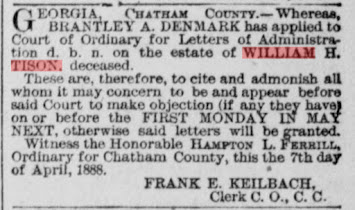
While not much could be found—at least not yet—about William H. Tison during his lifetime, there were several mentions of his name in Savannah subsequent to his passing. One, buried in the legal notices in The Morning News on April 23, 1888, announcing, "Whereas, Brantley A. Denmark has applied to Court of Ordinary for Letters of Administration d. b. n. on the estate of William H. Tison, deceased" got me scurrying to discover what "d. b. n." might mean.

Thankfully, a second insertion in the May 10, 1888, edition gave me more of a handle on resolving the mystery: "Brantley A. Denmark qualified as administrator de bonis non of the estate of William H. Tison."

Quick, racing from search engine Google to the genealogist's legal friend, blogger Judy Russell's Legal Genealogist, I ran for help—and help I received, from a post she wrote back in August 31, 2012, spelling out not only the meaning of "de bonis non," but of all the various terms we can encounter while researching our ancestors' administrators or executors. The straightforward explanation: "If the administrator dies and part of the estate still needs to be administered," that is the term used to designate the court-appointed replacement.

Of course, that brings up questions. Like, what happened to the original administrator? And, why hadn't William appointed an executor? Did he not have a will before his death at age sixty five?

Those, however, are questions for another research project. Our goal here, in trying to wrap up January's family history quest, was to see whether any of Job Tison's children might have reminisced about the good ol' days when their father was one of the early settlers in Glynn County, Georgia. Apparently, Job's son William was not only tight lipped about the history of his forebears, but about his own life, as well.


Above: Insertion in the legal notices in The Morning News, Savannah, Georgia, on April 23, 1888; image courtesy U.S. Library of Congress Chronicling America project.