Tuesday, March 1, 2022

In Search of
Charles McClellan's FAN Club


It's a new month, and time to switch research gears and step into the challenge of a different type of research goal. While most family history quests are outlined by simple statements—like, "Who was the father of Charles McClellan?"—I already know my third selection for my Twelve Most Wanted for 2022 will not be cooperative in that sort of way. I am going to have to sweet talk him into revealing his deeply-held relationship secrets.

As I put it back in December when I outlined my hopes for this month's research project, I want to learn about "the whereabouts, extended family, friends and neighbors" of the man I count as my fourth great-grandfather.

There is a reason I'm being less than specific. For one thing, having as many descendants on his research trail as I know there are for a man born on the eve of the American Revolution, you'd think there would be ample discoveries to resolve the mysteries about his origin by now. Details like where Charles McClellan was actually born, or where he married his wife—Elizabeth, the woman who has been doomed to exist in pedigree charts sans so much as a maiden name to augment her identity—have been noted as unsubstantiated in several resources where his name is mentioned. Documentation may be key, but in Charles McClellan's case, there is much that is missing.

That's not to say there are some who are sure they know who his parents were. On one widely consulted tree, Andrew C. McClellan and Sarah Rebecca Edwards are attributed as Charles' parents, with the only source to verify that information credited to a family tree on a different, subscription-based genealogy website. I can't say I'd be happy reporting that as a bona fide confirmation of fact.

Yet, neither can I assume the quest will be a simple matter of looking this up on the Internet. When I see who else has been looking—and how long they've been searching—I can recognize a tough case when I see one. That's why I'm content to try a different approach.

This month, we'll explore the places Charles McClellan once called home. More than that, we'll retrace our steps from his final resting place in territorial Florida—Jefferson County—back through his home in southeastern Georgia, where he showed up in the documents associated with another of my relatives we've already studied, Job Tison. And finally, we'll see what other associations Charles McClellan might have had that can help us construct a F.A.N. Club of all the people associated with him at different stages of his life.

To be sure, there are signs of this McClellan ancestor in several places. During this month, we just need to piece together the story, especially with an eye to possibilities that Charles' friends, associates, and neighbors might point the way to a broader understanding of who else might have been included in that McClellan family.

Monday, February 28, 2022

Except for Those Inconvenient Discoveries


Are government documents always correct? I've read, from time to time, rants by genealogists who seem to think our official record keepers are not above reproach. Death certificates often are the prime exhibit—which certainly makes sense, considering the reported names for parents of the deceased are blurted out by their grief-stricken survivors at some most inconvenient times, all in the name of the minutiae of bureaucracy.

There are, however, less excusable record gaffs. I'm convinced census enumerators should fall within this category of, um, less-sainted scribes. An inconvenient discovery in the midst of my quest to discover Catherine Laws' parents' names will be today's prime exhibit.

Over the weekend, I continued combing through my twenty five DNA matches whose trees contain the surname Laws, and my five DNA matches linked through Ancestry's Thru-Lines readout. I had already hypothesized that Catherine Laws, my second great-grandmother, could claim as her parents a couple from North Carolina who had settled in Greene County, Tennessee, after Catherine's marriage to Thomas Davis in nearby Washington County. That most likely couple, William and Elizabeth Laws, had headed a household in Yancey County, North Carolina, in 1850 which included a daughter named Catherine, of an age close to that of my Catherine.

Examining my DNA matches, I had found two small candidates whose trees showed them descended from Catherine's (as yet theoretical) brother, Pine Dexter Laws. One of those was a match sharing a precariously tiny twelve centiMorgans with me, whose paper trail I confirmed led to a relationship of fourth cousin once removed. The other supposed descendant of Pine Dexter Laws shared an even smaller genetic match with me, topped off with an assumption showing in the paper trail which was not adequately supported by documentation. For Pine Dexter and his DNA descendants, let's say we're at the fifty-fifty mark.

Another DNA match, this time descending from Catherine's possible brother Larkin Laws, turned out to be from a line of descent from which I had encountered problems with the first match I had studied: a daughter whose records indicated a given name different from that asserted by the DNA match. Though the match shared a slightly stronger total—twenty three centiMorgans—I am not comfortable using that to bolster my contention about possible parents' identity yet.

Matches linked to a third Laws descendant, Elizabeth, presented an uncomfortable consideration for me as well. Besides the small centiMorgan level, those matches' trees included a different given name for their "Elizabeth"—especially in marriage records—while I find no marriage record at all.

And yet, there was that other Laws descendant whose DNA results I stumbled upon, no thanks to the tools at Ancestry. Sharing thirty seven centiMorgans, this was another descendant from Pine Dexter Laws—an unmistakable name and identity—leading me back to that specific line of William and Elizabeth Laws. How could I doubt such a clear marker?

To complicate matters—and doesn't a solid proof argument require us to not ignore those "inconvenient" discoveries?—in a surprise moment of realizing that even Catherine herself, after her marriage, had lived briefly in Greene County near her family, I realized another possible genealogical train wreck headed down my research track.

Sure enough, Catherine Laws and her husband Thomas Davis were recorded in the 1870 census in the neighborhood—and on the same census page—as the household of her supposed father, William Laws, and one page ahead of the mangled entry for her brother, Larkin Laws.

There was only one problem for that entry regarding William Laws.

While his age was close to what I had seen previously—a birth about 1804 instead of 1802—and his shoemaker occupation was certainly spot on, this North Carolina man's unmarried daughter Elizabeth was suddenly twenty eight, when she should have been ten years older. But that wasn't the problem that concerned me.

Then, too, the twelve year old William in the household could well have been the elder William's grandson—and son of Larkin from the first marriage I had mused about last week. So I wasn't too concerned about that discrepancy, either.

The main problem about this Laws household in the 1870 census was that it contained an entry for a woman named Catherine Laws. As in, the same name as my second great-grandmother, the one I was presuming was represented by the entry three households later in that same 1870 census page. If Catherine Davis was William Laws' daughter, who was this other Catherine in his household?

This, of course, made me backtrack to my original problem-solving exploration of 1850 census possibilities. Could it be that William Laws was not the correct identity for Catherine's father? Should I have examined the alternate possibility, that of the Stokes County, North Carolina, household of John and Jane Laws?

Going back to that alternate possibility, I rolled that scenario ahead a few years to check for confirmation. As it turns out, John and Jane did have a daughter Catherine as well, but you will undoubtedly understand my relief to discover that their Catherine was married in her home county—ironically, in the same year as my Catherine, 1856—to a man named Elijah Frye.

Thus, at this point at the end of my research month, I can safely discard that Catherine's parents, John and Jane Laws, as the correct answer to my research question. And while I'm not yet thoroughly convinced of the solidness of the alternate option, I can concede that some of the DNA matches pointing to William and Elizabeth Laws have validity.

Above all, I can hold tight to my conviction that not all government documents are created equal. And remember to find more—many more—paths to documentation confirmation. 
Sunday, February 27, 2022

Off the Shelf:
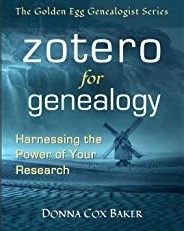
Zotero for Genealogy


There are a number of books languishing on my library shelves, bought with good intentions and the promise to read when I get around to it. Donna Cox Baker's Zotero For Genealogy is one such book which needs to get pulled down from its resting place, opened up and put to good use. Given what a great research tool Zotero can be, and given how much we need to keep track of resources in tracing our family history, I figured the book was a perfect fit for someone like me.

Zotero is a free open-source software program useful for organizing reference material—books, journals, even .pdf files, or any records accumulated when we research our roots. The software was originally developed by a nonprofit organization now known as the Corporation for Digital Scholarship, whose own roots reach back to George Mason University. Its nearly seamless operation helps researchers harvest bibliographic information from far-ranging subjects, thus making it a familiar tool for many who have recently completed graduate study programs.

One of those "many" is author Donna Cox Baker, Ph.D., perhaps best known in genealogy circles for her online project, Beyond Kin and her GenoHistory website. As a historian, her approach is to carefully weave genealogy into the broader perspective of history, which requires an organized system for keeping track of the many reference citations important in such projects. 

Since I already am deeply immersed in genealogy, and am well aware of the power of Zotero, Donna's 2019 paperback edition seemed a logical purchase for me. While the book's promise of eliminating paper and physical filing and reducing the duplication of keystrokes with those tedious citations necessary for journal publication may be tempting, my main reason for getting her book was to see her method for blending the basics of the software with the specifics of genealogy research.

"Harnessing the Power of Your Research" is not just the book's subtitle; it certainly speaks to someone drowning in reference material like I am. I'm looking forward to putting the program—and the book—through its paces, especially for some of the research goals I've set out for myself this year.


Saturday, February 26, 2022

Choosing Connection


It's the weekend before RootsTech, and all through the night, I've been trying to catch up with one particular connection tool available to conference participants: Relatives at RootsTech. Sure, there's a lot to be done to prepare for the beginning of the event when RootsTech opens this coming March 3 - 5. I certainly want to set up my RootsTech play list, for instance; even though there are nine hundred new sessions available, it seems like the fifteen hundred sessions from last year will still be available through the FamilySearch Learning Library. That alone will take some planning to navigate.

The theme for this year's free online conference is Choose Connection, and what better way to convert that sentiment into action than to participate in Relatives at RootsTech. That means, of course, signing up for a free FamilySearch.org account, if you don't have one (done). That also means registering for the conference (check) and clicking the statement indicating I specifically wish to participate in Relatives at RootsTech.

Those are all simple steps, of course. Far easier to accomplish than the next hurdle: making sure my ancestors' presence is included in the FamilySearch tree. For those who have been active participants in the universal tree build at FamilySearch, that task is as done as it ever will be, but for someone like me, who prefers the curmudgeonly plodding way of building my own tree in the solitude of my own subscription at Ancestry.com, it's not like I can simply upload my twenty-something thousand relatives onto FamilySearch via a GEDcom. Oh, no, think again: it means going step by step, adding my favorite—or at least most desperately sought—ancestors onto their tree, one by one.

Groan.

I did, however, persevere. I now have a token presence on the FamilySearch.org tree. Mainly, the lines I input represent my paternal grandparents' no-longer-mysterious Polish roots, and a few of my mother's lines. And you know what? In doing that process, I was amazed to discover that several of those individuals turned out to not have any matches already resident in the database—which means I contributed new information that, hopefully, others will be able to find and, perhaps, build onto from that stub of my building project.

Face it: every new bit of information we provide can, in turn, help someone else with their brick wall ancestor. Since RootsTech is such an international event, of course I have a selfish motive: that someone from Poland might discover some of the ancestral entries I included and be able to build out the line to current descendants halfway across the world from me. If those connected relatives happen to be able to speak English, connecting through chat at RootsTech might mean I can reach out to a long-lost distant cousin whose ancestors might have always wondered what became of my great-grandparents after they left their homeland. An exciting thought.

Apparently, I've already amassed over nineteen thousand "relatives" who have signed up for Relatives at RootsTech this year. Not a one of them is from Poland—so far—but I can keep hoping. Most are from the United States. While there are plenty of Broyles, Taliaferro, and Tilson connections I've spotted, a match is only as good as the data it is drawn from, and some of those ancestors "in common" are names I've never encountered before. I'll wait until I see the proof on paper before I become ecstatic about some of those sixth cousins (or beyond), but I've spotted a few third cousins of interest—yet another way to look at a theme like "Choose Connection" for a fun application like this.


Friday, February 25, 2022

Retracing Those "Fast and Furious" Steps


Toward the end of her life, my mother posted notes to herself, most likely as a reminder to keep working hard at a particular task. One note, however, did not refer to grocery shopping lists or calendared meetings, but was an enigmatic descriptor. The note said simply, "Fast and furious." At times, she had that note pinned to surfaces throughout the house, as if to remind herself, when working on a project, to focus for speed in accomplishing a specific task.

Now that I'm racing the month's close to find the parents of my second great-grandmother, Catherine Laws, I must have subconsciously taken my cue from my mother's scribbled reminders. I've been working fast and furious. Too fast, as it turns out: I misplaced the identity of the DNA match who leads back to a second potential brother of my Catherine.

Simple, you might be thinking: just pull up your DNA matches on Ancestry and search for all matches with a surname Laws in their tree...except that not all family trees of our DNA matches reach back that many generations. Let alone consider the difficulty of researchers who have not yet discovered the maiden name of their female ancestors.

I tried retracing my steps, recreating yesterday's research path in every way I could recall. Matches of matches? Nope. Search using a more recent surname in the match's family tree? Nice try, but no. I ended up going back to Catherine's proposed collateral line, dropping down from that other brother—Pine Dexter Laws—to the daughter I remember being named in the match's tree (Peggy). From there, I looked in my hints for every single Ancestry member's tree which contained that specific Laws descendant's name, and clicked through all the respective trees to each subscriber's name to see whether Ancestry mentioned that person as a DNA match.

Eventually, I retraced my way to the right DNA match—but let me tell you, I hope to never have to repeat that lesson again!

The match in question shares thirty seven centiMorgans in common with me. Taking a quick look at DNA Painter, home of the interactive version of Blaine Bettinger's Shared cM Project, I noticed that, of all the possible relationships for those sharing thirty seven centiMorgans, fourteen percent have reported being fourth cousins with their match. I fall into that less common category, for this Laws descendant DNA match and I are indeed fourth cousins.

On the heels of that research triumph, though, should follow this question: is there any other way my match and I could be related? After all, we share those thirty seven cMs in two segments. And Greene County, Tennessee, being the small, interrelated region that it is, there is that possibility of more than one connection. I don't see any possibilities yet, but keep in mind my match's tree is quite limited, though my tree doesn't reveal any other mutual family surnames.

I have yet to locate a match descending from any other of the siblings in my target Laws family—the children of William and Elizabeth Laws of Yancey County, North Carolina—but now that I've traced them through several decades and noted their move across the state line to Greene County, I did see one other encouraging sign: according to his death record, my own great-grandfather Will Davis, son of Catherine Laws, was born in Greene County. Not only that, but his entire family moved from their home in Washington County to Greene County for a while, showing up there in the 1870 census—a fact I had previously overlooked until prodded to pursue Catherine's own roots.

Over the weekend, you can be sure I will be thumbing my way through records for the rest of this proposed Laws family connection. My interim goal is still to locate any other DNA matches who descend from a William Laws family member other than Larkin or Pine Dexter. While the DNA matches I've already found from these two likely brothers of my Catherine seem to confirm I've selected the right potential parents for my second great-grandmother, it would certainly bolster a proof argument to strengthen it with even more lines to connect them.

In the meantime, while working "fast and furious" on the heels of a potential family history breakthrough, I've been reminded to always, always, always remember to keep track of that research trail. Better to spend time moving forward than retracing those tedious steps once again. 

Thursday, February 24, 2022

Leaning Toward the
Side of Greater Caution


Knowing half of a story never instills quite as much research confidence as knowing both sides of a story. That observation certainly applies, when it comes to using DNA tests for genealogical purposes. Discovering the name of one partner in a couple may be encouraging, but until we can confirm the other party involved, we are still left with conjectures.

That's pretty much where I stand with this exploration into the possibilities for my second great-grandmother's parents' identity. I have DNA matches whose trees point me back to a man by the name of Larkin Laws. Initial joy over the discovery that there was a household in 1850 North Carolina which included both Larkin and a possible candidate for my second great-grandmother, Catherine Laws, gave way to doubts, once I followed the line of Larkin's descendants. Comparing what I found with the trees of two of Larkin Laws' descendants inspired more questions than answers. Hence, the caution.

First on my list of questions was the point I brought up yesterday: did Larkin's three older children have a different mother than that of his younger children? This is important, because the specific descendant for two of my DNA matches was Larkin's second daughter, Elizabeth.

Well, let's put it this way: that daughter is identified as Elizabeth from her appearance as a two year old in the 1860 census, all the way to the day of her 1881 marriage to J. W. Bullman in Greene County, Tennessee. Records after her wedding named J. W. Bullman's wife as Frances.

It isn't so much that I'm concerned that Frances Bullman isn't the same woman as Elizabeth Bullman—although having some document to clarify the name switch would be reassuring. The root of the problem reaches farther back than that: to Elizabeth's own mother, whoever she was. Remember, Elizabeth's 1858 date of birth pre-dates her father's marriage to Matilda Oler. Not being able to specify the identity of Elizabeth's own mother leaves us open to the possibility that her descendants' DNA match to me might be owing to yet another family line in this region of tightly-knit (read: intermarried) communities.

Because of that, I've taken a closer look at the many other small DNA matches I have in common with Laws ancestors—specifically, to avoid descendants of Larkin. At closer inspection, several of my Laws connections have matches in common with my Davis ancestors, making it even more important that I only use descendants for whom I'm confident of both sides of their pedigree.

As it turns out, I have at least two small matches who descend from a different son of William and Elizabeth Laws. Like Larkin, this son had a given name making him ripe for lifelong mis-identification in government records. The man's name in the 1850 census, best I could tell, looked like Pendexter. It was no surprise to see the name rendered as the more familiar Poindexter in the 1860 census. By the time of the 1870 census, he may have just given up and settled for "Dexter" as a given name, but even though he was a single man boarding in another couple's home, his occupation as shoemaker in Greene County, Tennessee—same county where other Laws family members had settled—gave me enough confidence to assume that was the right identity.

Not long after that 1870 census, Greene County records alert us that "Pendexter" Laws had married Mary Ricker, beginning a family which grew to six surviving children by the 1900 census, still in Greene County. Among those six was their son David King Laws, whose own son Lawrence showed up in the tree for one of my matches. Even though that match's tree wasn't very large, all it took was seeing that one name, since I had already built out my hypothetical Laws tree for many of the lines of descent.

Just to be sure—especially since I am still in doubt over his brother Larkin's children—I'll be working over these Lawrence Laws DNA matches to examine whether that is indeed the right connecting link. And then—glutton for research punishment that I am—it would be nice to find a DNA match connected to another child of potential parents William and Elizabeth Laws, before I conclude that that was the identity of my Catherine's parents. An added bonus would be to wrap up this February research project before I run out of month.

Oh...one more thing: about Catherine Laws' other brother. His name turned out not to be Poindexter. Nor was it Pendexter. According to his children's own death records, he used the name Dexter, but that was apparently his middle name. His first name was Pine, producing his full name as Pine Dexter Laws. No wonder he confused all those government record keepers. 

Wednesday, February 23, 2022

Getting Lucky With Larkin


It is only with some lucky discoveries, thanks to DNA testing, that we can budge those previously immovable brick wall ancestors from their moorings. In my case, my second great-grandmother, Catherine Laws, may have had a sibling with an unusual name: Larkin. At least, that's what one of my closest Laws family DNA matches is showing me. Now to test out that possibility and see if it leads anywhere.

Let's see what we can find about Larkin Laws, the twenty three year old laborer in the household of William and Elizabeth Laws. At the time of the 1850 census, Larkin and Catherine and the rest of the Laws household were situated in Yancey County, North Carolina, and yet, before the next census, my Catherine had married a man in Washington County, Tennessee, by the name of Thomas Davis. How did that North Carolina girl end up in Tennessee? Tracing Larkin, as well as William and Elizabeth Laws, through subsequent enumerations helps quell my concerns about just how my second great-grandmother Catherine, from North Carolina, ended up marrying someone in Tennessee.

Following the Laws household to the 1860 census shows the shoemaker had moved to Carter County, Tennessee. While the location was in a different state from the Laws household's 1850 origin in North Carolina, checking a map shows the distance was not very far. Both counties border the state line, with Yancey County being slightly south of Carter County.

Fortunately, the elder Laws' occupation helps differentiate William Laws, and we can see, in 1860, that Larkin has followed his (likely) father's craft. The challenge in reviewing this 1860 census, though, is that ages don't advance by ten years from the previous census. Is that simply an indicator that ages weren't tracked as carefully in that region, or a sign that we've located the wrong family?

Names, compared with the previous census, seem to follow the pattern. Of course, by 1860, our Catherine would have removed to her own household with her husband Thomas Davis in nearby Washington County, Tennessee. Of the rest of the Laws grouping listed in 1850, all but Rebecca and John were accounted for in 1860—though some managed to age only five years in the interim, while others gained eight years. Only Wiley managed to complete a full ten years in the span between the two census records, a cause for some doubt about this research find.

When we move onward another ten years, we see several changes for Larkin's living situation. With that, I'm tempted to read between the lines, back at that 1860 census. Remember, the 1860 census did not include any explanation regarding relationship between members of a household; we need to infer what the connections might have been. As an example, for the presumed matriarch of the Laws household in the 1860 census, forty nine year old Elizabeth Laws, the youngest child was listed as a seven month old baby. While it is possible for that to have been Elizabeth's child, when we move to the 1870 census, I see a different scenario: the three youngest children from the 1860 census may actually have been the children of Elizabeth's eldest son, rather than her own.

The age gap from the next child up in that 1860 census—seventeen year old Wyley—to five year old Margaret also makes me wonder if Larkin might have been the father of children Margaret, two year old Elizabeth, and baby William. If so, those three youngest children might have lost their mother before 1860.

By 1862, Larkin Laws has taken a wife, a woman by the name of Matilda E. Oler of Greene County, Tennessee. The 1870 censusif we can believe that the listing for "Landon" Laws in Greene County actually refers to our Larkin—shows an interesting configuration. Though the couple married only eight years previously, their household now includes two teenagers by the names of Margaret and Elizabeth, who, like their father, had been born in North Carolina. The family is rounded out with two younger sons, Wylie and James, most likely children of both Larkin and Matilda.

Larkin Laws remains in Greene County for the two remaining enumerations in which I can find him listed: in 1880 and 1900. Beyond that, I can find no sign of either Larkin or his Tennessee-born wife Matilda. Still, there is enough information in those several census records to allow me to build a tree of their descendants. After all, that is the next step to take in comparing a possible link with my closest Laws DNA match.

It's a good thing I've already started that process, though, for it didn't take long for me to realize there might be a discrepancy between the tree I built and the one posted by my Laws cousin. We might not be as lucky with this discovery of Larkin as I had thought. The crux of the matter may go back to that same issue with Larkin's older children—the ones who might have had a different mother. If I don't know who that other mother was, how can I determine whether our DNA match is owing to a Laws connection, or through another line?