Friday, December 21, 2018

One Last Possibility


While we've been exploring the details regarding three different Iowa men named Albert Roberts to determine which one might have been the man in the antique photo I found, this last Albert is actually the only one who actually lived in the city in which that photograph was taken. Our third Albert Roberts was the one we found whose few newspaper mentions gave us an address right in Council Bluffs, itself.

The only thing is, out of all the gossipy news tidbits we've found for all three Alberts, those newspaper entries for this third Albert also gave us one of the more curious of the accounts. Looking closer at that May 8, 1919, notice in the Evening Nonpariel, shows me that this one will also take some reading between the lines to ferret out the real story.

For one thing, this was not just another sweet story of the now-grown kids coming home to visit family for the holidays. It was an article placed among the legal notices. A notice of referee's sale, it began with the official sounding "In the District Court of Iowa, in and for Pottawattamie County."

The plaintiff was none other than our third Albert Roberts. Part of the public announcement read,
Notice is hereby given that by virtue of a decree of the district court of Pottawattamie County, Iowa, entered on the twelfth day of April, 1919, in the above entitled cause, the property hereinafter described was partitioned and the undersigned was appointed sole referee and authorized and directed to sell the following described real estate at public sale....

The undersigned referee was a man by the name of William Arnd. The property was described by lot numbers in the city of Council Bluffs. The sale was to be held on the seventh day of June "at the front door of the court house" in the county seat, Council Bluffs.

It was the defendants who gave me pause to consider this routine legal notice more closely. The list of names included was long and curious. For one thing, the surname Roberts figured prominently. In addition to a couple, named individually as Fannie Binns and "I. M. Binns, husband of Fannie Binns," there were Dwight Roberts, Emmet Roberts, and Frances Roberts, all specifically designated as minors. One last defendant was listed as "Mrs. Nellie W. Roberts, guardian."

To see the rest of the story, we need to research the family tree of our third Albert Roberts, plaintiff in this case filed in 1919. This Albert, married sometime before he completed his draft registration in June of 1917, declared himself a divorced man to the 1920 census enumerator, and yet was father to his firstborn son, who arrived November 28, 1921—and, unfortunately, died only ten days later. The child's mother—and Albert's second wife—Josephine Anshutz Roberts, was herself, at the time of the child's birth, only sixteen years of age.

Albert—the only one of the three candidates for the Albert Roberts in our photo for whom we had a middle initial—himself was born in Nebraska in 1896, son of English immigrants Henry and Sarah Jane Fletcher ("Jennie") Roberts. Albert Lee Roberts was the youngest of six siblings, three of whom were still living at the time of the 1900 census. His two older siblings still remaining were William Edwin and Fannie Louise, each of them born in the 1870s, long before Albert's arrival in 1896 (or 1894, as both his 1925 Iowa state census entry and his Social Security Application indicate).

Of those two siblings, William Edwin was not long for this world, either. Also born in Omaha, William married Nellie McGill, another resident from that city, returning to her hometown in Des Moines, Iowa, for the December, 1893, nuptials. Over the years, William worked for the railroad, but in 1915, he was the victim of a brutal attack by a drunken man. Though he survived the attack, it left him "subject to spells of absentmindedness, when he wandered about in a dazed condition." From that point on, William was unable to work.

At some point in mid-November of that same year, William did not come home as expected. His Council Bluffs family, concerned for his well-being, put two and two together when they heard reports that a man had been killed by a train in nearby Omaha. His oldest son Dwight, heading to Omaha, confirmed that the reports were indeed of the missing man.

This was not the only unfortunate story in Albert's brother William's brief life. While William's oldest son had indeed remained in Council Bluffs, William's wife had already left him, taking the other children—Emmet, Henry, and Frances—sometime after the 1910 census, returning to her family's home in Des Moines before the state census in 1915, when she declared herself to be divorced.

Not long after William and Nellie had tied their ill-fated knot in 1893, William's sister Fannie Louise had also gotten married. Hers was an event in her home state of Nebraska in September of 1896, when she said "I do" to an Iowa man named Isaac M. Binns. Though they remained for a while in the Omaha area, by 1904, they had returned to Isaac's former residence in Montgomery County, Iowa, where they remained at least through 1910.

Such was the family history of Albert Lee Roberts' siblings. To add to all this woe, by 1917, Albert's mother, Sarah Jane Fletcher Roberts, died intestate. She apparently held property in her own name, for her husband was still alive, not following her until May of 1918. In March of 1918, Isaac Binns filed as principal, along with his brother-in-law, Albert Roberts, and William Arnd, for an administrator's bond to settle Sarah's estate. 

In the midst of all these misfortunes, sometime just before the 1920 census, a question came up about several lots in the city of Council Bluffs which somehow involved these siblings—or their remaining family members. Perhaps precipitated by their father's death in 1918 and the settling of the elder Roberts' estate, the legal notice was posted and the referee's sale scheduled.

No more mention was made in the local newspapers—at least that I can find—of that family difficulty. After that point, there was a brief comment, upon the 1926 arrival of another tiny child of Albert and Josephine Roberts, of how small the baby's birth weight was—followed by the not-surprising sad announcement of the funeral service for "Wauneta Louise" Roberts barely four months later.

It was a photograph placed online by an Ancestry subscriber, combined with the World War I draft registration description of Albert's appearance—medium height, medium build, with blue eyes and dark brown hair—that tended to dissuade me of any possibility that Albert Lee Roberts was the Albert Roberts in my photograph.

But I believe the clincher really is the dates involved in this Roberts family saga. While his siblings—all born in the 1870s—might have played the part in a wedding with the clothing styles of the photograph I found, Albert Lee's likely marriage in 1920, combined with the appearance of his second wife in the Ancestry.com photograph, convince me that, even though he was a Council Bluffs resident, this Albert's arrival on the scene was too late to make him a candidate for the true identity of the man in the photograph I found.

While that conclusion eliminates Albert Lee Roberts from the running, as far as photograph identity goes, it still doesn't answer the question of just who that couple was in the photograph I found. There are a few other options remaining in this search, but since we are so close to Christmas now, I'll set aside that chase for another time after the holidays.

Thursday, December 20, 2018

Considering a Second Possibility


Let's examine the second man who could possibly be the Albert Roberts in the Council Bluffs, Iowa, photograph I found. This man was a little younger than the first Albert we've already discussed—that Albert was born in November of 1869—as our second Albert made his arrival sometime around 1878.

That date, however, is an estimate based on the age he gave when he filed for his marriage license on January 4, 1900. Just like the Daily Nonpariel had mentioned in Council Bluffs on January 11, 1900, this Albert Roberts had married Hattie Eshelman in the county to the east of Council Bluffs, which is Cass County, Iowa. Apparently, his bride, daughter of Joseph and Julia Eshelman, was a lifelong resident of Noble Township in that county.

The couple didn't remain in Cass County, however, for we find them, only five months later, back in Adams County, evidently the place of Albert's own birth and home of his parents, James and Ann Slitty Roberts, who were listed only one entry below Albert and Hattie in the 1900 census.

That information helps us locate the right Albert Roberts—at least for the consideration of that second possibility for the photo's Albert—in the 1880 census. There, we find him in the Adams County household of James and Ann Roberts, and discover that he was the youngest of all his siblings, which included two brothers and four—yes, count them, four—sisters.

It wasn't long after Albert and Hattie were married in January, 1900, that they were joined by what turned out to be their only child. A daughter, whom they named Maude Ethel, was born to them on October 5, 1900—a fact we don't realize until stumbling upon her name in the 1910 census. At that point, the Roberts family was still living in Adams County.

Though the Daily Nonpariel did mention, on the occasion of their fiftieth wedding anniversary, that Albert and Hattie Roberts had been residents of Atlantic in Cass County since 1917, the first documented instance showing their new residence shows up with Albert's registration for the war, which he completed in 1918. From that card, we learn that he was employed as a mechanic in Atlantic, and had set up the family's residence at 409 West Tenth in the same city. From the point of the 1920 census onward, we can assume the Daily Nonpariel had the report of his residence in Atlantic correct.

This is the Albert for whom the delightful listing of attendees at their July 1922 family reunion provided so many relatives' names. As tempting as that genealogical gift might be—especially since I will have to find some descendants who would be willing to weigh in on whether their Albert Roberts bears any likeness to the one in the photo I found—I have my doubts that our second Albert and his wife Hattie are best candidates for the identity of the photograph I found. For one thing, their marriage occurred in 1900, while the previous Albert we examined was married in 1889. That leads to another question, one far removed from genealogy but apropos to a conversation about history: what is the timeline of the one fashion item, worn by the woman in our photo, whose popularity waned with the end of the 1880s?

It can be a fun detour—at least for fashionistas and costume designers—to review the many versions of the bustle. Yet, no matter how modest the style of the dress worn by Mrs. Albert Roberts in our photo, it may have been a fashion more suited to a 1889 wedding date than one in 1900.

There is, however, one more consideration: we still have a third Albert Roberts to learn about before we make any final decision on whom to eliminate from our roster of possible couples. We'll take a look at the third Albert tomorrow.  

Wednesday, December 19, 2018

Was Mrs. Roberts a Widow?


It was among those many newspaper clippings regarding Albert Roberts, the man in the Council Bluffs photograph I found, that I discovered one unusual detail. It was in one of those brief, gossipy newspaper mentions of doings about town, that I spotted one puny phrase that seemed out of place:
Mrs. Lillian Cowger and son, Edward, of Omaha spent Sunday with her mother, Mrs. Albert Roberts.

The sticking point in that April 20, 1914, entry in the Council Bluffs Evening Nonpariel is one idea: the woman and her son, traveling from Omaha, went to visit her mother. Not her parents, despite both Mr. and Mrs. Roberts being alive and living in the same place, but only her mother.

Clearly, by 1914, Mrs. Albert Roberts was already married, but the three oldest daughters, at least as far as we could see from the 1900 census, were named Leta, Eva, and Ola, not Lillian.

There was a second little detail which confirmed that glitch I noticed in the newspaper mention. The household of Mr. and Mrs. Albert Roberts of Riverton also included two other people, at least in the 1900 census. Those two people were listed as twelve year old Mamie Eachus and fifteen year old Lillie Eachus. 


The two Eachus girls were listed as daughters in the Roberts household, but no one else in that group of eight people had the surname Eachus. Since Alice was the likely reporting party, she (or the enumerator) may have incorrectly listed the relationship from her own vantage point, rather than as relationship to the head of household.

Looking at the marriage record for Alice and Albert Roberts seemed to muddy the waters even more. The August 13, 1889, event showed the correct information for Albert Roberts: twenty year old son of Thomas Roberts, as we have already seen, whose mother's name was Amanda van Horn. The record showed he had been born in Henry County, Iowa, and that this was his first marriage.


When it comes to the entry for Albert's bride, we encounter some confusing information. Her name, first of all, is listed as Alice Eachus, and the entry shows this to be her second marriage. And yet, her father's name is given as Charles E. Eachus, and her mother's as M. A. Roberts, the very surname of the man she was about to marry.


If Mamie and Lillian Eachus were indeed Alice's daughters and not Albert's, did this mean they were born to an unmarried woman? That seems highly unlikely in that era—especially twice for the same woman. What was the name of Alice's first husband? If not Eachus, then what?

Since we already have spotted a Mrs. Lillian Cowger coming from Omaha to visit her mother, Mrs. Albert Roberts, let's see what can be found for that Lillian Cowger. After all, Lillie was often a nickname for Lillian. It's possible that Lillie Eachus and Lillian Cowger could have been the same person.

As it turned out, learning to read between the lines often helps resolve research dilemmas. There was an additional curious entry for the Albert Roberts household, this time from the 1910 census. The Roberts household included a line for someone named Lillian. Her surname was listed as Roberts and she was listed as a daughter-in-law, not a daughter. Her entry also stated that, at twenty six years of age, she was a widow. She was mother of one child. And yet, there was no listing for that child.

There was one other problem with that entry: a widowed daughter-in-law presupposes a now-deceased son, and yet the Roberts' only son, Stanley, was still very much alive—and, at that point,  only twelve years of age. Unlikely he would have been the deceased husband of Lillian, let alone father of her child.

Moving to other indicators of just who this Lillian might have been, the easiest tell would be to pull up her own marriage record. Don't assume it would be easily found, searching for the Roberts surname, however. The record not only helps put every name in its proper place for Lillian, but helps us unearth the hidden story about her mother.

Married about a year and a half after that first appearance as Lillian Eachus in the Roberts' 1900 census entry, Lillian Elizabeth Eachus' December 2, 1901, event united her with a Riverton man whose scrawled name on the record looked like Ern. P. Cowger. More to the point, Lillian's parents' names were given as John W. Eachus and Alice Jane Dooley.

Was Alice Jane Dooley Eachus, then, the woman who became wife of Albert Roberts? If so, who was John Eachus, and what became of him?

One thing to note, from Lillian's marriage record, was that she was not born in Iowa, as the 1900 census had led us to believe. She was born in California. Her mother—and possibly Alice's parents, as well—had earlier moved to the Reno, Nevada, area, which is where John Eachus died.

While I can't locate the actual newspaper report from any online repositories, an Ancestry subscriber had transcribed a December 10, 1888, article from the Daily Nevada State Journal. Under the headlines, "Coroner's Inquest," the news item detailed the testimony obtained during the investigation and stated, in part, regarding John Eachus that,
the unfortunate man was lying on the track, but when he was discovered it was too late to stop the engine, although every effort was made to do so. As soon as the engine was stopped...the engineer went back and found the body, but no signs of life being evident, he started off for Reno and informed parties of the occurrence. Coroner Brown departed on a special to the scene of the accident, and found the unfortunate man alive but sinking rapidly. He was brought to Reno where he died Sunday morning at 3 o'clock.

Based on what we found in the 1900 census, we can piece together the rest of Alice's story. Widow Alice Eachus and her two daughters returned to Iowa, after that tragic 1888 episode, and by 1889 had married Albert Roberts.

Still, that does not give us the right information for Alice's own parents, who obviously were not surnamed Eachus. It takes moving to Alice's own death information to uncover that. Sure enough, at the point of Alice Roberts' death in 1927, we discover her father's name was indeed Charles E., as Alice's marriage records had revealed—it's just that her maiden name wasn't Eachus. It was Dooley. And her mother's name? Not quite M. A. Roberts, as we saw in Alice's marriage record. But close: it was Lydia A. Roberts.

That leaves me with one more question, though. Remember, I'm still trying to determine which of three couples named Mr. and Mrs. Albert Roberts is the right identity for the photograph I found bearing that same inscription. Does the Mrs. Albert Roberts in the Council Bluffs picture look like a woman older than her husband? Does she look like a woman who had already been widowed? Or do we need to consider the family stories of the other two men named Albert Roberts?


Above: All clippings of documents are courtesy of Ancestry.com; excerpt of an unidentified Mrs. Roberts from photograph labeled "Mr. and Mrs. Albert Roberts," which photo is currently in the possession of the author until claimed by a direct descendant.


Tuesday, December 18, 2018

A Look at the First Albert Roberts


Once we've clustered all the information we can find on an individual, it's time to look more closely at the details, search for supporting documentation, and see what additional clues that process will bring to us. Of the three possibilities we isolated for the Albert Roberts in the antique photograph I found from Council Bluffs, let's look first at the Albert Roberts from Riverton, Iowa.

We can fairly easily locate an Albert Roberts in the 1900 census, living in Riverton. A small city of less than seven hundred people in 1900, Riverton is located in Fremont County on the southwestern corner of the state of Iowa, two counties to the south of Council Bluffs.

We already know, from reading the newspaper mentions of Albert Roberts' name, that he had a daughter named Leta and a son named Stanley. He also had other daughters for whom we only know their married names. One is Parkison, another is Edwards. And the record for the Albert Roberts in the 1900 census seems to bear that out.


If this is the right Albert Roberts from Riverton, Iowa, we can glean a few other details right away. First, of course, is learning the possible name of the "Mrs. Albert Roberts" as she was labeled in the photograph I found; now we can call her—possibly—by her first name, Alice.

We can also gauge Albert's age by the birth information given, reporting that he was born in November of 1870. In addition, Albert and Alice were married around 1890. And, sure enough, they had a son named Stanley, just as we had learned from the newspaper reports.

As for all the mentions of a Roberts child called Leta, we can assume she was the daughter born in 1889, entered in the 1900 census under the name Milleta (or possibly Malleta). It takes a little additional searching to locate which daughter ended up being the Mrs. Parkison from the newspaper entries. She was likely Ruby Viola (nickname "Ola"), born April 23, 1890, who married Charles Edwin Parkison, as we can see from their son Lyman's marriage record many years later.

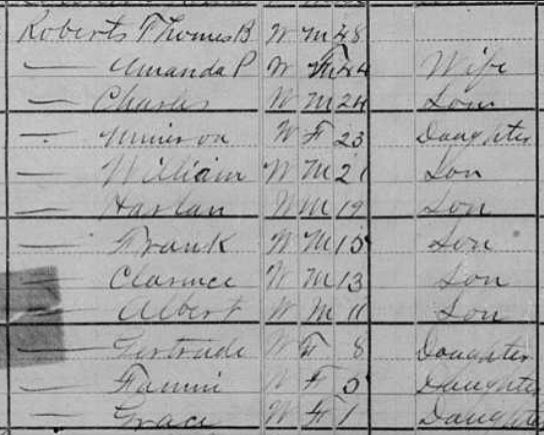
Looking forward another ten years from that 1900 census, the Albert Roberts household was again easily found in the 1910 census record. This time, two new individuals join the family. One is six year old daughter Edna. The other is Albert's father, a seventy eight year old widower named Thomas Roberts—definitely a helpful piece of information for our purposes.

Using that key of Albert Roberts' father's name, we can more accurately locate Albert as a son in his father's family in the 1880 census. From that vantage point in the Thomas Roberts household, we can spot Albert's sister Minerva, the Mrs. Cowger who came to assist Albert in those difficult days leading up to his wife's death in 1927.


We also gain a vantage point of now knowing the universe of sibling names for this Albert Roberts, helping us to demonstrate that these are not the same siblings as were listed in the family reunion report for the Albert from Atlantic.

Yet, before we move on to examine that second Albert Roberts, there is one more question I have about the Mrs. Albert Roberts in the case of the Riverton family. Not only had the newspaper coverage included a strange mention—of a "Mrs. Lillian Cowger" coming from Omaha to visit her mother—but the 1900 Albert Roberts household included two girls identified by a different surname. There is more we need to know about this Alice Roberts.


Images: Upper, from the Albert Roberts household entry in the 1900 U.S. Census; lower, from the Albert Roberts household entry in the 1910 U.S. Census; both images courtesy of Ancestry.com.

Monday, December 17, 2018

Clustering Clues


When it seems like there are too many details coming at us, in the course of one "simple" search, it's time to see if we can group the various clues into categories. In the case of the Albert Roberts identified in the hundred-plus year old photograph of a young couple in Council Bluffs, Iowa, the resultant hits obtained when searching for that common name likely indicated at least two, if not three, different men.

Last week, we took a look at a synopsis of all the mentions of the name Albert Roberts in Council Bluffs newspapers from about 1900 through the mid 1950s. Now, let's cluster the details into groups, particularly linking relatives' names with each of the different Alberts. From that point, we can begin to see what other documents can lead us to further clues on each of these individuals who share that same name.

From what I can see of the newspaper reports so far, my guess is that there are three different Alberts. Let's call one of them Albert from Riverton, the second Albert from Atlantic, and the third—the only one with a middle initial—Albert L.

Here's the picture that emerges on each of the three Alberts.

Albert from Riverton:
  • Has a daughter born January 4, 1900
  • Possibly has a step-daughter named Lillian, who married a Mr. Cowger, lives in Omaha, and has a son named Edward
  • Also happens to have a sister named Minerva Cowger
  • Has a daughter named Leta who lives in Omaha by the 1920s
  • Has a daughter named Lillian Fouts and a granddaughter named Alice Elizabeth
  • Has a daughter who married Lee Edwards
  • Has a daughter who married Ed Parkinson about 1908
  • Has a daughter who married Chauncey Parkinson, and a granddaughter named Nellie
  • Has a son named Stanley
  • Lost his wife, who died about 1927

Albert from Atlantic:
  • Married Hattie Eshelman on January 10, 1900
  • Has a sister who married H. S. Leonard, and who died in September of 1937
  • Has a sister who married a Mr. Neary
  • Has a sister who married a Mr. Hully
  • Lived in Grant through 1917
  • Was a resident of Atlantic since 1917

Albert L.:
  • Was plaintiff in a court case in Council Bluffs in 1919
  • Living at either 1905 or 1908 Third Avenue in Council Bluffs in 1926
  • Has a daughter who was born in 1926
  • Had a daughter named Wauneta Louise who died in 1926

While it may be possible that Albert L. Roberts was one and the same as either of the other Alberts, I believe the fact that his daughter was born so much later than the other two Alberts indicates that he was a younger man than they were. In fact, it is likely that, if we were to place the three Alberts in age order, I'd choose Albert from Riverton as the oldest of the three, followed by Albert from Atlantic.

Now that we have the three men sorted out, we'll start taking a closer look at each of them as we begin building their family constellations and personal histories through documentation, beginning with Albert from Riverton, tomorrow.

Sunday, December 16, 2018

Four Years and Counting


It's been exactly four years—as of yesterday—since I got my autosomal DNA test results from the first company I tested with, Family Tree DNA. That wasn't the first DNA test I had been involved with, of course. As soon as I could, following the tragic loss of my brother's son, I had asked the lone male survivor of my father's patriline if he would consider taking the Y-DNA test at that same company. Thankfully, at a SCGS Jamboree back in June of 2013, he agreed to play this part to help figure out our father's mysterious past. That past is still a mystery, five years later, as my brother still has only two matches, the closest of which has a genetic distance of three, not the exact match we were hoping for.

My own first foray into the world of genetic genealogy was to take the mitochondrial DNA test; I did that the very next Jamboree after the year my brother agreed to take his test at Jamboree. My results weren't much better than my brother's; I did manage to get a couple exact matches, but they were both for adoptees—one of whom, as it turned out, was determined to discover who his birth parents were.

It was this mystery cousin, that exact match to my mtDNA test, who had pleaded with me to consider also taking the autosomal test. He had hoped it would confirm just where on my family tree this adoptee could claim his own rightful place. Four years later, we are still waiting for that clue as to how we connect; pushing back two hundred years on the paper tree has not shaken loose any further hints.

Even so, we keep testing. And comparing notes. And contacting these strangers who are, in reality, our cousins.

And I, determined soul that I am, keep plugging away at that descendants' tree for all of our forebears. Of course, now that I'm getting close to the start of my SLIG course in Southern Research, I've been working solely on my mother's southern line, but that tree is blossoming as I add more branches and learn of more collateral lines' surnames. By this weekend, I had reached 16,318 in my mother's family tree, an increase of 267 names since the last two-week tally.

You can be sure, ever since my autosomal test—first at Family Tree DNA, then at AncestryDNA and 23andMe and MyHeritage and LivingDNA—that the count of matches has grown. Not steadily, of course; the surges in results are quite visible after each of the traditional sales periods, making me look forward to Christmas for yet another reason. And things are already picking up after the autumnal lull. In the past two weeks, I've received twelve additional matches at FTDNA, eleven at 23andMe, and that almost-unbelievable 159 at MyHeritage. Who knows how many new matches I've received at AncestryDNA; they top their count at one thousand, a point I've long since passed. Within a month, that rate of increase will leap with all the holiday sales, I'm sure.

That leaves me with 3,388 matches at FTDNA—the place where I first began—and 1,054 at 23andMe, the place where people keep retracting their results from view. And at MyHeritage, my 6,285 matches begin to slip into the realm of the inconceivable.

With the year rushing to a close, it will be interesting to see how much ground has been covered over the past year, both in traditional research efforts on my trees and in the high-tech boost from DNA testing companies and the auxiliary programs that help us evaluate this avalanche of information. Of course, once I've achieved my research focus for this year—delving into my mother's southern roots—it will be good to get back to a more balanced approach in working on all sides of my family's trees. In the meantime, the exclusive focus on one tree does show me how much ground can be covered with a specific research pursuit.

Saturday, December 15, 2018

Off the Shelf: The Culture Code


I've long been a student of small group dynamics. The interpersonal psychology fascinates me. So it may not have come as any surprise, if you read last Sunday's post at A Family Tapestry, to learn that I'm finding Daniel Coyle's book, The Culture Code, to be fascinating.

I'm reading the book mainly to satisfy my year-long quest to see how a small group like our local genealogical society can re-invent itself. If nothing else, how we can form small groups within our society to help energize our efforts at achieving our mission—and how we can encourage each other as fellow researchers in the process.

Author Daniel Coyle has such a readable writing style that I find myself sucked right into the text, turning pages I intended to mark as my stopping point for the evening's reading. (I might suggest, if you pick up his book, that you read it accompanied by a timer, especially if you are a night-owl reader.)

Using illustrations from organizations both notable and ignoble—he analyses the social media efforts of the notorious ISIS—Daniel Coyle builds his argument for what makes a highly successful organization. In his book, it's the interpersonal gel that makes the difference—and he picks apart groups until he finds the glue that enables them to hold together through the most challenging parts of their core mission.

This is one of those books that will become a go-to reference for me, as I muddle through whether a volunteer organization such as a genealogical society can lift the ideas from these sterling corporate and military entities and cross-apply them to a humble setting such as ours. We do, after all, have a vital mission of our own: to turn the hearts of the children to their fathers by wooing them to embrace their heritage. That heritage, after all, is what made us who we are; it's our roots, and those roots grow and reach out and tie us to one another in a curious way.

Just as our families have their own culture—and evolved from the Old World cultures of our roots—our groups develop their own cultures, too. How we allow those cultures to evolve eventually shapes what our group becomes in the future. We can allow that growth to occur haphazardly, or we can choose to take a hand in shaping how our organization grows—and how it responds to its environment.

My goal in reading books like this is to observe how the most effective groups have learned to create a culture of success so that I can take part in influencing my own society for the better, as well. Daniel Coyle's most recent book is turning out to be an inspiring handbook for such a quest.